The single most expensive DVIR mistake a fleet makes isn't a missed defect — it's an unclear one. "Brake feels weird" costs an hour of shop diagnostic time. "Left rear brake chamber pushrod stroke 2.5 inches, released position, air pressure at 100 PSI" costs 12 minutes and produces a photo-verified work order that closes on the first attempt. The gap between those two DVIRs is training. Yet most fleets train new-hire drivers on DVIRs the same way they onboarded them in 2005: hand them a paper checklist, walk them around a truck once, and hope. The result is predictable — 43% of vehicles have critical issues missed on paper checklists, FMCSA audits DVIR records in 89% of compliance reviews, and only 7% of motor carriers pass without a single violation. The fleets breaking this pattern aren't running longer training programs. They're running better 30-minute ones — tightly structured, mobile-app-first, focused on the four things that actually determine DVIR quality: FMCSA rules, defect language, the three-signature chain, and the app workflow. This is the exact curriculum. Sign up free for Truck Inspection & Maintenance today — no credit card required to run this training on your own devices in orientation this week, or contact our team for the printable trainer's guide and a walkthrough tailored to your driver count.
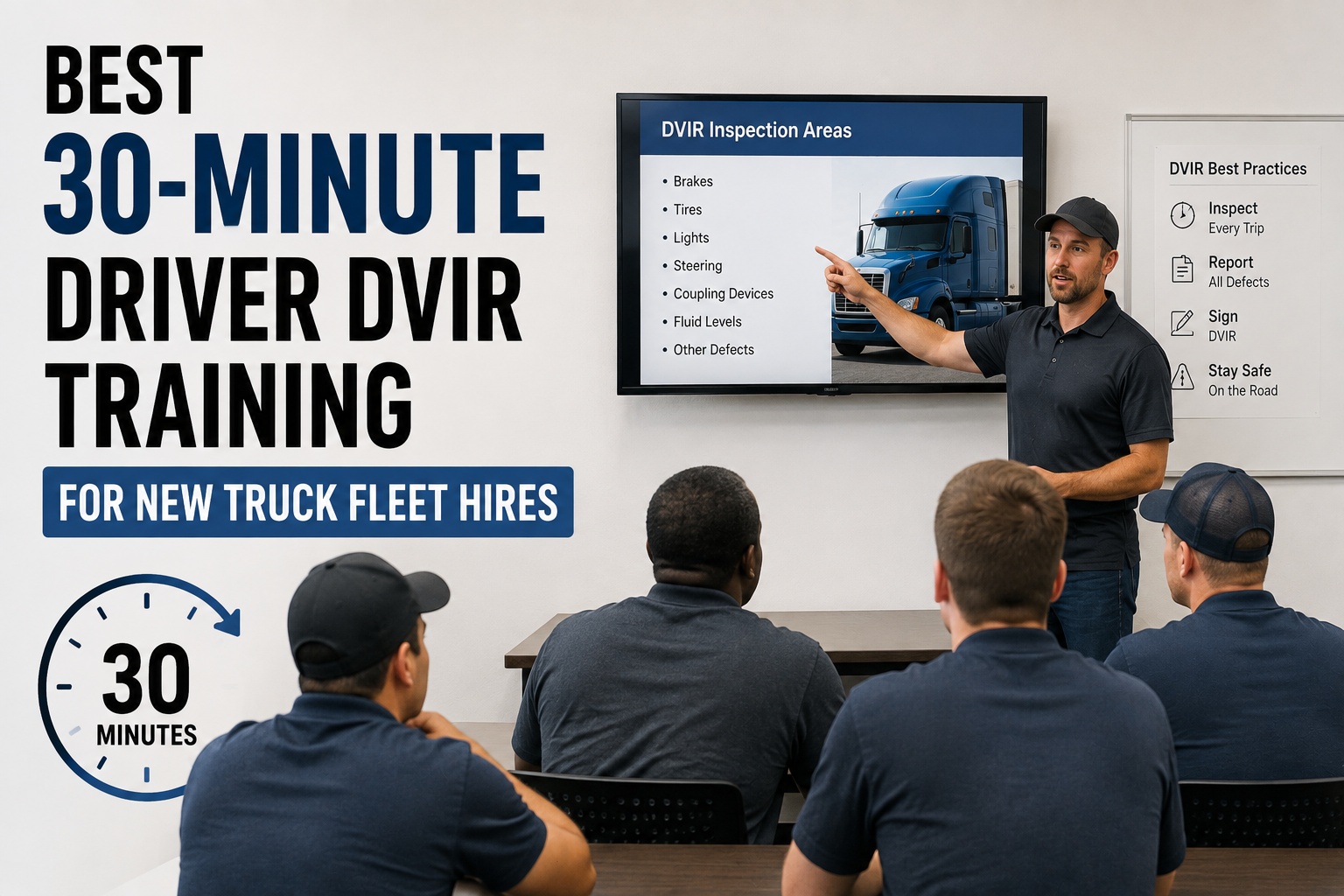
Best 30-Minute Driver DVIR Training for New Truck Fleet Hires
The tight, structured onboarding module that lifts DVIR quality from "checked OK" to defensible photo evidence — in the same 30 minutes most fleets waste on a paper walkaround.
Why 30 Minutes — Not 3 Hours
New drivers don't fail DVIRs because they didn't sit through enough training. They fail because the training covered everything except the four things that show up on every shift. Longer isn't better — tighter is. A 30-minute module targeting the specific failure modes auditors and shop managers see every week outperforms a half-day compliance lecture nobody remembers by Tuesday.
Module 1 · FMCSA Rules in 6 Minutes
Most drivers arrive knowing "you have to do a DVIR" and nothing else. Six minutes fixes that. The goal isn't legal expertise — it's understanding the two regulations that govern the report and the exemption most drivers get wrong.
Module 2 · Defect Language in 8 Minutes
This module produces the biggest quality lift of the entire training. New drivers write DVIRs the way they'd text a friend — vague, subjective, unmeasured. Auditors and mechanics can't work with that. Teach the three-part defect sentence and DVIR quality doubles overnight.
Module 3 · The Three-Signature Chain in 8 Minutes
The most commonly missed DVIR signature is #3 — the next driver's acknowledgment. Keys get handed over, DVIR sits in a folder, truck leaves. Chain broken. Violation exists. New drivers need to see the full custody chain and understand where they fit in it.
Run this exact training in orientation this week
Truck Inspection & Maintenance ships with the built-in trainer flow — new-hire drivers walk through all four modules on the same mobile app they'll use every shift. Interactive defect-language exercises. Signature chain enforced automatically.
Module 4 · The App Workflow in 6 Minutes
Six minutes on the mobile app is more valuable than sixty on paper procedure. Show new drivers the exact sequence, in the order they'll actually use it. If they can complete a full DVIR under supervision in this module, they'll do it correctly on their first shift alone.
Module 5 · The Live Test in 2 Minutes
The training doesn't end with a lecture — it ends with a supervised inspection on a real truck. Two minutes, five checkpoints. If the new driver misses any of these, the trainer catches it before shift one, not the auditor after month three.
What Changes After 30 Days of This Training
The training pays back in the first month. Here's what a mid-size fleet typically sees between a paper-walkaround orientation and this 30-minute mobile-first module.
| Metric | Paper Walkaround | 30-Min Mobile Training |
|---|---|---|
| DVIR completion rate | 60-70% | 98% |
| Avg time per DVIR | 30-45 min | 10-15 min |
| Defect actionability (first-attempt fix) | 44% | 89% |
| Photo-verified defects | Under 10% | Over 85% |
| Signature chain intact | ~65% | 100% (system-enforced) |
| DOT audit findings on DVIRs | Common | Rare |
| New-hire adoption at 30 days | 42% | 80-94% |
Frequently Asked Questions
Yes — for the core DVIR skill, 30 minutes of focused training outperforms 3 hours of general compliance lecture. The reason is that DVIR failures cluster around four specific issues: not knowing what §396.11 actually requires, writing unusable defect notes, missing signatures in the custody chain, and fumbling the mobile app. A tight 30-minute module targeting those four points closes the gaps that show up in real audits. Longer training that covers HOS, cargo securement, hazmat awareness, defensive driving, and DVIRs together dilutes the DVIR content and gets forgotten. The 30-minute number matches how new drivers actually retain procedural training — short, focused, immediately applied. Follow it up with a 5-minute refresher at 30 days and 90 days for the same result.
Under 49 CFR §396.11, the 11 mandatory categories are: service brakes (including trailer brake connections), parking brake, steering mechanism, lighting devices and reflectors, tires, horn, windshield wipers, rear-view mirrors, coupling devices, wheels and rims, and emergency equipment. Standard fleet practice adds four more that show up in roadside inspections and CSA scoring: fuel system, exhaust system, suspension, and frame/body — bringing the 15-item checklist most carriers use. Specialty carriers add category-specific items: hazmat adds tank integrity, refrigerated adds reefer unit checks, tanker adds discharge valve inspection. The 11 are non-negotiable; the additional items are best-practice discipline that also improves CSA scores.
Three signatures create the custody chain FMCSA requires: (1) Driver A inspects, reports defects, signs and submits; (2) Mechanic repairs the defect and certifies the repair on the original DVIR before next dispatch; (3) Driver B reviews the DVIR, confirms the repair status, signs acknowledging safe to operate before running the vehicle. The most commonly missed is #3 — the next driver's acknowledgment. Keys get handed over, DVIR sits in a folder, truck leaves without the review signature, chain broken, violation exists. FMCSA audits DVIR records in 89% of compliance reviews, and only 7% of motor carriers pass without a single violation — most of those violations are missing signatures, not unsafe trucks. Digital systems fix this by blocking dispatch until all three signatures are captured. Try the platform free to see the chain enforced automatically.
Yes — fully and explicitly. Electronic records and signatures have been permitted since 2018 under 49 CFR 390.32, and FMCSA published a final rule on February 19, 2026 (effective March 23, 2026) that added explicit electronic DVIR authorization directly into 49 CFR 396.11 and 396.13, removing any remaining ambiguity. Digital DVIRs on mobile apps are the current standard. They also produce a better paper trail than paper — every entry timestamped, every photo geo-tagged, every signature time-stamped and non-repudiable. Compliance managers report FMCSA audits under digital DVIR systems finishing in 40 minutes with zero findings on 90-DVIR samples, versus multi-day audits on paper systems that routinely surface missing signatures and unreadable notes.
The three-part defect sentence: Location + Measurement + Condition. Every defect gets all three parts. Location tells the mechanic where to look ("left rear brake chamber" not "brake"). Measurement gives them a target ("pushrod stroke 2.5 inches at 100 PSI" not "seems long"). Condition tells them what good looks like when fixed ("over limit — spec is 2 inches max"). Photo attaches automatically. This turns "brake feels weird" (untriageable, hour of diagnostic time) into "left rear brake chamber pushrod stroke 2.5 inches at 100 PSI, over 2-inch spec" (12-minute fix, photo-verified, work order closes first attempt). Practice this in orientation with three vague defects and three good rewrites — that 5-minute exercise is what actually locks it in.
Since the 2014 FMCSA rule change, drivers of property-carrying CMVs are NOT required to submit a DVIR when no defects are found. Passenger-carrying CMV drivers must still submit daily regardless. However, many carriers require daily DVIRs from all drivers as company policy — a best practice most compliance experts recommend because it creates a defensible paper trail proving the inspection actually happened. Without a daily record, a defect discovered later can raise the question: was the truck ever inspected, or was the "no defect" claim implicit? Digital DVIR systems make daily no-defect submissions trivial (30 seconds to walk through and confirm), so the compliance benefit far outweighs the effort. Train new drivers on your carrier policy, not just the federal minimum. Contact our team for a policy template.
Photo evidence is the difference between "driver checked OK" (no proof) and "driver photographed brake chamber showing 2.25-inch stroke" (indisputable). FMCSA estimates proper DVIRs prevent roughly 14,000 accidents annually, and under 2026 CSA scoring the "Driver Observed" category directly scores violations drivers should catch during walkarounds. Photo-verified inspections are the strongest evidence that training worked in practice, not just on paper. In digital DVIR systems, photos auto-attach with GPS and timestamp, making back-dating or fabrication impossible. In an audit, photo-verified DVIRs typically finish the review in a fraction of the time paper audits take — one compliance manager reported a 40-minute audit with zero findings on a 90-DVIR sample after moving to electronic DVIRs. Train new drivers on the four rules of a good defect photo: correct angle, adequate lighting, reference points for scale, and the specific defect detail visible.
Run this training in orientation — on the same app drivers use every shift
Built-in trainer flow, interactive defect-language exercises, and system-enforced signature chain. Push your new-hire DVIR quality from "checked OK" to defensible photo evidence — in 30 minutes.