One positive random test, one missed Clearinghouse query, one supervisor who wasn't trained to call a reasonable-suspicion test — any of these can put a carrier out of compliance and a driver out of the seat. DOT drug and alcohol testing is not a single rule; it is six test types, strict deadlines, and a federal database that now follows every violation and every return to duty. This guide lays out what a CDL fleet must run, when, and what gets reported where. Start free and keep every testing record audit-ready.
FMCSA Compliance · 49 CFR Part 382
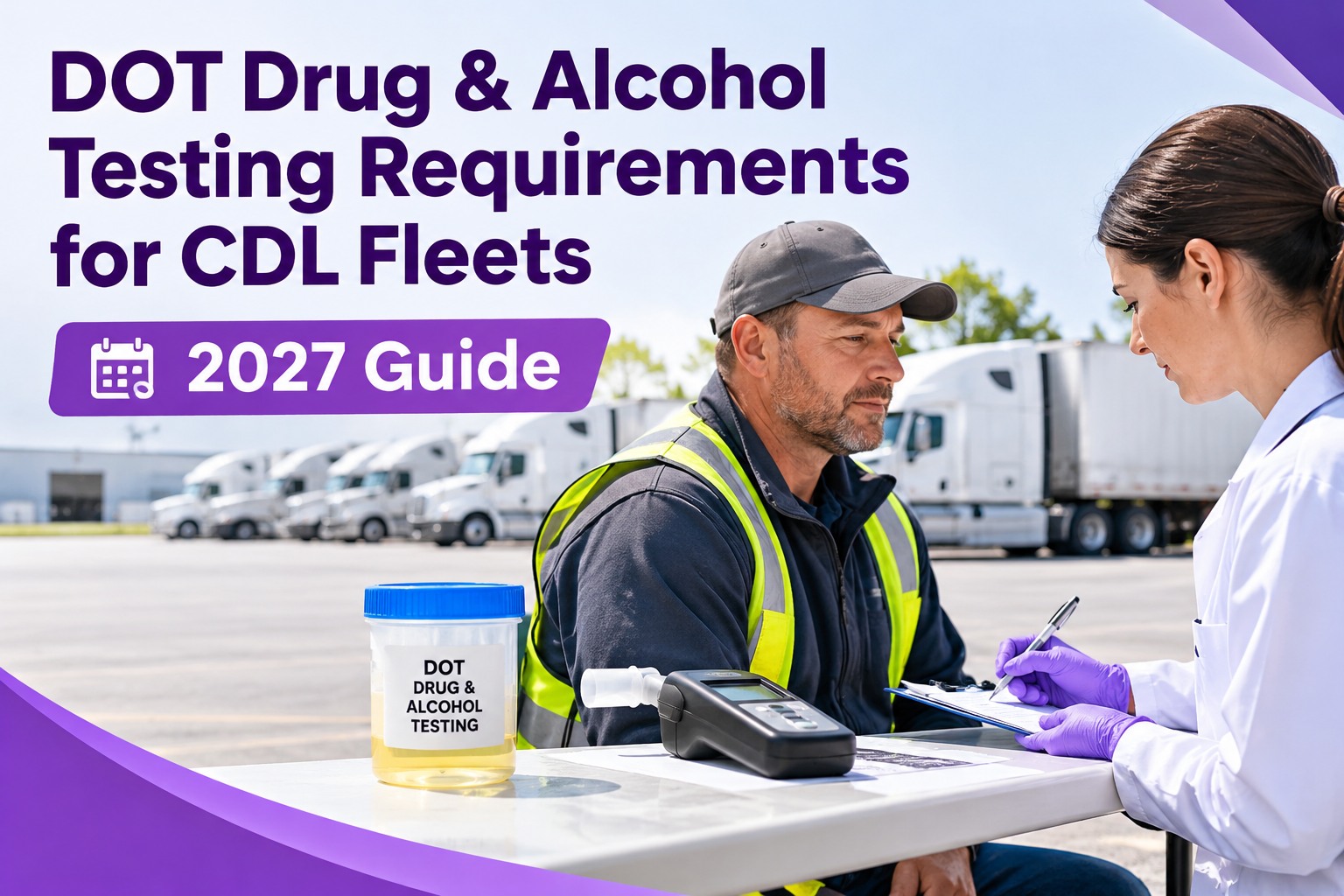
DOT Drug & Alcohol Testing Requirements for CDL Fleets: 2027 Guide
A testing program is only as strong as the records behind it — and a missing result or an unlogged query is what an auditor finds first. Truck Inspection & Maintenance Management Software keeps the proof in order: every driver's test type, date and result tracked against their file, Clearinghouse query and reporting deadlines surfaced before they lapse, and the whole trail ready the day a compliance review lands — so your program holds up on paper, not just in practice.
Pre-employment
Random50% drug · 10% alcohol
Post-accident
Reasonable suspicion
Return-to-duty
Follow-up
50% / 10%annual random rate — controlled substances / alcohol
5-panelDOT drug screen: THC, cocaine, opiates, amphetamines, PCP
0.04 BACalcohol concentration that counts as a violation
Clearinghousethe federal database tracking every violation & return
The Six Required Test Types
Part 382 requires six testing scenarios. Each has its own trigger, timing, and purpose — miss any one and the program is non-compliant.
TestWhen it's triggeredReg
Pre-employmentNegative drug result required before a driver operates a CMV§382.301
RandomUnannounced, year-round — 50% of drivers for drugs, 10% for alcohol§382.305
Post-accidentFatal crash, or a citation when the crash involves tow-away or injury care§382.303
Reasonable suspicionA trained supervisor observes signs of drug or alcohol use§382.307
Return-to-dutyAfter a violation, before resuming safety-sensitive duties§382.309
Follow-upAfter return — at least six unannounced tests in the first 12 months§382.311
Post-Accident Testing: Know the Clock
Post-accident testing is where carriers most often slip, because the windows are tight and start the moment the crash does.
2 hrsAlcohol — targetConduct the alcohol test as soon as possible, ideally within two hours.
8 hrsAlcohol — hard stopIf not done by eight hours, stop attempting and document why.
32 hrsDrug testThe controlled-substance test must be completed within 32 hours.
Which crashes qualify turns on fatality, citation, tow-away, and injury-treatment criteria — build the decision into your post-accident procedure. Book a demo to put the post-accident clock in your workflow.
The FMCSA Clearinghouse: Report and Query
Since 2020, a federal database tracks CDL drug and alcohol violations and returns to duty. It splits into two duties — reporting and querying — each with its own deadline.
Reporting
- MROs report verified positives and refusals, generally within two business days
- Employers report actual-knowledge violations and negative return-to-duty results
- The negative RTD result is reported within three business days
- SAPs report RTD eligibility by the close of the next business day
Querying
- Run a full pre-employment query before hiring a CDL driver
- Run an annual query for every current driver in the pool
- A driver with an unresolved violation cannot perform safety-sensitive duties
- Keep a record of every query and its result
The Program Is the Paper Trail
An auditor doesn't watch you test — they read your records. Truck Inspection & Maintenance Management Software keeps each driver's test history, query dates and results in one file, flags the annual query and reporting deadlines before they pass, and has the trail ready when a compliance review arrives — so your program is provable, not just in place.
After a Violation: the Return-to-Duty Process
A positive test, a 0.04+ alcohol result, a refusal, or an employer's actual knowledge of use all trigger the same federally defined path back. It runs through a Substance Abuse Professional, not the employer.
1Removed from dutyThe driver stops all safety-sensitive functions immediately and the violation is reported to the Clearinghouse.
2SAP evaluationA qualified SAP conducts an in-person clinical evaluation and prescribes education or treatment.
3Compliance & re-evalThe driver completes the program; the SAP re-evaluates and determines RTD eligibility.
4RTD testA return-to-duty test is conducted under direct observation; a negative result is required.
5Follow-up planAt least six unannounced follow-up tests in the first 12 months, on the SAP's schedule.
6Records reportedEach step's result flows to the Clearinghouse so the driver's status stays current.
Regulations change — treat this as an overview of the standing 49 CFR Part 382 and Part 40 rules, and confirm current requirements and any changes against official FMCSA sources before setting policy.
Frequently Asked Questions
1What are the DOT random testing rates for CDL drivers?
The annual minimum random rates are 50% of average driver positions for controlled substances and 10% for alcohol. Random testing must be unannounced and spread throughout the year, and a driver has to report to the collection site immediately on notification. The rates are set by FMCSA and can be adjusted, so confirm the current year's figures before building your random-testing plan.
Book a demo to track random testing per driver.
2What does the DOT drug test screen for?
The DOT uses a 5-panel urine screen covering marijuana, cocaine, opiates, amphetamines and PCP. For alcohol, a breath or saliva test applies, and a concentration of 0.04 or higher is a violation. A pre-employment test requires a negative drug result before the driver can operate a CMV; alcohol testing isn't part of the standard pre-employment requirement.
Book a demo to log test types and results.
3What are the post-accident testing time limits?
Conduct the alcohol test as soon as possible — ideally within two hours, and if it can't be done within eight hours, stop and document why. The controlled-substance test must be completed within 32 hours of the accident. Which crashes require testing depends on fatality, citation, tow-away and injury-treatment criteria, so your drivers and supervisors need that decision rule in hand before a crash happens.
Book a demo to build the post-accident steps in.
4What is the FMCSA Clearinghouse and who reports to it?
It's the federal database of CDL drug and alcohol violations and return-to-duty information. MROs report verified positives and refusals, employers report actual-knowledge violations and negative RTD results, and SAPs report return-to-duty eligibility — each on its own deadline. Employers must also query it: a full query before hiring and an annual query for every current driver. An unresolved violation keeps a driver out of safety-sensitive duty.
Book a demo to stay ahead of query deadlines.
Tested · Queried · Reported · On record
Keep Your Testing Program Audit-Ready
Truck Inspection & Maintenance Management Software keeps every driver's test type, date and result in one file, surfaces Clearinghouse query and reporting deadlines before they lapse, and has the full trail ready for a compliance review — so a DOT audit finds a program that's documented, not scrambling.
No credit card required. Free for up to 3 trucks. Built for FMCSA-regulated fleets.