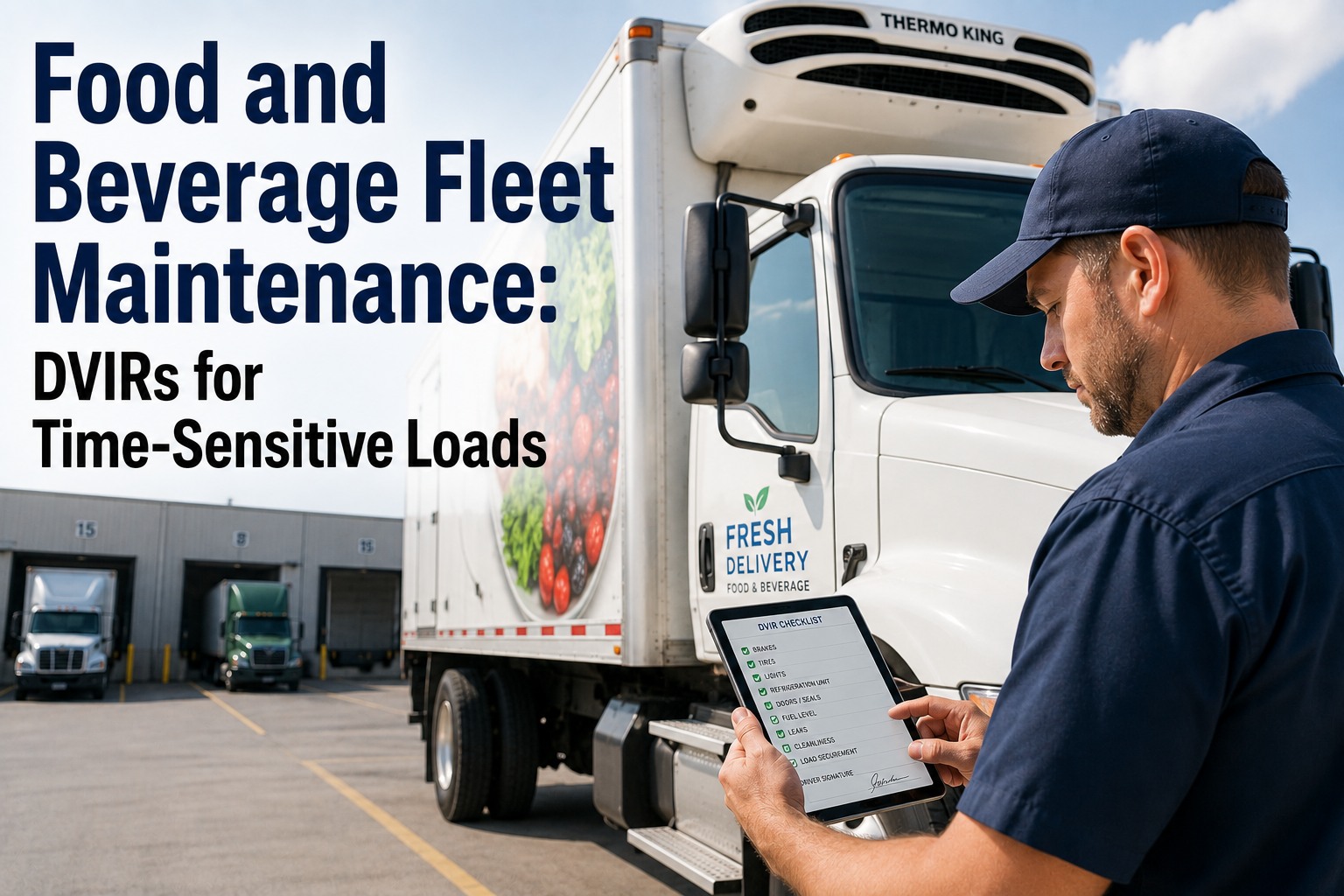
Food and beverage fleets run on a clock nobody else in trucking has to answer to. The reefer trailer left the DC at 4am pre-cooled to 34°F. The load has a 6-hour window to make the grocery DC crossdock or the receiver rejects it. A defect flagged on the pre-trip — a marker light out, a slack adjuster past spec, a reefer alarm at 40°F — has to route from driver phone to shop bay to work order to repair to release inside a few hours. In dry-freight linehaul, that same defect can wait until tomorrow. In F&B it can't wait until lunch. Under FDA FSMA 21 CFR Part 1, Subpart O, temperature-control failures on the road can trigger $50,000+ fines per violation, load rejection, and receiver-side blacklisting. And DOT still enforces every §396.11 DVIR requirement on top of that. This guide is the DVIR program tuned specifically for time-sensitive F&B fleets: the workflow speed requirements, the pre-cool checklist that FSMA demands, the reefer-specific DVIR points, and how Truck Inspection & Maintenance routes every defect from driver to shop before the load starts to warm. Sign up free or contact our team.
Food & Beverage Fleet Maintenance — DVIRs for Time-Sensitive Loads
Dry-freight fleets can defer defects until tomorrow. F&B fleets have hours before the load rejects.
Why F&B DVIRs Are Different — 3 Compounding Pressures
Every F&B fleet faces three simultaneous pressures that dry-freight fleets don't. Any DVIR program that ignores one of them fails in weeks:
FDA fines under FSMA Sanitary Transportation Rule exceed $50,000 per violation for temperature-control failure, cross-contamination, or missing records. Not fleet-wide — per incident.
Most grocery DC crossdocks reject loads arriving more than 6 hours late. Reefer loads with temperature excursions above spec reject at the dock regardless of arrival time.
All temperature monitoring, sanitation, and training records must be retained 12 months and produced to FDA within 24 hours of request — parallel to but separate from DOT's DVIR window.
One missed pre-cool photo becomes a $50K FSMA fine — start a free account and lock every load's pre-cool verification into the DVIR flow.
The F&B DVIR — All 11 FMCSA Points Plus 4 Reefer-Specific
Every F&B truck runs the full 11-point FMCSA DVIR from §396.11, then adds 4 reefer-specific items required by FSMA. The four extras are what separates a compliant F&B fleet from a fleet that's about to eat a $50K fine:
The 4 Reefer-Specific Points — What to Check
The four points above added to the FMCSA 11 aren't cosmetic. Each has specific FSMA compliance requirements and specific documentation obligations:
Reefer Unit Start & Run Cycle
Check: Unit starts on both diesel and shore power, runs 20 minutes minimum at high-speed cool without alarm, no fuel/coolant/refrigerant leaks visible, defrost cycle completes, ambient-vs-setpoint reading stable.
Trailer Pre-Cool Verification
Check: Trailer interior at shipper-specified temperature BEFORE loading. Frozen: below 0°F. Fresh: 32–36°F. Produce: varies. Never load hot product into hot trailer expecting reefer to catch up.
Trailer Sanitation from Prior Load
Check: Floor free of spillage, walls free of residue, no odor from prior load, drain functional, no pest evidence. Cross-contamination between prior load (e.g. raw meat) and current load (produce) is a categorical FSMA violation.
Temperature Datalogger Active
Check: Datalogger powered on, logging at correct interval (typically every 5 min), sensor placed per shipper spec (return-air, discharge-air, or in-load), memory has capacity for full route length.
Want a printable 15-point F&B DVIR template for the shop wall? Contact our team and we'll send you the master template free.
The Defect-Routing Speed Requirement
F&B fleets need DVIR-to-repair speed that dry-freight fleets don't. Below is the target routing time by defect severity — anything slower and the load is at risk:
Reefer won't cool, prior-load contamination, datalogger dead. Load cannot be released — driver must have alternate trailer or repair fired in under 15 minutes.
Brake defect, coupling failure, steering issue, tire below spec. Truck grounded — substitute truck or shop repair inside 30 minutes to keep load on schedule.
Single marker light out, cracked mirror, weak horn. Truck can run current route but must be shop-scheduled inside 2 hours to prevent escalation.
Wear pattern, low fluid at normal, minor cosmetic damage. Log at post-trip, re-check next day. Trend flags escalation to non-critical.
Severity-based auto-routing fires the right work order priority the moment the driver submits — sign up free and hit sub-15-minute reefer routing this week.
The One Rule That Protects Every F&B Load — Never Break Seal Without a Backup Trailer Assigned
The moment a reefer defect grounds a trailer with an FSMA-covered load already sealed, the clock on the load starts running against you. Grocery DCs typically reject sealed loads that arrive re-worked or transferred, so opening the seal to move product is a controlled event that must be logged, documented, and often shipper-approved. The rule that protects the load: every F&B fleet keeps at least one pre-cooled, sanitized backup trailer available at every terminal. When a defect hits, the load doesn't wait for repair — it moves to the backup while repair happens in parallel. Talk to our team for a backup-trailer sizing calculator built for F&B fleets.
The 5 Most Expensive F&B DVIR Mistakes
Every F&B fleet manager has watched one of these five mistakes cost real money. All five are preventable with the right workflow:
Skipped Pre-Cool Verification
Cost: Load rejected at receiver DC because temperature history shows product loaded warm. Full reload or full loss. Average $8,000–$25,000 per rejected load.
Cross-Load Contamination
Cost: Allergen residue from prior load contaminates current load. Recall notice + FDA investigation + $50K+ FSMA fine. Long-tail brand damage often larger than direct cost.
Datalogger Battery Dead
Cost: No temperature record for the route. FSMA compliance = presumed non-compliant. Load may still deliver but receiver holds payment pending investigation.
DVIR Defect Sat in Folder
Cost: Paper DVIR flags reefer intermittent; sits in shop folder overnight; truck rolls next morning; reefer fails at hour 4; entire load lost. Same defect caught in a real-time queue prevents it.
No Backup Trailer Assigned
Cost: Reefer fails at yard; no backup pre-cooled; load waits 2 hours for a trailer to prep; arrives at DC 2 hours late; rejected. Backup trailer discipline pays for itself on the first prevented rejection.
Recognize your fleet in any of these five patterns? Get in touch for a free F&B compliance review call.
Run the full 11+4 DVIR on driver phones with reefer photo verification and sub-15-minute defect routing.
FMCSA 11-point DVIR + FSMA 4-point reefer inspection + auto-routing by severity + 12-month temperature archive. Free forever for up to 3 vehicles — create your free account or talk to our team.
The KPI Dashboard — 6 F&B-Specific Numbers
Standard fleet KPIs don't capture F&B risk. These six are what F&B fleet managers should track weekly:
Every load starts with pre-cool photo. Non-negotiable — a miss is an FSMA violation waiting to be discovered.
Median time from driver flags reefer defect to shop tech assigned. Above 15 min = load at risk.
Any receiver rejection is a red flag. Target zero. One rejection triggers root-cause investigation immediately.
Every reefer load leaves with active datalogger. Any load without = FSMA gap regardless of actual temperature.
Pre-cooled, sanitized backup trailer at every distribution center. Below 1 = single point of failure on defects.
Every temperature log, sanitation record, training record retained for full 12 months. FDA can demand within 24 hrs.
All six F&B KPIs track in real time when the DVIR, reefer logs, and shop workflow live on one platform — create your free account in 10 minutes.
Frequently Asked Questions
What is FSMA Sanitary Transportation Rule and how does it affect food fleets?
The FDA FSMA Sanitary Transportation of Human and Animal Food Rule, codified at 21 CFR Part 1, Subparts O and P, requires food carriers to maintain adequate temperature control, prevent cross-contamination between loads, keep vehicles sanitary, train drivers on food safety practices, and retain records for 12 months. Fines for violations can exceed $50,000 per incident. FSMA is enforced in parallel with DOT — food fleets must comply with both simultaneously.
Do F&B DVIRs replace or supplement FMCSA 11-point DVIRs?
Supplement. F&B fleets still run the full 11-point FMCSA §396.11 DVIR (service brakes, parking brake, steering, lights, tires, horn, wipers, mirrors, coupling, wheels, emergency equipment) then add 4 reefer-specific items required by FSMA: reefer unit start & run cycle, trailer pre-cool verification, sanitation from prior load, and temperature datalogger active. Total 15 points. Missing any of the FMCSA 11 is a DOT violation; missing any of the 4 reefer points is an FSMA violation.
What is trailer pre-cool verification and why does FSMA require it?
Pre-cool verification confirms the reefer trailer interior is at the shipper's specified temperature BEFORE loading begins. Frozen loads typically require below 0°F, fresh dairy 32–36°F, produce varies by commodity. Loading warm product into a hot trailer expecting the reefer to catch up is a categorical FSMA failure — the reefer maintains temperature, it does not remove significant heat from the load. Pre-cool verification with a photo of the trailer thermometer at load time is the audit-defense record when a temperature excursion is later flagged.
How fast should DVIR defects route to the shop on an F&B fleet?
Reefer or sanitation defects must route in under 15 minutes because the load is already sealed and on the clock. Safety-critical truck defects (brakes, coupling, steering, tires) must route in under 30 minutes because a substitute truck may be needed to keep the load on schedule. Non-critical defects (single lamp out, cracked mirror) can route within 2 hours to prevent escalation. Monitor items get logged at post-trip and reviewed next day. Speed on the first two categories is what separates F&B fleets that meet grocery-DC delivery windows from fleets that don't.
How long must food fleets retain DVIR and temperature records?
Two parallel retention windows apply. FMCSA §396.11 requires DVIRs to be retained for 3 months. FSMA requires temperature monitoring, sanitation records, and food safety training records to be retained for 12 months and produced to FDA within 24 hours of request. Food fleets should default to 12 months for all records — the longer window covers both regulatory obligations and simplifies the compliance program.
How does Truck Inspection & Maintenance support F&B fleet compliance?
Truck Inspection & Maintenance runs the full 15-point F&B DVIR (FMCSA 11 + FSMA reefer 4) on driver phones with photo verification for pre-cool, sanitation, and datalogger checks. Defects auto-route by severity — reefer defects fire under 15 min, safety-critical truck defects under 30 min. Every temperature log, sanitation record, and training record archives for the full 12-month FSMA window, searchable by truck, driver, or date for FDA/DOT audit response. Free forever for up to 3 vehicles. Sign up in 10 minutes or contact our team for larger fleets.
Dry-freight fleets defer defects until tomorrow. F&B fleets get the load rejected by lunch.
Reefer inspections, pre-cool verification, sub-15-minute defect routing, 12-month FSMA archive — one platform, free forever for up to 3 vehicles. No hardware, no contract, no credit card.