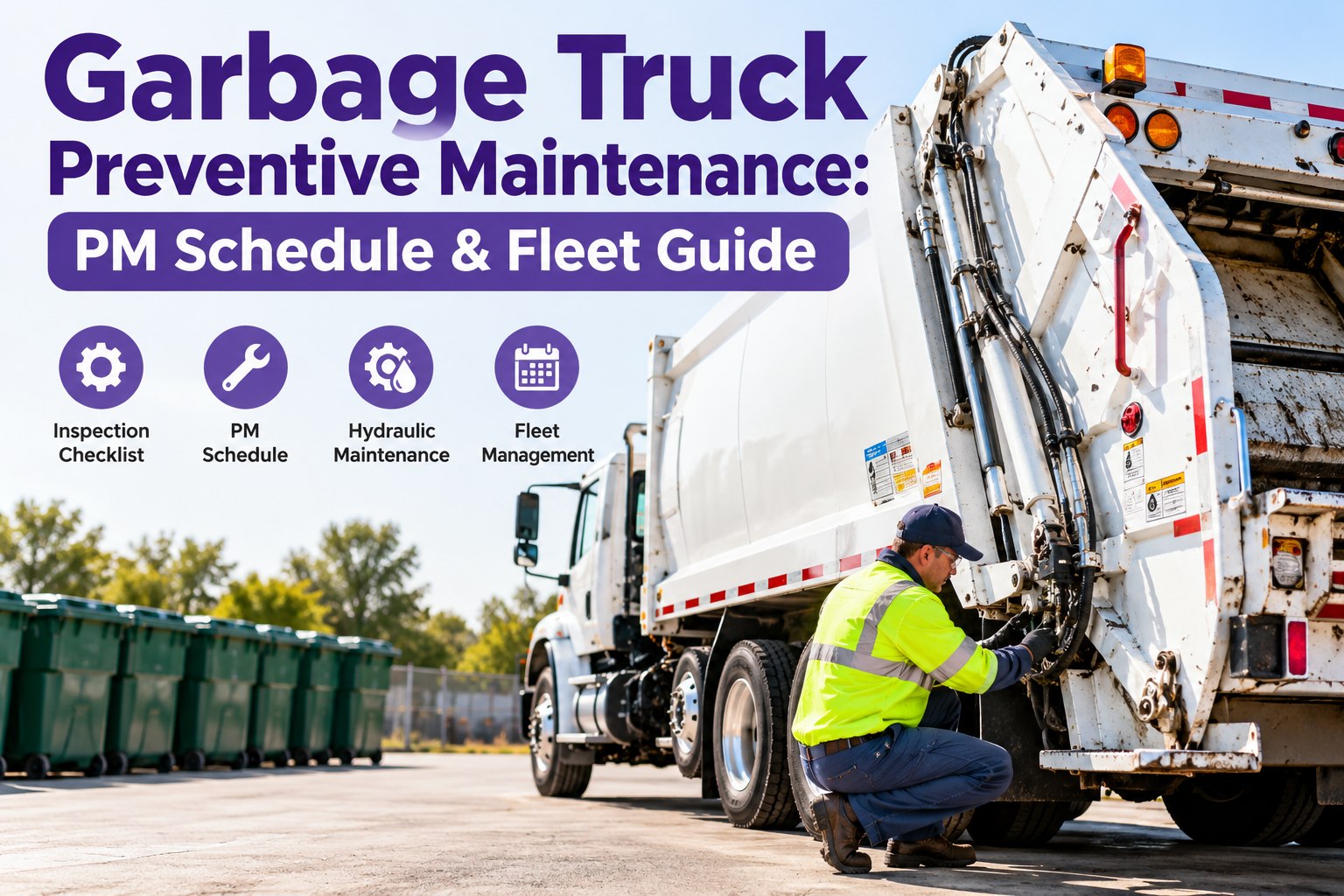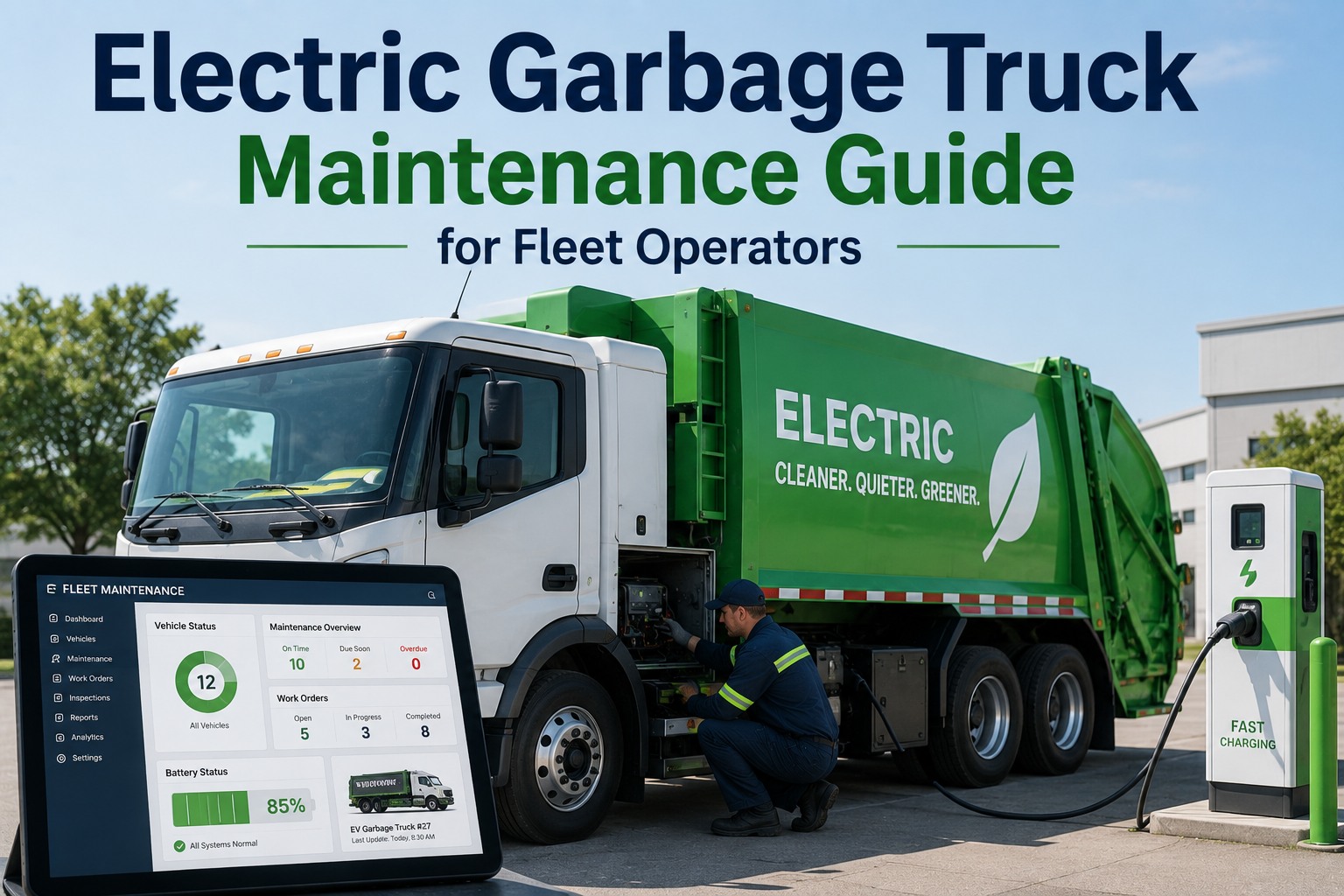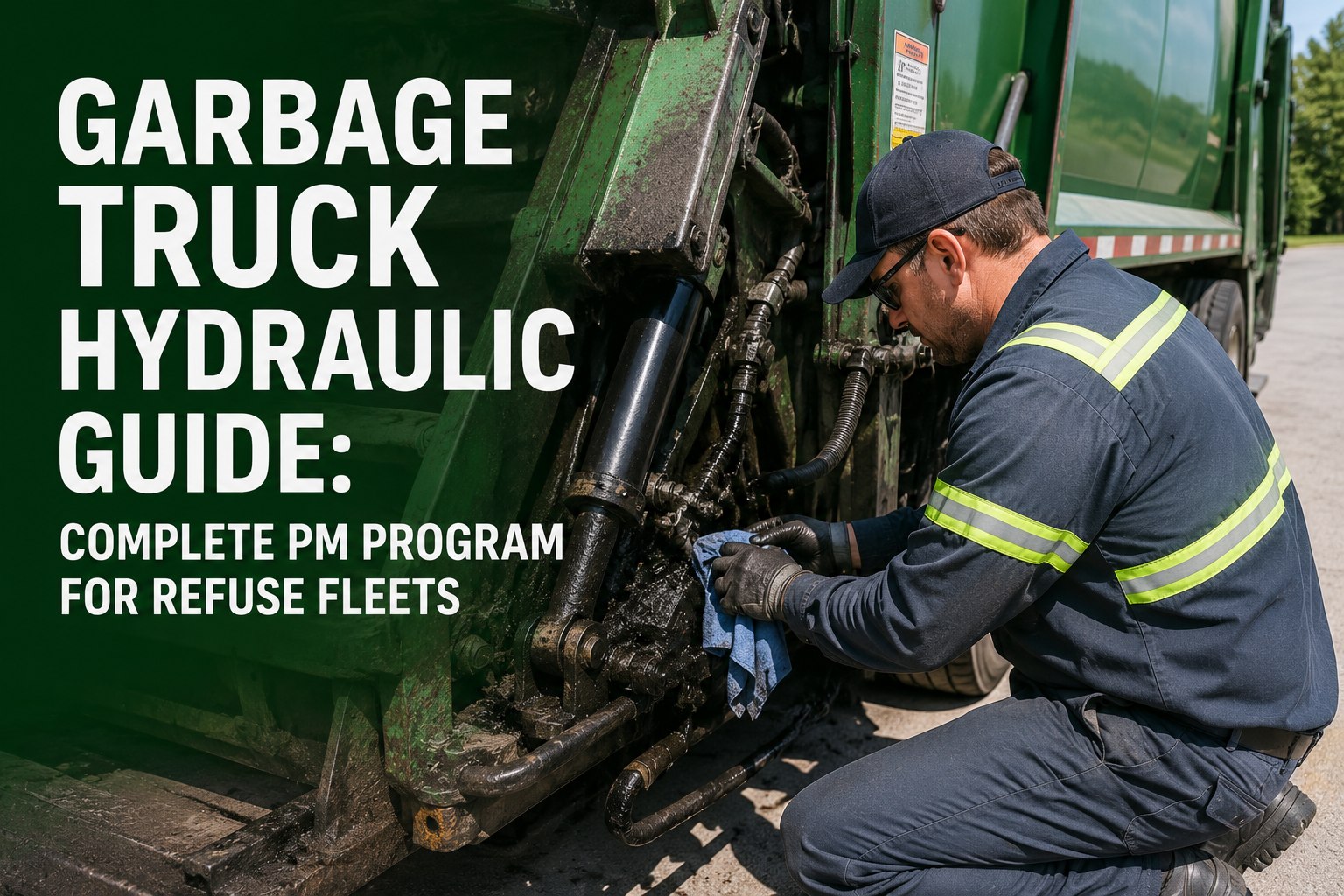
A refuse truck's hydraulic system does more work in one route than most construction equipment does in a week — packer, ejector, tailgate, tipper, and lift arms all firing off the same reservoir, all day, every day. Which is why refuse hydraulic PMs cannot look like the generic hydraulic PM schedule that came with the truck's chassis manual. They need their own program: cycle-triggered, driver-inclusive, and organized around the components that actually fail on refuse duty. Below is the complete hydraulic PM program top-performing refuse fleets run in 2026 — the 8-component system map, the daily/weekly/monthly/quarterly task matrix, the role assignments that stop tasks from falling between shifts, the KPI dashboard, and how Truck Inspection & Maintenance runs the whole program on driver phones and shop dashboards. Sign up free or contact our team.
Garbage Truck Hydraulic Guide — Complete PM Program for Refuse Fleets
The generic PM schedule from your chassis manual doesn't know about packers. This one does.
Why Refuse Needs Its Own PM Program
Line-haul PM assumes hydraulics are barely used. Refuse PM has to assume the opposite. Three duty-cycle realities force a different program:
A residential route puts the packer through 800–1,200 compression events in one shift. That's more actuation in a day than most industrial hydraulic systems see in a week.
Continuous cycling under load pushes reservoir temps to 150–160°F. Above 180°F, fluid oxidation doubles — heat management IS the PM program, not an afterthought.
Refuse hydraulic components fail at three times the rate of equivalent line-haul systems. A mileage-only PM schedule catches roughly one-third of the wear before it becomes a breakdown.
Refuse fleets running mileage-only PM in a system built for line-haul lose money every month — start a free account and switch to cycle-triggered PMs today.
The 8-Component System Map
A refuse hydraulic system is not one thing you PM — it's eight interconnected components, each with its own wear pattern. The complete PM program covers all eight:
Reservoir
Holds the fluid. Baffles calm return flow. Breather cap keeps out contaminants. Sight gauge lets driver read level. 15–40 gallon capacity typical.
Hydraulic Pump
The heart. Usually gear or piston. Feeds every actuator. Failure = truck cannot pack. Runs 10 hours a day under load.
Packer Cylinder
Highest cycle count on the truck. 800–1,200 compression events per shift. Rod scoring from contamination is the #1 seal-failure cause.
Ejector Cylinder
Long-stroke telescopic. Pushes compacted load out at landfill. Damage from foreign objects wedged in the load — inspect after every dump.
Tipper / Lift Arm
Grabs and lifts 800+ containers per shift. Grip pad wear drops containers. Arm cylinders take dynamic side-loads on every cycle.
Tailgate Cylinder & Cam Lock
200+ open/close cycles per shift. Cam lock failure spills load on road. Cylinder seal failure allows tailgate to drop under load pressure.
Hoses, Fittings & Valves
Miles of hose flex at joint bends every cycle. Fittings loosen from vibration. Control valves stick from varnish and contamination.
Filters & Cooler
Return filter catches particles down to 10 microns. Cooler drops fluid 20–40°F before reservoir return. Both must flow — clogged = derate.
Want a printable 8-component PM checklist template for the shop? Contact our team and we'll send you the master template free.
The 4-Tier PM Cadence — Every Task, Every Trigger
The complete refuse hydraulic PM program runs on four cadences. Every task has a home. Nothing falls between shifts:
Every task above becomes a scheduled reminder with photo verification when the program lives in one platform — sign up free and stop tracking PMs on paper.
Cycle-Triggered Events — When the Calendar Isn't Enough
Some PMs fire on hydraulic cycle count, engine hours, or fluid analysis — not on the calendar. These are the four cycle triggers every refuse fleet should run:
Primary refuse trigger. Fluid is chemically spent by 15,000 hydraulic cycles regardless of miles or hours. Replace fluid, return filter, breather. Roughly 60–75 days on a residential route.
Secondary trigger for lower-cycle trucks with heavy idle time. Also aligns with most body-OEM warranty requirements — running past 1,500 hours voids many warranties.
OEM-recommended interval for packer and ejector cylinder rebuild. Rod, seals, wear rings. Waiting for external leak means rod damage forcing full replacement.
Fluid sample at every PM shows particle count above ISO 20/18/15, water above 500 ppm, or VI drop >10% — flush now regardless of interval. Contamination compounds damage.
Roles & Responsibilities — Nothing Falls Between Shifts
The most common cause of a missed hydraulic PM isn't laziness — it's ambiguity about whose job it is. Assign every task to a specific role:
Owns the daily 5-minute pre-trip and post-trip. Logs level, rod condition, leaks, and cycle smoothness. Reports any anomaly before dispatch. Photo verification prevents skipped items.
Owns weekly 30-min inspection and monthly 2-hour deep inspection. Executes cycle-triggered flushes and rebuilds. Logs torque values, cam lock cycles, filter indicator readings per truck.
Owns the quarterly half-day PM and fluid analysis review. Reads lab reports, triggers early flushes when analysis fails. Approves cylinder rebuilds and pump replacements.
Owns the KPI dashboard, PM compliance rate, and root-cause review on any breakdown. Reviews trend data monthly. Escalates chronic issues to body OEM warranty claims.
Need help mapping roles to your specific team structure? Get in touch for a free 30-minute program setup call.
The One Rule That Makes the Program Work — Every Task Has One Owner and One Trigger
A PM program with shared ownership becomes a PM program with no ownership. Every task in the four tiers above must have one role assigned and one trigger defined (calendar date, cycle count, or hours). "Someone should check the cam lock this week" is not a task; "Shop tech runs the cam lock cycle test every Friday, logged with pass/fail per truck" is. This one distinction separates fleets running 95%+ PM compliance from fleets running 60%. Start a free account and assign every task to a driver, tech, or foreman with automatic reminders and photo verification.
The KPI Dashboard — What to Measure Weekly
You cannot manage what you don't measure. These are the six numbers a refuse fleet manager should see on a weekly dashboard:
Scheduled PMs completed on time ÷ total scheduled. Below 90%, breakdown rate climbs fast.
Any hydraulic issue that pulls a truck from route. Trend up = PM program failing somewhere.
Average interval per truck. Trucks running past trigger = PM scheduling failure.
Daily driver inspections submitted with photos. Skips = drivers not seeing what shop needs.
Mean time between failures on hydraulic pump. Below 6,000 hrs = fluid or contamination issue.
Parts + labor + downtime. Above $50K = reactive maintenance dominant, PM program broken.
Run the full four-tier program on driver phones and shop dashboards.
Daily DVIR with photo, weekly/monthly/quarterly PM schedules, cycle-triggered flush alerts, and KPI dashboard — free forever for up to 3 vehicles. Create your free account or talk to our team.
Body-Specific PM Overlays
Every body configuration adds its own priority items to the base PM. The base program covers the shared components; these overlays cover what's unique to each body type:
Body-specific PM overlays load automatically per truck when you configure vehicle type — create your free account in 10 minutes.
Frequently Asked Questions
How often should I service the hydraulic system on a garbage truck?
The complete PM program runs on four cadences: driver daily inspection (5 minutes), shop weekly inspection (30 minutes), shop monthly deep inspection (2 hours), and shop quarterly PM (half day). On top of that, cycle-triggered events fire on their own schedule — fluid flush at 15,000 hydraulic cycles or 1,000 operating hours, cylinder rebuild at roughly 200,000 cycles, and analysis-triggered flushes whenever a fluid sample fails threshold. Mileage-based PM alone misses most refuse hydraulic wear because a truck at 25,000 miles has already seen 240,000+ hydraulic cycles.
What are the most important components in a refuse hydraulic system?
Eight components make up the complete system: reservoir, hydraulic pump, packer cylinder, ejector cylinder, tipper/lift arm, tailgate cylinder with cam lock, hoses and valves, and filters plus cooler. Each has its own wear pattern and its own PM cadence. The packer cylinder sees the highest cycle count (800–1,200 compressions per shift) and needs daily rod inspection; the pump is the single most expensive failure and needs quarterly fluid analysis to catch early wear; the tailgate cam lock is the safety-critical item and needs weekly cycle testing to prevent mid-route spillage.
Who should be responsible for hydraulic PMs on a refuse fleet?
Every task in the program has one assigned role. Drivers own the daily pre-trip and post-trip inspection. Shop techs own the weekly 30-minute visual and the monthly 2-hour deep inspection, plus cycle-triggered flushes. Shop foremen own the quarterly half-day PM and fluid analysis review. Fleet managers own the KPI dashboard, PM compliance tracking, and root-cause review on any breakdown. Shared ownership means no ownership — the program only works when every task points to one specific role with one specific trigger.
What KPIs should I track for a refuse hydraulic PM program?
Six numbers on the weekly fleet dashboard: PM compliance rate (target 95%+), hydraulic breakdown events per 100 trucks per month (target under 2), fluid flush interval per truck (target ≤ 15K cycles or 1,000 hours), DVIR completion rate (target 100%), MTBF on hydraulic pumps (target 8,000+ hours), and cost per truck per year fully loaded (target $18K–$32K). Any KPI drifting outside target for two consecutive weeks means investigate the cause before the trend becomes a breakdown pattern.
Does every body type need the same hydraulic PM program?
The base program covers all body types because the shared components — pump, reservoir, cylinders, filters — are the same. But each body configuration adds priority items on top of the base. Rear loaders need daily packer rod attention because of highest cycle count. Automated side loaders need grabber jaw pad and grip force calibration. Front loaders need heavy lift arm cylinder and fork alignment focus. Roll-off trucks need hoist cylinder and frame stress inspection. The base PM stays constant; the overlays adapt to what your fleet actually runs.
How does Truck Inspection & Maintenance run a refuse hydraulic PM program?
Truck Inspection & Maintenance runs the full four-tier PM cadence on driver phones and shop dashboards. Daily DVIR with photo verification for level, rod condition, and leaks. Weekly, monthly, and quarterly PM checklists auto-schedule per truck with role assignment. Cycle-triggered flushes fire on whichever comes first (cycles, hours, calendar). Fluid analysis integrates with lab reports. KPI dashboard tracks all six fleet metrics in real time. Free forever for up to 3 vehicles. Sign up in 10 minutes or contact our team for larger fleets.
Stop running the chassis-manual PM on refuse trucks. Run a program built for the duty cycle.
Daily DVIR, weekly/monthly/quarterly PMs, cycle-triggered flushes, and KPI dashboard — all on one platform, free forever for up to 3 vehicles. No hardware, no contract, no credit card.