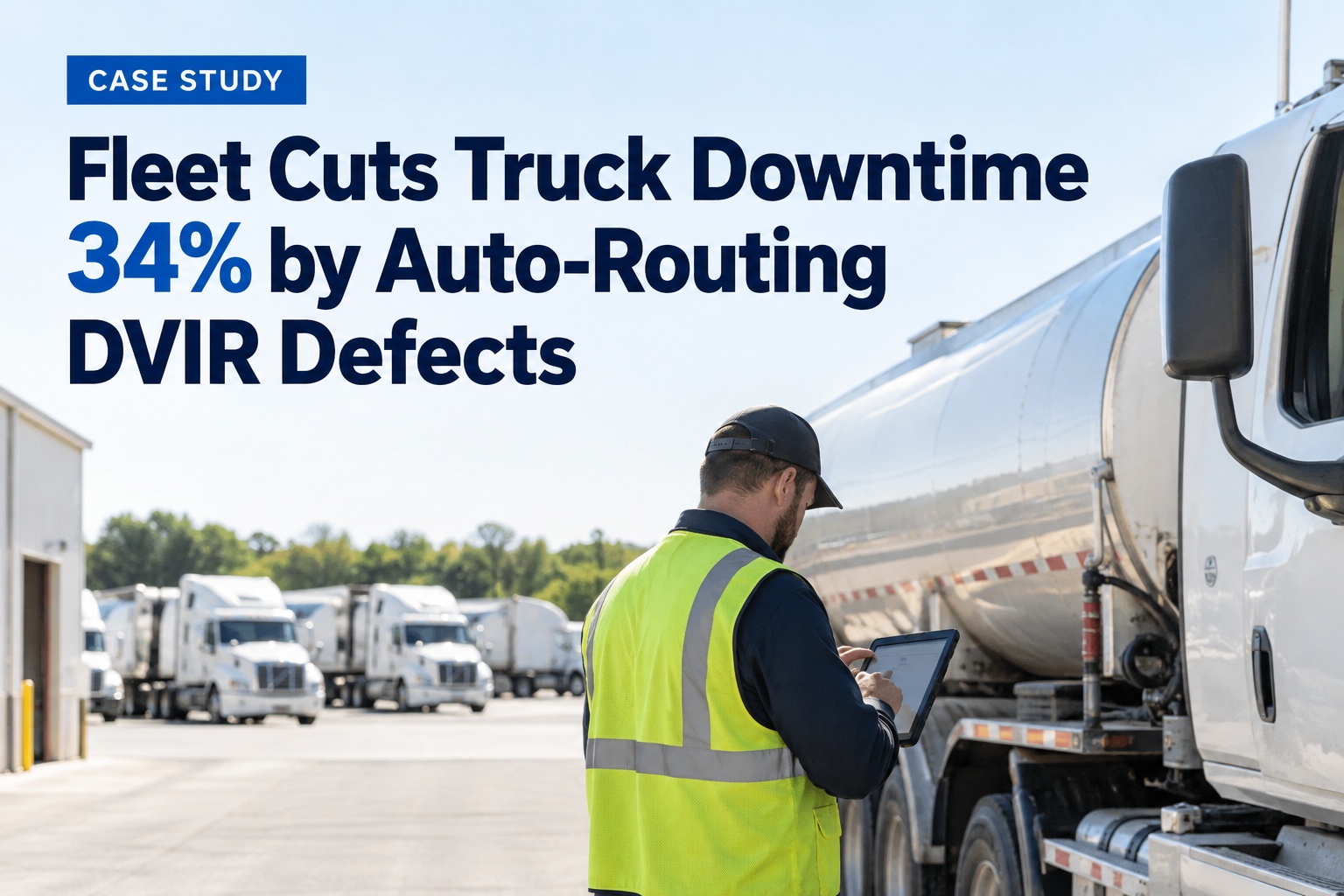
Discover how a 240-truck food-grade tanker fleet cut truck downtime by 34% in nine months by replacing manual DVIR triage with intelligent auto-routing that pushed every reported defect to the correct shop, technician, and parts bin within seconds. Before automation, the average defect-to-repair lag was 2.7 days of paper-shuffling. After rollout, it dropped to under 4 hours—and unplanned downtime fell from 9.2 to 6.1 days per truck per year. This case study walks through the routing logic, the food-grade FSMA compliance layer, and the nine-month phased rollout that made it possible.
The Hidden Cost of DVIR Routing Delay
The most expensive gap in any fleet maintenance operation is the space between a driver flagging a defect and a technician picking up a wrench. Every hour in that gap is either paid downtime or rolling risk. For food-grade tankers, it's also a sanitation and FSMA exposure. Contact Support to map your own defect-routing path, or Start Free Trial to start collapsing the lag today.
The Food-Grade Tanker Fleet at a Glance
How the Auto-Router Decides Where a Defect Goes
The routing engine isn't magic—it's a set of transparent rules that mirror the decisions a skilled dispatcher would make, but executed in seconds instead of days. Every DVIR defect gets classified along four dimensions the moment it's submitted.
Why Food-Grade Tankers Raise the Stakes
A defect on a dry-van tractor is a maintenance problem. A defect on a food-grade tanker—a compromised gasket, a leaking sanitary valve, a corroded internal fitting—is a maintenance problem PLUS a cargo-integrity problem PLUS an FSMA compliance problem. Five characteristics make food-grade routing categorically different from generic OTR maintenance.
The Nine-Month Rollout
Two hundred forty trucks and six shops don't switch systems overnight. The rollout ran in three quarterly phases, each validating the routing engine on a bigger scope before opening the gates to the next.
- Deploy mobile DVIR to 40 trucks on a single dedicated route
- Route defects only to the pilot shop with 8 certified sanitary techs
- Build parts-bin catalog with food-grade certification tags
- Baseline defect-to-repair cycle: 2.7 days
- Expand to 140 trucks across 4 shops
- Enable severity classification and shop selection routing
- Wire up technician skill profiles and workload balancing
- First cross-shop parts transfer triggered automatically
- All 240 trucks & 6 shops on the routing engine
- FSMA sanitation-compliance layer active on all sanitary-critical defects
- Wash-out logs auto-linked to defect records
- Full downtime reduction realized
What's your defect-to-repair cycle costing you?
Every hour a defect sits in a paper form is an hour of downtime, roadside risk, or CSA exposure. Auto-routing collapses the gap.
The Four KPIs That Told the Story
The downtime cut was the headline. The four KPIs underneath told the fleet manager exactly why it happened—and where any regression would show up first.
The Full Numbers
| Metric | Before | After | Change |
|---|---|---|---|
| Unplanned downtime days / truck / yr | 9.2 | 6.1 | −34% |
| Defect-to-repair cycle time | 2.7 days | 3.9 hrs | −94% |
| Correct-shop routing rate | 71% | 99.4% | +28 pts |
| First-time fix rate | 68% | 91% | +23 pts |
| Sanitary defects breaching FSMA window | 14 / yr | 0 | Eliminated |
| Wash-out documentation completeness | 84% | 100% | +16 pts |
| Truck-days recovered (fleet-wide) | Baseline | +744 | Net gain |
| DVIR submission rate | ~74% | 100% | +26 pts |
What Made the Auto-Routing Actually Work
Plenty of fleets have "digital DVIRs" that still route defects manually behind the scenes. Four design choices made this fleet's routing intelligent, not just electronic.
Severity Rules Were Sanitation-Aware
The routing engine understood the difference between "leaking coolant" and "leaking sanitary valve." Food-contact defects escalated to sanitary-critical automatically, no human triage needed.
Parts Bins Tagged for Food-Grade Only
Food-grade gaskets, seals, and fittings were tagged with certification lot numbers. The router refused to assign non-certified parts to sanitary jobs. FSMA compliance became structural, not procedural.
Technician Skill Profiles Kept Current
Sanitary certification, brake work, refrigeration — every tech's live skill matrix drove assignments. When a certification lapsed, the router stopped routing those defects to that tech automatically.
Cross-Shop Load Balancing
When one shop hit capacity, the router shifted defects to the next-nearest certified shop instead of queuing. Downtime was measured across the network, not per shop.
For years the biggest gap in our operation was the space between a driver flagging a bad gasket and a certified sanitary tech putting hands on it. Two-and-a-half days on average. In that window the truck was either parked or hauling with an unresolved food-contact defect, which nobody in our industry wants to think about. The auto-routing didn't just move the paper faster—it moved the right defect to the right shop with the right parts before the driver was done with his post-trip. Nine months in, our downtime is down thirty-four percent, our first-time fix rate went from 68% to 91%, and we haven't missed a single FSMA sanitation window on a defect since the full rollout.
Close Your Own Defect-to-Repair Gap
Downtime isn't a maintenance problem—it's a routing problem. Every hour a defect spends in triage instead of on a wrench is downtime the fleet is paying for whether or not anyone realizes it. Auto-routing that classifies severity, matches shops, assigns skilled technicians, and stages parts before the driver walks away turns days into hours—and hours into recovered truck-days.
Ready to Cut Your Downtime by a Third?
See how intelligent DVIR auto-routing collapses defect-to-repair cycle time from days to hours—with measurable downtime reduction inside the first 90 days.