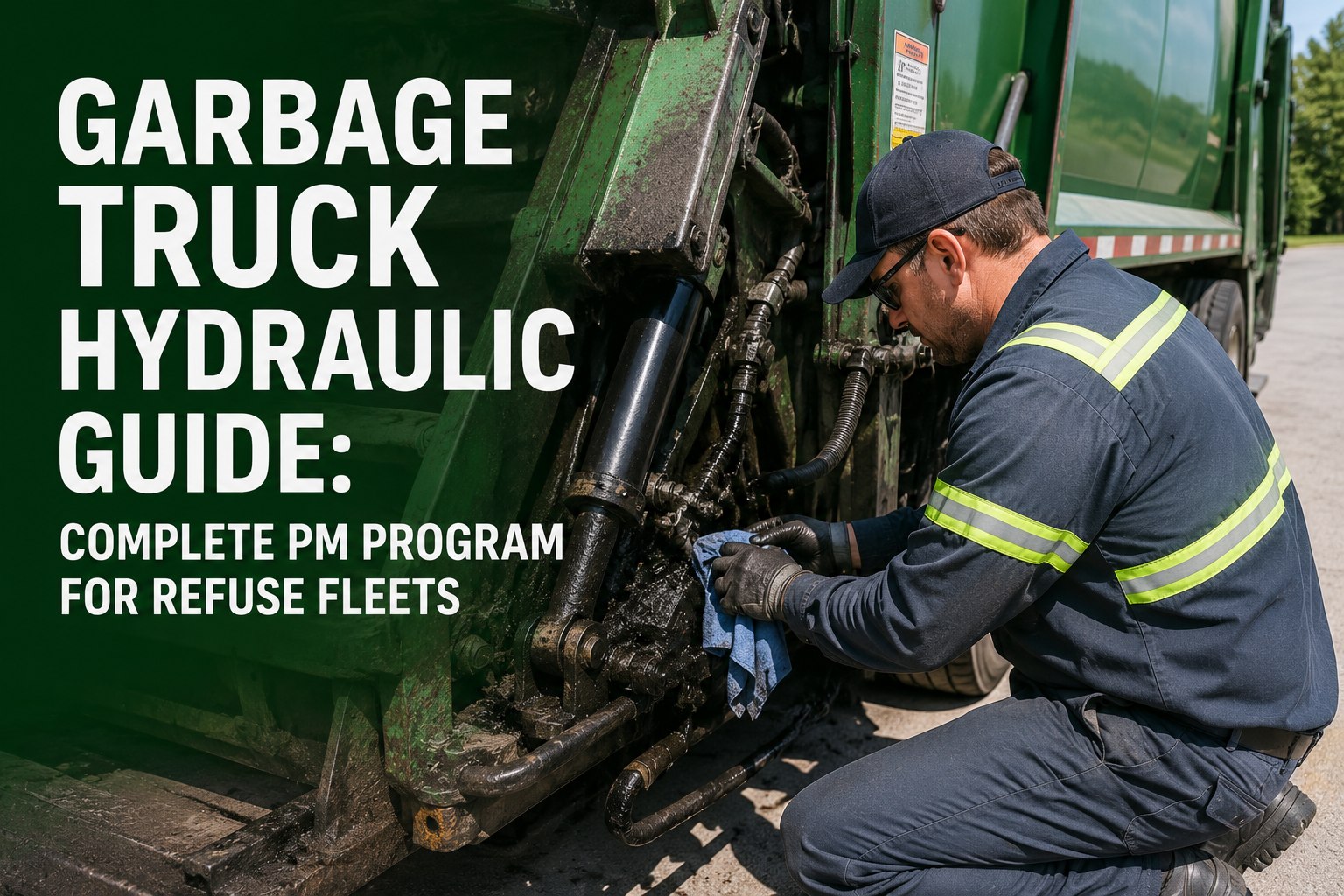
A refuse truck's hydraulic system runs the harshest fluid duty in commercial trucking — 800–1,200 packer cycles a day, 150–160°F reservoir temps under peak load, and the exact same fluid asked to move at –5°F on a January morning six hours later. One grade of oil cannot do both jobs well. The wrong ISO VG on a hot Phoenix route causes seal-melting film breakdown by August. The wrong ISO VG on a Minneapolis route causes pump cavitation and blown seals every January. Most refuse fleets pick one 55-gallon drum from whatever's on the shop shelf and hope — then wonder why hydraulic failures cluster in July and January. This guide covers how to actually pick hydraulic oil for a refuse truck based on your climate, your duty cycle, and your OEM's viscosity window — plus the change intervals, contamination controls, and cold-morning protocol that get the fluid to last.Truck Inspection & Maintenance tracks hydraulic PMs by cycle count and hours so no truck ever runs past its flush interval — sign up free or contact our team.
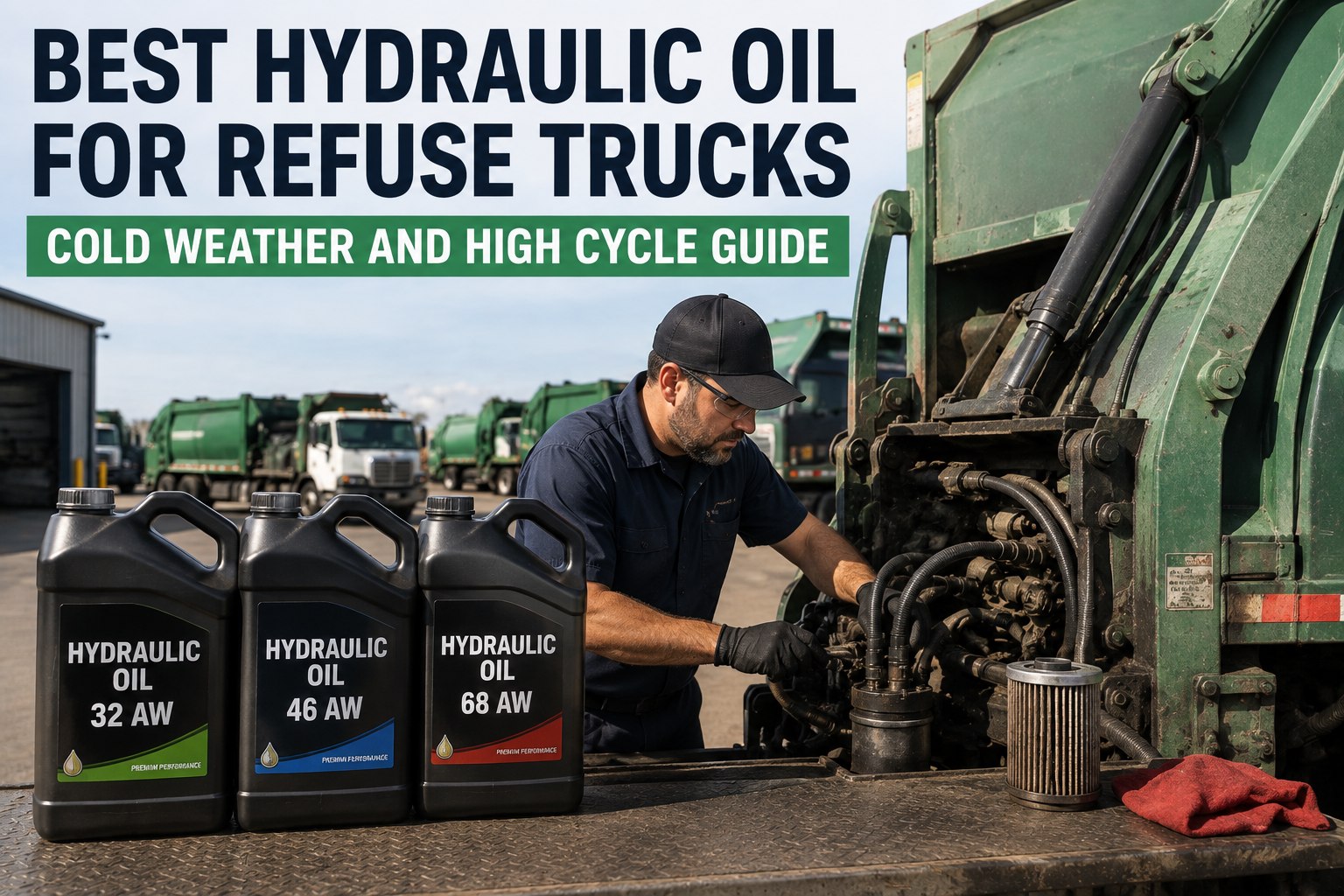
Best Hydraulic Oil for Refuse Trucks — Cold Weather & High Cycle Guide
Pick the grade wrong and you'll blow seals in July or cavitate pumps in January. This guide picks it right.
Why Refuse Trucks Are Different — And Why Generic Fluid Fails
Line-haul trucks barely use their hydraulic systems. Refuse trucks live in theirs. Three factors compound to make hydraulic fluid selection uniquely brutal on garbage trucks:
Packer, tipper, tailgate, ejector — a residential route puts a refuse system through more hydraulic events in one day than a construction excavator sees in a week. Fluid shears down faster.
Continuous cycling under load pushes reservoir temps to 150–160°F on hot days. Above 180°F the fluid oxidizes at double the normal rate — hot-climate fleets need heat-stable formulations.
Same truck, same fluid, hits 15°F at 6am startup and 155°F by noon. Only a high viscosity index (VI 140+) fluid stays in-spec across that swing.
Not sure which grade your fleet is actually running across all trucks? Start a free account and lock the right grade to every vehicle so shop techs never top off from the wrong drum.
The 5 Specs That Actually Matter
Ignore marketing labels and price-per-gallon. These five specifications on the product data sheet decide whether a fluid survives refuse duty:
ISO VG (Viscosity Grade)
The core number — 32, 46, or 68 for most refuse work. Matches fluid thickness to your climate. Get this wrong and nothing else matters.
Viscosity Index (VI)
Measures how well the fluid holds viscosity across temperature swings. VI 100 is basic; VI 140+ is what refuse needs to handle 15°F to 155°F in one shift.
Pour Point
The temperature at which fluid stops flowing. A pour point of –35°F means the fluid still moves in a Wisconsin winter startup; a pour point of –10°F cavitates the pump.
Anti-Wear (AW) Package
Zinc-based (ZDDP) additives that protect pump vanes and cylinder rods from metal-on-metal wear during high-cycle operation. Non-negotiable for refuse.
Oxidation Stability
How long the fluid resists chemical breakdown under heat. TOST life (turbine oil stability test) gives a comparable number — higher is better.
OEM Approval
Body-builder specs (Heil, McNeilus, Labrie, New Way) list approved fluids. Using an unapproved fluid can void the hydraulic pump warranty even if the ISO VG matches.
The Climate-Matched Fluid Matrix
Below is the fluid selection matrix top refuse fleets run, cross-referenced by winter-low temp and summer-high temp for the fleet's operating region:
Fleet operates across multiple climate zones and unsure how to split your fluid stock? Contact our team for a climate-zone-matched fluid recommendation.
The 6 Ways Wrong Fluid Kills a Refuse Hydraulic System
Every hydraulic pump failure a refuse fleet sees traces back to one of these root causes. Five are fluid-selection errors; the sixth is a change-interval failure:
Cause: Fluid too thick at startup temp — pump can't draw it fast enough, creates vacuum, air bubbles collapse against pump internals.
Fix: Lower ISO VG or higher VI. In deep cold, drop from VG 46 to VG 32 with pour point ≤ –35°F.
Cause: Fluid too thin at 160°F operating temp — hydrodynamic film collapses, metal-on-metal wear, cylinder rod scoring.
Fix: Higher ISO VG for climate. Phoenix fleet running VG 46 should be on VG 68 with heat-stable AW package.
Cause: Poor oxidation stability under prolonged heat — fluid darkens, forms varnish on valve bodies, sticks solenoids.
Fix: Fluid with TOST ≥ 3,000 hrs. Flush every 1,000 hrs or 15,000 cycles regardless of visual condition.
Cause: Rain, wash-bay spray, or condensation gets past the reservoir cap or breather. Fluid turns milky, hydrolyzes AW additives.
Fix: Sealed reservoir with desiccant breather. Weekly visual for milky appearance — a $12 breather beats a $4,200 pump.
Cause: Shop tops off VG 46 truck from a VG 68 drum. Additives fight, VI drops, oxidation accelerates, warranty voids.
Fix: Label every drum. One grade per truck. Never mix ISO VGs even from the same brand.
Cause: Fleet flushes on mileage only. Refuse truck at 25,000 miles has 240,000+ hydraulic cycles — fluid is destroyed but PM software says fine.
Fix: Flush at first-to-occur: 1,000 hrs OR 15,000 cycles OR annually. Track cycles per truck, not miles.
The One Rule That Saves Refuse Hydraulic Pumps — Match Grade to Climate, Not to Whatever's on the Shelf
The single most expensive shortcut in refuse maintenance is buying one ISO VG for the whole fleet regardless of climate zone. A Minneapolis truck running VG 68 in January will cavitate its pump within one winter; a Phoenix truck running VG 32 in August will burn out seals by the end of the season. Match the grade to your climate zone using the matrix above, buy from your body OEM's approved fluid list, and never let a shop tech top off from the wrong drum. Every top-performing refuse fleet in 2026 runs this rule — talk to our team for a climate-matched fluid audit for your fleet.
Change Intervals — Why Mileage-Only PMs Miss the Real Wear
Refuse hydraulic fluid degrades on cycles and hours, not miles. Below is the first-to-occur interval matrix top fleets run — whichever hits first triggers the flush:
The primary refuse trigger. A busy residential route accumulates 15,000 cycles in about 60–75 days. This is when the fluid is actually spent — long before mileage indicates it.
Backup trigger for trucks with lower cycle counts but heavy idle time. Also aligns with most body-OEM warranty requirements. Never let hours exceed 1,500 regardless of cycles.
Absolute cap regardless of hours or cycles. Fluid oxidizes on the calendar even when the truck sits — a spare or backup truck still needs annual fluid replacement.
Send a fluid sample to a lab at every 250-hour PM. Water above 500 ppm, particle count above ISO 20/18/15, or VI drop >10% triggers an immediate flush regardless of intervals.
All four triggers can run in parallel per truck — sign up free and let the system fire the flush PM on whichever hits first.
Cold Weather Startup Protocol
Winter is when wrong-fluid mistakes surface as pump failures. Even the right fluid needs proper startup handling below freezing — this protocol prevents 90% of cold-weather hydraulic damage:
Engine Warm-Up (5 min)
Start engine, let it idle 5 minutes before any hydraulic function. Engine heat begins warming the reservoir through shared bulkhead/manifold contact.
Low-Speed Cycle (5 min)
Cycle packer at slowest available speed for 5 minutes. Warm fluid circulates through cylinders and lines without stressing pump against thick oil.
Reservoir Temp Check
Verify reservoir is at least 60°F before full-speed operation. Below that, extend low-speed cycling. Never assume the fluid warmed up just because the cab is warm.
Full-Speed Operation
Only after reservoir crosses 60°F should the driver run full-speed packer cycles. Rushing this step is the #1 preventable cause of winter pump failures.
Running a fleet in a deep-cold region and need a driver-facing cold-startup checklist? Get in touch and we'll send one over.
Track cycles, hours, and calendar in parallel. Never miss a hydraulic flush again.
Cycle-triggered PMs, fluid sample logs, and OEM-matched flush schedules per truck. Free forever for up to 3 vehicles — create your free account or talk to our fleet team.
Contamination Control — The Silent Killer
Even the perfect fluid fails fast in a dirty system. Four contamination sources cause most refuse hydraulic wear:
Water
Enters through reservoir breather, wash bay, or condensation. Turns fluid milky. Above 500 ppm, AW additives hydrolyze and pump wear accelerates.
Metal Particles
Generated by cylinder rod scoring or pump wear. Circulates as grinding paste. Detected by lab particle count (ISO 4406 code).
Air Entrainment
Suction leaks or low reservoir causes foaming. Fluid turns whitish, hydraulic response goes spongy. Damages pump on next cycle.
Cross-Fluid Mixing
Wrong grade or wrong brand tops off the reservoir. Additive packages fight, VI drops, fluid goes off-spec within one shift.
Contamination alerts, fluid sample history, and per-truck grade lockouts all built in — create your free account in 10 minutes.
Frequently Asked Questions
What ISO VG hydraulic oil is best for a refuse truck?
ISO VG 46 is the universal default for refuse trucks operating in moderate climates (20°F to 80°F). Cold-climate fleets (winters below 20°F) should drop to ISO VG 32 with a viscosity index of 150+ and pour point below –30°F. Hot-climate fleets (summers above 90°F) should step up to ISO VG 68 with a heat-stable anti-wear package and TOST life ≥ 3,000 hours. Always cross-check the body OEM's approved fluid list — running an unapproved grade can void the hydraulic pump warranty.
How often should I change hydraulic oil in a garbage truck?
Every 1,000 operating hours OR 15,000 hydraulic cycles OR 12 months, whichever comes first. Mileage-based PMs miss most refuse hydraulic wear — a truck at 25,000 miles has typically seen 240,000+ hydraulic cycles and 1,800+ engine hours. Fluid analysis at every 250-hour PM catches early degradation and can trigger a flush ahead of schedule if water, particles, or VI drop cross threshold.
Can I use motor oil or ATF in a hydraulic system as a stopgap?
Never. Motor oil lacks the anti-wear additive package hydraulic pumps need, and ATF has a different additive chemistry that will fight the residual hydraulic fluid still in the system. Even a partial top-off with wrong fluid damages seals and voids warranties. If the truck is critically low, park it and wait for correct-grade fluid — the cost of a tow is a fraction of the cost of a destroyed pump.
What causes hydraulic pump failure on a refuse truck?
Five root causes account for nearly all refuse pump failures: cavitation from too-thick fluid on cold startup, film breakdown from too-thin fluid at operating temp, oxidation and varnish from poor-quality fluid or skipped flushes, water contamination through a bad breather, and cross-grade mixing from shop error. All five are preventable with correct fluid selection, cycle-triggered PMs, and basic contamination control. Track your fleet's failure pattern to identify which root cause dominates.
Do I need synthetic hydraulic oil for a refuse truck?
Not universally, but often worth it. Synthetic hydraulic oils maintain viscosity across wider temperature ranges (VI 180+), resist oxidation longer (TOST 5,000+ hours), and can extend change intervals by 25–50%. The cost premium is 2–3× conventional fluid, but for high-cycle refuse work in extreme climates (deep cold or sustained heat), the reduced pump wear and extended intervals usually pay back within one PM cycle. For moderate climates, high-VI conventional fluid at VG 46 is typically sufficient.
How does Truck Inspection & Maintenance help manage hydraulic PMs?
Truck Inspection & Maintenance tracks hydraulic cycles, engine hours, mileage, and calendar in parallel — the fluid flush PM fires on whichever trigger hits first. Fluid sample logs attach to each truck's history, contamination alerts fire when analysis crosses threshold, and OEM-matched fluid grades stay locked to each vehicle so shop techs can't top off from the wrong drum. Free forever for up to 3 vehicles. Sign up in 10 minutes or contact our team for larger fleets.
Wrong hydraulic oil is a $4,200 pump failure waiting to happen. Match grade to climate. Flush by cycles, not miles.
Cycle-triggered PMs, fluid sample logs, and per-truck grade lockouts. Free forever for up to 3 vehicles — no hardware, no contract, no credit card.