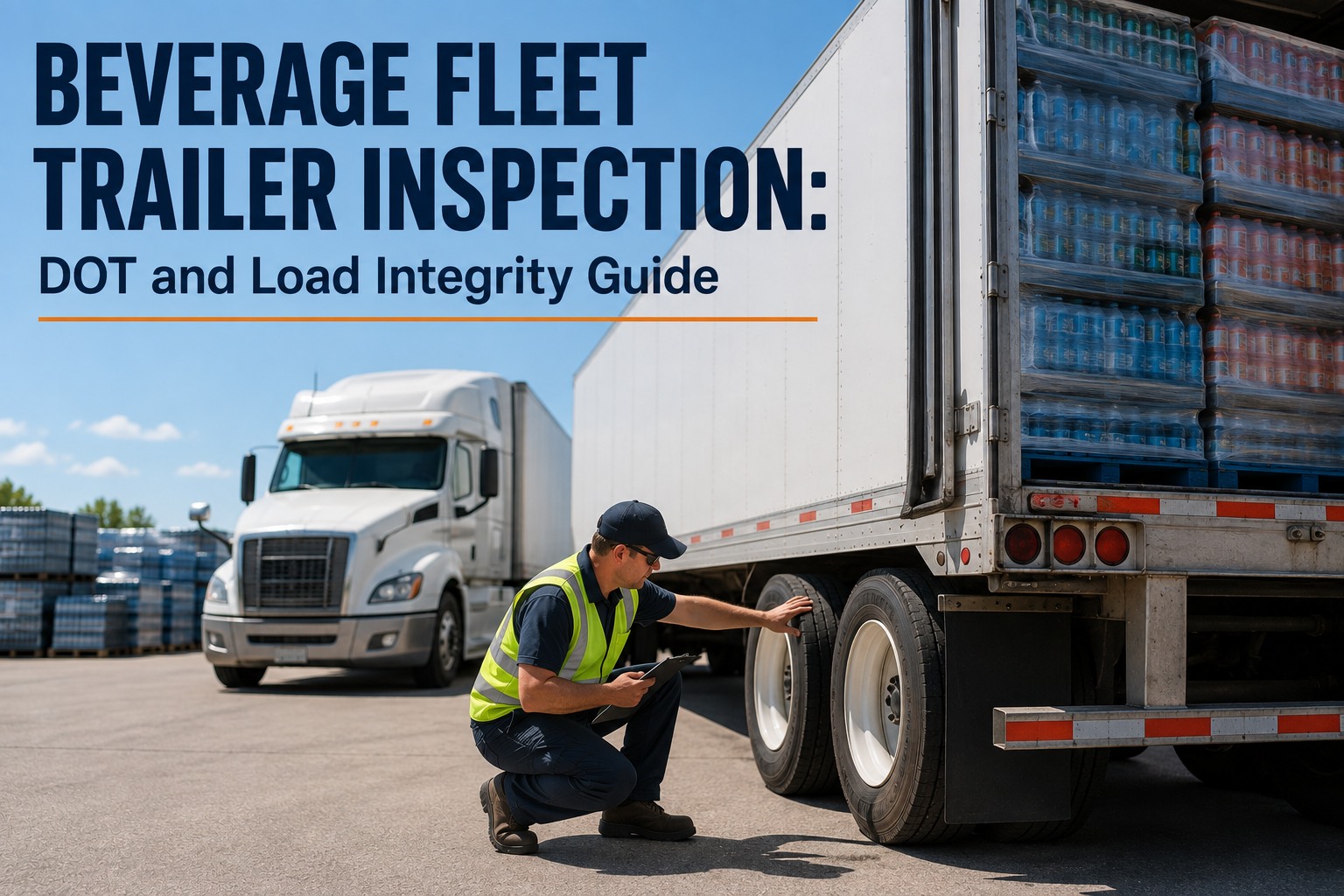
Beverage trailers live at the intersection of DOT compliance and load integrity. The FMCSA rules apply the same as any other trailer — brakes, coupling, lights, tires — but bay-loaded kegs, palletized cases, and refrigerated micro-brews add load-integrity checks that no dry-freight trailer needs. Miss a load bar tension check and 42 pallets of glass shift on the first hard brake. This guide covers the full beverage trailer inspection program tuned for 2026. Truck Inspection & Maintenance runs the whole program on driver phones — sign up free or contact our team.
Beverage Fleet Trailer Inspection — DOT & Load Integrity Guide
Kegs shift. Glass breaks. Refrigerated micro-brews warm. The trailer inspection has to catch it before the truck leaves the yard.
Why Beverage Trailer Inspections Need a Second Domain
Beverage loads combine three risk factors that no other freight segment combines simultaneously. Any inspection program that only checks the DOT boxes will miss the other three:
A standard 53-ft beverage trailer carries 42 pallets of bottled/canned product. A single load-bar failure on a hard brake shifts several tons of glass — driver injury risk, product loss, and hazmat cleanup all on the same call.
Load shift events on beverage trailers average $18K in product loss plus recovery, plus roughly $6K in trailer interior damage. Refrigerated micro-brew loads run higher due to seal breach and temperature excursion.
Beverage delivery routes are shorter than linehaul but higher-frequency — 30–120 miles per stop with multiple stops per day. Pre-trip inspection quality matters more because inter-stop inspection is limited.
Stop losing $18K+ loads to preventable shift events — start a free account and put the full 22-point beverage DVIR on every driver phone this week.
Domain 1 — DOT Compliance Points (14)
The FMCSA §396.11 trailer inspection combined with §393 equipment requirements totals 14 mandatory points on any beverage trailer. Every one of these is a roadside violation risk if missed:
Want the DOT 14 as a printable pre-trip card for the shop wall? Contact our team and we'll ship one per truck, free.
Domain 2 — Load Integrity Points (8)
The 8 load-integrity points below aren't in FMCSA — they're the difference between a shipment that arrives whole and a shipment that arrives as broken glass. Every beverage fleet DVIR should include these:
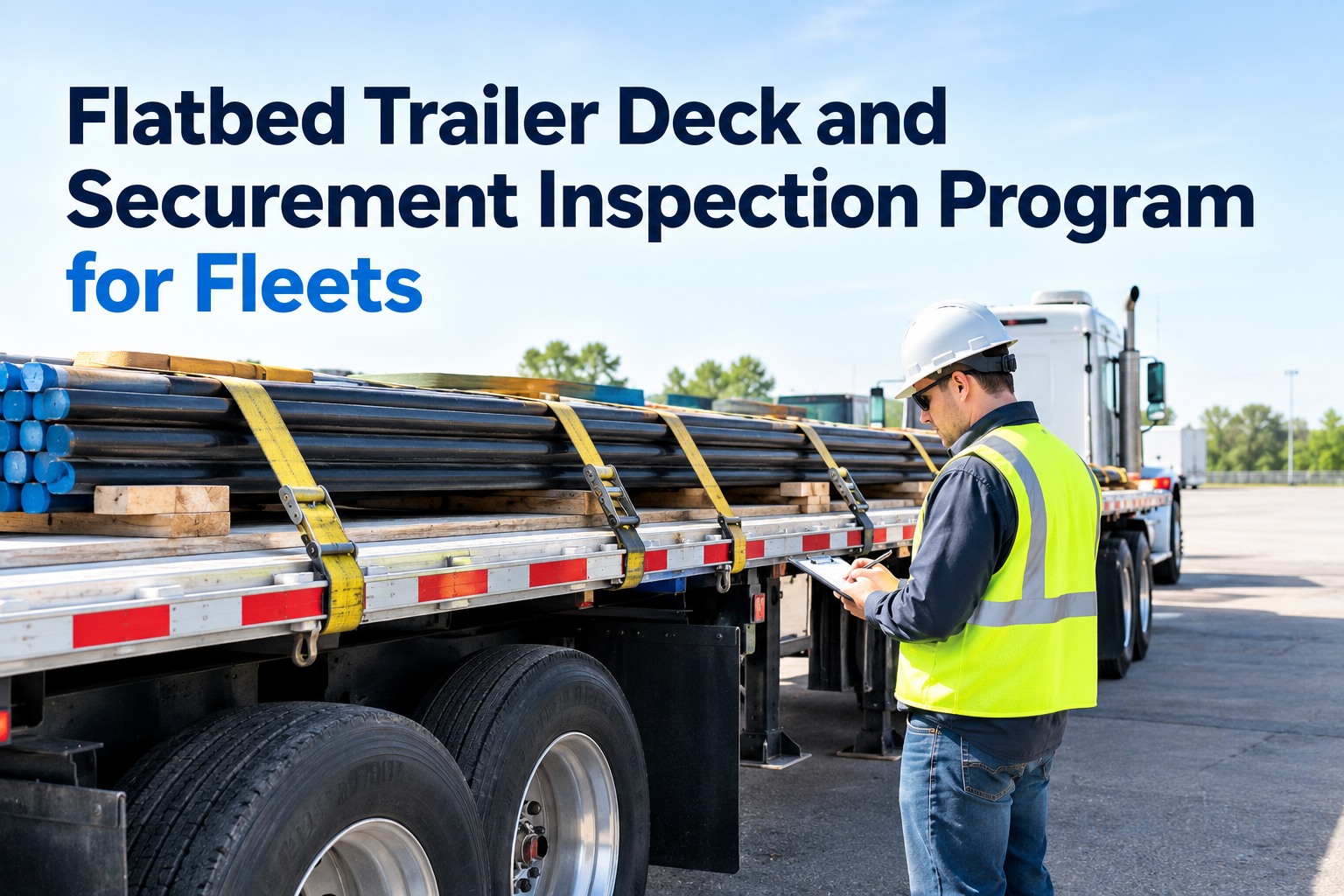
Load Bars / Cargo Bars
Check: Bars in place between pallets, tension-locked at both ends, no bent or corroded bars. Count = spec for load configuration (typically 3–6 per full load).
Load Straps & Ratchets
Check: Straps tensioned, ratchets locked and secured, straps not cut or frayed, hooks engaged in proper trailer anchors, not on E-track alone for kegged loads.
E-Track / Logistics Track
Check: Track rails securely fastened to trailer walls, no missing bolts, no bent sections. Anchor points functional along the full length. Damaged E-track = load can't be secured.
Bay Dividers (Side-Loader Only)
Check: Bay dividers engaged and locked in position on beverage side-loader trailers. Each bay's load can't shift between bays. Divider damage = adjacent bays can collide.
Interior Floor Condition
Check: Floor clean, dry, no product residue from prior load, no protruding nails or splinters, no soft spots. Floor damage = pallet drops, keg rolls.
Reefer Unit & Temperature (If Equipped)
Check: Reefer starts on both power sources, runs 20 min at high-cool without alarm, setpoint matches product spec (typically 34–38°F for craft/micro-brew), datalogger active.
Keg Racks & Restraints (If Kegged Load)
Check: Keg racks secure, restraint bars engaged, keg tops not touching trailer roof (bounce damage), floor of rack clean. Empty return kegs strapped same as full.
Weight Distribution
Check: Load distributed evenly front-to-rear and side-to-side within trailer axle capacity. Heavy pallets forward, lighter to rear. Confirm at scale before departure on full loads.
Load integrity failures cost more than DOT violations most weeks — sign up free and add the 8-point load check to every beverage DVIR today.
The One Rule That Prevents Load Shift — Check Load Bar Tension AFTER the First 25 Miles
Loading crews torque load bars to spec at the DC. Straps and tension settle on the first stretch of highway as suspension flexes and pallets seat. The rule every beverage fleet should build into route pattern: driver pulls over safely at 25 miles into the route, opens the rear or bay doors, and re-checks load bar tension and strap ratchets. Any bar found loose gets re-tensioned right there. This 5-minute stop prevents 80%+ of load shift events. Start a free account and add the 25-mile re-check as a scheduled DVIR item on every beverage route.
Pre-Trip vs Post-Trip Split — Beverage Trailer Specific
Not all 22 points make sense at both ends of the day. The right split maximizes what each inspection catches:
Full DOT 14 + load integrity 8. This is the make-or-break inspection — everything must be verified before wheels turn. Load integrity failures caught here save the whole route.
Load bar tension, strap ratchets, keg restraints. The re-tension stop that prevents 80% of load shift events. No DOT walkaround required unless defect suspected.
Full FMCSA §396.11 walkaround at end of driving day. Documents any defects developed during route. Load integrity items only re-checked if empty return.
Need help splitting your DVIR flow across pre-trip, mid-route, and post-trip? Get in touch for a free workflow design call.
The KPI Dashboard — 6 Beverage-Specific Metrics
Six numbers to track weekly on any beverage fleet. All six move together — a slip in one usually predicts a slip in the others:
Every pre-trip covers all 22 points, DOT plus load integrity. Missing any = load at risk, roadside violation risk, or both.
Zero-tolerance metric. Every event triggers root cause investigation and DVIR review across the whole fleet the same week.
Drivers stopping and re-tensioning after 25 miles. Below 95% means the rule isn't landing — coach or automate.
Trailer-related violations per inspection. Below 2% = FMCSA compliance program working; above = §396.11 gaps opening.
Every refrigerated load has active datalogger. Craft/micro-brew loads without = temperature liability with receiver.
Total product loss (breakage, shift, temperature) divided by cases delivered. Above $0.50 = load integrity program failing.
Run the full DOT + load integrity DVIR on driver phones with tension photo verification and 25-mile re-check enforcement.
FMCSA 14 + load integrity 8, photo-verified fails, auto-scheduled re-check reminders, reefer datalogger integration. Free forever for up to 3 vehicles — create your free account or talk to our team.
The 5 Most Expensive Beverage Trailer Mistakes
Every beverage fleet manager has watched at least three of these five play out. All five are preventable:
Skipping the 25-Mile Re-Check
Cost: Load shift at highway speed = $18K product loss + $6K trailer interior repair + downtime. Prevented by a 5-minute stop.
Loose Kegs on Return Trip
Cost: Empty kegs treated as "just returns" — strapped loose, damage keg valves and denting on route. Keg repair or scrap: $80–$150 per unit, 20 kegs per event.
Wet Floor from Prior Load
Cost: Un-mopped spillage on floor causes pallet slide on the first sharp turn. Multi-pallet shift + cleanup + delivery delay averages $12K per event.
Reefer Alarm Ignored on Pre-Trip
Cost: Reefer shows fault code, driver dismisses "it's usually nothing," craft-brew load warms above spec by mile 80. Full load rejected: $22K+.
Damaged E-Track Not Reported
Cost: Bent E-track section not flagged, load bar fails at the damaged anchor mid-route, load shifts. Bent rail costs $200 to repair vs the load loss.
Recognize your fleet in any of these five mistakes? Create a free account and fix the top 3 in the first week of the mobile inspection program.
Frequently Asked Questions
What are the 14 DOT compliance points on a beverage trailer inspection?
The FMCSA §396.11 trailer inspection combined with §393 equipment requirements covers: service brakes, brake chambers & cans, wheels & rims, tires, lighting devices & reflectors, coupling devices, air & electric lines, suspension, frame & cross-members, landing gear, doors & latches, mud flaps & splash guards, placards & markings, and rear underride guard. All 14 are mandatory on any commercial trailer including beverage — missing any is a roadside violation risk.
What load integrity points should be added to a beverage trailer DVIR?
Beyond the 14 DOT points, beverage trailers should add 8 load integrity checks: load bars/cargo bars, load straps & ratchets, E-track/logistics track, bay dividers (side-loaders), interior floor condition, reefer unit & temperature (if equipped), keg racks & restraints (if kegged), and weight distribution. These aren't FMCSA-required but they're the difference between an intact shipment and a load shift event costing $18K+ in product plus trailer damage.
Why should beverage drivers re-check load tension after 25 miles?
Load bars and straps torqued at the DC settle during the first stretch of highway driving as suspension flexes and pallets seat. Bars that were tight at the loading dock loosen measurably in the first 25 miles. A 5-minute stop to re-tension bars and check strap ratchets prevents an estimated 80%+ of load shift events on beverage fleets. The 25-mile re-check should be a scheduled DVIR item, not a driver-discretion item.
Do craft or micro-brewery beverage loads need different inspection?
Yes on two counts. First, refrigerated craft/micro-brew loads require reefer datalogger verification and setpoint check (typically 34–38°F) at pre-trip — non-refrigerated beverage loads skip this. Second, glass-bottled craft product breaks more easily than canned macro beverage in a shift event, so load bar and strap discipline matters more. Craft-brew fleets often add a 50-mile second re-check on longer routes to catch settling missed at 25 miles.
Are kegged loads inspected differently than cased product?
Kegged loads add checks for keg racks, restraint bars, and roof clearance that don't apply to palletized cases. Empty return kegs need the same restraint discipline as full outbound kegs — loose returns damage each other and the trailer interior. Keg tops must not contact trailer roof or bounce damage during transit is guaranteed. Kegged loads also often use different trailer configurations (side-loader with bay dividers) that add bay-divider inspection to the DVIR.
How does Truck Inspection & Maintenance handle beverage trailer inspection programs?
Truck Inspection & Maintenance runs the full 22-point beverage trailer DVIR (DOT 14 + load integrity 8) on driver phones with photo-required fails on both categories. The 25-mile re-check auto-schedules as a DVIR item after pre-trip completes, with GPS-triggered reminders. Reefer datalogger data pulls into the DVIR record for craft/micro-brew loads. All records retain for 3 months FMCSA and 12 months for temperature-controlled loads. Free forever for up to 3 vehicles. Sign up in 10 minutes or contact our team for larger beverage fleets.
DOT compliance keeps the truck on the road. Load integrity keeps the product on the pallet.
Full 22-point beverage trailer DVIR on driver phones, 25-mile re-check enforcement, reefer datalogger integration. Free forever for up to 3 vehicles — no hardware, no contract, no credit card.