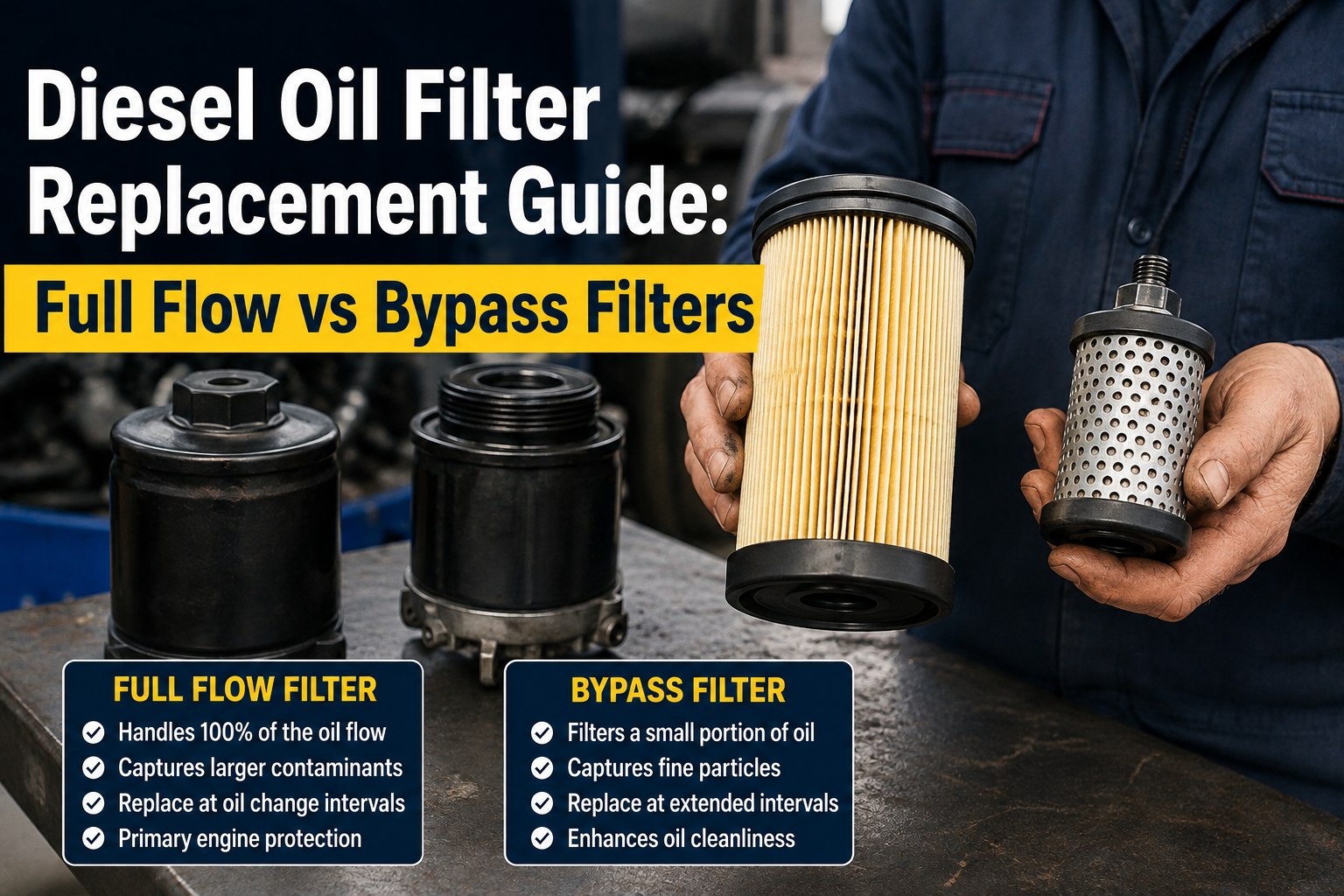
Every diesel engine oil system needs particulate protection, but not all filters do the same job. Full-flow filters process 100% of the oil coming off the pump — they're the primary defense every engine ships with — and typically trap contaminants down to 15-25 microns at 99% efficiency. Bypass filters process only 5-10% of oil flow through a much finer media — capturing 2-micron and even sub-micron particles — while the rest of the oil continues through the full-flow. Neither replaces the other; they work together, and understanding the split is what separates fleets that hit 60,000+ mile oil intervals from those that pull oil at 15,000 because their pump wear metals came back elevated. A worn-out or clogged full-flow filter opens its internal bypass valve and lets unfiltered oil through — silent, unmarked, and destructive across the entire lubrication circuit. A bypass filter left unchanged simply stops adding value; the full-flow still protects the engine, but the extended-drain justification disappears. Get the two intervals aligned to your specific engine platform (Cummins X15 hits 75,000 miles with proper bypass; Detroit DD-series follows MPG-based schedules; PACCAR MX-13 publishes three duty-cycle schedules) and the ROI compounds every quarter. Ready to run diesel oil filter PM that captures the extended intervals safely? Sign up free for Truck Inspection & Maintenance today — no credit card required and start tracking filter interval per truck with automatic replacement alerts, or contact our support team for a personalized walkthrough tailored to your fleet's engine mix and duty cycles.
Diesel Oil Filter Replacement Guide: Full Flow vs Bypass Filters
Two filter architectures. One oil circuit. 100% flow vs 5-10% fine polish. Get the split right and 60,000+ mile drain intervals become routine.
Full-Flow vs Bypass — Two Different Jobs
Full-flow and bypass filters are complementary, not competing. Each handles a different job in the same oil circuit. Confusing the two is what causes fleet operators to either over-service or under-protect.
How the Oil Flows — Circuit Visualization
Understanding the oil path through both filters makes every service decision obvious. Here's what happens between the pump and the engine bearings on a fleet truck equipped with both filters.
Micron Capability Ladder — What Each Filter Actually Catches
Filter effectiveness comes down to micron rating and Beta ratio. Here's the capability ladder showing what each filter type stops — and what slips through.
Replacement Intervals by Filter Type
Full-flow and bypass filters have different replacement rhythms. Missing either creates a different problem — full-flow neglect endangers the engine; bypass neglect just wastes the extended-drain investment.
Engine-Specific Filter Requirements
Every major heavy-duty diesel platform has specific filter spec requirements. Getting the part number wrong is not a minor mistake — the filter that works in one engine can starve bearings in another.
Track filter spec per truck — never install the wrong part number again
Filter part numbers logged per engine model. Full-flow AND bypass replacement intervals tracked independently. Combination filter housing type flagged per unit. Wear metal trending from used-oil analysis. Truck Inspection & Maintenance software ships with pre-built PM templates for every major diesel platform — Cummins, Detroit, PACCAR, Volvo, CAT.
The Bypass Filter ROI Calculation
Adding a bypass filter is a one-time capital investment that returns compounding value over the truck's life. Here's how the math actually plays out on a typical Class 8 fleet truck.
Frequently Asked Questions
Full-flow filters process 100% of the oil coming off the pump — they're the primary defense every diesel engine ships with, typically trapping contaminants down to 15-25 microns at 99% efficiency. Full-flow filters sit between the oil pump and the engine bearings; every drop of pressurized oil passes through before reaching the engine. Bypass filters process only 5-10% of oil flow through a much finer media, capturing 2-micron and even sub-micron particles, while the remaining 90-95% of oil continues through the full-flow to the engine. Bypass filters are optional aftermarket additions on most trucks, mounted in parallel to the main circuit, with the filtered oil returning to the sump. The two filter types are complementary, not competing — full-flow prevents catastrophic engine damage, bypass extends drain intervals and reduces wear metals. Neither replaces the other. Truck Inspection & Maintenance software tracks both filter types on independent intervals per truck.
Full-flow filter: replace at every oil change — never reuse an old filter with new oil. The full-flow filter's media is saturated with the same soot, wear metals, and combustion contaminants that made the oil ready for change. Bypass filter: typically every 15,000 miles or annually, whichever comes first. Some heavy-use fleets service the bypass every 7,500 miles for maximum extended-drain benefit. Combination filters (like Fleetguard LF9028 Venturi): replaced with every oil change since both functions are in one housing. Specific engine-dependent intervals: Cummins 6.7L runs 15,000 miles or 12 months, Cummins X15 with proper filtration and VDS-4.5 oil can extend to 75,000 miles on long haul, Detroit DD-series follows MPG-based schedules (never exceed 100,000 miles), PACCAR MX-13 publishes three duty-cycle schedules, Volvo D11/D13 with 42L pan runs 35K to 60K miles by duty cycle. Always follow the OEM interval when it differs from generic guidance.
For most fleet operators running high-mile trucks, yes — the ROI compounds every quarter. Investment: bypass filter kit runs $400-$800 one-time, installation labor $150-$300, bypass element replacement $50-$120 annually, plus used-oil analysis at $20-$40 per PM to validate the extended interval. Return: extended drain interval (often 2× typical), oil consumption reduction of 10-15%, wear metal reduction of 30-50% in used-oil analysis, and engine service life extension of 100,000-300,000 miles over the truck's life. On a truck expected to run 800,000-1,000,000 miles of service life, the bypass investment pays back multiple times over. Best fits: line-haul fleets, owner-operators targeting extended service life, trucks running severe duty where wear metals are elevated. Weaker fit: short-haul urban trucks with limited daily mileage where drain intervals are already low.
Diesel engines are engineered around specific oil pump output rates, oil pressures, and flow requirements. Using the wrong filter can cause serious damage in several ways. Filter too small: restricts oil flow, causing the internal bypass valve to open under normal operating conditions — bearings receive unfiltered oil across every mile of operation, accelerating wear on cams, bearings, and cylinder walls. Filter too large: may fit physically but provides inadequate pressure differential for optimal filtration efficiency. Wrong micron rating: standard 30μ filter in an engine spec'd for 15μ synthetic allows fine particulates to reach bearing surfaces, causing gradual wear metal accumulation visible in used-oil analysis. Wrong bypass valve setting: mismatched bypass valve pressure can either open too soon (bypassing filtration constantly) or too late (starving the engine of oil under cold-start conditions). Always match the OEM spec or an equivalent from a reputable manufacturer (Fleetguard, Donaldson, Baldwin, WIX Heavy Duty). Never assume filters from different platforms are interchangeable. Contact our team to see how Truck Inspection & Maintenance software enforces filter spec per truck.
Full-flow filter micron rating depends on engine spec and application. Standard cellulose full-flow filters run 25-30 microns at 95-99% efficiency — adequate for older engines and shorter drain intervals. Synthetic-media full-flow filters run 15-25 microns at 99% efficiency — the modern OEM standard for extended-drain applications. Premium synthetic full-flow (like Fleetguard Stratapore) run 10-15 microns at 99% efficiency for maximum extended-drain performance. Bypass filters go significantly finer: standard bypass at 5 microns with 98.7% efficiency, premium bypass (Amsoil EaBP, Sinister Diesel, Insane Diesel) down to 2 microns or even 1 micron for the finest polish. The 10-micron damage rule matters here: contaminants at 10 microns and smaller cause nearly 4× more engine damage than larger particles because they fit through the bearing clearances. This is why bypass filtration provides measurable wear metal reduction that full-flow alone cannot achieve. Choose full-flow micron rating per OEM spec; add bypass if targeting extended drain intervals or maximum engine service life.
Yes on most platforms — bypass filter installation is a DIY-friendly job for a mechanically-inclined owner-operator or shop technician. Basic requirements: tap into an existing plugged oil pressure port (typically on the block or above the stock full-flow filter), route pressure line to the bypass filter head, and route return line back to the oil fill tube or a tapped return point on the valve cover. Universal bypass kits from Amsoil, Sinister Diesel, or Insane Diesel include everything needed. Installation time typically 3-5 hours with basic tools. Considerations before DIY: verify tapped ports don't compromise cooling passages, use quality fittings and high-pressure hydraulic hose rated for oil temperatures, mount the filter housing in a location accessible for service, protect all lines from chafing against frame components. For fleet operations, most operators have the local truck shop install bypass systems during regular PM visits to standardize the installation across the fleet. Try free: sign up here.
Truck Inspection & Maintenance software makes filter strategy a documented spec, not a memory-based decision
Full-flow and bypass filter intervals tracked independently per truck. Engine-specific part numbers locked per unit (Cummins, Detroit, PACCAR, Volvo, CAT). Combination filter housing type flagged. Used-oil analysis integration for wear metal trending. Automatic filter replacement alerts by mileage and time. OEM spec compliance documentation. Every element of diesel oil filter PM captured in one platform — because a $30 wrong filter can void warranty and destroy an $18,000 engine, and top-performing fleets track filter spec per truck to prevent exactly that.