A diesel truck's serpentine belt is a $50 rubber ribbon that stands between $10,000 worth of connected engine accessories and the shoulder of the highway. When it snaps, everything snaps at once — the alternator stops charging, the water pump stops circulating coolant, the power steering pump goes rigid, and on many diesel platforms the vacuum pump for the brake booster loses assist. The driver has minutes, not hours, to get off the road before either the coolant temperature climbs into engine-damaging territory or the battery drains enough to stall the ECU. And unlike a gas engine where a snapped belt is inconvenient, on a heavy-duty diesel under load — pulling grade, hauling a full trailer, in the middle of a delivery route — a belt failure is a full downtime event: 48 to 72 hours out of service on average, plus tow costs, plus whatever the cascade damaged. Modern EPDM rubber belts have pushed lifespan into the 60,000 to 100,000 mile range on light-duty use, but diesel trucks running high torque, heavy towing, and elevated underhood temperatures see that number cut significantly. And the belt is only half the system — the automatic tensioner, idler pulleys, and driven accessory pulleys all wear together, which is why a shop that quotes "new belt" without inspecting the tensioner is setting you up to shred the new belt within months. This guide covers exactly what a diesel serpentine belt replacement involves — how the belt actually powers the engine's accessories, the 6 warning signs that mean replace now, the real cost breakdown by repair scope, the diesel-specific factors that shorten belt life, when to replace the tensioner alongside the belt, and how Truck Inspection & Maintenance software tracks belt condition per truck so a scheduled 45-minute PM replaces an emergency 48-hour breakdown. Ready to catch belt wear before it becomes a roadside tow bill? Start a free trial of Truck Inspection & Maintenance, or contact our support team for a walkthrough.
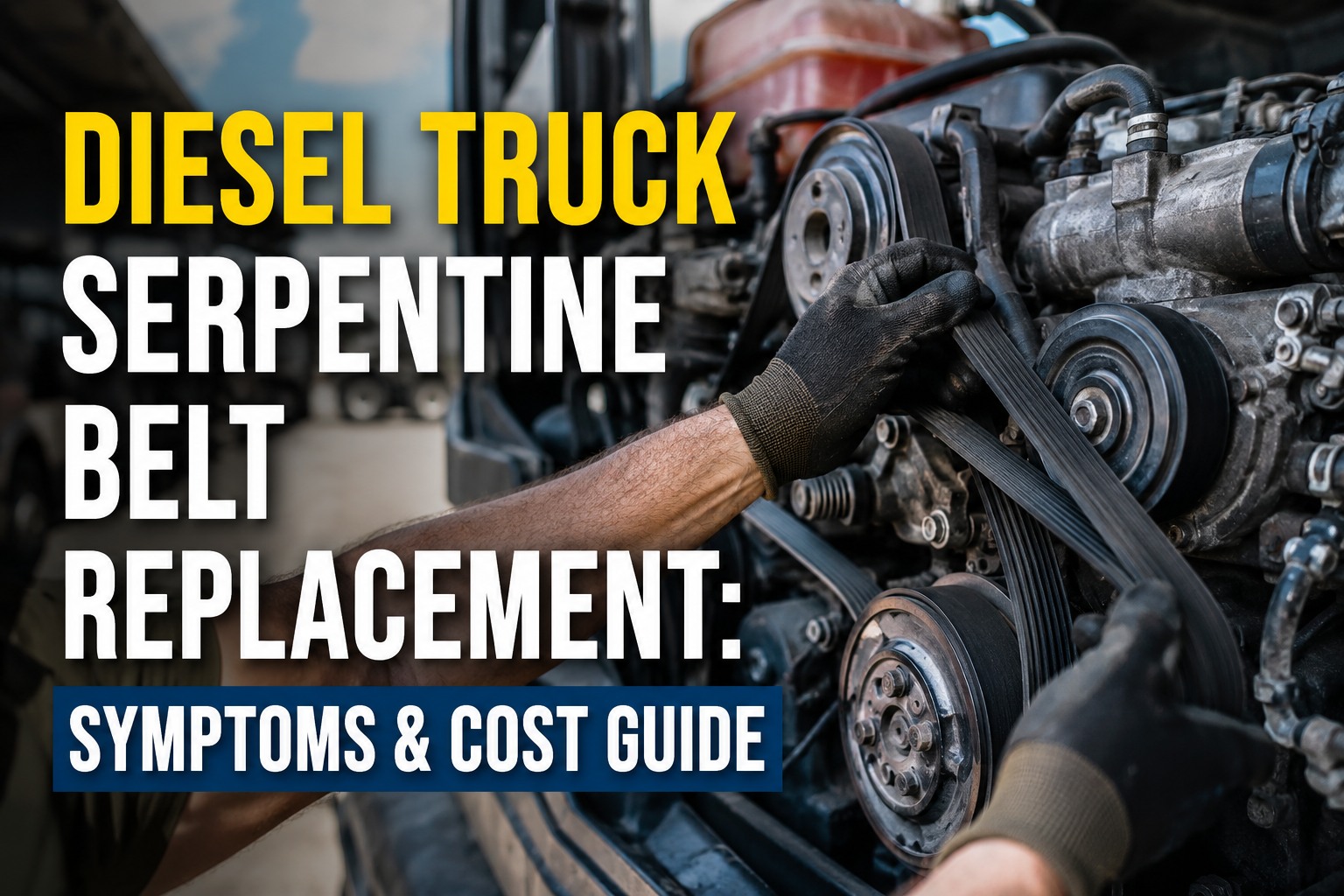
Diesel Truck Serpentine Belt Replacement: Symptoms & Cost Guide
One rubber ribbon powers every belt-driven accessory on the engine. When it snaps, everything snaps at once. Here's how to catch the wear before the tow bill.
What the Serpentine Belt Actually Powers
One belt drives every rotating accessory attached to the engine. When it fails, every one of these systems fails simultaneously — that's why belt replacement is the highest-leverage maintenance dollar in the entire drivetrain.
The 6 Warning Signs — Replace Before Failure
A serpentine belt rarely fails without warning. Learn these six symptoms and you'll catch every belt problem in the shop instead of on the shoulder of the highway.
Cost Breakdown — What You're Actually Paying For
Serpentine belt replacement cost depends entirely on how deep the shop has to go. Belt-only is cheap. Belt plus tensioner plus damaged accessory is not. Here's the tier ladder.
Diesel-Specific Factors That Shorten Belt Life
Modern EPDM belts are rated for 60,000–100,000 miles under ideal conditions. Diesel operating conditions are rarely ideal. These 6 factors are what push a diesel belt toward the low end — or past it — of that range.
A scheduled 45-minute PM replaces an emergency 48-hour breakdown
Belt condition tracking per truck. Mileage-based replacement alerts. Photo-verified inspection history. Tensioner service dates logged. Truck Inspection & Maintenance software makes serpentine belt maintenance a proactive schedule instead of a reactive shoulder-of-the-highway event.
When to Replace the Tensioner Alongside the Belt
The tensioner is the single most-ignored component on the accessory drive. Replacing the belt without checking the tensioner is a common mistake that destroys the new belt within months. Here's the decision matrix.
Belt Inspection at Every PM — 5-Minute Check
A systematic belt inspection takes less than 5 minutes at every scheduled PM. Do it right and you'll catch every failing belt before it strands the truck.
Frequently Asked Questions
Modern EPDM rubber serpentine belts are rated for 60,000 to 100,000 miles under ideal conditions. Diesel trucks running high torque, heavy towing, or sustained high underhood temperatures typically see belt life at the low end of that range — 60,000 to 80,000 miles is a realistic diesel service interval. The actual replacement trigger should be a combination of mileage and visual inspection: cracking, glazing, missing chunks, or fraying at any mileage means replace now. Fleet operators should build serpentine belt inspection into every PM and plan replacement at the manufacturer-recommended interval or when visual wear appears — whichever comes first. Trucks operating in Pacific Northwest road salt, desert heat, or heavy-tow mountain routes may need earlier replacement. Truck Inspection & Maintenance software logs belt condition per PM and trends replacement timing per truck.
Six warning signs indicate a failing serpentine belt. Squealing on startup or acceleration — belt slipping on pulleys, worst on cold start or under A/C compressor load. Visible cracks on the rib side of the belt — more than 3–4 cracks per inch means end-of-life. Glazed or shiny belt surface — heat-polished from slippage, has lost grip. Missing chunks or frayed edges — pre-failure state, belt can shed within hours. Battery warning light illuminated — belt slipping enough to under-drive the alternator. Chirping, clicking, or grinding noise — usually pulley misalignment or worn idler bearing chewing the belt. Any one of these symptoms means schedule replacement immediately, before the belt fails on the road.
Serpentine belt replacement cost falls into four tiers based on repair scope. Tier 1 — belt only: $110 to $300 for a straightforward belt swap with functional tensioner and pulleys, 30 to 60 minutes of labor on most diesel platforms. Tier 2 — belt plus tensioner: $220 to $410, the best-practice repair for high-mileage engines to prevent new belt destruction. Tier 3 — belt plus tensioner plus idler pulley: $300 to $650+ for full accessory drive service when pulley noise is present. Tier 4 — post-failure cascade repair: $800 to $2,000+ when the belt snapped in service and damaged the alternator, water pump, or caused overheating, plus tow and downtime costs. The economics are clear: a $200 scheduled belt-only replacement is orders of magnitude cheaper than a $1,500+ cascade repair.
It depends on tensioner condition. Belt only is fine if: the truck is under 75,000 miles, the tensioner arm has no wobble or excessive play, it provides smooth spring-loaded resistance when pushed, the pulley shows no cracking, and there's no unusual noise. Replace belt AND tensioner if: the truck is over 100,000 miles, the tensioner shows visible wobble or is stuck in one position, it makes squealing or grinding noise, or the old belt was shredded/glazed/thrown (which indicates tensioner failure was the cause). A weak tensioner will destroy a brand-new belt within months — that's the biggest reason to include the tensioner in the repair when there's any doubt. The added $50 to $150 in parts plus additional labor is cheap insurance. Contact our team to see how the software tracks tensioner service history.
Everything belt-driven fails simultaneously. The alternator stops charging — the battery starts draining and will fail within minutes as ECU and injectors keep drawing current. The water pump stops circulating coolant — engine temperature climbs rapidly, and sustained overheating can warp the head, blow the head gasket, or seize the engine. The power steering pump loses hydraulic pressure — the steering wheel becomes very heavy and hard to turn, especially at low speed. The A/C compressor stops — no cabin cooling. On many diesel platforms, the vacuum pump for the brake booster also stops — the brake pedal becomes hard and braking assist is reduced. Cascade damage typical of a snapped belt event: 48 to 72 hours of downtime, tow bill, plus repair of anything the failure damaged. Pull over as soon as safely possible when the belt fails or a warning light activates.
Technically yes — for a short distance to a shop. Practically no — the risk isn't worth it on a commercial diesel truck. A squealing belt is slipping; a cracked belt is degraded; either can snap without further warning at highway speed, load, or on a grade. When it snaps, you face the cascade failure of every belt-driven accessory (alternator, water pump, power steering, potentially brake vacuum on diesels), 48 to 72 hours of unexpected downtime, tow costs, and potentially thousands of dollars in additional repair from overheating or a stalled engine. The cost calculus is unbeatable: a $200 scheduled belt replacement vs. a $1,500+ cascade repair plus lost revenue. If the belt is showing symptoms, park it and replace it before the next trip. Try free: sign up here.
Truck Inspection & Maintenance software turns belt failure from an emergency into a scheduled PM
Belt condition tracked per truck at every inspection. Mileage-based replacement alerts before recommended service interval. Photo-verified inspection history. Tensioner condition and service dates logged. Idler pulley tracking. Cost tier documentation per repair event. Belt-related downtime metrics per unit. Every element of accessory drive maintenance managed in one platform — because catching a worn belt at PM is the difference between a 45-minute shop visit and a 72-hour roadside cascade event.