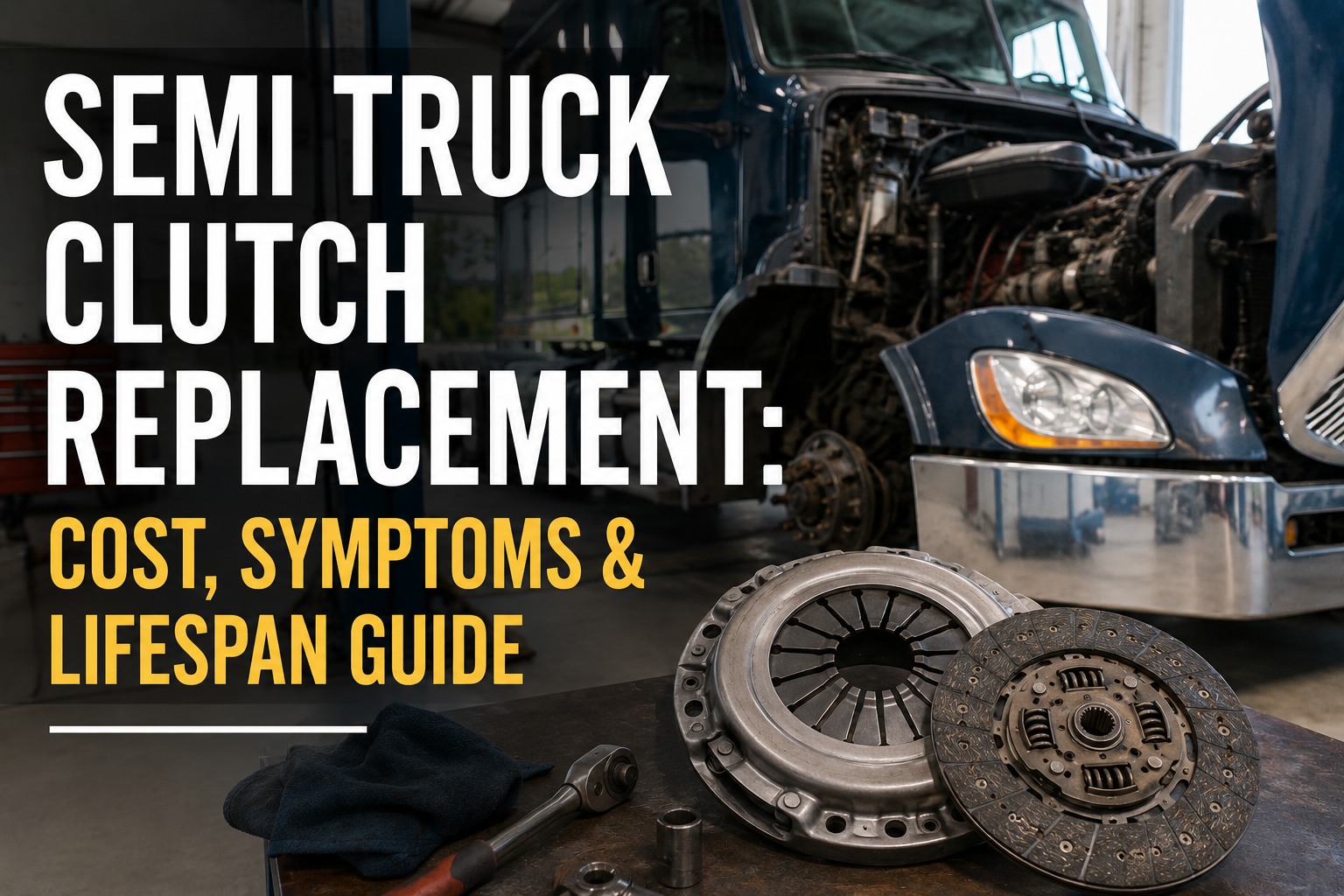
Semi truck clutch replacement is one of the most misunderstood expenses in commercial trucking — quoted anywhere from $1,000 to $6,500 depending on the shop, the truck, the parts choice, and whether the flywheel needs work. The wide range isn't shop gouging; it reflects real variables. A basic clutch kit swap on a spacious Freightliner with no flywheel work runs $1,800–$2,500 all-in. That same job on a Volvo or Mack with tight engine bay access, PTO complications, and a scored flywheel that needs replacement can reach $5,000–$6,500. In 2026, most fleet-managed replacements land in the $2,800–$4,500 range for a proper job with Eaton parts, rear main seal replacement while the transmission is out, and flywheel resurfacing. The single biggest cost driver isn't parts — it's labor. Removing a heavy-duty transmission to access the clutch takes 8 to 15 hours depending on truck configuration, and shop rates run $130–$200 per hour across most markets. That's why the parts-to-labor ratio flips compared to passenger vehicles: on a semi, labor typically equals or exceeds the parts cost. Beyond cost, the more useful conversation is lifespan and prevention. Well-treated heavy-duty clutches routinely reach 500,000 miles — some make it past 750,000 miles in linehaul service. Abused clutches (constant stop-and-go, riding the pedal, missed shifts, chronic overloading) fail at 100,000–200,000 miles. The difference between those two outcomes is 90% driver technique and 10% maintenance discipline. This guide walks through what's in a semi truck clutch kit, the six warning signs of failure, complete cost breakdown by service type, expected lifespan by duty cycle, the driver techniques that add hundreds of thousands of miles, and how Truck Inspection & Maintenance tracks clutch adjustment intervals and driver behavior signals across every truck in your fleet — free forever for up to 3 vehicles.
Semi Truck Clutch Replacement: Cost, Symptoms & Lifespan — Complete 2026 Guide
The $2,800–$6,500 job, the 500,000-mile lifespan, and the driver habits that decide which one your fleet gets.
Why Semi Truck Clutches Are Different
Nothing about a passenger vehicle clutch prepares you for what's on a Class 8 truck. Three fundamentals shape everything about cost, service, and expectations:
15.5" Twin-Disc Design
Standard heavy-duty clutch is 15.5" diameter twin-disc — dramatically larger than the 8–10" single-disc in passenger vehicles. Designed to transfer 1,650+ lb-ft of torque from Cummins X15 or Detroit DD15 engines. Common variants include Eaton Advantage, Eaton Solo self-adjust, and Eaton Enhanced Clamp Load (ECL/ECA).
Transmission-Out Access
Heavy-duty transmissions weigh 500–800 lbs and must be removed to access the clutch. That single reality drives 8–15 hours of labor. On tight-engine-bay trucks (Volvo, Mack) it can reach 20 hours. Labor drives most of the total cost.
Clutch Brake Involvement
Heavy-duty manual transmissions include a clutch brake — a device that stops the input shaft to allow non-synchronized gear engagement from neutral. Clutch brakes wear separately from the clutch itself and are typically replaced during clutch service.
What's in a Clutch Kit
Semi truck clutch replacement isn't just swapping a friction disc — it's a full kit replacement. Every component in the kit works together as a matched system. Skimp on any one part and the whole assembly wears prematurely:
Clutch Disc(s)
The friction plate(s) that engage between flywheel and pressure plate. Heavy-duty semi clutches are typically twin-disc — two friction plates for higher torque capacity. This is the wear item that drives replacement timing.
Pressure Plate
Spring-loaded assembly that clamps the clutch disc against the flywheel to transfer engine torque. Includes the diaphragm spring, cover, and release fingers. Always replaced with the disc — reusing an old pressure plate wastes the new disc.
Release Bearing
Also called the throwout bearing. Rides against the pressure plate fingers when the driver depresses the clutch pedal. High-wear component — often the noise source when a clutch is failing. Never reused on a clutch service.
Pilot Bearing
Small bearing in the end of the crankshaft that supports the input shaft of the transmission. Replaced during every clutch service — costs $20 to buy, costs $2,500 in labor to replace on its own if skipped.
Clutch Brake
Heavy-duty transmission-specific component. Stops the transmission input shaft to allow non-synchronized gear engagement from a stop. Fully replaced with clutch service — typically $50–$100 additional part cost.
Rear Main Seal (opportunistic)
Not part of the clutch, but the transmission is out — the perfect time to replace the engine rear main seal. Costs $30 to buy but $2,000+ in labor if done later on its own. Standard practice on every clutch service.
The 6 Warning Signs of Clutch Failure
Semi truck clutches announce their end clearly. Recognize these six symptoms and you can plan the replacement rather than getting stranded on I-80 at 2 AM:
Clutch Slipping Under Load
Engine RPM climbs but road speed doesn't increase proportionally. Most obvious on grades or heavy acceleration. The friction disc has worn thin and no longer grips fully. Drive with a slipping clutch and you'll cook the flywheel — turning a $3,000 job into a $5,000+ job.
Chatter or Shudder on Engagement
Truck shakes or shudders when releasing the pedal from a stop. Uneven friction disc wear or contamination (oil from a leaking rear main seal is common). Difficult to smooth out with technique — a symptom, not a habit issue.
Hard Shifts or Gear Grinding
Difficulty selecting gears from neutral, grinding on shifts, or gears won't engage smoothly. Often a worn clutch brake (not fully stopping the input shaft) or an out-of-adjustment clutch (not fully disengaging).
High Engagement Point
Clutch grabs at the top of pedal travel instead of the middle. Indicates worn friction material. On self-adjusting clutches (Eaton Solo), this can be normal wear compensation; on manual-adjust clutches, indicates the adjustment interval has passed or the disc is at end of life.
Burning Smell After Grade
Distinctive burnt-friction smell after climbing a grade or towing heavy. Clutch overheating from slippage. If this happens once from an unusual condition, no action needed. If regular, the clutch is at end of life.
Noises: Whine, Chirp, or Growl
Whining that changes with pedal position = release bearing failing. Chirp when pedal is depressed = release bearing dry. Growl when engine idles in neutral with pedal released = pilot bearing or transmission input bearing. All point toward comprehensive clutch service.
Complete Cost Breakdown (2026)
Real-world cost bands for semi truck clutch service in 2026. Numbers reflect independent shop pricing in most US markets; dealer pricing runs 15–30% higher, mobile service adds emergency premium:
Do Rear Main Seal & Flywheel Resurface Every Time
Both are trivial add-ons while the transmission is out — $30 and $200–$400 respectively. Skip them, and if either fails 6 months later, you're paying another 8–15 hours labor to pull the transmission again. That's $1,500–$3,000 wasted to save $400 today. Every semi truck clutch service should include both.
Expected Lifespan by Duty Cycle
Semi truck clutch lifespan varies dramatically with duty cycle. Same truck, same clutch — three different outcomes depending on how it's used:
Highway OTR with disciplined shift technique. Minimal starts and stops. Clutch engaged smoothly at cruise speeds. Best-case scenario — clutch outlasts truck's first owner.
Regional runs with mix of highway and city work. Multiple daily stops for delivery, dispatch, or drop trailers. Middle-of-the-road wear. Typical fleet expectation.
City delivery, construction, refuse, or heavy stop-and-go. Constant clutch engagement cycles. Even with good technique, wear is 3–5× faster than linehaul.
The Driver Technique Impact
Driver habits are the single biggest variable in clutch lifespan — bigger than truck brand, weather, or load type. Six habits separate the 500,000-mile drivers from the 150,000-mile drivers:
Double-Clutching Properly
Coordinate pedal movement and gear selector — pedal down to shift into neutral, release, match RPM, pedal down to select next gear. Reduces synchronizer wear and clutch friction. Adds 100,000+ miles to clutch life.
Float Shifting (Skilled)
Shifting without clutch by perfectly matching engine and transmission speed. Skilled drivers can float most shifts, using the clutch only from a stop. Correctly executed, this dramatically extends clutch life. Poorly executed, it destroys transmissions.
Foot Off Pedal When Not Shifting
Keep left foot completely off the clutch pedal between shifts. Any pressure keeps the release bearing engaged and slowly wears the friction disc. This is the single most common bad habit and the biggest killer of clutch life.
Riding the Clutch
Keeping the pedal partially depressed while driving. Kills clutches faster than any other habit. Continuous slippage overheats friction material. A 500,000-mile clutch becomes a 150,000-mile clutch with this single habit.
Slipping to Hold on Grade
Using clutch slippage to hold the truck on a hill instead of the brake. Generates massive heat, wears disc rapidly, and warps the flywheel. Always use service brake or parking brake to hold on grade — never the clutch.
Grinding Gears
Forcing gear selection when RPM doesn't match. Damages synchronizers, clutch brake, and can crack the transmission housing. Each grind is measurable wear. Drivers who grind regularly need retraining before they cost the fleet significant money.
Track clutch adjustment intervals, driver technique signals, and replacement forecasts
Truck Inspection & Maintenance tracks clutch adjustment intervals, service records with parts and labor, driver DVIR observations (chatter, slip, hard shifts), and mileage-based clutch replacement forecasts per vehicle. Fleet-level dashboards reveal which drivers are hardest on clutches — data that drives training, not accusations. Replace clutches on schedule with data, not on breakdowns. Sign up free for up to 3 vehicles.
Preventive Maintenance That Extends Life
Beyond driver technique, four maintenance actions extend clutch life. These aren't optional — they're the difference between the manufacturer's rated lifespan and getting there:
Free-Play Adjustment (Manual)
Manual-adjust clutches need free-play verified every 15,000–25,000 miles. Too little free play = disc drags constantly, wears fast. Too much = incomplete disengagement, grinding on shifts. Self-adjust clutches (Eaton Solo) skip this step but still benefit from inspection.
Clutch Linkage Inspection
Cable or hydraulic linkage inspected at every PM-A. Worn linkage causes improper release, dragging, and eventual clutch failure. Cheap to fix at inspection; expensive to fix after it wears the clutch out prematurely.
Rear Main Seal Monitoring
Any oil leak from the rear of the engine can contaminate the clutch — killing it in thousands of miles instead of hundreds of thousands. Small leaks at the rear main become urgent clutch problems fast.
Driver Skills Refresh
Annual driver training on shift technique pays for itself in extended clutch life. Newer drivers particularly benefit from double-clutch and float-shift technique review. Some fleets tie clutch-life metrics to driver bonuses.
Frequently Asked Questions
How much does a semi truck clutch replacement cost in 2026?
Total cost typically ranges from $2,800 to $6,500 in 2026. A basic clutch kit swap without flywheel work runs $1,800–$3,000. Standard service with flywheel resurface runs $2,800–$4,500 (most common). Premium 15.5" ECA clutches with flywheel work reach $3,500–$5,500. Complex jobs on tight-access trucks (Volvo, Mack) with flywheel replacement can reach $6,500+. Parts run $800–$2,500; labor is 8–15 hours at $130–$200 per hour depending on region. Always include flywheel resurface ($200–$400) and rear main seal replacement — trivial to add while transmission is out.
How long does a semi truck clutch last?
Depends heavily on duty cycle and driver technique. Long-haul linehaul with disciplined technique: 500,000–750,000 miles typical. Regional mixed service: 300,000–500,000 miles. Urban/vocational with constant stop-and-go: 100,000–200,000 miles. Same truck and same clutch can produce dramatically different lifespans based on how it's used. Driver habits (riding the clutch, slipping to hold on grades, grinding gears) are the single biggest lifespan variable — bigger than truck brand, weather, or load type.
What are the symptoms of a failing semi truck clutch?
Six warning signs indicate a clutch approaching end of life: (1) slipping under load — RPM climbs but road speed doesn't; (2) chatter or shudder on engagement; (3) hard shifts or gear grinding; (4) high engagement point (pedal grabs at the top of travel); (5) burning smell after climbing a grade; (6) whining, chirping, or growling noises. Any one of these warrants inspection. Multiple symptoms together indicate replacement is imminent — plan the service before you get stranded.
How long does clutch replacement take?
Typical clutch replacement takes 8–15 hours of labor. Simple jobs on spacious trucks with easy access run 8–10 hours. Standard jobs with flywheel resurface run 10–12 hours. Complex jobs on tight-access trucks (Volvo, Mack) with PTO complications or flywheel replacement can reach 15–20 hours. The primary time driver is transmission removal — heavy-duty transmissions weigh 500–800 lbs and require lifting equipment, transmission jack, and often supplemental support. Most shops complete a standard job in one working day.
Can I drive with a slipping clutch?
Not for long — continued driving with a slipping clutch generates massive heat that damages the flywheel. That converts a $3,000 clutch job into a $5,000+ job with flywheel replacement. The slipping friction disc also destroys itself faster with each mile of use. If you notice slipping, plan replacement within days, not weeks. If the truck is stranded and needs to move to a shop, drive gently at moderate RPM to minimize additional damage. Talk to our team about clutch service tracking.
How does Truck Inspection & Maintenance help with clutch management?
Truck Inspection & Maintenance tracks clutch adjustment intervals per vehicle, service records with parts and labor, driver DVIR observations (chatter, slip, hard shifts, unusual noises), and mileage-based replacement forecasts. Fleet dashboards reveal which drivers are hardest on clutches — data that drives training decisions objectively. Photo-verified service records support warranty claims. Rear main seal condition tracked separately. Replace clutches on schedule with data — not reactively after roadside failure. Free forever for up to 3 vehicles. Sign up in 10 minutes.
Clutch service tracking, driver behavior signals, and replacement forecasts — for every truck.
The difference between a 500,000-mile clutch and a 150,000-mile clutch is 90% driver technique. Truck Inspection & Maintenance tracks clutch adjustment intervals, service records, driver DVIR observations (chatter, slip, hard shifts), rear main seal condition, and mileage-based replacement forecasts per vehicle. Fleet dashboards surface training opportunities objectively. Free forever for up to 3 vehicles with no hardware and no contracts. Set it up in 10 minutes.