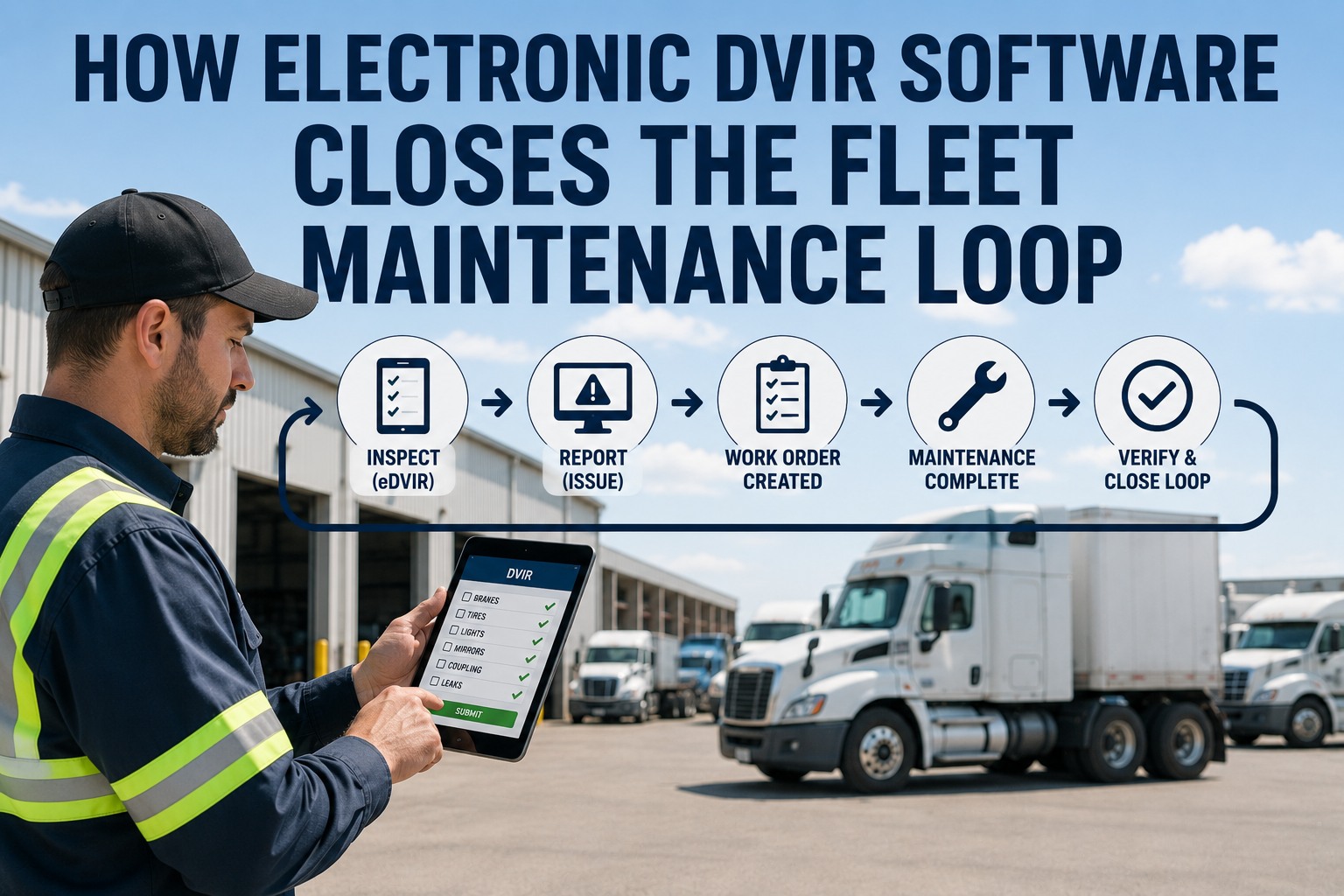
A paper DVIR is a compliance artifact. An electronic DVIR is a workflow trigger. That's the entire difference — and it's what closes the loop most fleets don't know is open. In a paper fleet, the pre-trip inspection, the defect report, the mechanic's repair, and the PM schedule all live in different files, different hands, different weeks. In an eDVIR fleet, one submitted inspection auto-opens a work order, alerts the shop foreman, updates the truck's status, blocks dispatch if severity requires, and cross-references the defect against pending PM items — all inside 60 seconds. The February 2026 FMCSA final rule (Docket FMCSA-2025-0115) made this official: eDVIR is now the FMCSA-preferred format under §396.11 and §396.13. Fleets running eDVIR average 94%+ PM compliance vs 54% for paper — a 40-point gap driven entirely by whether the loop between inspection and maintenance is closed automatically or left to human coordination. This guide walks how eDVIR software actually closes the loop, what "closed loop" means in practice, and what to look for when evaluating a platform in 2026. Sign up free for Truck Inspection & Maintenance today — no credit card required to run closed-loop eDVIR across your fleet, or contact our team for a workflow audit configured to your current DVIR setup.
How Electronic DVIR Software Closes the Fleet Maintenance Loop
Paper DVIRs are compliance artifacts. Electronic DVIRs are workflow triggers. The difference between the two is a 40-point PM compliance gap.
The Open Loop — Where Paper DVIRs Actually Fail
The compliance chain (driver signs → mechanic certifies → next driver acknowledges) technically closes on paper. The maintenance loop — from inspection to repair to PM update — usually doesn't. Here's where the paper workflow drops the handoff.
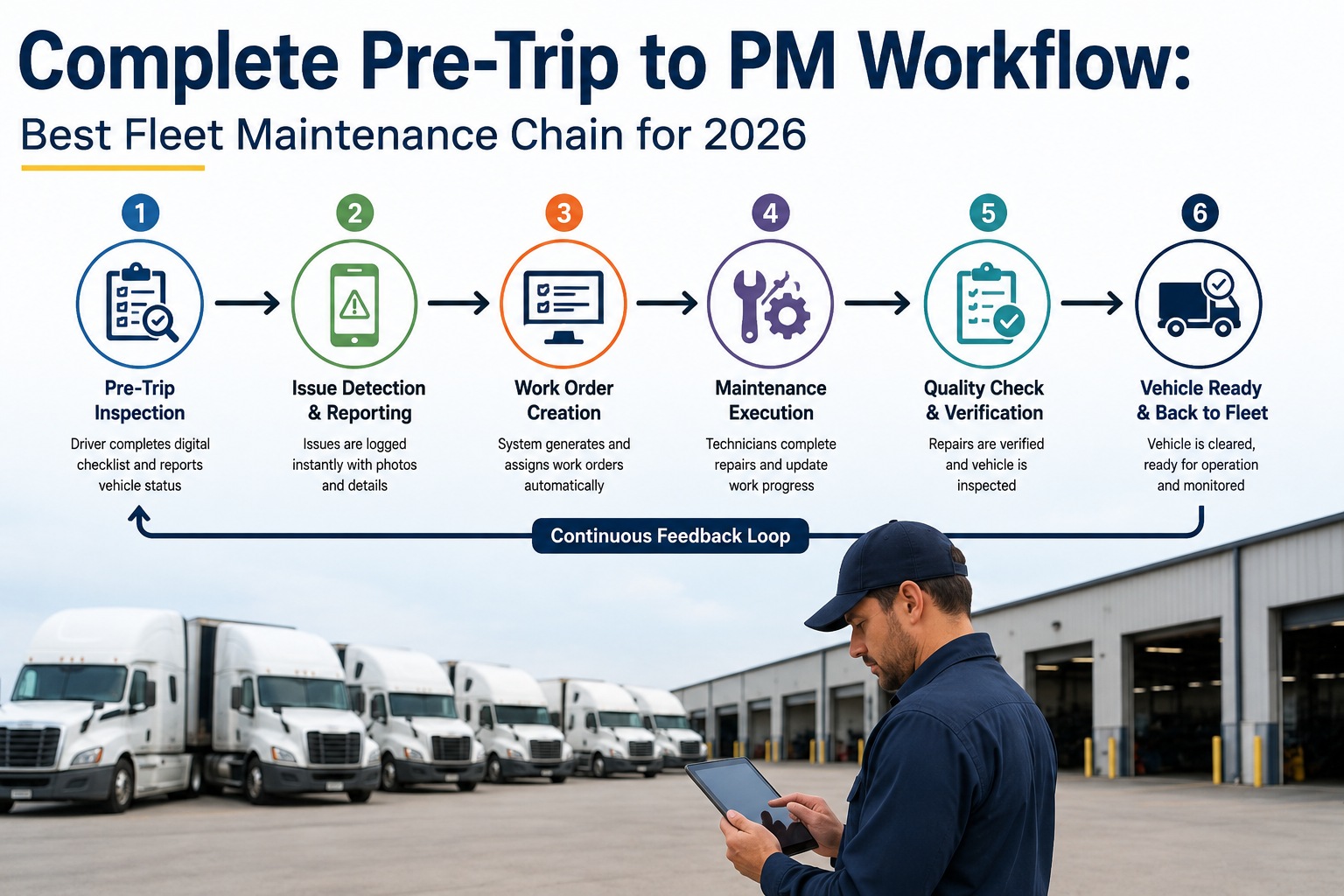
The Closed Loop — How eDVIR Software Actually Works
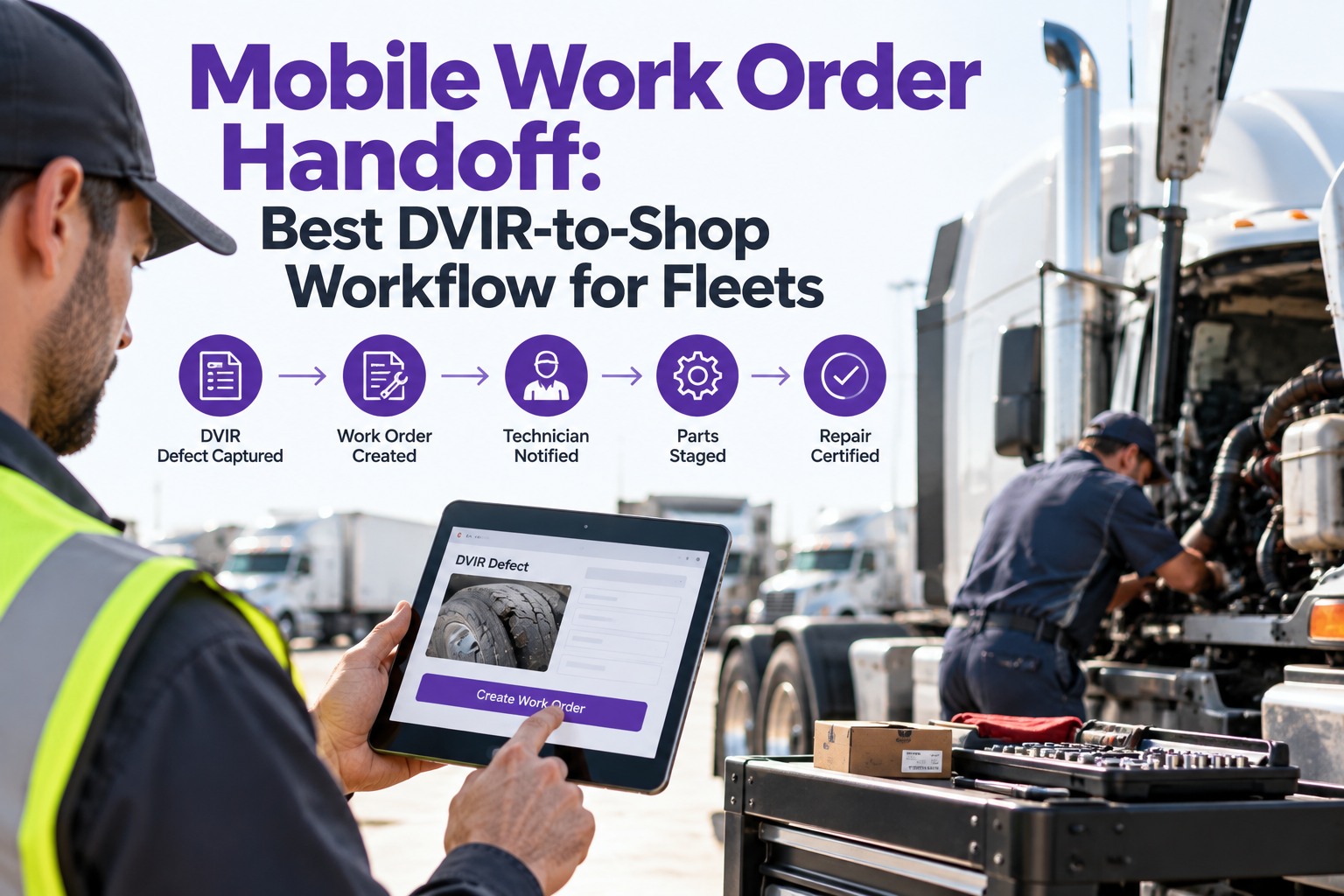
An eDVIR platform doesn't just replace the paper form. It re-architects the flow so every inspection triggers the next action automatically. Here's the sequence that runs on every submission.
Side-by-Side — Paper Loop vs eDVIR Loop
The same defect on the same truck, running through the two workflows. The differences are structural, not incremental.
The 6 Integration Points That Actually Matter
Not every eDVIR platform is a closed-loop platform. Some digitize the form and stop there — a "digital paper" system that captures the same data faster but doesn't trigger downstream actions. The six integrations below separate real closed-loop eDVIR from digital paper.
What the 2026 FMCSA Rule Actually Changed
The February 19, 2026 FMCSA final rule (Docket FMCSA-2025-0115, effective March 23, 2026) added explicit eDVIR authorization to §396.11 and §396.13. Here's what that means practically for fleets choosing between paper and digital.
Close the loop — from driver's phone to shop bay to next driver
Auto work order creation on defect submission. Dispatch board integration. Parts inventory sync. PM schedule coordination. J1939 DTC ingestion. FMCSA §396.11 & §396.13 native. Move from 54% to 94%+ PM compliance in 12 months.
What Changes When the Loop Closes — Real Fleet Numbers
The transition from paper to eDVIR produces measurable changes across the fleet within the first quarter. Here's what a typical mid-size fleet sees.
Frequently Asked Questions
Closed loop means every DVIR submission automatically triggers the next action in the maintenance workflow — work order creation, dispatch board update, parts check, PM cross-reference, and mechanic certification — without human coordination steps in between. In an open (paper) loop, each handoff requires someone to physically move the DVIR from one desk to another, translate the defect into a work order manually, walk to check parts stock, and update the dispatch board separately. In a closed loop, the system does all of that automatically the moment the driver submits. The 40-point PM compliance gap between paper and eDVIR fleets is driven almost entirely by whether these handoffs are automated or manual — humans forget or defer them, systems don't.
A digital form captures the same data as paper faster — that's it. True eDVIR software has six additional integrations: auto work order creation on defect submission, dispatch board integration for severity-based truck locks, parts inventory sync for ready-to-execute vs waiting work orders, PM schedule coordination for bundling repair with pending PM, J1939 telematics ingestion for auto-generated DVIR entries from ECM diagnostic codes, and FMCSA-formatted compliance export for the 48-hour audit window. Without all six, the platform is "digital paper" — it captures maybe 20% of the closed-loop benefit. When evaluating vendors, ask specifically about each integration; the sales demo will show the form, but the value is in what happens after the form is submitted.
No — paper DVIRs remain legal. The February 19, 2026 final rule (Docket FMCSA-2025-0115, effective March 23, 2026) added explicit eDVIR authorization to §396.11 and §396.13, formalizing what was already allowed under §390.32 since 2018. The rule doesn't mandate eDVIR; it clarifies that digital signatures with server timestamps and GPS carry the same legal weight as wet ink, and that photo evidence attached to DVIRs is part of the compliant record structure. But the direction is clear: FMCSA is signaling digital-first enforcement, and auditors, insurance underwriters, and litigation counsel all now expect eDVIR as the default. Fleets running paper remain legal but are increasingly the outlier — the gap between what's legal and what's expected is closing fast. Try the platform free to see FMCSA-compliant eDVIR in action.
Typically within the first quarter for mid-size fleets. The primary savings come from: 7x reduction in unplanned breakdowns (2.8 to 0.9 per truck/year), 28% cut in overall maintenance spend, 45% reduction in unplanned downtime, and elimination of audit prep scrambles (8-40 hours per audit compressed to minutes). On a 50-truck fleet, year-one savings typically hit $84,000 from the PM compliance gain alone before counting audit efficiency and downtime avoidance. Per-vehicle, the industry-average to top-quartile jump is worth $2,800-$4,400 per vehicle per year in preventable maintenance and downtime cost. The math almost always favors deployment: fleet-specific eDVIR platforms recover their cost within the first quarter, then ongoing savings drop to the bottom line for the life of the deployment.
Better than paper does. The FMCSA three-signature chain — driver post-trip signature under §396.11, mechanic repair certification under §396.11(c), next-driver acknowledgment under §396.13 — is legally required regardless of format. eDVIR platforms enforce the chain automatically: driver signature captured at submission with GPS and server timestamp, mechanic signature captured at repair completion with tool integration, next-driver signature captured before dispatch with full defect and repair history displayed. The system can also block dispatch if any signature is missing from the chain, which paper systems cannot do. The February 2026 FMCSA final rule explicitly authorized all three signatures to be captured electronically. Signature #3 (next-driver acknowledgment) is the most-missed on paper systems; digital systems close that gap by making the signature a required step before the truck can be dispatched.
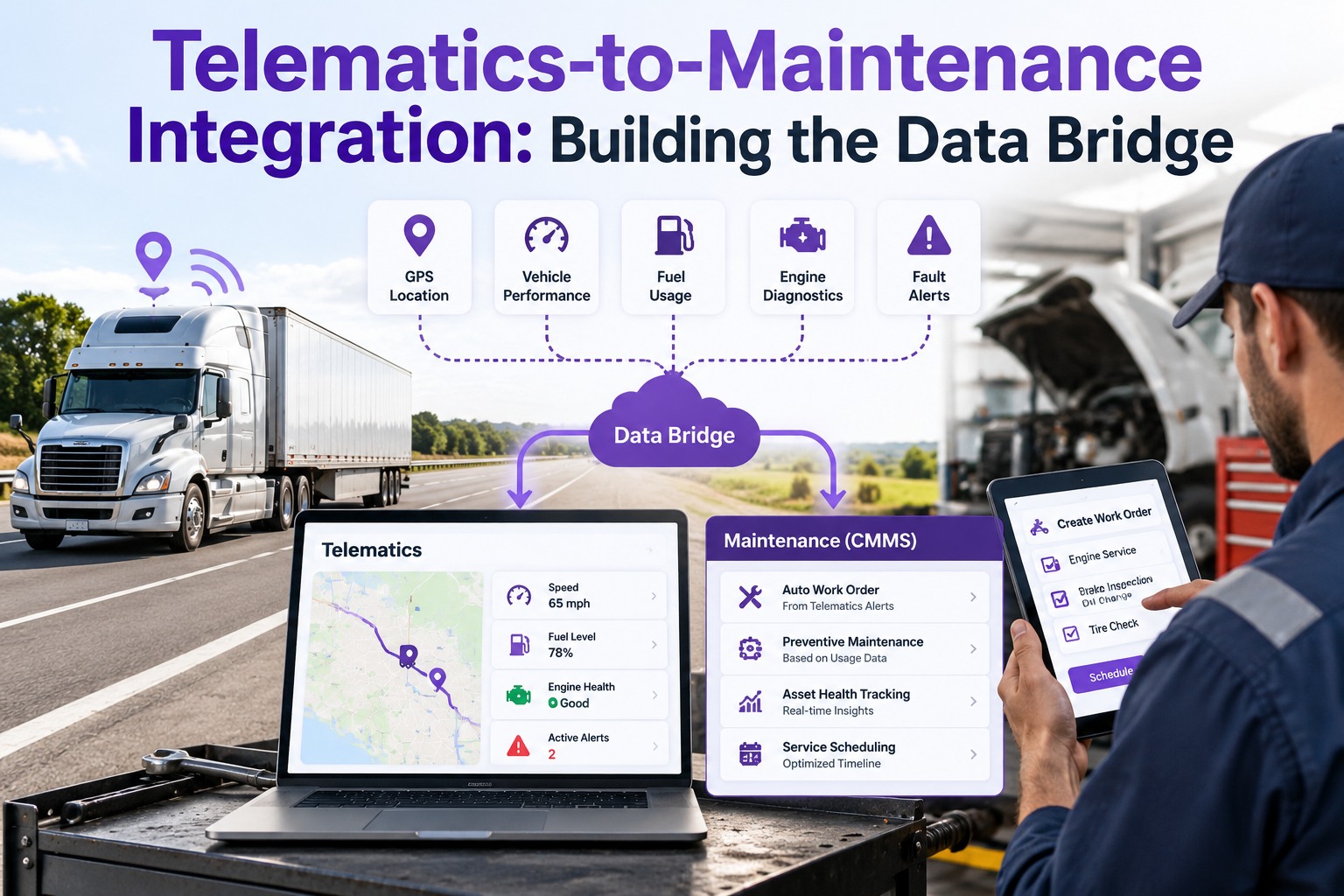
Yes — modern eDVIR platforms include integrations with the major dispatch systems (McLeod, TMW, Truckstop, etc.) and telematics providers (Samsara, Geotab, Motive, PACCAR Connect, Detroit Connect, Mack GuardDog, Volvo Dynafleet, Cummins Connected Diagnostics). J1939 CAN bus data flows from the truck ECM into the eDVIR platform in real time, auto-generating work orders from diagnostic trouble codes. Dispatch board integration means truck status updates flow both directions — eDVIR-based defect locks show up on the dispatch board immediately, and dispatch changes trigger required DVIR reviews before assignment. Integration depth varies by vendor, so ask specifically which systems the platform connects to and whether the integrations are native (built-in) or require middleware. Native integrations produce dramatically better data flow than middleware bridges. Contact our team for an integration compatibility check with your current stack.
Six evaluation criteria separate closed-loop platforms from digital paper. First, native §396.11 / §396.13 / §396.17 compliance workflows — not customized from a generic CMMS. Second, auto work order creation from defect submission, sized to severity, routed to the correct shop queue. Third, dispatch board integration with severity-based truck locks. Fourth, parts inventory sync for ready-to-execute vs parts-waiting work orders. Fifth, PM schedule coordination that bundles repair items with pending PM. Sixth, J1939 telematics ingestion for auto-generated DVIR entries from ECM diagnostic codes. Beyond these, verify FMCSA-formatted audit export (48-hour window met), photo evidence with server timestamp and GPS, three-signature chain enforcement with dispatch lock, mobile-first driver UX (drivers use phones, not shop terminals), and vendor track record on regulatory updates (the platform should update automatically when rules change, like the February 2026 eDVIR final rule). Any platform that fails on more than one of these six is digital paper, not closed-loop eDVIR.
Close the maintenance loop — from driver's phone to shop bay to next dispatch
Auto work order creation. Dispatch board integration. Parts inventory sync. PM schedule coordination. J1939 telematics ingestion. FMCSA §396.11 & §396.13 native. Move from paper's 54% PM compliance to eDVIR's 94%+ within 12 months.