Most fleets run five maintenance activities that never talk to each other. The driver does a pre-trip on paper. The dispatcher assigns the truck. Something breaks mid-route. The post-trip DVIR notes it. The paper hits the shop three shifts later. The repair happens, but nobody links it to the PM schedule — so the same failure hits again next month. Five disconnected steps, five points where information dies. The fleets running the lowest cost-per-truck in 2026 don't have better mechanics or newer trucks. They have one closed-loop workflow — pre-trip flows into post-trip, DVIR flows into repair, repair flows into PM history — and every step feeds the next automatically. This guide is the complete workflow chain: the six links, what happens at each, how they connect, the roles that own each step, and how Truck Inspection & Maintenance runs the whole chain on one platform. Sign up free or contact our team.
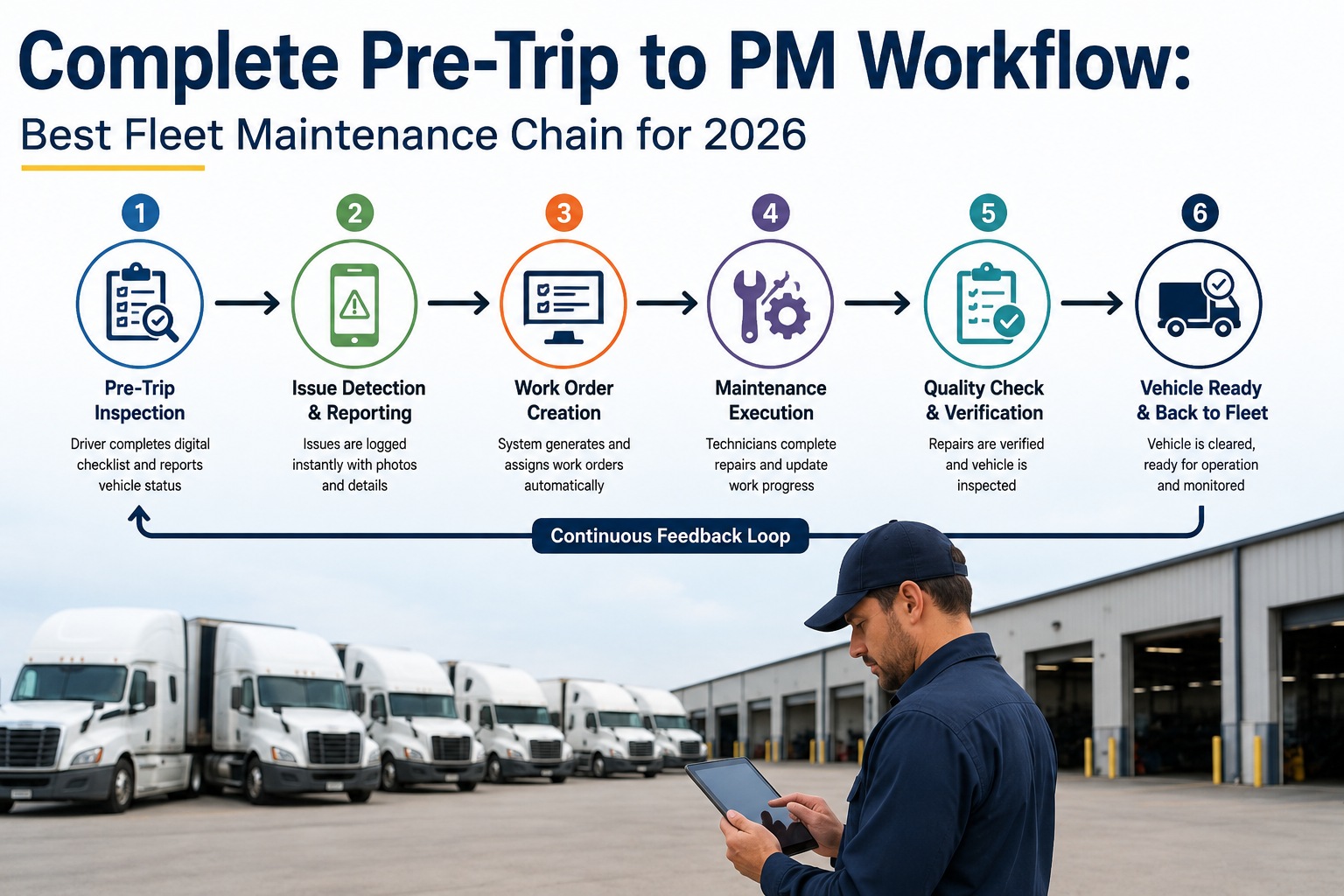
Complete Pre-Trip to PM Workflow — Best Fleet Maintenance Chain for 2026
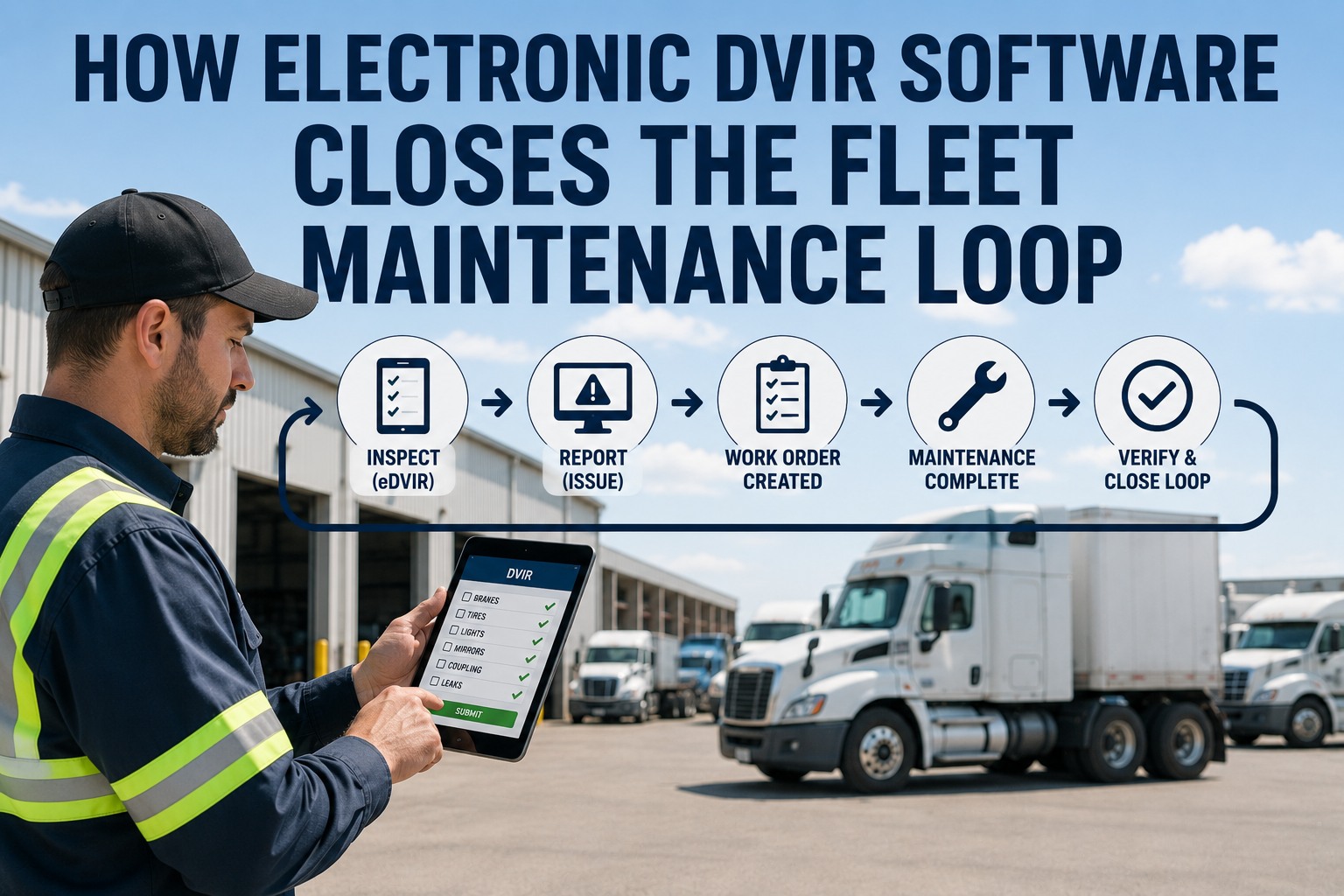
Six steps. One closed loop. No paper handoffs, no dropped defects, no repeat failures.
Why Disconnected Workflows Cost Fleets Money
The gap between five separate activities and one closed loop is not a paperwork problem — it's a P&L problem. Three numbers show why:
On paper-DVIR fleets, roughly 4 out of every 10 defects noted at post-trip never make it to a shop work order. The paper goes into a folder; the truck goes back out tomorrow.
Fleets without a closed loop see the same failure recur on the same truck 3.2× more often than fleets with connected repair-to-PM history. No pattern data = no prevention.
A defect caught at pre-trip and repaired in-shop averages $180. The same defect that escalates to a roadside breakdown averages $2,800 — tow, road service, missed delivery, driver time.
Fleets stuck on paper DVIRs lose money every shift — start a free account and move every driver onto digital in under a week.
The 6 Links of the Chain — What Happens at Each
Each link in the workflow has a specific owner, a specific input, and a specific output that feeds the next link. Break any one connection and the loop stops:
Input: Assigned truck + FMCSA 11-point inspection checklist.
Output: Pass/fail per point, photo evidence on any defect, digital DVIR record with timestamp.
Handoff: Feeds dispatch — a fail routes truck to shop, a pass releases it to route.
Input: Pre-trip DVIR result + route assignment + load details.
Output: Truck released to route OR held for repair. Substitute truck assigned if held.
Handoff: Approved trucks flow to route execution; held trucks flow directly to work-order queue.
Input: Same 11-point checklist + any in-route observations + engine fault codes pulled from telematics.
Output: End-of-day DVIR with defects flagged, photos attached, severity coded (safety-critical / repair-soon / monitor).
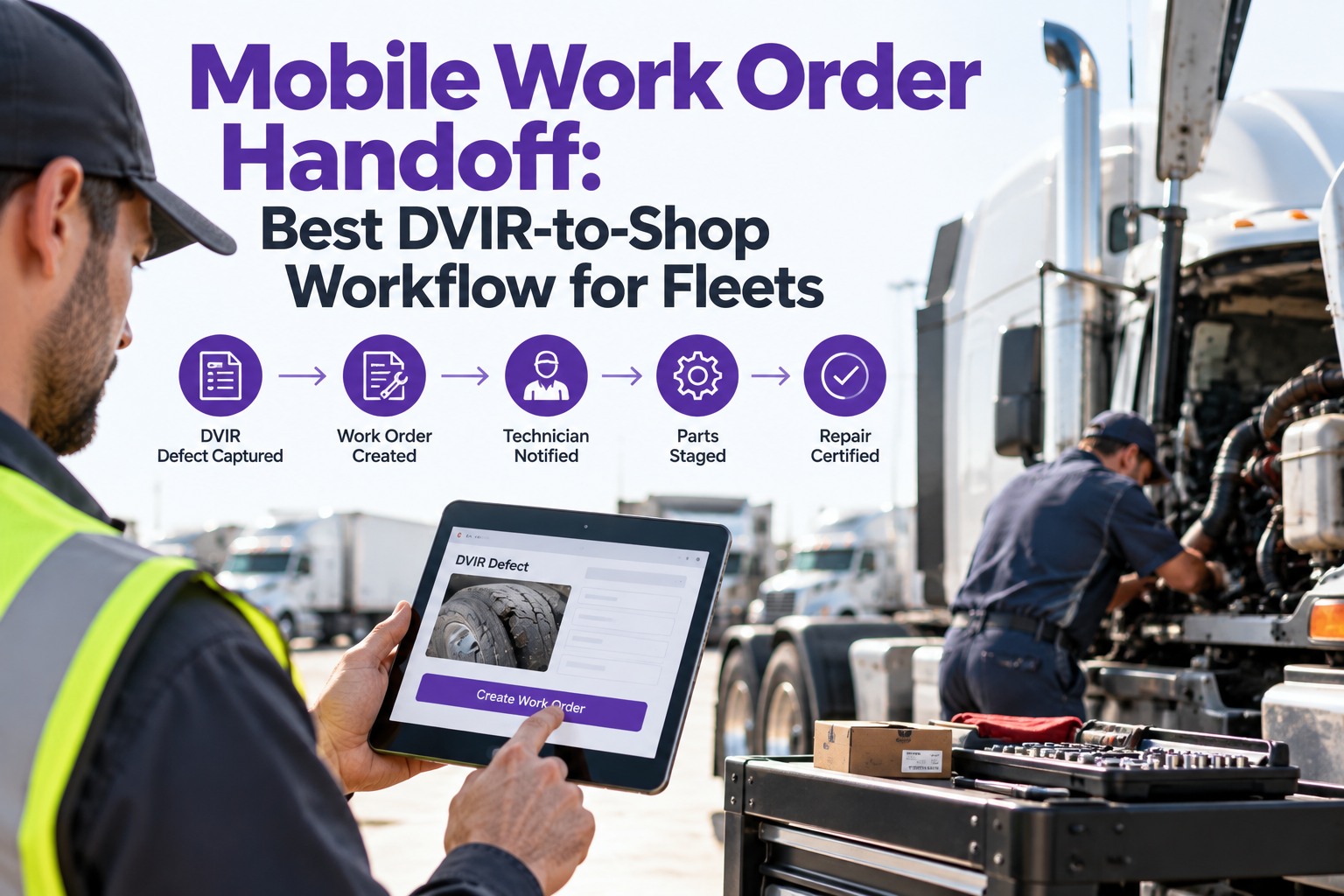
Handoff: Any defect auto-routes to shop work-order queue — no paper transfer, no shift-gap.
Input: Post-trip DVIR defect records with severity codes.
Output: Work order per defect with assigned tech, priority, parts required, estimated hours. Safety-critical items block dispatch until closed.
Handoff: Work orders enter the repair queue with truck grounded (safety) or scheduled (non-safety).
Input: Work order with defect description, parts, priority.
Output: Repair completed with tech notes, parts consumed, labor hours, root cause coded (wear / contamination / operator error / manufacturing).
Handoff: Repair record attaches to the truck's history AND updates PM schedule if the failure hit before its expected interval.
Input: Repair root-cause data + component life expectations + fleet-wide failure patterns.
Output: PM intervals adjusted per truck. Trucks with early failures get tightened intervals; trucks trending well get extended. Trend patterns flag fleet-wide issues.
Handoff: Updated PM schedule feeds back into next pre-trip and every subsequent DVIR — closing the loop.
Not sure which link in your chain is breaking? Contact our team for a free 30-minute workflow audit.
Where Traditional Workflows Break — 5 Common Handoff Failures
Every disconnected workflow fails at one of these five handoffs. Fix these five and the chain closes automatically:
Paper DVIR to Shop
The break: Driver hands paper DVIR to yard supervisor, who puts it in a folder for shop to review tomorrow. Truck rolls out again on today's shift with defect unresolved.
Shift Change Loses Defects
The break: Day-shift driver logs a defect at 3pm; night-shift dispatcher hasn't seen the paper; truck goes out on night route with unresolved issue.
Repair Not Linked to PM
The break: Alternator replaced at 40,000 miles. PM schedule still expects next alternator check at 100,000 miles. No trend data means the pattern never surfaces.
Telematics Codes Ignored
The break: Truck throws SPN 3226 mid-route. Telematics logs it. Nobody looks at telematics until the truck goes into derate. Amber lamp becomes red lamp.
PM Data Never Reviewed
The break: Same truck fails alternator every 40K miles. Nobody sees the pattern because each repair is a separate paper record. Same failure recurs indefinitely.
Compliance Records Scattered
The break: DOT audit requests 90 days of DVIRs. Paper files in three offices, some missing, some illegible. Audit fails on documentation before it starts on trucks.
Every one of these six failure modes disappears when the chain runs on one platform — sign up free and eliminate them this month.
The One Rule That Closes the Loop — Every Defect Must Have a Timestamp on Every Link
The single test of a closed-loop workflow: pick any defect logged in the last 90 days, and you should be able to see the timestamp on all six links — when the driver flagged it, when dispatch saw it, when the shop received it, when the tech started the repair, when the repair closed, and when the PM schedule updated. Any gap in that timeline is a handoff that broke. Fleets that can produce those six timestamps for every defect run the lowest cost-per-truck in the industry. Start a free account and get every defect timestamped end-to-end.
Role & System Matrix — Who Owns What
The workflow works because every role and every data flow has an assigned home. Below is the matrix that top-performing fleets follow:
Need help mapping these roles to your existing team? Get in touch for a role-mapping worksheet built for fleets your size.
The KPI Dashboard — 6 Numbers That Prove the Loop Works
The workflow chain either closes or it doesn't. These six metrics tell you weekly whether it's working:
% of scheduled pre-trips and post-trips submitted on time with photos. Below 90% means drivers skipping the loop.
Median time from defect logged to work order created. Above 24 hours = paper handoff still exists somewhere.
% of logged defects that reach documented repair within their severity SLA. Safety-critical must hit 100%.
Same component, same truck, within 6 months. Ratio above 2× indicates root cause never diagnosed at repair.
Scheduled PMs completed on time. Below 90%, breakdowns climb; below 80%, DOT audit exposure spikes.
DOT roadside inspection violations per 100 inspections. Above 3 = pre-trip loop failing.
Every link, one platform. Pre-trip on driver phones, PMs on shop dashboards, DOT audit-ready records.
Digital DVIR, auto-routed work orders, cycle-triggered PMs, and full compliance archive. Free forever for up to 3 vehicles — create your free account or talk to our fleet team.
Rolling Out the Chain — The 30/60/90 Playbook
You don't need to redesign everything at once. Fleets that succeed roll out the workflow chain in three 30-day phases:
Move pre-trip and post-trip off paper onto driver phones. Set photo requirement on any fail. Train drivers in 30-min shop meetings. Nothing else changes yet — just the DVIR.
Every DVIR defect auto-creates a work order. Shop foreman reviews queue daily, assigns tech, sets priority. Safety-critical defects auto-ground truck until closed.
Every completed repair codes a root cause. Fleet manager reviews weekly trends. PM intervals adjust per truck based on actual failure history. Loop is now closed.
Day 1 of the 90-day rollout starts with a free account and digital DVIR — create yours in 10 minutes and kick off phase one today.
Frequently Asked Questions
What is a closed-loop fleet maintenance workflow?
A closed-loop workflow is one where every step feeds the next automatically — pre-trip DVIR flows into dispatch, dispatch flows into route execution, post-trip DVIR flows into shop work orders, repairs flow into PM history, and PM history flows back into the next pre-trip. No paper handoffs, no shift gaps, no lost defects. The test is whether you can trace any defect end-to-end with timestamps on all six links. Fleets running the closed loop see 3× fewer repeat failures and 42% higher defect capture rates than fleets running disconnected activities.
What are the 6 links in the complete fleet maintenance chain?
Pre-trip inspection (driver, 15 min), dispatch decision (dispatcher, 30 sec), post-trip inspection (driver, 10 min), DVIR routing to shop (foreman, 5 min per defect), repair execution (tech, varies), and PM schedule update (fleet manager, automated). Each link has one owner, one defined input, and one defined output that feeds the next. The workflow only works when all six connect — break any one and the loop opens back up into disconnected activities.
What's the biggest cause of missed defects on fleet trucks?
Paper DVIR handoffs. On paper-based fleets, roughly 4 out of 10 defects noted at post-trip never make it to a shop work order — the paper goes into a folder, the truck goes back out tomorrow, and the defect either escalates or gets noted again the next day. Digital DVIR with auto-routing to work orders eliminates this failure mode entirely because there is no folder to lose the paper in. A defect logged on a driver's phone appears on the shop foreman's dashboard within seconds.
How long does it take to roll out a complete workflow chain?
90 days for a full rollout in three 30-day phases. Days 1–30: digitize the DVIR (drivers move off paper onto phones). Days 31–60: connect defects to work orders (every DVIR defect auto-creates a work order routed to shop). Days 61–90: close the loop to PM (repairs code root causes, PM schedules auto-adjust). Fleets that try to do all three at once typically fail — the phased approach lets drivers, techs, and managers absorb each change before the next arrives.
What KPIs prove a workflow chain is actually working?
Six numbers on a weekly dashboard: DVIR submission rate (target 95%+), defect-to-work-order time (target under 4 hours), defect closure rate (target 85%+, 100% for safety-critical), repeat failure ratio (target under 1.5× within 6 months), PM compliance rate (target 95%+), and CSA violations per 100 roadside inspections (target under 1.5). Any KPI drifting outside target for two consecutive weeks means investigate the specific handoff that's failing, not the workflow as a whole.
How does Truck Inspection & Maintenance run the full workflow chain?
Truck Inspection & Maintenance runs all six links on one platform. Pre-trip and post-trip DVIRs on driver phones with photo verification and FMCSA 11-point compliance. Defects auto-route to shop foreman's work-order queue with severity coding. Techs work orders on mobile with parts scanning and root-cause coding. Fleet manager dashboard shows real-time KPIs and per-truck repair history. DOT-ready DVIR archive for audit prep. Free forever for up to 3 vehicles. Sign up in 10 minutes or contact our team for larger fleets.
Fleets don't lose money on bad mechanics. They lose money on broken handoffs.
Close the loop on driver phones and shop dashboards, one platform, free forever for up to 3 vehicles. No hardware, no contract, no credit card.