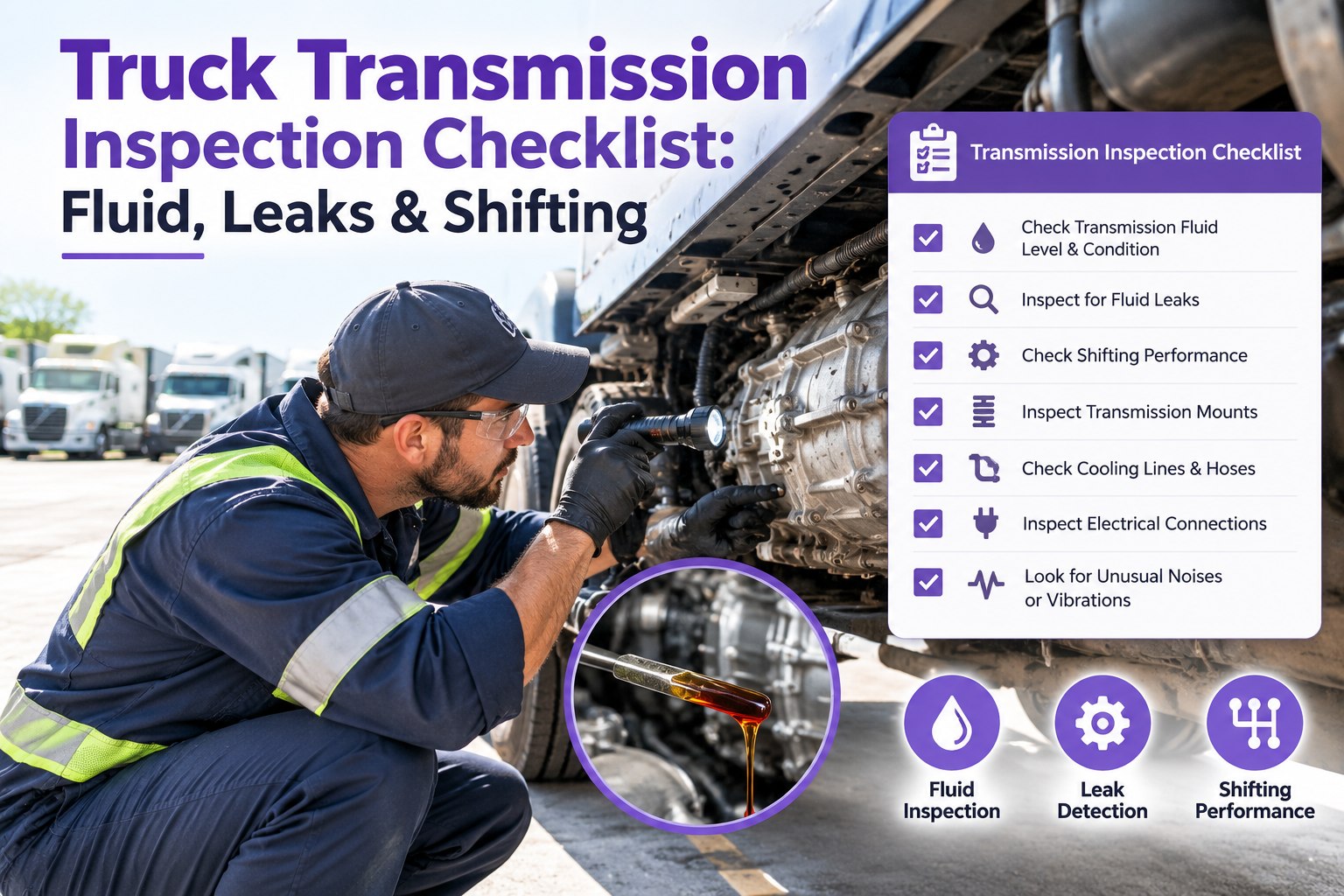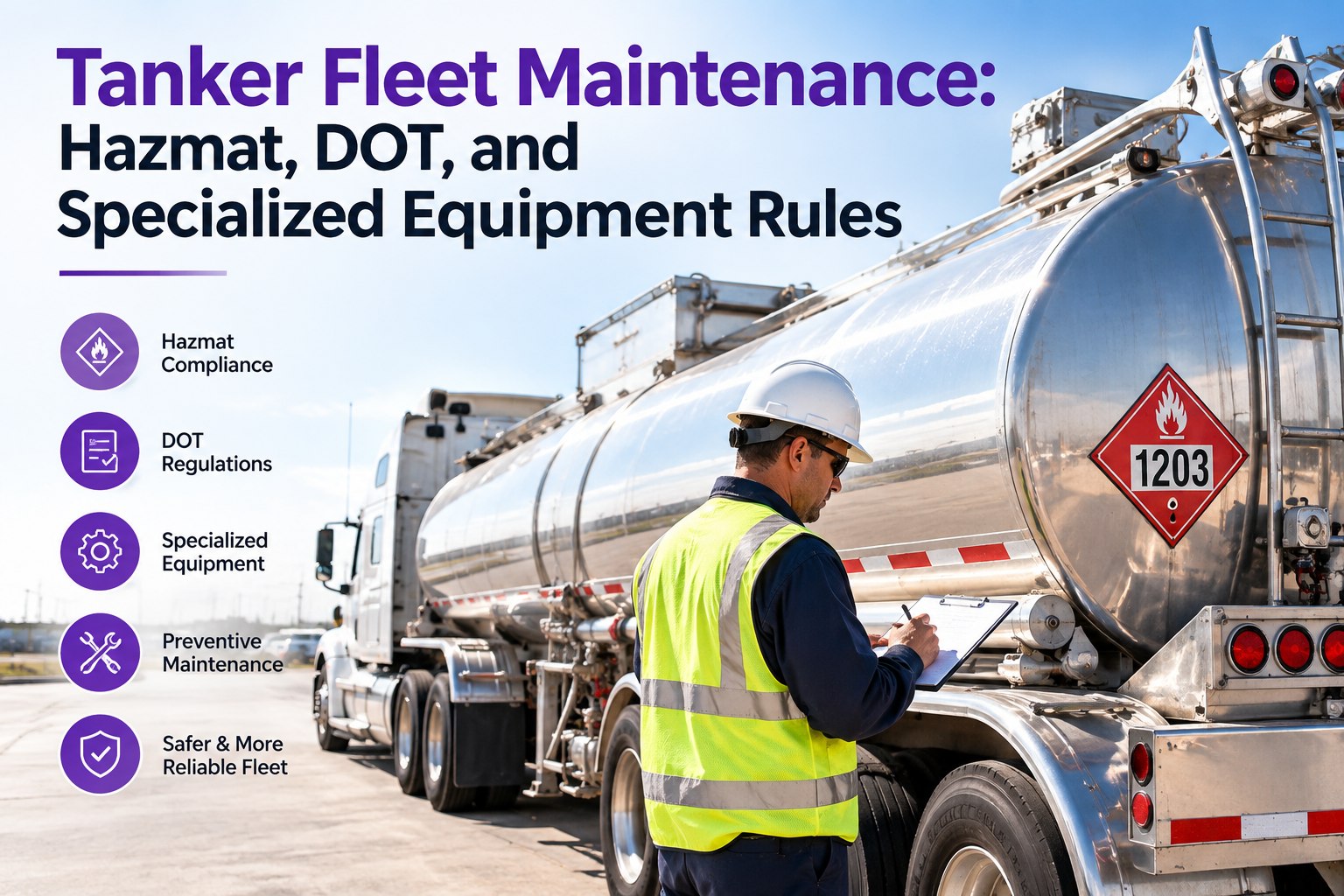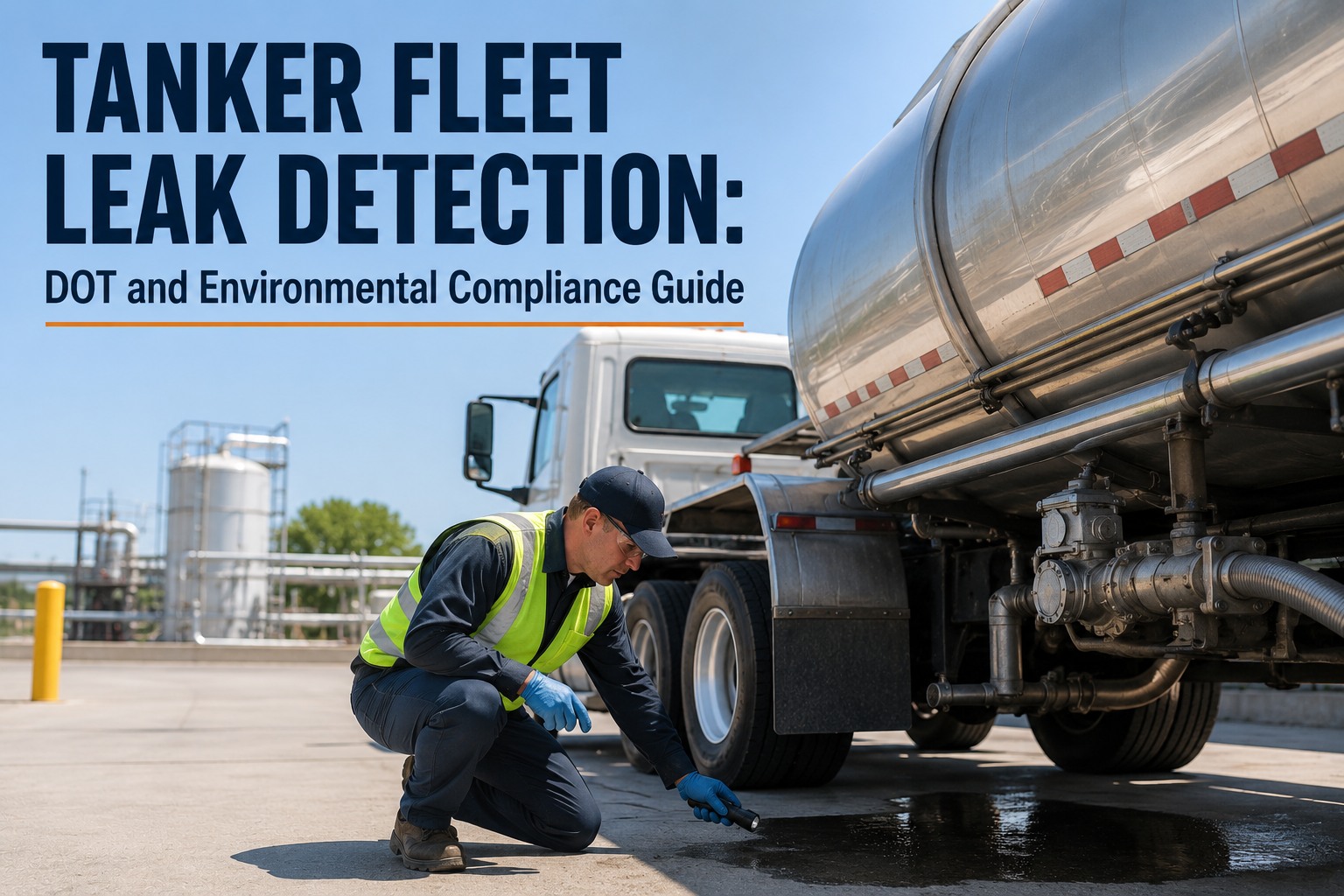
A dry-van fleet detects a fluid leak and files a DVIR entry. A tanker fleet detects a fluid leak and starts a 12-hour countdown clock to the National Response Center. The compliance surface is completely different. Under 49 CFR §171.15, any tanker carrier "in physical possession" of hazardous material must call the NRC hotline (1-800-424-8802) within 12 hours of an incident meeting the reportable threshold — and follow up with a written DOT Form F 5800.1 within 30 days under §171.16. EPA layers on separately under 40 CFR §302.6, requiring notice for any release meeting a hazardous-substance reportable quantity. And PHMSA enforces cargo tank integrity under §180.407 with six required tests (external visual, internal visual, pressure retest, leakage test, thickness testing, lining inspection) each on their own interval, each stamped on the tank. Miss a due date on any one and the tank cannot legally carry hazmat freight. Fines run up to $78,376 per day per violation. And unlike a dry-van fleet where a leak is a maintenance issue, a tanker leak is a maintenance issue plus a regulatory event plus a potential environmental release requiring three parallel workflows to execute correctly on tight timelines. This guide walks the full tanker-specific leak detection program — the classification, the reporting protocols, the six PHMSA tests, and the workflow that keeps tanker fleets ahead of both DOT and EPA. Sign up free for Truck Inspection & Maintenance today — no credit card required to run leak detection with §171.15 timers and §180.407 tracking built in, or contact our team for a tanker compliance program review configured to your commodity mix and tank specs.
Tanker Fleet Leak Detection: DOT and Environmental Compliance Guide
A tanker leak isn't just a maintenance issue — it's a 12-hour NRC clock, a 30-day PHMSA report, and a potential EPA release event running in parallel.
Three Regulators, Three Overlapping Frameworks
Tanker fleets operate under three federal regulatory frameworks that overlap on leak detection. Understanding what each requires — and where they intersect — is the compliance foundation.
The 4 Tanker Leak Severity Tiers
Not every tanker leak triggers reporting. The regulatory workflow branches at the severity level. Fleets that classify leaks correctly at detection avoid two failure modes: over-reporting (crying wolf, wasting regulator time) and under-reporting (missing the threshold and inheriting fines).
The 6 PHMSA Cargo Tank Tests
49 CFR §180.407 defines six required tests for every specification cargo tank. Each has its own interval, its own qualified inspector requirement, and its own permanent marking on the tank. Miss any one due date and the tank cannot legally carry hazmat.
| Test Type | Interval | Inspector Requirement | What Gets Checked |
|---|---|---|---|
| External Visual | 12 months | Registered Inspector | Shell, heads, attachments, piping, markings, upper coupler |
| Internal Visual | 1-5 years (spec-dependent) | Registered Inspector | Interior surface for corrosion, cracks, distortion |
| Pressure Retest | 1-5 years (spec-dependent) | Registered Inspector | Hydrostatic or pneumatic test to design pressure |
| Leakage Test | 12 months | Registered Inspector | Tank + piping tested at operating pressure for external leaks |
| Thickness Testing | 2 years (unlined MC/DOT) | Registered Inspector | Shell wall thickness via ultrasonic — detects corrosion loss |
| Lining Inspection | 12 months (lined tanks) | Registered Inspector | Interior lining integrity — critical for corrosive commodities |
The 12-Hour Incident Reporting Workflow
When a Tier 4 reportable release happens, the workflow runs on a strict clock. Every minute of delay narrows the compliance window. Here's the sequence that gets it right.
Every tanker leak triggers the correct workflow — automatically
Four-tier severity classification built into the DVIR. §171.15 12-hour countdown timer starts at incident. §180.407 six-test tracking per tank with interval alerts. NRC number and Form F 5800.1 pre-filled. Complete audit trail for PHMSA and EPA production.
Leak Detection by Tanker Type
Different tanker types face different leak vulnerabilities and different regulatory scrutiny. Match the detection program to the tank type.
What Tanker Fleets Get Wrong Most Often
Five failure patterns account for the majority of PHMSA violations and NRC late-notice citations against tanker fleets. Knowing them in advance is the fastest way to avoid them.
Frequently Asked Questions
49 CFR §171.15 requires anyone in physical possession of a hazardous material to notify the National Response Center at 1-800-424-8802 within 12 hours of a reportable incident. The clock starts at the incident occurrence, not at discovery — which is a critical distinction. A leak that began at 2 AM and was discovered at 3 PM may already be past the window. Reportable incidents under §171.15(b) include: any fatality directly resulting from hazmat, hospitalization of any person, evacuation of the general public for 1+ hour, closure of a major transportation artery for 1+ hour, fire/explosion/reaction of hazmat, marine pollutant release above RQ, radioactive material release, or infectious substance release. The notice must include reporter identity, incident location, commodity class and name, quantity, injuries, and continuing danger status. NRC issues an incident number — record it, because the follow-up written report under §171.16 references it.
External visual inspection (12-month interval), internal visual inspection (1-5 year interval depending on tank specification), pressure retest (1-5 year interval, hydrostatic or pneumatic to design pressure), leakage test (12-month interval, tank and piping tested at operating pressure), thickness testing (2-year interval for unlined MC/DOT tanks, ultrasonic measurement of shell wall thickness to detect corrosion loss), and lining inspection (12-month interval for lined tanks, interior lining integrity critical for corrosive commodities). Each test requires a Registered Inspector whose credential PHMSA verifies. Each test result is stamped as a permanent marking on the tank. Miss any single test interval and the tank cannot legally carry hazmat freight until the test is completed. Three events trigger immediate re-testing regardless of interval: any damage that may affect the tank's ability to hold its lading, any tank out of hazmat service for a year or more, and any leak discovered during operation. Interval-based testing is the floor, not the ceiling.
No — only Tier 4 reportable releases trigger the 12-hour NRC notification. The classification workflow: Tier 1 (maintenance leak on non-hazmat fluid like hydraulic oil or coolant) requires only standard DVIR entry, no regulatory notice. Tier 2 (cargo leak with no release — product contained inside valve or fitting) requires driver stop, tow to shop, and PHMSA leakage test under §180.407 before return to service, but no reporting. Tier 3 (release below EPA reportable quantity) requires containment, cleanup, and 30-day written PHMSA report under §171.16 — but no immediate NRC call. Tier 4 (release meeting EPA RQ or triggering any §171.15(b) criterion — fatality, hospitalization, evacuation, major artery closure, fire, radioactive, infectious substance) triggers the full workflow: immediate NRC call within 12 hours, followed by DOT Form F 5800.1 within 30 days, plus state agency and insurance notifications. Misclassifying between tiers is one of the top-5 tanker compliance failures. Try the platform free to see tier classification built into the DVIR.
DOT (via PHMSA) regulates the transportation event under 49 CFR Part 171 — the vehicle, the driver, the shipping papers, the packaging integrity. EPA regulates the environmental release under 40 CFR §302.6 — the substance in the environment regardless of how it got there. The two frameworks overlap on tanker leaks because a transportation incident that releases product to the environment triggers both. The convenient part: both regulators use the same National Response Center hotline (1-800-424-8802), so a single call can satisfy both immediate notification requirements — but only if the caller provides the specific data elements each regulator needs (DOT wants class/proper shipping name/packaging spec; EPA wants CERCLA hazardous substance identification and quantity vs RQ). After the NRC call, the two paths diverge: DOT requires the 30-day PHMSA Form F 5800.1, EPA follow-up may involve state agencies and CERCLA §103 written notice to the SERC/LEPC. Many state agencies have parallel requirements adding a third notification chain.
Up to $78,376 per day per violation under current PHMSA penalty schedules. Fines apply per-day and per-violation, meaning a single incident with multiple violations (late notice + missing test + inadequate placarding) can accumulate rapidly. Common violation categories include: late NRC notification (past 12 hours), missing cargo tank test interval (§180.407 violation, tank cannot legally haul), Registered Inspector credential lapse (invalidates the test), EPA reportable quantity misclassification (§302.6 violation), missing 30-day written report after NRC call (§171.16 violation), and improper loading/unloading procedures (§177.834 violation). Beyond direct fines, tanker leak violations feed FMCSA's CSA Hazmat BASIC scoring which affects insurance rates, customer contract eligibility, and can trigger operating authority reviews for repeat offenders. State agency fines and cleanup cost liability add on top of federal penalties. A single Tier 4 incident with late reporting often produces $30,000-$150,000+ in combined federal, state, and cleanup exposure before any civil litigation.
No — food-grade tankers (milk, juice, edible oils, water) are not subject to 49 CFR §171.15 hazmat incident reporting because they don't carry hazardous materials. But they operate under a parallel regulatory framework: FDA and USDA regulate food safety, sanitation, and cross-contamination. A leak on a food-grade tanker doesn't trigger NRC notification, but it may trigger a food safety recall event with equally severe business consequences — customer contract loss, brand damage, potential FDA enforcement action. Food-grade tankers still require the six §180.407 tests if the tank specification requires it (many food tanks are DOT 407 spec vehicles that carry non-hazmat products but need hazmat-tank testing anyway). The base FMCSA rules apply identically: DVIR, annual DOT inspection, N-endorsement CDL. Food-grade tanker fleets should build leak detection programs mirroring hazmat protocols — same detection speed, same containment discipline — because the operational and reputational consequences of a food safety incident often exceed the direct penalties of a hazmat violation. Contact our team for a food-grade tanker program template.
Three specific ways. First, incident-time capture: continuous tank monitoring and driver mid-route inspection protocols close the "clock starts at incident, not discovery" gap that causes most late-notice violations. A leak detected at hour 3 stays inside the 12-hour NRC window; a leak discovered at hour 14 doesn't. Second, six-test interval tracking: digital systems track each §180.407 test independently per tank, alert 30/60/90 days before expiration, cross-verify Registered Inspector credentials at test time, and produce PHMSA-formatted audit records instantly. Manual spreadsheets miss expirations routinely — the six-interval matrix is hard to track without automation. Third, workflow enforcement: digital DVIR captures the tier classification at the point of detection, auto-generates the NRC notification checklist, pre-fills DOT Form F 5800.1, and tracks the 30-day countdown for written report submission. Fleets running paper-based systems typically produce 60-70% audit-ready incident documentation; fleets on purpose-built platforms produce 95%+ audit-ready documentation with dramatically shorter response times when incidents occur.
Never miss a 12-hour clock, a 30-day report, or a §180.407 interval again
Four-tier leak severity classification built into DVIR. §171.15 12-hour countdown timer at incident. §180.407 six-test tracking with Registered Inspector credential verification. NRC notification checklist and Form F 5800.1 pre-fill. Full audit trail for PHMSA, EPA, and state agency production.