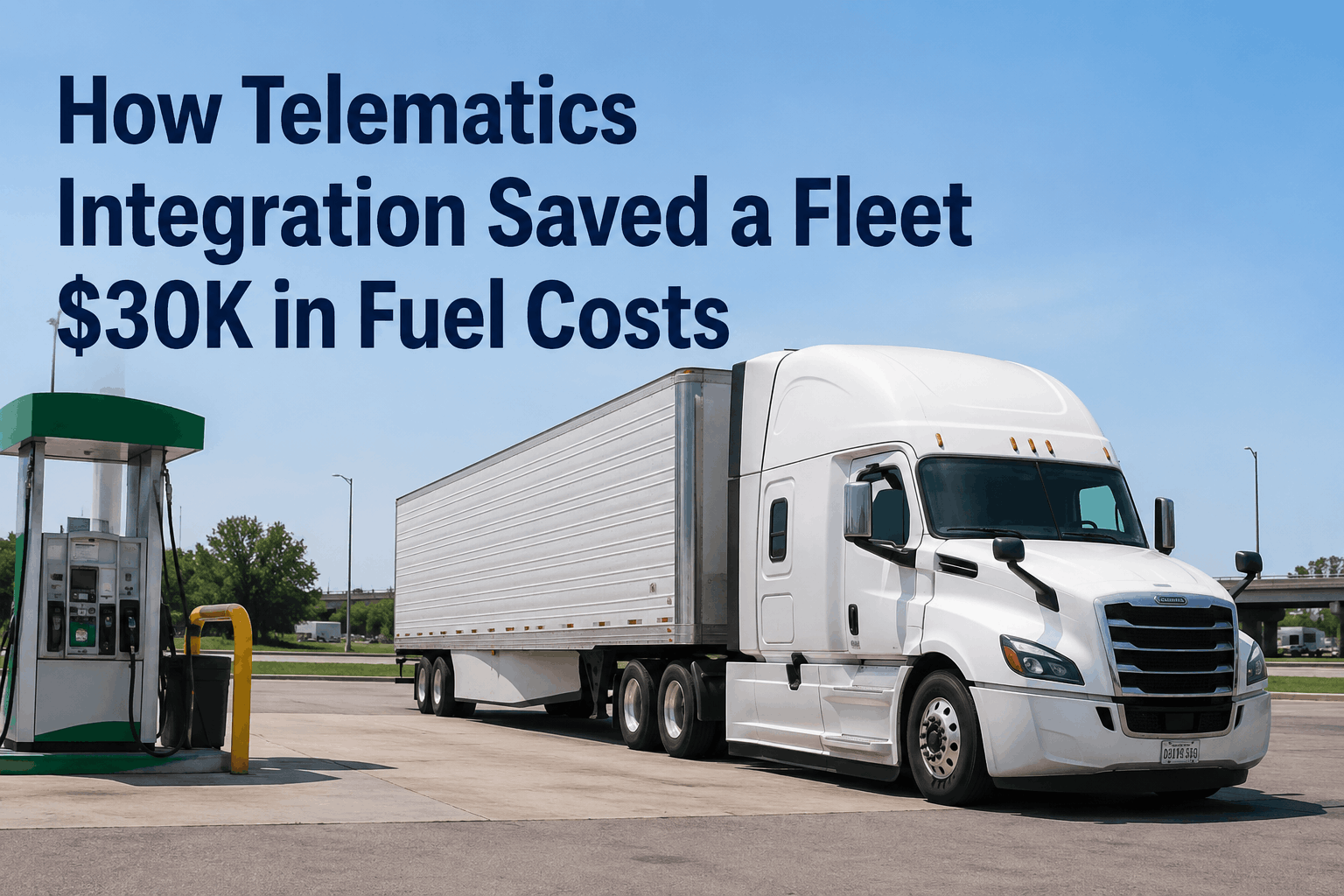
Discover how a 64-vehicle regional fleet eliminated $30,000 in annual fuel waste within twelve months by integrating telematics data directly into their fleet management workflow. This case study reveals how a mid-sized distribution operation running 78 drivers across two terminals turned raw GPS pings, idle alerts, and route data into a structured cost-reduction program—without buying new trucks, hiring more dispatchers, or asking drivers to work harder. With diesel averaging $4.80 per gallon in 2026 and fuel consuming 21–30% of total operating costs across the industry, every gallon burned at a stoplight or wasted on a longer route hits the bottom line directly. Learn how three connected levers—idle-time reduction, route optimization, and driver behavior coaching—combined to deliver measurable savings that paid for the entire telematics integration in under seven months.
Why Fuel Costs Were Bleeding the Budget
Before integration, this fleet treated fuel as an uncontrollable line item—a cost of doing business that fluctuated with the market. The reality was different. Most fuel waste was happening inside the fleet, not at the pump. Contact Support to discuss your fuel visibility gap, or Start Free Trial to start tracking fuel data within 24 hours.
Where the Fuel Was Actually Going
A 90-day audit revealed the silent leaks no one was watching
The Integration Approach
The fleet already had GPS hardware installed—it was generating data, but the data lived in one platform while maintenance, fuel cards, and dispatch lived in another. Telematics integration meant connecting these data streams into a single workflow where every signal triggered a clear action.
Lever One: Killing Idle Time
Idle time was the single biggest fuel leak—and the easiest to fix. The Department of Energy estimates a heavy-duty truck burns about 0.8 gallons per hour at idle. Across 64 vehicles idling an average of 3.2 hours per day, this fleet was burning roughly 164 gallons every single day on stationary engines. Start Free and start measuring your idle waste today.
Automated Idle Detection & Driver Alerts
Engine-on stationary thresholds set at 3 minutes for delivery stops, 5 minutes for loading zones
Lever Two: Routing Backed by Real Data
Dispatchers had been routing trucks from memory and habit. With telematics-integrated routing, the system used actual GPS data—real traffic patterns, real stop times, real delivery densities—to plan smarter sequences and group nearby stops together.
GPS-Informed Route Optimization
Daily route planning uses historical telematics data to minimize miles, sequence stops, and avoid known congestion windows
- Stops sequenced by ZIP code or salesperson territory
- No accounting for time-of-day traffic patterns
- Backtracking common between zones
- One-size-fits-all 8-hour route templates
- Avg route distance: 187 miles
- Stops clustered by actual travel-time data
- Routes adjusted around recurring traffic windows
- Cross-zone reassignment when geography justifies it
- Route length scaled to driver and density
- Avg route distance: 162 miles
Lever Three: Coaching Drivers With Data
Driver behavior accounts for up to 33% of fuel economy variance between trucks operating identically. Telematics made this invisible variable visible—turning generic safety talks into specific, personal coaching conversations grounded in each driver's own data. Start Free Trial to give your drivers individual fuel scorecards.
Want to find your own fuel savings?
Connect your existing GPS hardware to our platform and turn raw location pings into measurable diesel savings.
The $30K Breakdown
Twelve months after full integration, the accounting was straightforward. Each lever delivered measurable savings that compounded into a single, verifiable number—roughly $469 per vehicle per year, well within the industry-benchmark range of $3,200 per vehicle that integrated telematics fleets typically achieve at higher mileage levels.
Wins That Didn't Show Up On The Fuel Line
Twelve-Month Comparison Table
| Metric | Before Integration | After Integration | Change |
|---|---|---|---|
| Fleet average MPG | 6.4 | 7.3 | +14% |
| Avg daily idle per truck | 3.2 hrs | 1.1 hrs | −66% |
| Avg route length | 187 mi | 162 mi | −13% |
| Hard braking events / week | 412 | 198 | −52% |
| Speeding minutes / week | 1,640 | 525 | −68% |
| Annual fuel spend | $612,000 | $582,000 | −$30K |
What Made The Integration Actually Work
Telematics hardware on its own changes nothing. Plenty of fleets have GPS data they never act on. What turned this fleet's data into dollars was the discipline around using it—four practices that any operation can copy.
Data Hits A Workflow, Not An Inbox
Every alert triggered a clear next step—an in-cab chime, a supervisor notification, a coaching agenda item. Data that doesn't drive action is just noise.
Drivers Saw Their Own Scores First
Before any manager review, drivers received their own scorecards. Most self-corrected without being asked. Transparency drove behavior more than discipline ever did.
Existing Hardware, New Workflow
The fleet didn't replace its GPS units. The platform was hardware-agnostic, layering analytics over the devices already on every truck—zero new install cost.
Weekly Cadence, Not Quarterly Reviews
Supervisors reviewed scorecards weekly. Quarterly reviews are too far from the behavior to coach effectively. Tight feedback loops drove the speed of change.
We had the GPS data the whole time. What changed was finally connecting it to the rest of our operation—maintenance, dispatch, fuel cards, driver reviews. The first month we ran integrated reports, we found $4,800 in fuel card transactions that didn't match a truck's location. That alone paid for the first quarter of the platform. Twelve months in, fuel is down $30K, drivers are coaching themselves off the scorecards, and we're not buying any extra trucks to do the same work.
Turn Your GPS Data Into Real Fuel Savings
If your fleet has telematics hardware but still treats fuel as an uncontrollable cost, the gap isn't your trucks—it's your workflow. Connecting GPS data to maintenance, dispatch, and driver coaching is what turns location pings into measurable dollars saved.
Ready to Find Your Own $30K?
See how our platform connects your existing telematics into a single workflow that drives idle reduction, smarter routing, and data-backed driver coaching—starting in week one.