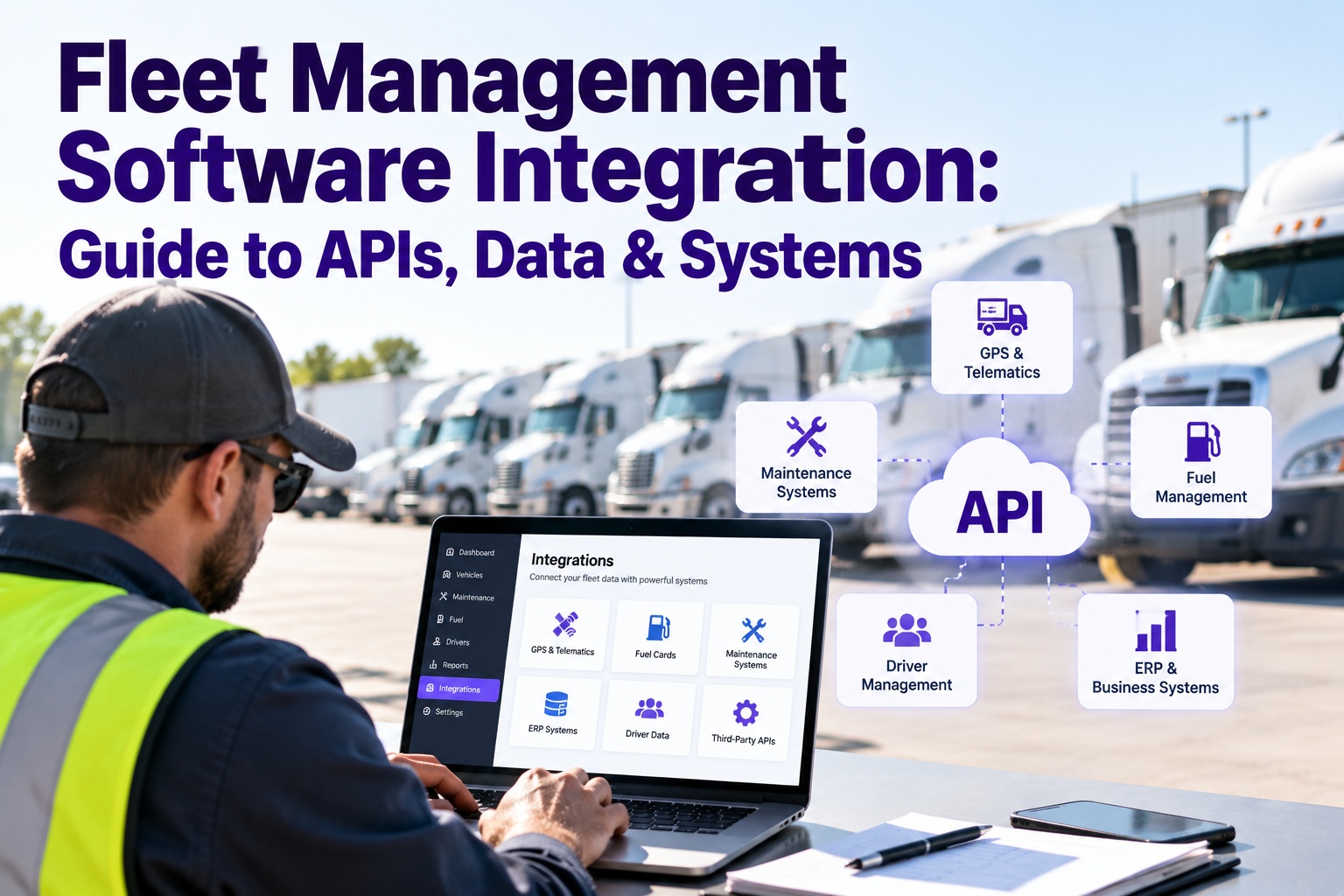
Every fleet manager has watched the same thing happen. Fuel card transactions arrive as a monthly CSV that somebody has to reconcile against telematics GPS pings to catch fraud. Engine fault codes flash on the driver's dashboard and never make it to the mechanic's work queue. HOS violations pile up in the ELD system while the dispatcher is still assigning loads to the truck that just went out of service. Parts invoices come in three formats from three different vendors, get retyped into accounting one line at a time, and take four days to hit the P&L. Every one of these problems is an integration problem, and every one of them has been solved by fleets that treated their CMMS not as a maintenance tool but as the central hub of a connected fleet tech stack — a system whose value comes from what it plugs into, not just what it does on its own. Industry data is unambiguous: fleets running integrated stacks report 25–40% reductions in accident rates, 10–15% fuel savings, and 80% reductions in fuel card fraud when GPS-validated transactions replace paper reconciliation. Fleets running disconnected systems report the opposite — manual data entry that consumes an FTE per 100 vehicles, delayed maintenance response times that turn Tier 2 defects into Tier 1 emergencies, and fault codes that generate nothing but a warning light nobody ever saw. This checklist walks through the 20 integrations every serious fleet software stack should support, organized by category — telematics and ELD, fuel and expense, parts and vendors, accounting and finance, dispatch and driver, and compliance and safety — with the specific data flow each connection enables, the ROI signal to watch for, and how the free Truck Inspection & Maintenance app ships with all 20 categories supported out of the box. Sign up free for up to 3 vehicles or contact our team for larger fleet rollouts.
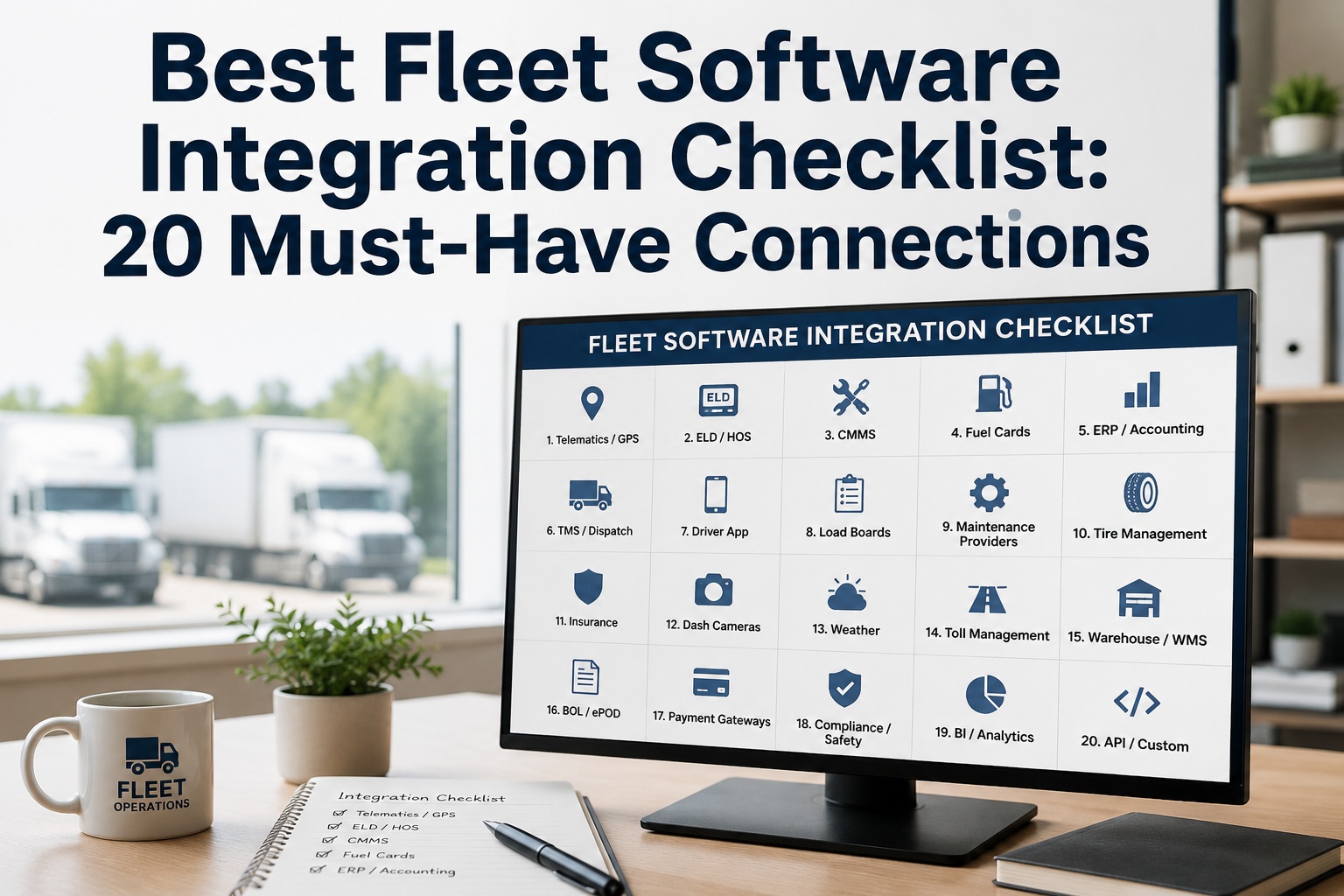
Best Fleet Software Integration Checklist — 20 Must-Have Connections
Your CMMS is only as good as what it plugs into. Here are the 20 integrations that separate a connected fleet from a data-silo mess.
Why Integrations Matter More Than Features
Modern fleet software wins or loses on connections, not features. Three data points every fleet manager evaluating platforms should know:
with GPS-validated fuel transactions instead of paper reconciliation — the difference between catching the wrong-pump purchase in real time versus finding it four weeks later in a statement.
from fleets running predictive maintenance stacks that automatically route J1939 DTCs from telematics feeds into CMMS work orders before the defect becomes a breakdown.
on unintegrated fuel systems — nearly one dollar in five never reaches its intended purpose because the data lives in silos nobody reconciles.
The 20 Must-Have Integrations by Category
Every integration below carries a category badge, a specific data-flow description, and the ROI signal to watch for. Print this checklist and score every fleet platform on your shortlist against all 20 points:
GPS Telematics Feed
Real-time vehicle location, speed, and route history from Geotab, Samsara, Motive, Verizon Connect, or Ford Pro. Enables geofencing, arrival estimates, and route-vs-plan analysis.
Engine Diagnostics (J1939/OBD-II)
Live DTC codes from the vehicle CAN bus routed directly into CMMS work order queue. Turns dashboard warning lights into scheduled shop time — automatically.
ELD Hours of Service
Driver HOS clocks synchronized into the PM scheduler. PMs slot into legal off-duty windows automatically. Dispatch sees who is legal to roll before load assignment.
Driver Behavior Scoring
Harsh braking, rapid acceleration, speeding, idling — telemetry-derived driver scores flow into coaching workflows and insurance premium negotiations.
Fuel Card Transaction Feed
WEX, Comdata, Fleet One, Voyager, or Coast card transactions flow in near real-time. Every gallon, every station, every driver — reconciled automatically against telematics location.
MPG & Fuel Efficiency Tracking
Per-truck fuel economy computed from fuel card gallons ÷ telematics miles. Flags outliers by driver, route, and vehicle for coaching or diagnostic follow-up.
IFTA Fuel Tax Reporting
Quarterly IFTA jurisdiction miles + gallons reports auto-generated from combined telematics + fuel card data. One-click filing instead of manual state-by-state spreadsheet math.
Toll & Citation Data
PrePass, Bestpass, and tolling authority feeds push toll transactions and citations into the vehicle cost ledger. No more surprise chargebacks at end of month.
Parts Catalog Punch-Out
Direct API to NAPA, FleetPride, Napa Prolink, or O'Reilly Fleet — search inventory, check price, place orders from inside the work order screen. No tab-switching.
Vendor Invoice Import
Third-party shop invoices auto-import via EDI or supplier portal. Line items map to work orders. Vendor scorecards update automatically on cost, comeback rate, and turnaround.
Tire Vendor Data
Bridgestone, Michelin, Goodyear fleet portal integration — tire mounts, retreads, casings tracked at wheel position. Extends tire life through pattern-based analysis.
Parts Inventory Sync
Two-way sync between CMMS parts inventory and shop management system. Reserve, consume, and reorder without dual entry. Min-max levels trigger auto-PO generation.
Accounting System Export
QuickBooks Online, Sage, Xero, NetSuite, SAP — work orders, purchase orders, parts usage, and vendor invoices flow directly into the GL. No CSV exports, no manual reconciliation.
Cost-Per-Mile Analytics
Combined fuel + maintenance + insurance + tolls + depreciation per vehicle per mile. The single most important number for cycle-out decisions and rate quoting.
Payroll & Driver Pay Integration
Miles driven, load pay, detention, per diem flow from dispatch and ELD into payroll systems (Gusto, ADP, Paychex). Drivers get paid accurately without dispatcher spreadsheet gymnastics.
Corporate Card / AP Integration
Corporate credit cards, ACH vendor payments, and accounts payable workflows integrated so shop and PM spending flows into approval + payment automatically.
TMS / Dispatch Integration
McLeod, TMW, Turvo, or in-house TMS push load assignments; CMMS pushes vehicle availability (out-of-service, in PM, ready). Dispatch never assigns a truck in the shop.
Driver Qualification File
CDL expiration, medical card expiration, drug/alcohol test dates, MVR reports — flow into a single driver qualification dashboard with automatic renewal alerts.
Dash Cam / Video Telematics
Samsara AI Dash Cam, Motive, Lytx event video correlated with accident records, driver coaching, and insurance claims. Video evidence reduces false-claim liability significantly.
Insurance Telematics Feed
Approved insurance carriers accept telematics-derived safety scores for premium calculation. Direct feed reduces renewal negotiation to a data comparison instead of a story.
The API vs CSV Distinction
Not all integrations are equal. Real-time API connections keep data flowing continuously; spreadsheet exports and CSV downloads always lag reality by days and introduce human error. When evaluating any fleet platform, ask specifically whether each integration is API-based or CSV-based — the "we integrate with QuickBooks" claim covers everything from real-time bidirectional sync to a nightly CSV drop that requires manual import. The delta between the two determines whether the integration is worth using or worth ignoring.
Every category covered. Every connection API-based. No CSV workarounds.
Truck Inspection & Maintenance ships with native support for all 20 integration categories on this checklist. Telematics from Geotab, Samsara, Motive, Verizon, Ford Pro. Fuel cards from WEX, Comdata, Voyager, Coast, Fleet One. Accounting to QuickBooks, Sage, Xero, NetSuite. Parts vendors, dispatch systems, insurance carriers, driver qualification systems — all API-based, all real-time, all included. Free forever for up to 3 vehicles. Create your free account in 10 minutes or talk to our expert team for a fleet-scale walkthrough.
The Integration Rollout Sequence
Attempting to connect all 20 integrations at once is a recipe for stalled projects. The fleets that succeed follow a phased sequence — highest-value connections first, dependencies built before dependents:
Foundation Layer
Real-time vehicle data is the base every other integration builds on. Get this working first; nothing else has value without it.
Cost Visibility Layer
Once vehicle data is flowing, wire in the spend data. This is where the fraud detection and cost visibility ROI shows up first — usually within the first month.
Operational Depth
With foundation and cost layers stable, add the operational connections that keep dispatch aligned with maintenance and prevent compliance surprises.
Advanced & Optional
Advanced integrations that compound on top of the foundation. Insurance premium negotiation and IFTA automation require months of clean baseline data to be effective.
Frequently Asked Questions
Why is fleet software integration more important than features?
Because features solve one problem while integrations solve the workflow. A CMMS with excellent PM scheduling but no telematics feed cannot schedule PMs based on actual engine hours — a mileage-based CMMS misses vocational wear entirely. A fuel card platform with strong reporting but no telematics validation cannot detect ghost transactions. The value of any fleet feature multiplies when it can pull data from and push data to other systems in the stack. Industry data shows fleets running integrated stacks report 25–40% accident rate reductions, 10–15% fuel savings, and 80% fraud reductions versus disconnected systems.
What is the difference between API and CSV integrations?
API integrations use direct system-to-system connections that push and pull data continuously in real time — a fuel transaction hits the CMMS within seconds of the pump swipe. CSV integrations rely on scheduled file exports and imports — the same fuel transaction might not appear in the CMMS for 24 hours or until somebody manually runs the import job. The "we integrate with X" claim from software vendors often covers both types without distinguishing. API is always preferable; CSV should be treated as a temporary workaround while proper API integration is being built. Ask specifically about API vs CSV before signing any contract.
Which integrations deliver the fastest ROI?
The three highest-ROI integrations for most fleets are: (1) fuel card + telematics for fraud detection — GPS-validated transactions typically catch 80% of the fraud that goes undetected in paper reconciliation, worth 3–5% of total fuel spend annually; (2) telematics J1939 DTCs into CMMS work orders — turning warning lights into scheduled maintenance prevents 25–40% of breakdown events; (3) accounting system export — closing the CSV data-entry gap saves an FTE per 100 vehicles at typical labor rates. All three deliver payback inside the first quarter for most fleets.
How many integrations does a fleet actually need?
Small fleets under 20 vehicles typically need 6–8 integrations to cover core operations — GPS telematics, ELD, engine diagnostics, fuel card, accounting export, and driver qualification file. Mid-sized fleets 20–200 vehicles need 12–15 integrations to add parts vendors, dispatch, cost-per-mile analytics, and dash cam. Large fleets 200+ vehicles typically implement all 20 categories on this checklist because the compounding value of integrated data at scale justifies every connection. Phase them in — do not attempt all 20 at once.
What is the biggest mistake fleets make with integrations?
The most common failure is attempting to connect everything simultaneously. Integration projects have dependencies — cost-per-mile analytics cannot work without both fuel card and telematics data flowing, so wiring both at once creates debugging nightmares. The successful pattern is phased rollout in dependency order: foundation (telematics, ELD, engine diagnostics) first, then cost layer (fuel cards, accounting), then operational (dispatch, parts, vendor), then advanced (insurance telematics, dash cam). Any integration built on manually-exported spreadsheets will always lag reality and should be replaced with API connections as soon as possible. Talk to our team for a phased integration plan.
How does Truck Inspection & Maintenance support these 20 integrations?
Truck Inspection & Maintenance ships with native API support for all 20 integration categories on this checklist. Telematics providers include Geotab, Samsara, Motive, Verizon Connect, Ford Pro, and Caterpillar VisionLink. Fuel cards include WEX, Comdata, Voyager, Coast, Fleet One, and Fuelman. Accounting integrations cover QuickBooks Online, Sage, Xero, NetSuite, and SAP. Parts vendor punch-outs include NAPA and FleetPride. Every connection is API-based, real-time, and included at every plan tier — no upcharges for integrations. Free forever for up to 3 vehicles with no hardware to buy. Sign up in 10 minutes.
Stop evaluating fleet software on features. Start scoring it on connections.
Every day a fleet runs on disconnected systems, data lives in silos, fraud goes undetected, PMs slip past HOS windows, and cost-per-mile is a monthly guess. Truck Inspection & Maintenance ships with all 20 integrations native — API-based, real-time, included at every plan tier. Free forever for up to 3 vehicles. No hardware, no contract, no credit card to start.