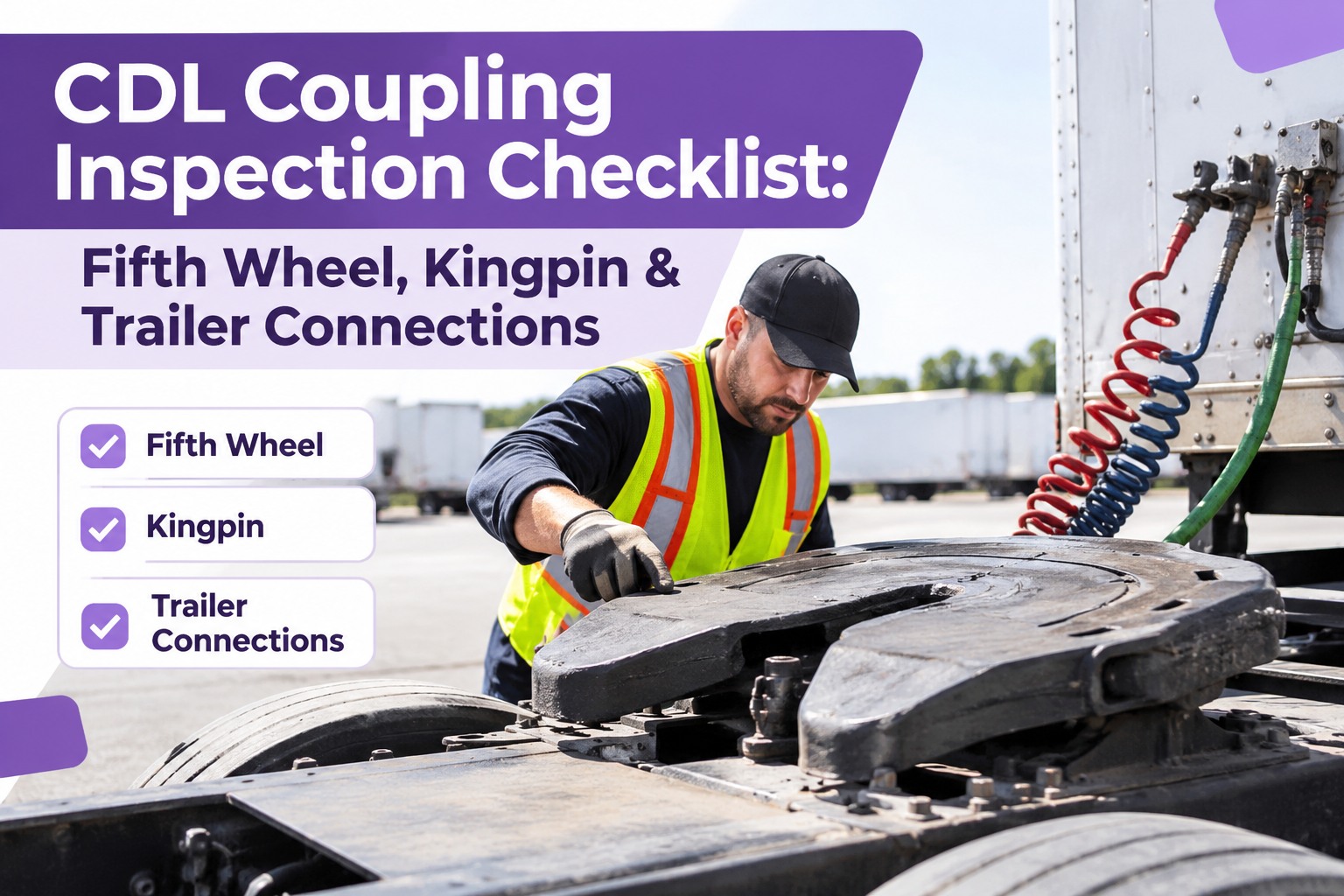
A driver couples up, does a tug test, feels it hold, and pulls out. Forty minutes later an inspector gauges the kingpin and finds a gap over half an inch — the tug test passed, the coupling didn't. A coupling device defect is an immediate out-of-service with no grace period, because a separation at highway speed isn't a repair-later problem. This checklist walks the fifth wheel, kingpin and connections the way it has to be walked, and shows how Truck Inspection & Maintenance Management Software captures the measurements the tug test can't feel. Start free and prove every coupling before dispatch.
A coupling can look hooked, pass a tug test, and still be over the out-of-service limit. Our software runs the coupling check as guided measurement fields — not open-ended boxes: kingpin wear, jaw gap and plate condition each get a reading and a photo, a failed one becomes a work order or an out-of-service hold, and the numbers trend per trailer. You catch the wear the tug test misses, before the scale house does.
Zero toleranceA coupling defect parks the rig on the spot.Under §393.70, coupling devices carry a severity weight of 8 and are out-of-service eligible. There's no repair-later option and no benefit of the doubt at the roadside — trailer separation is one of the most severe failures in trucking.
§393.70coupling devices
8severity weight (of 10)
Immediateout of service, no grace
The Tug Test Proves the Lock — Not the Wear
The tug test is mandatory and non-negotiable, but it only confirms the jaws are holding today. A kingpin at 0.100" of wear passes a tug test every time and is still weeks from an out-of-service gauge reading. A full coupling check needs all five.
1Tug testHolds under load — necessary, but not sufficient on its own.
2Visual jaw checkJaws actually closed around the kingpin shank, not the head.
3Gauge: kingpin wearMeasured against the 0.125" limit — visual misses uniform wear.
4Gauge: jaw gapKingpin-to-jaw gap measured, not estimated by feel.
5Plate & mountingNo cracks, no gap to the apron, no loose bolt.
A positive tug test is preliminary — it's still possible to be high-hooked, with the jaws closed above the kingpin instead of around it. The gauge and the visual are what catch that. Book a demo to see coupling measurement fields.
The Coupling Inspection Checklist
Walk it in coupling order — prep, hook, verify, connect. Each group names the out-of-service condition it guards against.
ABefore You Back UnderOOS if coupled wrong
BFifth Wheel & MountingOOS: loose bolt or crack
CKingpin & Lock EngagementOOS: gap or jaws open
DAir Lines & Glad HandsOOS: disconnected or leaking
Capture the kingpin and jaw-gap readings as numbers, not a checkmark, so the third reading tells you the wear rate instead of repeating the word OK. Start free and log coupling readings per trailer.
Do Not PullWhen any one of these is true, the coupling is not safe to move
⊘A visible gap between the fifth-wheel plate and the trailer apron — the trailer is riding on the jaws only.
⊘Jaws closed above or on the head of the kingpin instead of around the shank — a high hook.
⊘Release handle not seated in the locked position, or the safety latch not engaged.
⊘A gauge reading over the limit, or any crack in the kingpin or plate weld.
Out-of-Service Thresholds at a Glance
These follow the North American Standard Out-of-Service Criteria, built on 49 CFR §393.70 and SAE J2228. Any one exceeded parks the rig.
ConditionLimitBasis
Kingpin wear0.125" maxSAE J2228
Kingpin-to-jaw gapover 1/2"§393.70
Movement between couplersover 1/2"§393.70
Plate-to-apron gapover 2" (high-hitch)CVSA OOSC
Crack in kingpin or plateanyimmediate
Loose or missing mounting boltanyimmediate
The wear is invisible between gauge checks — a kingpin that moves by hand today was well under the limit two months ago. Trended readings are the early warning. Book a demo to trend kingpin wear per trailer.
Measure the Coupling, Don't Just Feel It
Kingpin wear, jaw gap and plate condition logged as readings with photos — so a worn coupling shows up on a trend line, not at the scale house as an out-of-service.
It proves the jaws are gripping the kingpin under load right now. It does not catch kingpin wear or a high hook — a worn kingpin passes a tug test and still fails a gauge. Pair it with a visual and a measurement. Book a demo to see the full coupling check.
2What are the fifth wheel out-of-service thresholds?
Kingpin wear over 0.125", a kingpin-to-jaw gap over 1/2", movement between couplers over 1/2", a plate-to-apron gap over 2", any crack, or a loose mounting bolt — each is an immediate out-of-service under §393.70. Book a demo to see the thresholds on a template.
3Should the jaws close on the shank or the head?
The shank — the neck of the kingpin. Jaws closed on the head, or above it, are a high hook that can look coupled and separate under load. Go under and look. Book a demo to see the visual jaw check.
4How often should coupling be inspected?
A full visual and tug test at every hookup and pre-trip, plus a gauge measurement of kingpin wear and jaw gap on a periodic schedule — the measurement catches what the daily check can't. Book a demo to set the cadence.
Fifth Wheel · Kingpin · Lock · Connections
Prove the Coupling Before the Roadside Does
Truck Inspection & Maintenance Management Software runs the coupling check as measurements, routes an over-limit reading to a hold, and trends kingpin wear per trailer — so the defect the tug test can't feel never reaches the scale house.