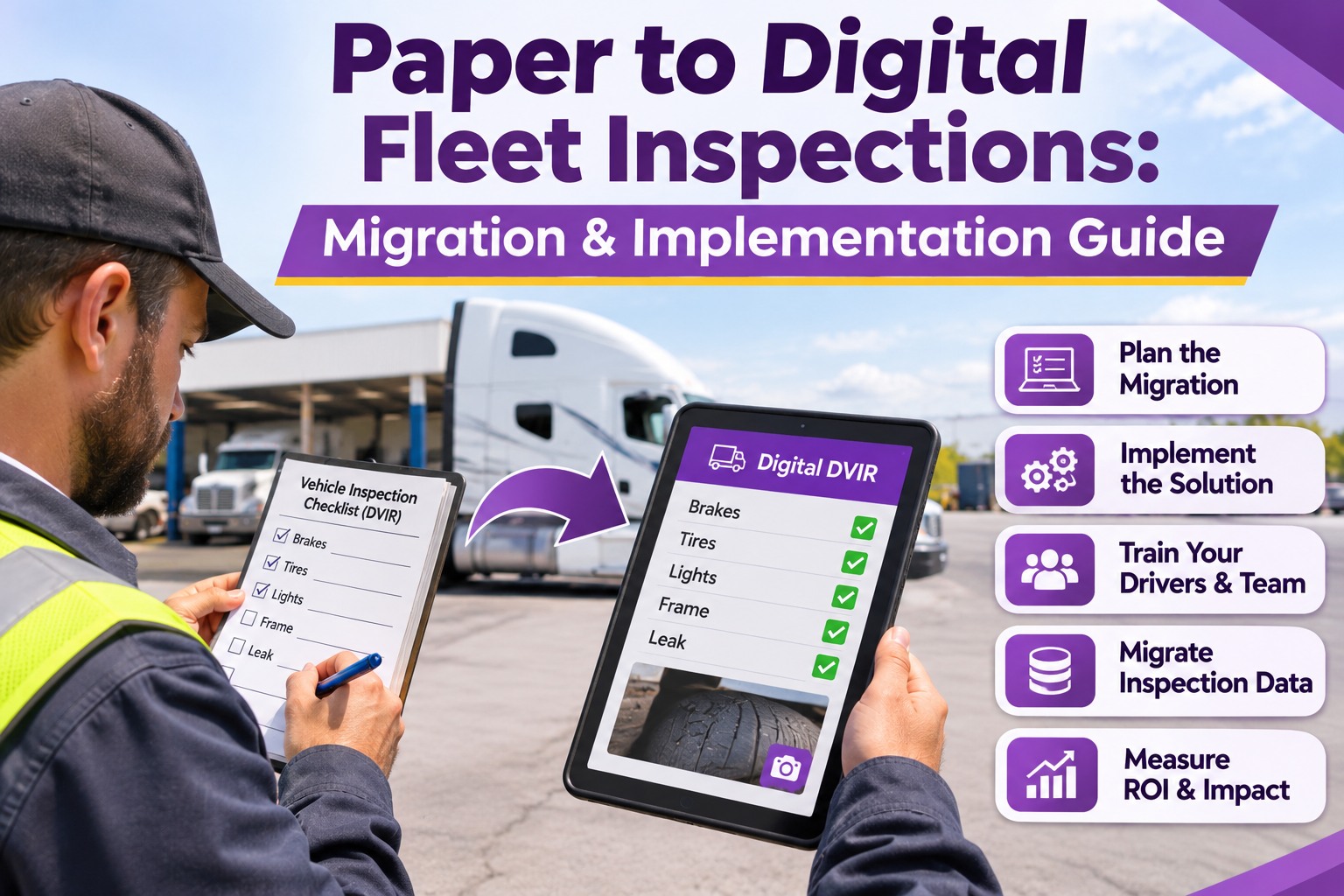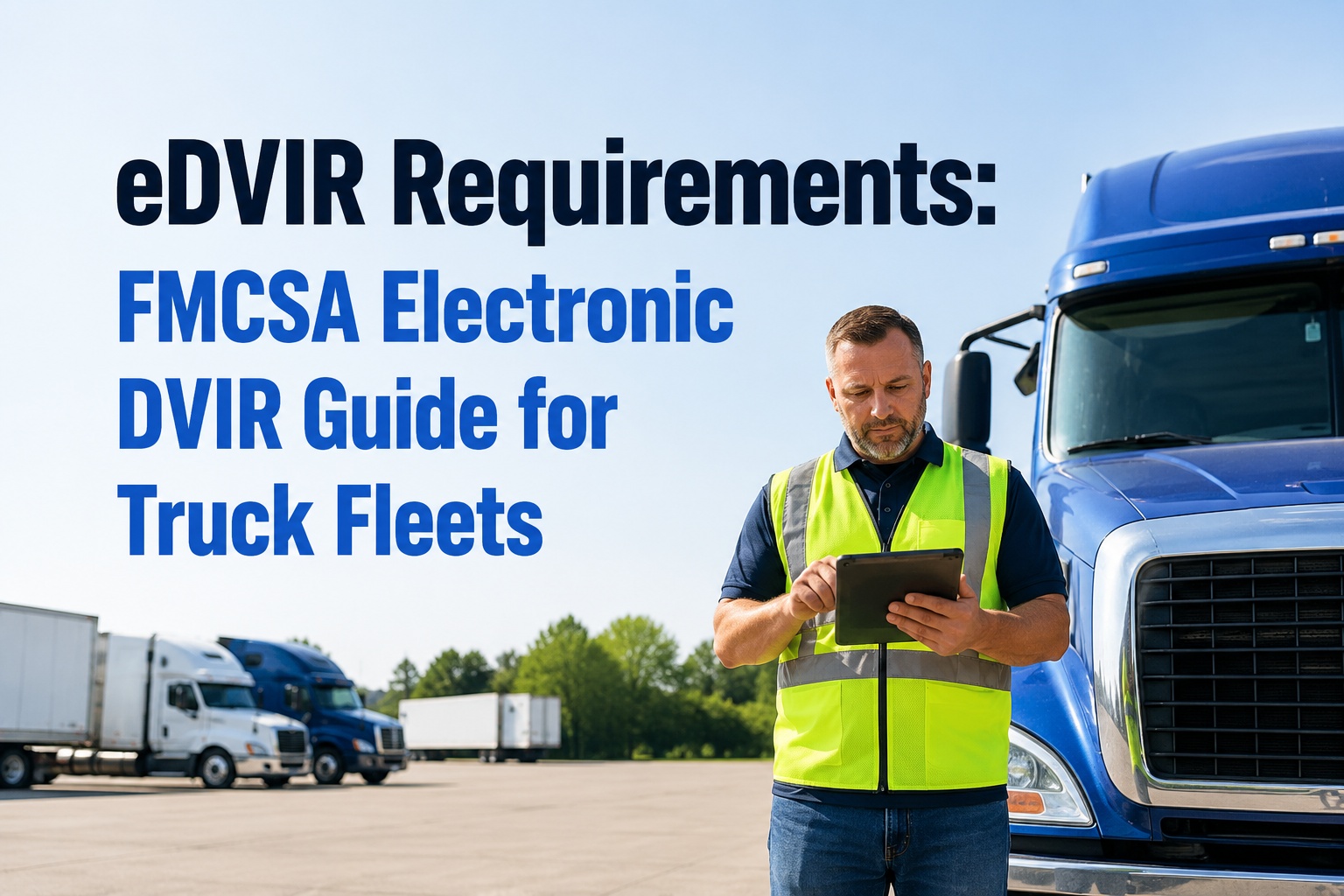
Electronic DVIRs are legal and increasingly the default — the February 2026 FMCSA rule removed the last argument for the clipboard. Yet most rollouts that stall fail on adoption, not the regulation: drivers keep a paper pad "just in case," or a mechanic signs a repair on paper and the digital record shows an open defect forever. This guide covers the implementation that sticks — the rule, the rollout, and the two failure modes to design out. Map it on your own fleet with a free Truck Inspection & Maintenance account.
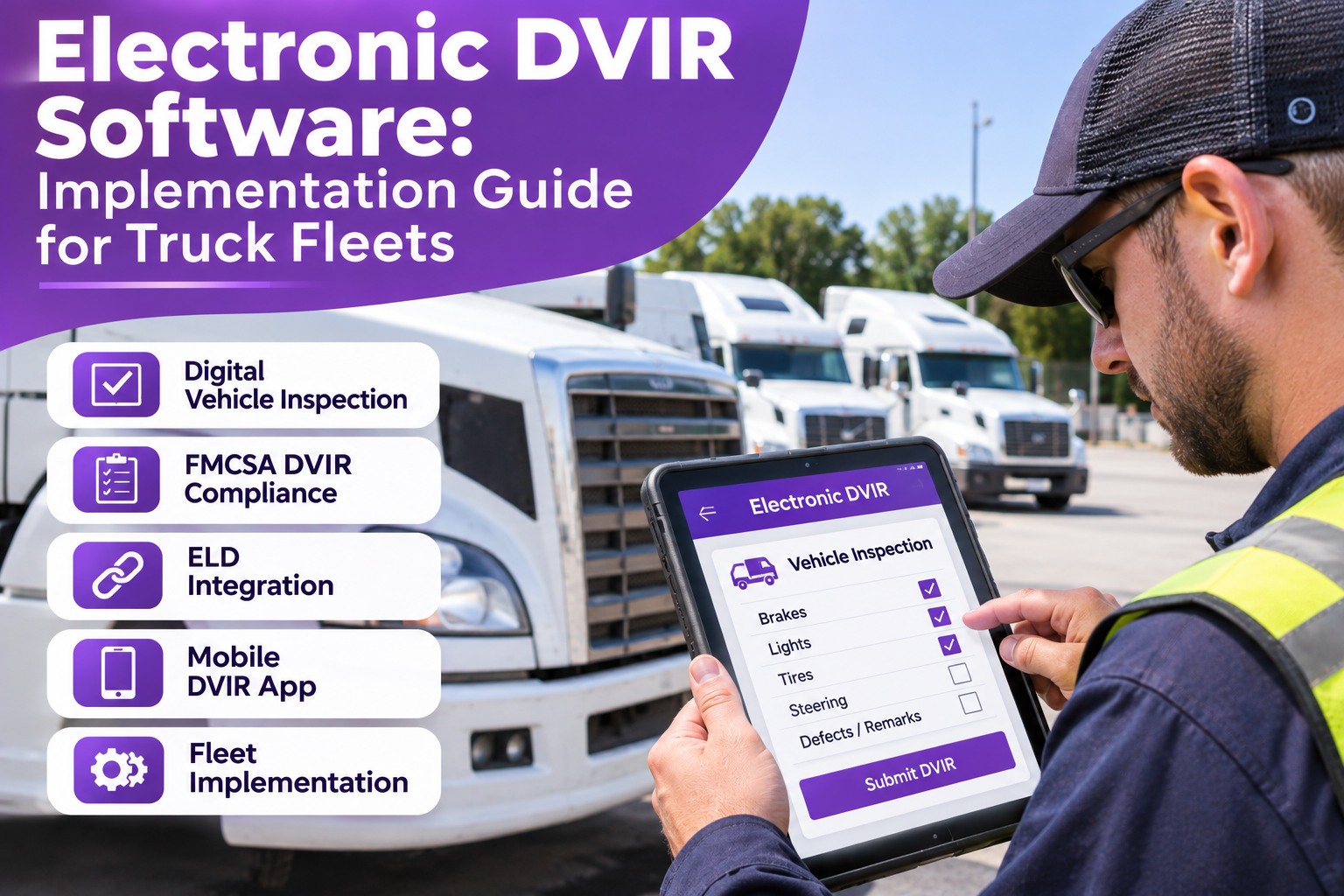
Electronic DVIR Software: An Implementation Guide for Truck Fleets
If your inspection reports still live on paper, you know the cost — a defect sitting in a tray while the truck rolls, a signature chain nobody can prove at audit. Truck Inspection & Maintenance runs the loop end to end: a guided DVIR on the phone, a flagged defect that opens a work order automatically, the mechanic certifying inside the platform, and the next driver acknowledging before dispatch. On any safety defect you get a guaranteed four-hour first response — acknowledged, graded, and assigned within four hours — so nothing waits.
What the 2026 rule actually changed
Electronic DVIRs were already permissible under 49 CFR 390.32 before 2026. The FMCSA final rule — published February 19, 2026, effective March 23, 2026 — added explicit electronic-DVIR language to 49 CFR 396.11 and 396.13, so digital signatures, mobile submission, and cloud storage now have named authorization rather than an inference. The inspection requirement itself is unchanged. If a rollout stalled over "is this even allowed," that objection is gone.
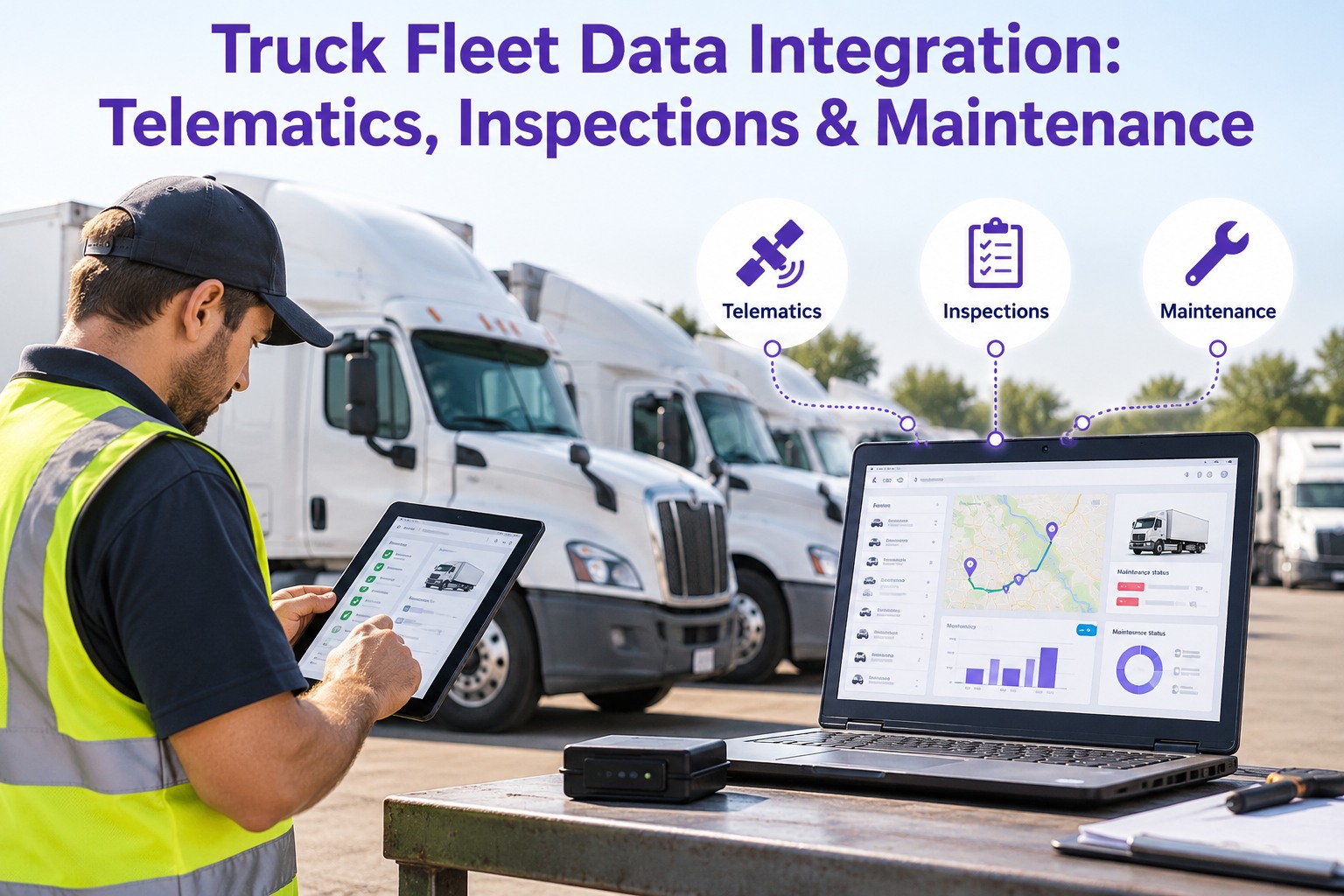
Settle one point early: the DVIR, the ELD, and HOS are three separate systems. The DVIR (§396.11/396.13) asks whether the vehicle is safe; the ELD (§395 Subpart B) records duty status; HOS (Part 395) governs driving time. Good software connects them so a driver enters data once — but integration connects them, it does not merge them. Confusing a DVIR module with an ELD is the fastest way to buy the wrong tool. Book a short demo to see the three side by side.
The five-phase rollout that sticks
A clean paperless transition follows a disciplined sequence — skip a phase and you get spotty adoption and audit gaps. Most fleets finish in about thirty to forty-five days without disrupting operations. The point is getting every driver and mechanic onto the same record before the paper disappears.
Build the digital template
Mirror your existing inspection sequence so drivers do not relearn the order. One template per vehicle category, mandatory photos on critical defects, GPS and timestamp automatic.
Set defect routing and work-order rules
Decide what each severity grade does. A critical defect flags the vehicle and blocks dispatch until certified; a minor one opens a routine work order. This is what turns a defect into a repair, not a note.
Train in one short session
Roughly twenty-five minutes per group is enough: install the app, run one practice inspection, done. Lead with "this is faster than paper," not with compliance, and uptake is far better.
Run parallel for a few days
For three to five days, drivers go digital and keep paper as a backup. Any missing template item or routing gap surfaces while stakes are low — then paper stops, on a named date everyone knows.
Activate the full fleet and watch adoption
Go live and check adoption weekly for the first month — who has not logged through the app yet. Well-run rollouts reach ninety-five percent-plus adoption within thirty days.
Each phase has one exit test, and you do not start the next until it passes. Spin up a template and route a test defect in minutes with a free account.
The signature chain is where paperless programs break
A DVIR is not one signature but a chain of three — driver reports, mechanic repairs and certifies, next driver reviews and acknowledges before the vehicle moves. On paper, any link can go missing unnoticed until an audit. Digitally, the platform can block a skipped link — but only if every party signs inside the platform.
The most common way a digital DVIR program quietly breaks: the driver files the defect on the app, the mechanic fixes it and signs a paper work order. The eDVIR record never gets a certification, so it shows an open defect forever — and the next audit finds incomplete records on trucks that were actually repaired. The fix is a hard rule: mechanic sign-off happens inside the platform. Paper work orders do not close the digital loop.
Why drivers revert — and how to stop it
The second failure mode is softer and just as fatal: hand drivers a login, skip the walkthrough, and they keep a paper pad "just in case" — now you run two systems for six months. The lesson under both is one line worth taping to the wall: the app has to be faster than the paper it replaces. If the mobile inspection takes longer or demands real tech skill, completion rates fall and gaps open.
Mirror the paper order
Build the digital template in the exact sequence drivers already walk. No relearning means no resistance.
One short walkthrough
A single guided session beats a login and a shrug. Drivers who complete one practice inspection rarely go back to paper.
Lead with speed, not compliance
Frame it as the faster tool, not the rulebook. Fleets that do see quicker, more thorough adoption.
Work offline
Inspections must complete with no signal and sync when a connection returns — or yard-edge dead zones push drivers back to the pad.
Every inspection captured once, every defect a tracked work order, every signature in one searchable record — and a four-hour first response on any safety defect so nothing waits in a tray.
Book a Demo — Plan Your RolloutWhat to require in the software
Not every tool labeled "electronic DVIR" closes the loop. Before you commit, check for the things that hold up at audit and in the shop — and test it with your actual drivers, because driver experience is the whole ballgame.
The inspection covers every FMCSA-required component, configurable per vehicle and trailer category.
Driver, mechanic, and next-driver signatures with timestamps — the full chain enforced, a skipped signature blocks dispatch.
A flagged defect generates a tracked work order automatically — priority, asset, photos — with no manual re-entry.
Mandatory photo on critical defects, automatic location and time stamped server-side for a tamper-evident trail.
Runs fully offline on any phone and syncs on reconnect — no dead zone stops an inspection.
Records held and indexed by truck, driver, and date, retrievable in seconds for a roadside or audit request.
Run a real inspection against this list with a free Truck Inspection & Maintenance account before you decide.
Frequently asked questions
Yes — unambiguously. They were permissible under 49 CFR 390.32 since 2018, and the FMCSA rule effective March 23, 2026 added explicit language to 49 CFR 396.11 and 396.13 covering digital signatures, mobile submission, and cloud storage. See how the compliant chain works on your fleet — book a quick demo here.
About thirty to forty-five days without disrupting operations — template build, defect routing, a ~25-minute training session per group, a short parallel run, then full activation. Adoption typically passes ninety-five percent within thirty days with one proper walkthrough. See the plan mapped to your fleet size — schedule a demo.
Two failure modes: drivers get a login with no walkthrough and revert to paper, and mechanics certify on paper so the digital record shows an open defect forever. The fixes are one guided training session and a hard rule that mechanic sign-off happens inside the platform — and the app must be faster than paper. See how the loop prevents both — book a demo.
No. An eDVIR is the vehicle safety inspection report under §396.11/396.13; an ELD records duty status under §395 Subpart B; HOS under Part 395 governs driving time. Good software connects the three — it does not merge them. Buying an ELD expecting it to cover your DVIR obligation is a common, costly mistake. See the three running together — grab a demo slot.
Go paperless without the stall
The rule is settled and the rollout is a known path — the fleets that succeed wire the signature chain and train drivers before the paper disappears. Truck Inspection & Maintenance runs the full loop: guided mobile DVIR, automatic defect-to-work-order, enforced three-party signatures, offline capture, and a four-hour first response on every safety defect.