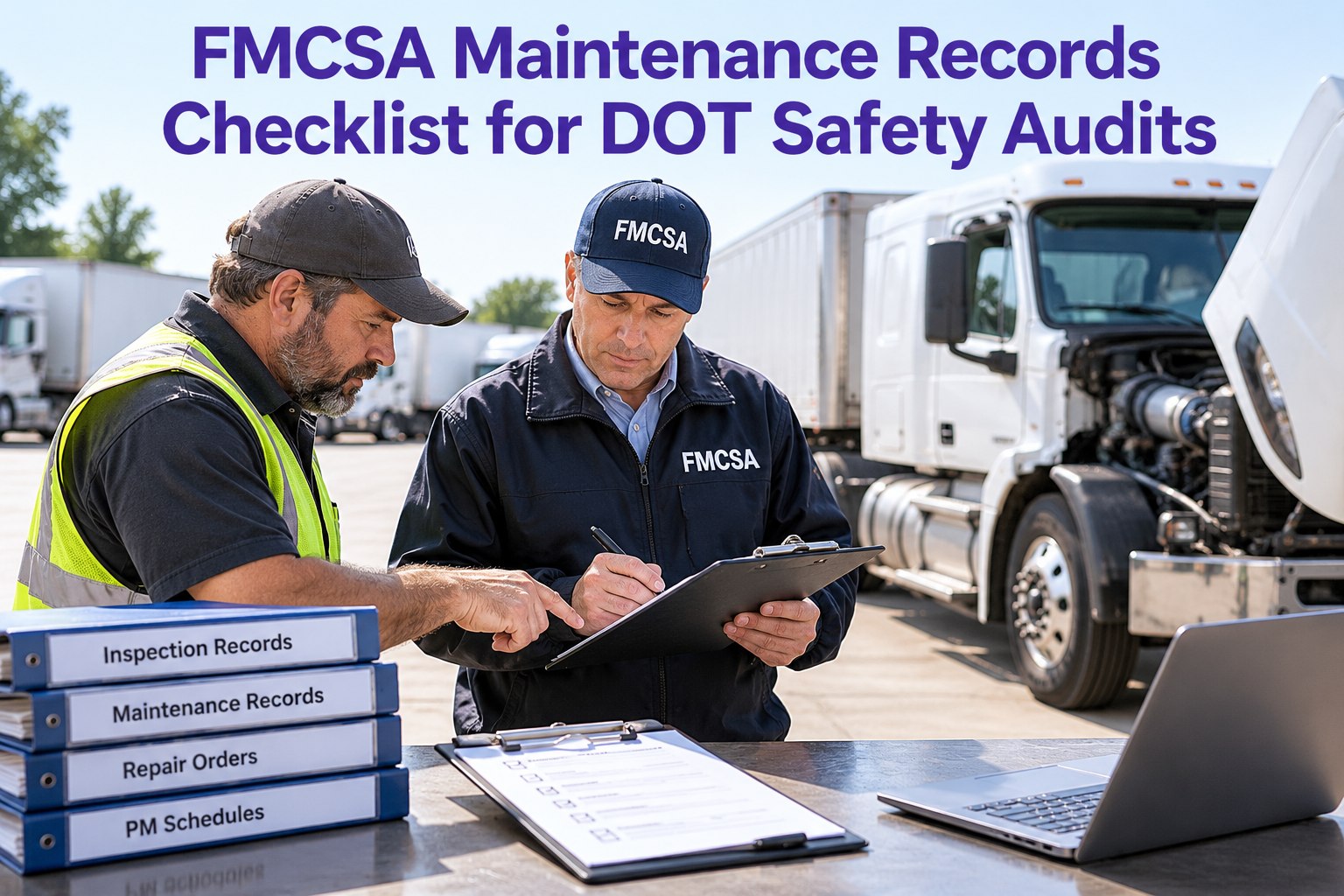
A DOT safety audit is not a surprise test on how well your trucks are maintained it is a surprise test on whether you can prove it. Six categories of records are required for every commercial motor vehicle under 49 CFR Part 396, and the gap between "we did the work" and "we have the file" is where almost every poor Vehicle Maintenance BASIC score comes from. This is the checklist to run before the auditor shows up. Contact our team to put the whole file on our software.
49 CFR Part 396 · Vehicle Maintenance BASIC
The FMCSA Records File. Audit-Ready, Every Truck, Every Day.
An FMCSA auditor can arrive on a compliance review, a new-entrant safety audit, or a post-crash investigation. In every case they are checking the same thing: for every power unit, do you have the required maintenance records, in the required retention window, with the required signatures and proofs. Our Truck Inspection & Maintenance Management Software keeps all six categories of records in one filterable file per VIN — ready in seconds when the request comes in.
§396.3(b)Maintenance records required for every CMV
14 monthsAnnual inspection retention under §396.21
3 monthsDVIR retention under §396.11
1 yr / 6 moMaintenance history on hand & after disposal
What Actually Triggers a DOT Safety Audit
Most fleets expect "an audit" to mean one thing. In fact FMCSA runs several — each with a slightly different scope but the same records expectation. Our Truck Inspection & Maintenance Management Software keeps you ready for any of them, because the underlying file is the same.
01New Entrant Safety Audit
Required within 12 months of getting a USDOT number. Reviews maintenance records among six categories of compliance.
02Compliance Review (CR)
Triggered by CSA scores, complaints, crash patterns, or random sampling. Vehicle Maintenance BASIC is one of the seven scored areas.
03Post-Crash Investigation
After a reportable crash, investigators pull maintenance and inspection history to look for mechanical contributing factors.
04Roadside Inspection Follow-up
Out-of-service findings or repeat defects trigger a records request — the shop file must match the roadside story.
The FMCSA Records File — Six Categories Per Truck
Under 49 CFR §396.3(b), every commercial motor vehicle must have these six categories of records on file. Our software stores all six per VIN, with timestamps and signatures, so the whole file is one unit click away.
AVehicle identificationCompany number, year, make, VIN, GVWR, tire size
BMaintenance scheduleNature and due dates of PM inspections and services
CInspection & repair historyDate, nature of each inspection, maintenance, repair performed
DDVIRs with defectsDriver inspection reports showing any defects found or none
EAnnual periodic inspection§396.17 report, inspector qualifications, sticker/decal
FLubrication recordsPer §396.5 — lubrication of parts needing periodic lubrication
The Checklist — Five Sections, Every Box Required
Run this before an audit — or set it up as a standing weekly check inside our software. Each item below is a native checkbox: tick as you confirm the record exists, is current, and is signed. Anything unticked at audit time is a finding.
Retention Rules at a Glance
Every record type has its own retention window. Mix them up and you fail the audit on paperwork alone. Our Truck Inspection & Maintenance Management Software applies the right retention rule per record type automatically.
Record type
Rule reference
Retention window
Where our software stores it
Driver DVIR
49 CFR §396.11
3 months minimum from preparation
Per-VIN inspection log with driver signature + photos
Annual inspection
49 CFR §396.21
14 months from inspection date
Per-VIN compliance file with inspector qualifications attached
Maintenance history
49 CFR §396.3(b)
While under control + 6 months after disposal
Per-VIN repair log with date, nature, mechanic
PM schedule
49 CFR §396.3(b)(2)
Current & up to date on every active unit
Per-VIN rules — mileage, engine hours, calendar
Lubrication records
49 CFR §396.5
As part of maintenance history
Per-VIN service entries with lubrication noted
Roadside inspection
49 CFR §396.9
12 months from inspection
Per-VIN compliance file with repair certification
Reflects 49 CFR Part 396 as commonly applied. Some states and intrastate programs apply stricter rules — confirm with your state DOT and your own compliance counsel.
Where Fleets Actually Fail the Vehicle Maintenance BASIC
Auditors see the same handful of findings over and over. Each one is a records problem more than a wrench problem — and each one our Truck Inspection & Maintenance Management Software closes by design.
01
No annual inspection on file
The service was done; the §396.17 report is lost. Our software stores the inspection record and tracks the 14-month retention clock per unit.
02
DVIR without mechanic sign-off
Driver flagged a defect, no repair certification follows. Our software routes every DVIR defect to a graded work order with mechanic signature on close.
03
Missing repair history for a VIN
Spreadsheet got rebuilt, old entries lost. Our software holds the full repair log tied to the VIN, impossible to misplace.
04
Overdue PMs on active units
Service missed its interval, no alert raised. Our software fires the PM the moment mileage, hours, or calendar hits — no overdue drift.
05
Brake work by unqualified staff
§396.25 requires qualified brake inspectors. Our software records the inspector per repair so the qualification trail is on the record.
06
Records that cannot be produced in time
Audit timeframe passes while someone searches binders. Our software filters any record by VIN and date in seconds, from any device.
One Software. Every Record. Every Signature. Audit-Ready.
Our Truck Inspection & Maintenance Management Software holds the full FMCSA records file per VIN — DVIRs, annual inspections, repair history, PM schedule, signatures, and photos. Every retention clock applied automatically. Every record filterable in seconds. A Vehicle Maintenance BASIC that stays clean, not one that gets patched the week an audit letter arrives.
How Our Software Holds the FMCSA File
Six jobs that turn a scattered records problem into a one-click audit answer, every day, on every truck.
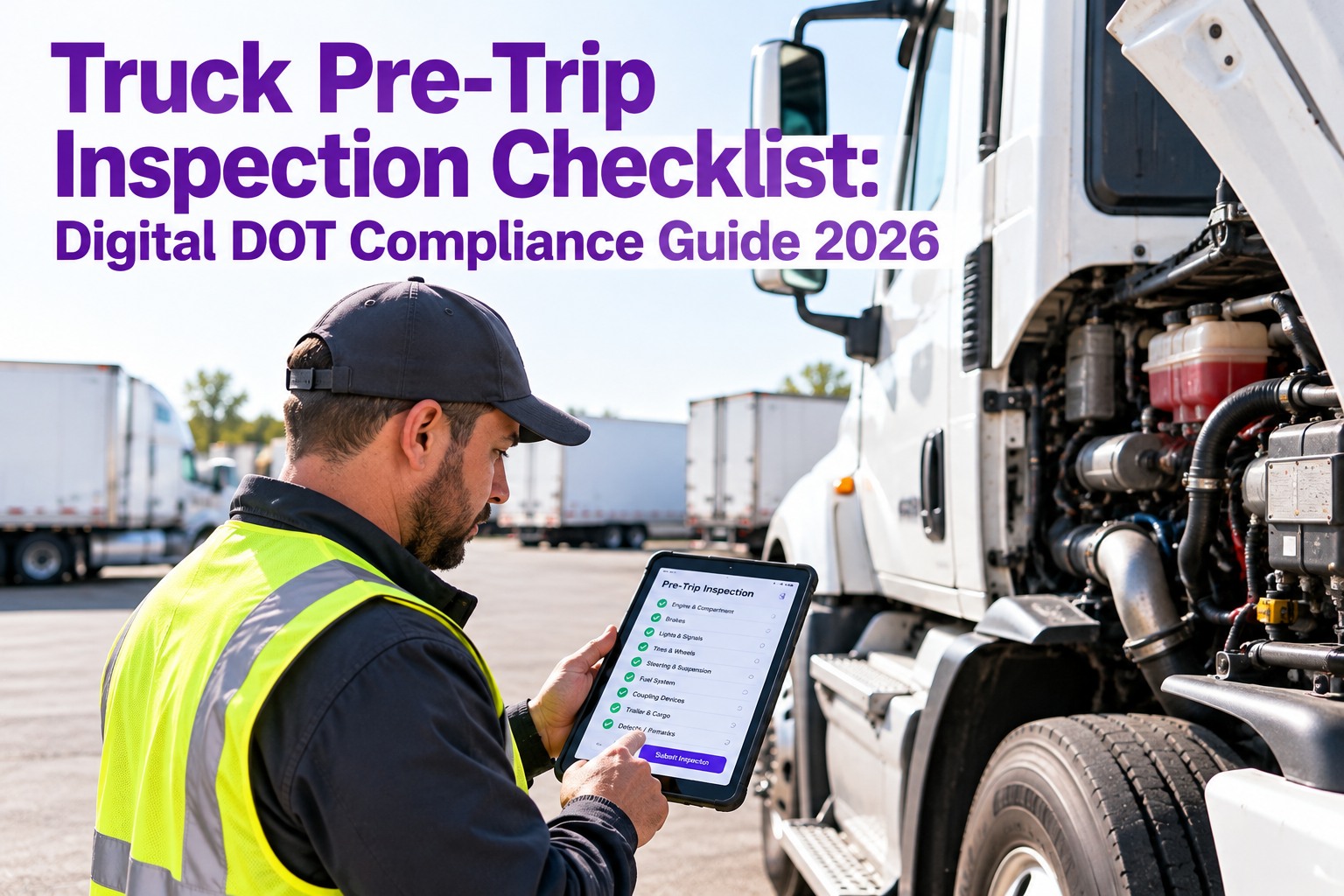
01Our software captures the DVIRGuided pre-trip and post-trip on the driver's phone — signed, timestamped, photos attached
02Our software routes the defectEvery DVIR defect becomes a graded work order with mechanic sign-off on close — repair certification complete
03Our software fires the PMMileage, engine hours, and calendar triggers per unit — service never drifts past its interval
04Our software stores the §396.17Annual inspection report, inspector qualifications, decal date — all held for the 14-month retention window
05Our software tracks retentionEach record type on its own retention clock — DVIR 3 mo, annual 14 mo, maintenance history 1 yr + 6 mo
06Our software answers the auditorFilter by VIN, date, record type — the whole file ready for the investigator from any device, in seconds
Expert Review
Reviewed forFleet safety managers, DOT compliance officers, and maintenance directors preparing for a new-entrant audit, a scheduled compliance review, or a post-crash investigation under FMCSA Part 396
Sources checkedFMCSA 49 CFR Part 396 — specifically §396.3 (maintenance records), §396.5 (lubrication), §396.11 and §396.13 (DVIR), §396.17 and §396.19 and §396.21 (annual periodic inspection and inspector qualifications), §396.25 (brake inspector qualifications), and the Vehicle Maintenance BASIC methodology under the Compliance, Safety, Accountability (CSA) program
RecommendationRun this 25-item checklist monthly on every active CMV and before any inspection letter arrives. The three records most commonly missing in audits are the §396.17 annual report, the mechanic's repair certification on DVIR defects, and the maintenance history for recently retired units. Confirm every retention window against your state and your own compliance counsel
Frequently Asked Questions
What records does FMCSA actually require under Part 396?
Six categories under 49 CFR §396.3(b): vehicle identification (company number, VIN, GVWR, tire size); the maintenance schedule showing nature and due dates; records of each inspection, maintenance, and repair performed; DVIRs with defect records; the annual §396.17 periodic inspection report; and lubrication records per §396.5. Our Truck Inspection & Maintenance Management Software holds all six categories per VIN automatically.
Start free and build the file in one place.
How long do I have to keep DVIRs?
A minimum of three months from the preparation date, under 49 CFR §396.11. Our software stores each DVIR with driver signature, timestamp, and any photos — then applies the 3-month retention automatically so you are never short on required proof.
How long is the annual DOT periodic inspection record kept?
Fourteen months from the inspection date, under §396.21(b). The record must identify the vehicle, the inspector, and the components checked, and the inspector must meet the qualifications in §396.19. Our software stores the full report alongside inspector credentials and tracks the retention clock per unit.
What's the Vehicle Maintenance BASIC and how is it scored?
Vehicle Maintenance is one of seven Behavior Analysis and Safety Improvement Categories (BASICs) in FMCSA's Compliance, Safety, Accountability (CSA) program. It is scored from roadside inspection violations — brake problems, lights, tires, body/chassis defects — weighted by severity. A clean records file by itself does not fix a bad BASIC score, but it is what the auditor reaches for when deciding whether the roadside pattern is systemic.
What's the fastest way to be audit-ready?
Stop running the records file as a separate task from the maintenance work. Our Truck Inspection & Maintenance Management Software captures the DVIR, routes the defect, fires the PM, stores the annual inspection, and tracks every retention clock — all as the normal workflow. The audit file is a by-product of running the shop, not a last-minute scramble.
Contact our team to walk the file on your fleet.
Part 396 · DVIR · §396.17 · Retention — All in One File
Pass the Next Audit. On the Records You Already Have.
Our Truck Inspection & Maintenance Management Software turns every daily DVIR, every scheduled PM, every repair, and every annual inspection into one filterable file per VIN — with every FMCSA retention clock running automatically behind it. When the audit letter arrives, the file is already built.
No credit card required. Reflects 49 CFR Part 396 as commonly applied — confirm with your state DOT and compliance counsel. Not legal advice.