A driver can't react to what they can't see — and on a heavy truck, what can't be seen is a lot. A cracked mirror, a loose bracket that shakes at speed, or a hazed windshield turns every lane change and backing move into a guess. Mirrors and glass are the driver's only window onto the truck's huge blind zones, which is why they deserve a check of their own. Walk the checklist below before every trip, and let Truck Inspection & Maintenance Management Software (TIM) turn any defect into a tracked repair. Start free and run visibility inspections on one record with TIM.
TIM · Mirror & Visibility Checklist
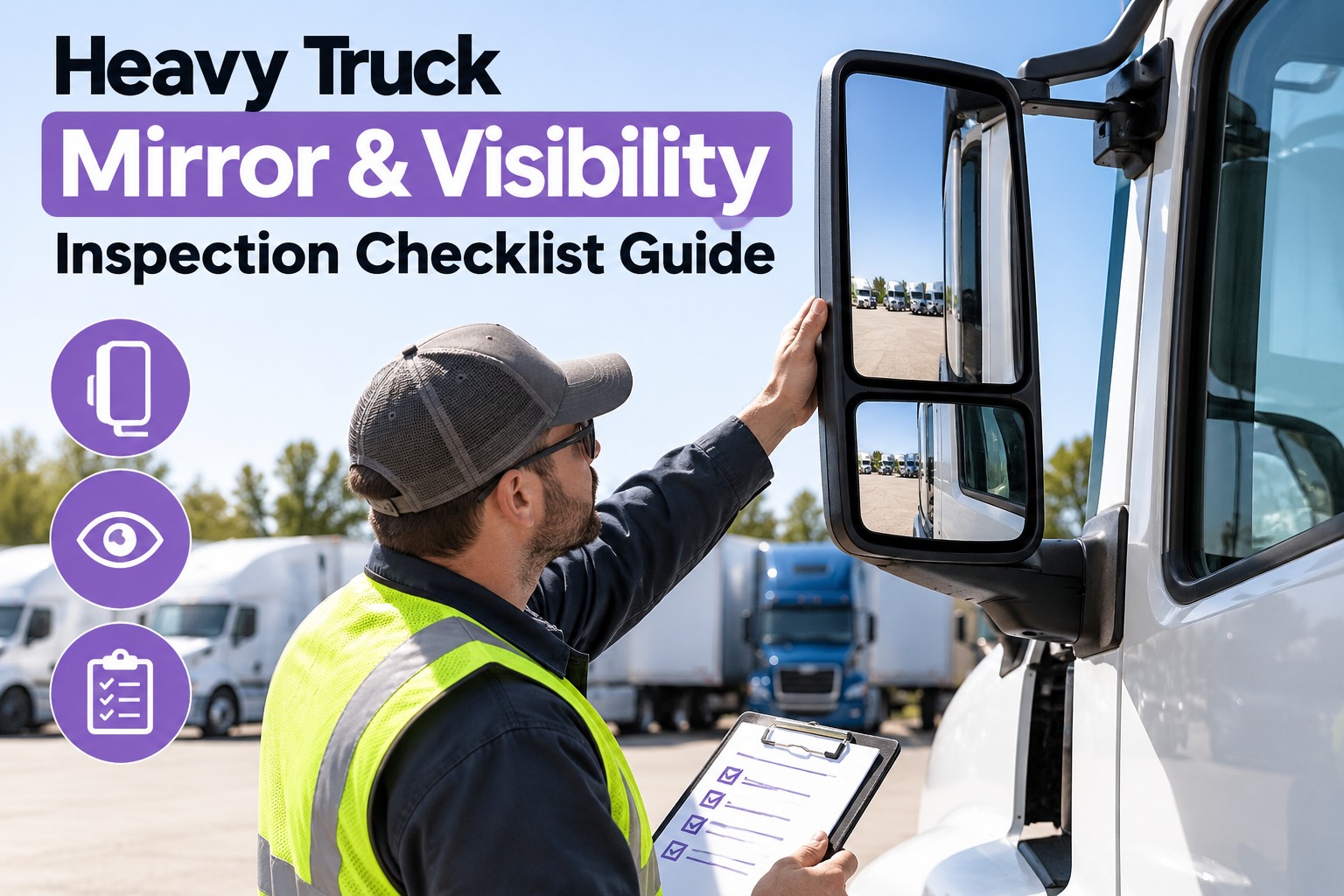
Heavy Truck Mirror & Visibility Inspection Checklist Guide.
A heavy truck has blind zones a car driver never imagines — and mirrors, glass, and vision aids are the only things that shrink them. A shaking mirror, a chip in the sightline, or a wiper that smears is a safety defect, not a cosmetic one. This checklist walks every mirror and every piece of glass that keeps the driver's view clear, and TIM turns each failed item into a graded work order before the truck rolls.
Our promise: every flagged defect gets a 4-hour first response — acknowledged, graded, and assigned.
4
blind zones around the truck
5
vision systems, one inspection
1
record, check to repair
Why Visibility Gets Its Own Inspection
Mirrors and glass aren't just comfort items — they're the driver's entire awareness of what's around a 70-foot vehicle. Three things make them worth a dedicated check.
◼
The blind zones are hugeA heavy truck hides whole vehicles in its No-Zones — the right side worst of all — and mirrors are the only way to cover them.
↯
A shaking mirror is a blind mirrorA loose bracket or worn mount vibrates the image into a blur at highway speed — present but useless.
◐
Glass and aids fade slowlyHazing, pitting, smearing wipers, and a dying camera degrade bit by bit, so the loss of vision sneaks up.
None of these announce themselves — they have to be looked for. Contact our team to build a visibility-specific inspection form.
The Blind Zones — and the Mirror That Covers Each
Before the checklist, know what you're checking for. A heavy truck has four blind zones, and each mirror exists to shrink one of them. If a mirror fails, its zone goes dark.
FRONT
Directly ahead and below the cab
Hood / crossover mirror
LEFT SIDE
Along the driver's side
West Coast + convex
RIGHT SIDE largest
The big blind zone, curb side
Fender + convex + camera
REAR
Directly behind the trailer
Backup camera / spotter
Every mirror on the checklist maps to one of these zones — which is why a single failure matters. Start free and keep every zone covered with TIM.
The Mirror & Visibility Checklist
Walk these five vision systems before every trip. Items marked CRITICAL are required or safety-essential — a fail takes the truck out of service until corrected. Tick each as you go, and aim the mirrors before you roll.
M2
Convex & Wide-Angle Mirrors
W
Wipers, Washers & Defrost
C
Cameras & Electronic Aids
Five systems, one walk-around, every blind zone accounted for. Start free and capture every item on one record with TIM.
AIM BEFORE YOU ROLL
A perfect mirror aimed wrong is still a blind spot. Set the flat side mirrors so a sliver of the trailer shows at the inside edge — just enough to judge position — with the rest covering the lane beside and behind. Angle the convex mirrors down and out to catch the close-in zones the flat glass misses, and tilt the right-side fender mirror to sweep the curb-side blind zone. Re-check the aim whenever a mirror has been bumped, serviced, or replaced.
The Visibility Defects That Cause Incidents
When a sightline failure leads to a crash, it's usually one of these — and every one is a checklist item above.
✕
Missing or broken mirrorA required mirror gone or cracked leaves an entire blind zone uncovered — and it's a roadside violation too.
✕
Loose, shaking mountA vibrating mirror turns the image to blur at exactly the speed it matters most.
✕
Obstructed windshieldA crack or chip in the sightline splits the driver's view and can sideline the truck at inspection.
✕
Dead camera or smeared wiperThe rear zone goes dark or the glass smears in rain — vision lost right when it's needed.
Every one starts as a checklist item someone skipped. Start free and make sure nothing gets skipped with TIM.
How TIM Helps
From Walk-Around to Work Order — Every Mirror Logged
A visibility check only works if a cracked mirror or a dead camera actually reaches the shop. TIM makes the inspection digital and the follow-through automatic — a failed item becomes a graded work order on one record, so a safety-critical defect is fixed before the truck rolls and the proof stays on file.
1Walk the five systems
→
2Defect graded
→
3Work order routed
→
4Repair certified
Visibility checklistMirrors, glass, wipers, and cameras built into a guided mobile inspection.
Critical-item flagsA missing mirror or obstructed windshield marks the truck out of service.
Defect becomes a work orderA flagged item routes to the shop the moment it's filed — no re-keying.
Photo on every defectA cracked mirror or chipped glass documented for the technician.
Per-unit historyEvery mirror, glass, and camera repair logged against that truck.
Audit-ready recordsInspections and repairs kept searchable and produced on demand.
Frequently Asked Questions
What mirrors is a heavy truck required to have?
At minimum, a rear-vision mirror on each side that gives the driver a view to the rear and along both sides of the vehicle. Most heavy trucks go well beyond the minimum with a flat West Coast mirror plus a convex spot mirror on each side, a wide-angle fender mirror on the right for the largest blind zone, and often a hood or crossover mirror for the area right in front of the cab. A required mirror that's missing or broken is both a safety hazard and a roadside violation.
Start free and track every mirror on every unit with TIM.
Where are a heavy truck's biggest blind spots?
There are four — front, rear, and both sides — and the right side is by far the largest, running back along the trailer where a whole car can disappear. The front blind zone sits directly ahead of and below the cab, and the rear zone runs straight back behind the trailer where no mirror reaches without a camera. Each mirror and camera on the truck exists to shrink one of these zones, which is why one failed mirror leaves a real gap in what the driver can see.
When does a windshield crack take a truck out of service?
When the damage sits in the driver's critical viewing area and obstructs the view, or when it spreads beyond the limits the rules allow. Small chips and short cracks outside the sightline are often acceptable, but anything that splits or distorts the forward view is a problem — both for safety and at a roadside inspection. The practical rule on a pre-trip is simple: if the damage is in the driver's line of sight, treat it as a defect and get it addressed before the truck runs.
How should heavy truck mirrors be aimed?
Set the flat side mirrors so just a sliver of the trailer shows at the inside edge, with the rest covering the lane alongside and behind — enough to judge your position without wasting glass on the truck itself. Angle the convex mirrors down and out to catch the close-in zones the flat mirrors miss, and tilt the right-side fender mirror to sweep the curb-side blind zone. Re-aim any mirror that's been bumped, serviced, or replaced, since a mirror pointed wrong is the same as no mirror at all.
Why use a digital checklist for mirrors and visibility?
Because a visibility defect is easy to note and easy to forget. A digital inspection sends a cracked mirror or dead camera straight to the shop as a work order with a photo, flags a required-mirror or windshield fault as out-of-service on the spot, and keeps the record per truck for audits. On systems where a missed defect means a blind zone goes uncovered, closing the gap between finding it and fixing it is exactly the point.
Mirrors · Glass · Wipers · Cameras
Give the Driver Back Every Blind Zone
A heavy truck is only as safe as the driver's view around it, and that view lives entirely in the mirrors, the glass, and the cameras. A crack, a loose mount, a smeared wiper, or a dead lens quietly hands a blind zone back to chance. A visibility walk-around before every trip catches it, and TIM turns each finding into a tracked, certified repair — so the truck that rolls out lets the driver see everything they need to.
No credit card required · Free for up to 3 trucks · Visibility checklists, critical-item flags, and certified closure built in