The crash isn't what wins or loses the case. What wins or loses it is what your records look like on a subpoena. Nuclear verdicts against trucking companies — jury awards of $10 million or more — have climbed roughly 300% over the past decade, with the median plaintiff award now sitting in the $36–$51 million range. Awards over $100 million ("thermonuclear") that were rare a decade ago now happen multiple times a year. And the pattern behind them is consistent: plaintiff attorneys don't try to prove a driver made one mistake. They try to prove the company created the conditions that made the mistake inevitable — through weak inspection discipline, ignored defect reports, missed PMs, and undocumented decisions that a jury reads as "profits over safety." The defense is documentation. Specifically, an unbroken chain of DVIRs, PM records, work orders, and repair certifications that tell one consistent story instead of four contradictory ones. This article walks through how maintenance records actually get used in court, what plaintiff attorneys look for, and how Truck Inspection & Maintenance produces the unified evidence file that can shift the outcome of a case. Start a free trial to build the defensible record now — before you need it.
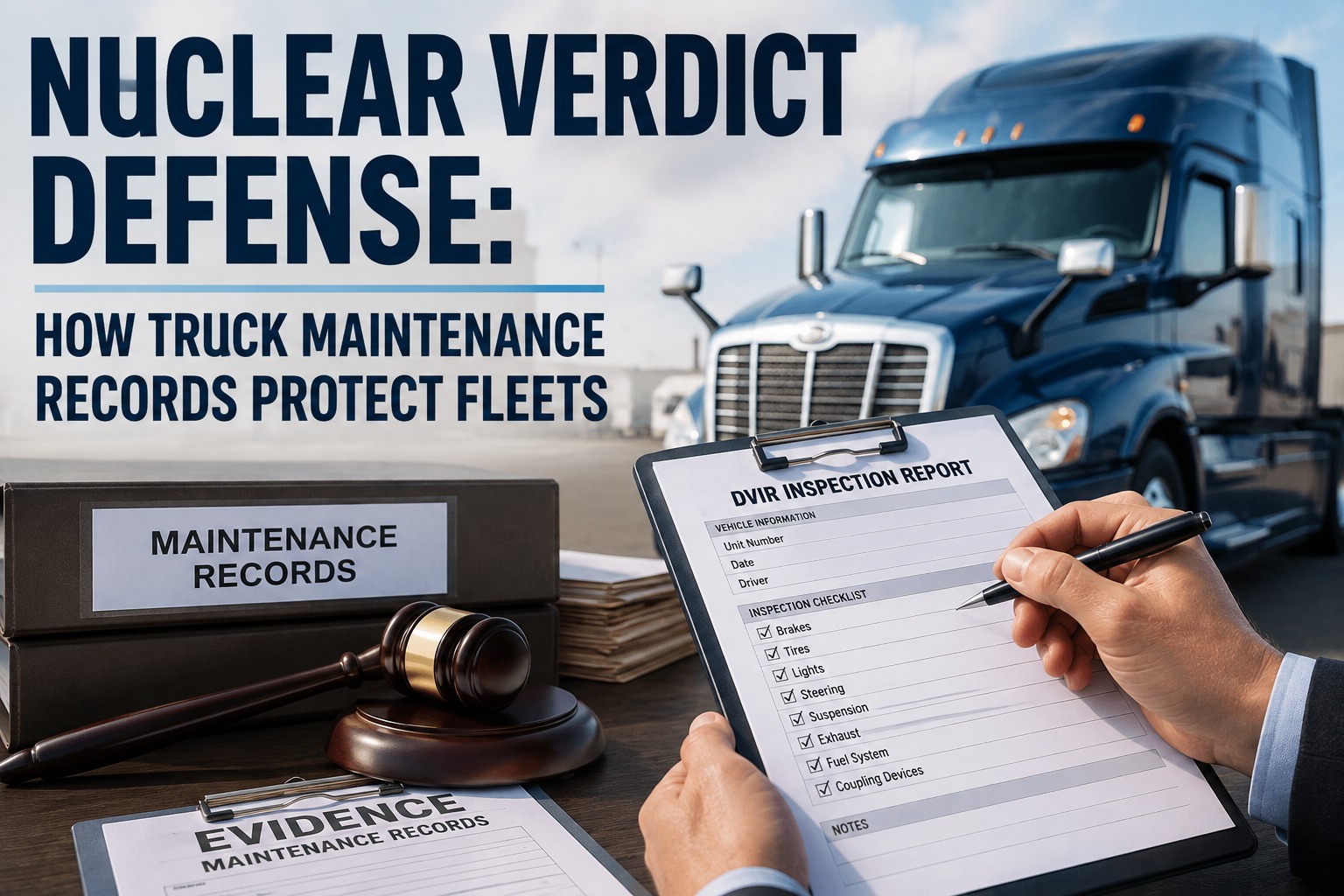
Nuclear Verdict Defense: How Truck Maintenance Records Protect Fleets
Nuclear verdicts routinely reach eight and nine figures against trucking carriers. The single strongest defense is documentation — DVIR chains, PM logs, work orders, and repair certifications that tell one consistent story on subpoena. Here's how to build that record before you need it.
The Scale of What's at Stake
Understanding the size of the exposure is the first step in taking documentation discipline seriously. These are not hypothetical numbers. They are current, verified figures from 2024–2026 trucking litigation.
Reptile Theory: What You're Actually Defending Against
Plaintiff attorneys don't try cases the way defense attorneys do. They deploy a strategy called reptile theory — a psychological framework that shifts the jury's focus away from the specific crash and toward the systemic threat your fleet allegedly poses to public safety. The goal is not to prove fault. The goal is to activate the jury's protective instinct: this company is dangerous, and only a large verdict will stop them.
Attorney gets your witness to agree that "safe fleets always inspect brakes before every trip" — an uncontroversial rule.
Produces a DVIR with a missing signature, a PM that ran 30 days late, a defect never certified as repaired.
Uses that one gap to argue a pattern — "if they let this one slide, imagine what else." Jury sees a threat, not an accident.
The number stops being about the plaintiff's injury. It becomes about "sending a message" — the door to eight and nine figures.
The Records That Get Subpoenaed First
The moment a serious crash happens, your maintenance records stop being paperwork and become evidence. Plaintiff attorneys know exactly which files to request and in what order. These seven are the ones that arrive first on every subpoena.
Every DVIR filed on the crashed unit for the prior 12 months. Attorneys hunt for missing signatures, uncertified defects, and vague entries.
Scheduled vs. actual PM completion. Any late or skipped PM in the 12 months before the crash becomes exhibit material.
Every repair on the unit — defect reported, part replaced, tech who did the work, closing sign-off. Gaps are treated as concealment.
Most recent annual inspection plus the technician's 396.19 qualification file. Either missing invalidates the inspection.
Every roadside inspection, every violation, and what your fleet did in response. Pattern hunting territory for the plaintiff.
MVRs, training records, medical certs, coaching notes. Any gap in the driver's file becomes a hiring-and-supervision negligence claim.
The policies you have on paper vs. the practices you actually followed. Divergence is where the reptile-theory case builds.
How a Fragmented Record Loses the Case
The single most damaging thing a defense attorney can hear from their own client is "I'll need to check three different systems to answer that." A fragmented record isn't just inconvenient — it is affirmative evidence for the plaintiff's argument that your fleet doesn't take safety seriously enough to keep track of it.
If the paper DVIR says one thing, the telematics data another, and the work order a third, the attorney doesn't need to prove which is true. They just need to argue you can't be trusted on any of it.
A missing record is not a neutral absence. In front of a jury, it becomes "what were they hiding?" — even when the honest answer is "we just never kept it."
Every week your legal team spends reconstructing records is a week the plaintiff's team spends building narrative. Fast, clean production is negotiating power.
When the record can't defend the case, insurance carriers push for settlement instead of trial — even at inflated numbers — because trial exposure is worse.
One Unified Record. One Consistent Story.
Truck Inspection & Maintenance automates the full inspection-to-repair loop — mobile DVIR capture with GPS and photo, instant defect routing to work orders, PM scheduling with on-time tracking, and complete DOT recordkeeping — producing the single unified evidence file that gives your defense team a consistent story to tell on day one.
The Anatomy of a Defensible Maintenance Record
A record is not "defensible" because it exists. It is defensible when it satisfies five specific tests that any competent plaintiff attorney will apply. Get these five right on every record, every day, and your fleet is doing the actual work of nuclear verdict prevention. Start free and every record you create passes all five by default.
Created at the time of the event, not backfilled. Timestamp integrity matters more than the entry itself.
Identifies the specific person who did the work or the inspection, with signature and role — never anonymous.
Every required field populated. Missing fields let the attorney fill them in with the most damaging possible interpretation.
Original and any revisions preserved with audit trail. A record that can be edited without trace is worth little in court.
Producible within the subpoena deadline. A record that exists but can't be found in time functionally does not exist.
Post-Crash: The First 24 Hours
The moment a serious crash happens, a litigation-hold clock starts running. What your team does — and doesn't do — in the first 24 hours materially shapes what your defense looks like months later at deposition.
Issue litigation hold. Freeze the unit's DVIRs, PMs, work orders, telematics, dashcam footage. Nothing deleted, nothing overwritten.
Pull the last 12 months of records for the unit and the driver. Get them into a single package — not four separate systems.
Hand the unified file to your legal team and insurance carrier. Fast, clean production changes the tone of every subsequent conversation.
What Prevention Looks Like Day-to-Day
Nuclear verdict defense isn't a legal strategy you turn on when the lawsuit arrives. It is a maintenance discipline you run every day, and the paper it produces silently. These six habits, sustained across a fleet, are what a defense team wants to see when they open your records.
Frequently Asked Questions
Yes, in two ways. First, they can prevent the case from ever going to trial — plaintiff attorneys are less likely to push for a nuclear number when the defense file is clean, and insurers are less likely to force a settlement when they can actually defend. Second, when cases do go to trial, ATRI research shows defendants win in ambiguous or fact-unclear situations — but only when they can produce the paper to support their story. Fleets that can't produce the paper lose those same cases. Start free and build the paper trail now.
A documented history of the issue being tracked, worked on, and monitored is fundamentally different from silence about it. Even when a genuine defect contributed to a crash, a maintenance record showing the fleet was actively addressing the pattern shifts the narrative from "reckless disregard" to "diligent effort with an unfortunate outcome" — which is what the defense needs. Silence around a known issue is the reptile-theory attorney's dream evidence. Documentation, even of imperfect situations, is protection.
Typically 12 to 36 months on the specific unit and driver involved, and increasingly further on systemic policies and training records. Federal retention rules set the floor (90 days for DVIRs, 14 months for annual inspections, life of assignment for maintenance records), but litigation regularly reaches further. Fleets that retain digital records well beyond federal minimums as a matter of course have a material advantage when the discovery request arrives.
Your insurer handles the legal defense, but they cannot create records that don't exist. When they receive a case with a fragmented or incomplete maintenance file, their choice narrows to defending a weak position at trial or pushing you toward settlement — often at inflated numbers. The maintenance record is your responsibility. What you hand your insurer determines what they can do with it. See how our platform strengthens what you hand your insurer.
Arguably more important. Nuclear verdicts against small carriers can be existential — a $30 million award ends operations that a large fleet's insurance might absorb. And plaintiff attorneys with third-party litigation funding often specifically pursue smaller carriers because settlement pressure is easier to apply. The good news: a small fleet with a clean digital record is often better positioned than a large fleet with fragmented systems, because everything lives in one place from day one.
Build the Record Before You Need It
Truck Inspection & Maintenance is the fleet maintenance platform that produces litigation-ready evidence as a byproduct of daily operations — mobile DVIRs with signature chains, PM scheduling with on-time tracking, digital work orders tied to defects, and complete DOT recordkeeping in one system that speaks with one voice on subpoena. The best time to build a defensible record is before you need to defend anything.