A reefer holds its setpoint perfectly — right up until it doesn't. The moment the box starts to drift off temperature, a clock starts ticking on the load, and the only question that matters is whether you learn about it in minutes from an alert or hours later at the dock. Protecting the cold chain takes two things working together: inspection that keeps the unit holding temperature, and an alert strategy that catches the excursion when it happens anyway. This guide covers both, and shows how Truck Inspection & Maintenance Management Software (TIM) ties them into one record. Start free and protect every load with TIM.
TIM · Temp Control · Inspection · Alerts
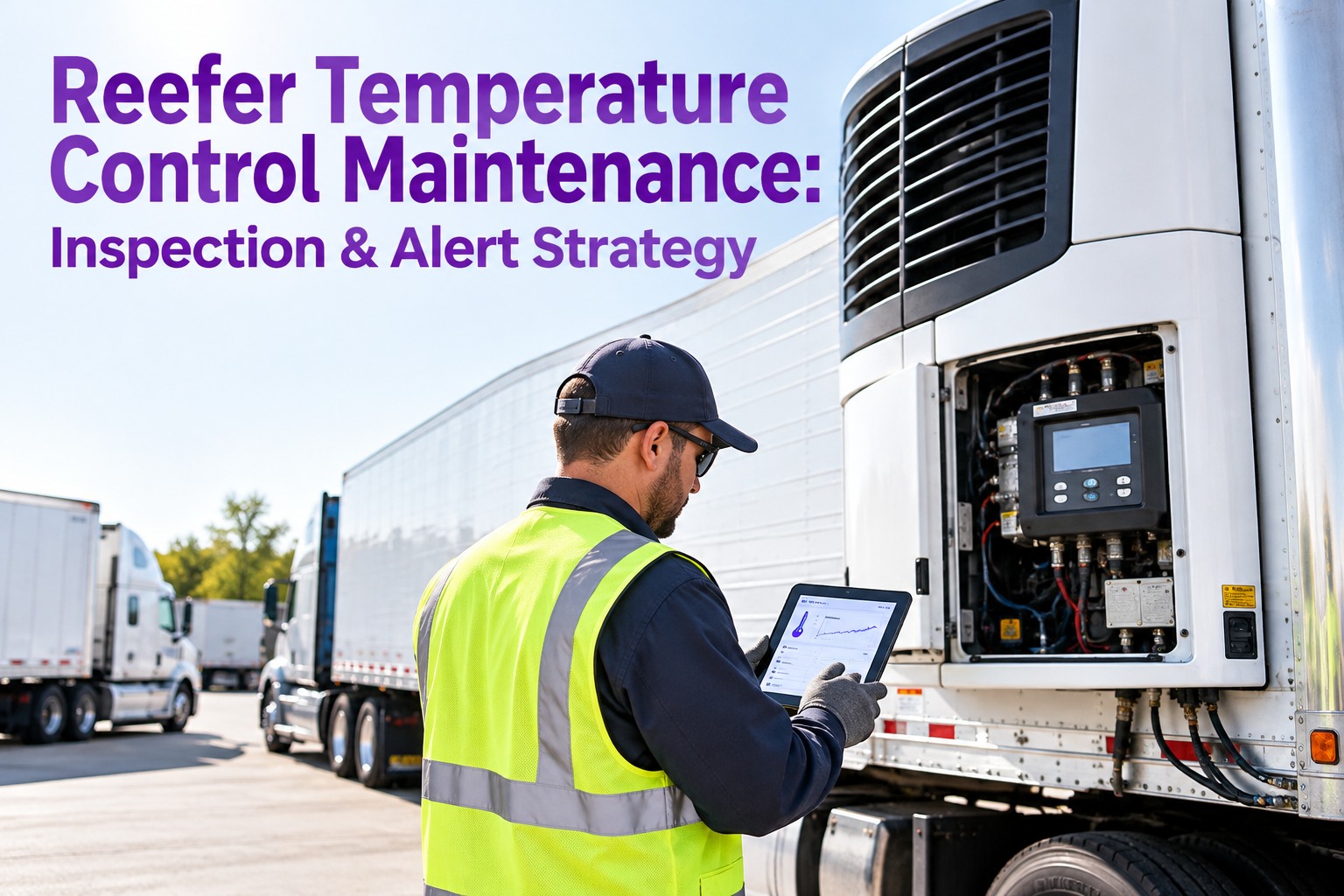
Reefer Temperature Control Maintenance: Inspection & Alert Strategy
A refrigerated load is only as safe as how fast you know it's at risk. Inspection keeps the reefer healthy enough to hold temperature; the alert strategy catches the drift the moment it begins, while there's still time to act. Get both right and a wandering setpoint is a notification, not a claim. TIM runs the inspections, tracks the alert response, and keeps the temperature record on one unit history.
Our promise: every flagged defect gets a 4-hour first response — acknowledged, graded, and assigned.
1
record, alert to repair
Two Jobs Protect the Cold Chain
Temperature control isn't one task — it's two that back each other up. Inspection reduces how often the reefer loses temperature; alerts make sure that when it does, you know in time to save the load.
PREVENT
Inspection & PM
Keep the reefer unit, airflow, seals, and setpoint healthy so the box holds temperature in the first place. Most excursions start as a defect that a pre-trip would have caught.
DETECT
Alert Strategy
Watch the temperature continuously and alert on drift before it becomes an excursion. Even a healthy unit meets power loss, a door left ajar, or a probe fault — detection is the safety net.
Lean on only one and the cold chain has a gap. Contact our team to set up both halves for your fleet.
Why Early Detection Wins — the Excursion Curve
Temperature rarely fails all at once. It drifts, and every minute you catch it earlier is product saved. This is why the alert thresholds sit where they do — well before the cargo-risk line.
In-band — holding setpointNormal operation
Deviation begins — door event or minor driftWatch, deadband filters noise
Warning threshold — sustained driftAct now, while there's margin
Critical excursion — out of rangeEscalate, load at risk
Cargo-risk line — breachToo late to prevent, now documenting
The whole point of an alert strategy is to act in the amber, not the red. Start free and get the alert before the excursion with TIM.
Prevent — Inspecting the Temp-Control System
These are the parts that keep a reefer holding temperature. A pre-trip and routine check of each is what stops most excursions before a load is ever on board.
◆
Reefer unit & compressorRuns and cycles normally, no unusual noise, overcurrent, or overheating.
≋
Refrigerant circuitHigh- and low-side pressures normal; no leaks, blockages, or low charge.
⇄
Airflow & return airSupply and return paths clear; return-air reading tracks setpoint, cargo loaded for airflow.
▢
Door seals & curtainsGaskets intact, doors close tight, strip curtains in place — warm-air ingress is a top cause of drift.
❄
Defrost & coilsEvaporator and condenser coils clean; defrost cycles complete so ice doesn't choke airflow.
◎
Setpoint & probesProgrammed setpoint correct; supply, return, and cargo probes reading accurately, not drifting.
Six checks, and most temperature trouble never leaves the yard. Contact our team to put these on every pre-trip.
Detect — the Alert Tier Strategy
Not every deviation deserves the same response — that's how teams learn to ignore alerts. Sort them into tiers by consequence, with the response and channel matched to each.
DEVIATION · info
Minor, within deadband — a door opening or brief swing
Response: Log it, let the deadband and time delay filter the noise. Channel: dashboard / email.
WARNING · act
Sustained drift past the warning threshold with margin still left
Response: Verify and act now — close doors, check power, dispatch if needed. Channel: SMS to the driver and yard.
CRITICAL · escalate
Out of range, or power loss — the load is at risk
Response: Escalate to on-call within the acknowledgement window; auto-call if unanswered. Channel: call + SMS.
An alert strategy covers more than temperature — these are the six alarm types worth watching:
Temperature — high / low / deviation
Power — mains or genset loss
System — compressor & pressure faults
Sensor — probe failure or bad reading
Door — open or ajar too long
Communication — link lost
Set thresholds from cargo tolerance, not generic defaults, and use deadbands so the goal is fewer irrelevant alerts, not fewer alerts. Start free and tier your reefer alerts with TIM.
WHEN AN ALERT FIRES — THE RESPONSE PROTOCOL
A good alert is only half the job; the response is the other half. The protocol is the same every time: 1) Acknowledge and record who responded, when, and how. 2) Validate — compare supply versus return probes, check the door, the defrost state, and power, so a sensor fault isn't mistaken for a real breach. 3) Act — close doors, check the power connection, correct the setpoint, or dispatch a technician. 4) Escalate if it isn't resolved within the window. 5) Document the root cause and the fix, and review recurring alerts for a threshold or hardware problem. A written response policy is what turns an alert into a saved load.
The Failures That Cost a Load
When a refrigerated load is lost, it's usually one of these — and each is either an inspection item or an alert the strategy should have caught.
✕
Power or genset lossThe unit stops cooling and the box warms fast — the single most common path to an excursion.
✕
Door left ajarWarm-air ingress at a stop pushes the box off setpoint before anyone notices without a door alarm.
✕
Probe or sensor faultA failed probe reads normal while the real temperature wanders — a hidden breach the inspection catches.
✕
Lost communicationA dead monitoring link blinds you to every other alarm — silence that looks exactly like a healthy load.
Each one is caught by either the pre-trip or the alert tier above. Start free and close every gap with TIM.
How TIM Helps
Inspection, Alert Response, and the Temperature Record — On One Unit
A reefer program has two halves that have to connect: the pre-trip that prevents excursions and the alert response that catches them. TIM keeps the reefer inspection on every pre-trip, turns an alert or a finding into a graded work order, and holds the response and repair history on the unit record — so prevention and detection live in the same place as the proof.
1Inspect or alert fires
→
2Verify & grade
→
3Work order routed
→
4Response documented
Reefer pre-trip checklistUnit, airflow, seals, defrost, and setpoint on every guided inspection.
Alert turns into a work orderA temperature or system alert becomes a routed work order — no re-keying.
Severity-based routingA critical excursion escalates now; a minor item joins the planned queue.
Response loggedWho acknowledged, what they did, and the outcome kept against the unit.
Per-unit temperature historyEvery excursion, repair, and inspection on one reefer record.
Records produced on demandThe inspection and corrective-action trail ready for a cold-chain audit.
Frequently Asked Questions
What should a reefer temperature alert strategy include?
Tiered alerts matched to consequence, thresholds set from the cargo's real tolerance, and a written response protocol. The tiers run from a minor deviation that the deadband filters, to a warning on sustained drift that needs action, to a critical excursion or power loss that escalates to on-call. Alongside temperature, the strategy should cover power, system, sensor, door, and communication alarms, with the channel matched to urgency — dashboard for routine, SMS for warnings, and an automated call for anything unacknowledged.
Start free and build your tiered alert strategy with TIM.
Why does return-air temperature matter more than supply air?
Because the return-air reading reflects the air coming back from around the load, so it's the better indicator of what the cargo is actually experiencing, while supply air only shows what the unit is putting out. A reefer's control typically regulates to one of these, and the readings can differ — especially with poor airflow or a badly loaded box. It's also why reefer air temperature isn't the same as product temperature: airflow and load placement decide how well the set conditions reach the cargo.
How do you avoid alert fatigue without missing real excursions?
With deadbands, time delays, and thresholds tuned from history rather than loosened limits. A deadband stops an alert chattering around a threshold, and a short time delay keeps a normal door opening or defrost cycle from firing a false alarm — without weakening the real cargo-protection limit. The principle is that the goal isn't fewer alarms, it's fewer irrelevant ones, so the alerts that do reach a person always mean something and never get ignored.
What are the most common causes of a temperature excursion?
Power or genset loss, a door left ajar, airflow problems from a bad load or iced coils, and probe or sensor faults that hide the real condition. Power loss is the big one, since the unit stops cooling entirely, which is why power alarms rank near the top of any strategy. Most of these either show up on a proper pre-trip — seals, defrost, charge, probe accuracy — or are caught the moment they happen by the right alarm type, which is exactly why prevention and detection have to work together.
Why keep the temperature and corrective-action records?
Because in cold-chain transport the proof matters as much as the result. A record of the setpoint, the temperature history, the alerts that fired, and what was done in response shows a load was kept in its safe range — or documents exactly what happened and how it was corrected if it wasn't. Keeping the inspection, the alert response, and the repair on one unit record means that trail is retrievable when a customer, an auditor, or a claim asks for it, instead of scattered across devices.
Prevent · Detect · Respond · Document
Catch the Drift, Not the Claim
A refrigerated load doesn't fail the moment the reefer does — it fails in the minutes nobody was watching. Inspection keeps the unit holding temperature, a tiered alert strategy catches the drift while there's still margin, and a clear response protocol turns the alert into a saved load. TIM runs all three on one record — the pre-trip, the alert response, and the temperature history — so a wandering setpoint is a notification you act on, not a loss you explain.
No credit card required · Free for up to 3 trucks · Reefer pre-trips, alert-to-work-order, and temperature records built in