The air dryer on a commercial truck is the piece of hardware that separates air brakes that work from air brakes that don't. A diesel-driven air compressor pumps atmospheric air into the brake reservoirs — and along with the air, it pushes in water vapor from the atmosphere, oil aerosol from the compressor's own internal lubrication, and any contaminants present at the intake. Without the air dryer, that moisture accumulates in the reservoirs, freezes in cold weather to block valves and lines, corrodes brake components from the inside, and eventually reaches valve seats and diaphragms that fail from the water contact. Oil aerosol coats every downstream component and destroys the sensitive solenoid valves in modern automated systems. And unlike a fuel filter that gives you obvious warning when it clogs, a failing air dryer degrades silently — the symptoms are subtle rattling from the purge cycle, water in the drain when the tanks are drained, or a slow accumulation of oil residue in the reservoirs that no one notices until a valve fails during roadside inspection. Bendix, the dominant manufacturer, categorizes commercial vehicle air usage into three tiers — standard (5 or fewer axles, line haul, delivery), medium (double-trailers, light transit, 8 or fewer axles), and high (multiple trailers, city transit, heavy-duty off-road, 9 or more axles) — and each tier has its own cartridge replacement interval that fleet operators frequently miss. Miss the replacement and the desiccant beads inside the cartridge become saturated, moisture starts passing through into the tanks, and the downstream damage begins. This guide covers exactly how to maintain a commercial truck air dryer — how the dryer actually works, the usage-tier replacement interval matrix, the standard vs oil-coalescing cartridge distinction, the 6 warning symptoms that mean service now, the 5-step cartridge replacement procedure, and how Truck Inspection & Maintenance software tracks cartridge age and replacement intervals per truck so a $60 cartridge doesn't become a $2,000 downstream valve replacement. Ready to protect every air-brake component downstream of the dryer? Start a free trial of Truck Inspection & Maintenance, or contact our support team for a walkthrough.
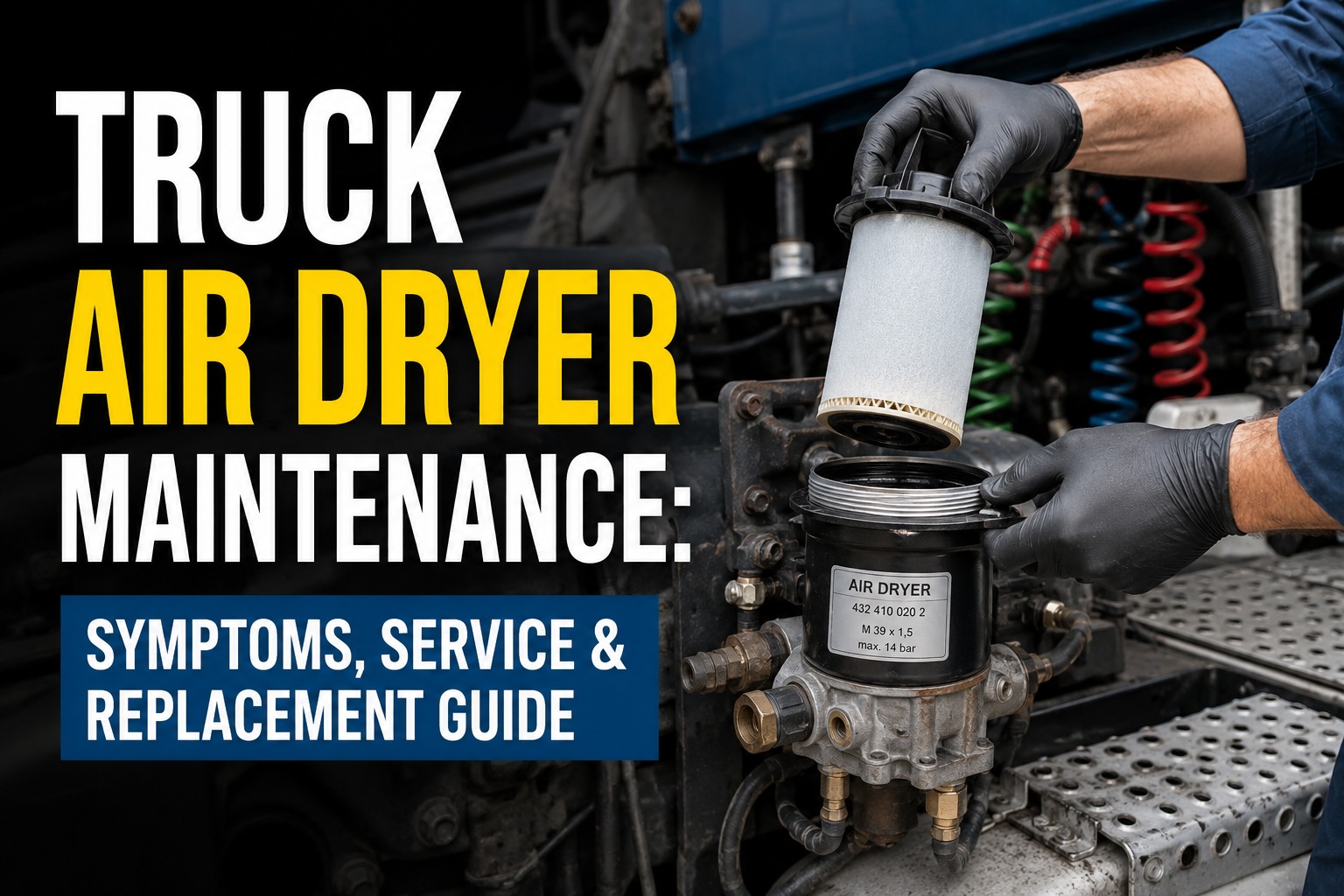
Truck Air Dryer Maintenance: Symptoms, Service & Replacement Guide
One cartridge stands between clean air and every valve downstream. Miss the interval and moisture reaches components that cost 10× more to replace. Here's exactly how to service it right.
How the Air Dryer Actually Works — 4-Stage Flow
Understanding what happens inside the dryer housing makes every maintenance decision obvious. Air enters wet and contaminated; it exits clean and dry. Between those two states, four distinct stages do the work.
The Bendix Usage-Tier Interval Matrix
Bendix categorizes commercial vehicle air consumption into three tiers, and each tier has its own cartridge replacement interval. Miss the tier classification and you'll under-service the truck — or over-service it and waste maintenance dollars.
Standard Cartridge vs Oil-Coalescing — Know the Difference
Two cartridge types dominate the market, and they are NOT interchangeable in the wrong direction. Downgrading from oil-coalescing to standard on a truck spec'd for coalescing damages downstream components.
The 6 Symptoms of a Failing Air Dryer
Air dryer problems are subtle. Learn these six symptoms and you'll catch a failing dryer before moisture reaches valves that cost 10× more to replace than the cartridge.
Replacement Procedure — 5-Step Cartridge Service
Cartridge replacement is a straightforward procedure that takes 30–45 minutes on most platforms. Skip the purge valve inspection and you'll be back on the shop lift within months.
Never miss a cartridge interval again
Cartridge age and mileage tracked per truck. Usage tier classification per unit (standard/medium/high). Automatic replacement alerts before the interval. Purge valve service history logged. Truck Inspection & Maintenance software makes the Bendix service matrix a scheduled event, not a chased-symptom repair.
Downstream Damage — What a Failed Dryer Costs You
Skipping cartridge replacement doesn't save money — it delays and multiplies the cost. Here's what happens to each downstream component when the dryer stops working.
Frequently Asked Questions
Bendix categorizes commercial vehicle air usage into three tiers and provides specific intervals for each. Standard usage (5 or fewer axles, line haul, city delivery, standard freight): PuraGuard oil-coalescing cartridges every 24 months or 200,000 miles, standard desiccant every 24 months, GC Green cartridges every 12 months. Medium usage (double trailers, light transit, 8 or fewer axles): PuraGuard every 18 months or 150,000 miles, standard desiccant every 18 months, GC Green every 12 months. High usage (multiple trailers, city transit, heavy-duty off-road, 9+ axles): PuraGuard every 12 months, standard desiccant every 12 months, GC Green every 6 months. Always follow the truck manufacturer's specific service interval when it differs from Bendix guidance. Truck Inspection & Maintenance software tracks cartridge age per truck with automatic replacement alerts.
Six symptoms indicate air dryer failure or a failing cartridge. Water in the reservoir drains — draining the wet tank at post-trip and finding liquid water means desiccant is saturated. Rattling, fluttering, or hissing from the dryer housing — loose desiccant, worn purge valve, or stuck-open purge port. Oil residue in reservoirs when drained — indicates compressor issue OR need for oil-coalescing cartridge upgrade. Extended compressor cycles reaching cut-out — air leak, damaged purge valve, or saturated desiccant. Frozen air lines in cold weather — moisture in the system freezing in valves; any freeze-up means immediate service. Absent or weak purge "psst" sound at governor cut-out — purge valve failure means the cartridge can't regenerate. Any single symptom warrants inspection; multiple symptoms mean immediate cartridge replacement.
Standard desiccant cartridges filter water vapor only — they do NOT remove oil aerosol from the airstream. They are cheaper, appropriate for older trucks and non-AMT platforms, and can be upgraded to oil-coalescing versions. Oil-coalescing cartridges (like Bendix PuraGuard) contain an oil filter located before the desiccant bed that removes oil aerosol along with water vapor. They protect modern components sensitive to oil contamination — automated manual transmission (AMT) shifters, solenoid valves, and emission control systems. Critical rule: if the truck was originally equipped with an oil-coalescing cartridge, you MUST replace it with oil-coalescing regardless of age. Downgrading exposes AMT and solenoid systems to oil contamination they weren't designed to handle, with repair costs downstream that far exceed the cartridge cost difference. You CAN upgrade a standard-cartridge truck to oil-coalescing for added protection.
On high-mileage air dryer service, yes — replace the purge valve alongside the cartridge. Industry consensus among experienced technicians is that skipping the purge valve service risks premature system failure and roadside breakdown. If the purge valve sticks or fails internally, it can render the entire dryer assembly unusable — meaning replacement of the complete dryer unit (hundreds of dollars in parts and labor) instead of just the small purge valve. The purge valve is inspected while the cartridge is off; it costs relatively little compared to complete dryer replacement. On lower-mileage first-service intervals, inspection may be enough — but on any truck approaching 300,000+ miles or showing purge cycle irregularities, replace the purge valve at cartridge service. Contact our team to see how the software logs purge valve service history.
Cascading downstream damage across the entire air brake system. Air brake valves ($300–$800 per valve): water corrodes valve seats and diaphragms, causing sticking, slow response, and air leaks. AMT solenoid valves ($500–$1,500 per unit): oil aerosol contaminates precision solenoids, causing shift errors. Brake chambers ($150–$400 per chamber): moisture rusts push rods and internal springs, reducing force output. Reservoir tanks ($200–$600 per tank): standing water corrodes tanks from the inside out, eventually creating pinhole leaks. Air lines and fittings ($50–$300 per repair): freeze-cracked lines in winter, oil-swollen seals. Governor ($200–$500 replacement): oil and moisture cause sticking, compressor over-cycling. Total downstream damage from one skipped cartridge can easily exceed $2,000–$5,000. A $60 cartridge replacement at the correct interval prevents all of this.
Yes — it's a straightforward 30–45 minute procedure with basic tools, but the safety and specification steps are non-negotiable. Five-step procedure: (1) Depressurize the system by draining all reservoirs completely, wait for zero pressure on all gauges before touching anything. (2) Remove old cartridge with cartridge wrench, twist counter-clockwise, discard per hazardous waste policy since it contains oil residue. (3) Inspect the dryer body and purge valve while cartridge is off — this is when purge valve replacement happens if needed. (4) Install new cartridge — verify correct type (standard vs oil-coalescing per truck spec), apply oil to seal gasket, thread hand-tight then torque per manufacturer spec. (5) Pressurize and test — start engine, build to cut-out, listen for characteristic "psst" purge sound, check for leaks with soapy water, document replacement date and mileage. Never mix cartridge types or downgrade from oil-coalescing to standard. Try free: sign up here.
Truck Inspection & Maintenance software turns air dryer service into a scheduled event, not a chased symptom
Cartridge age and mileage tracked per truck. Usage tier classification (standard/medium/high) per unit. Automatic replacement alerts before Bendix interval. Cartridge type spec logged (standard vs oil-coalescing). Purge valve service history captured. Downstream valve and component wear correlated to dryer service dates. Every element of air brake system protection managed in one platform — because a $60 cartridge prevents $2,000+ in downstream damage every single interval.