Most DOT audit findings on inspector qualification aren't caused by unqualified technicians — they're caused by fully qualified technicians whose paperwork doesn't prove it. Under 49 CFR 396.19, motor carriers and intermodal equipment providers must ensure every person performing an annual inspection meets three specific requirements, and — just as importantly — must retain documented evidence of those qualifications for the duration of the inspector's tenure plus one year. When that evidence file is thin, incomplete, or scattered across email threads and paper certificates in a shop drawer, the inspection itself is at risk of being deemed invalid regardless of how well it was actually performed. This guide walks through what 396.19 requires in plain English, how to build an internal certification program that satisfies both letter and spirit of the rule, and how Truck Inspection & Maintenance turns that evidence file into something you can produce in seconds instead of scrambling to assemble on audit day. Start a free trial to see the technician certification module in action.
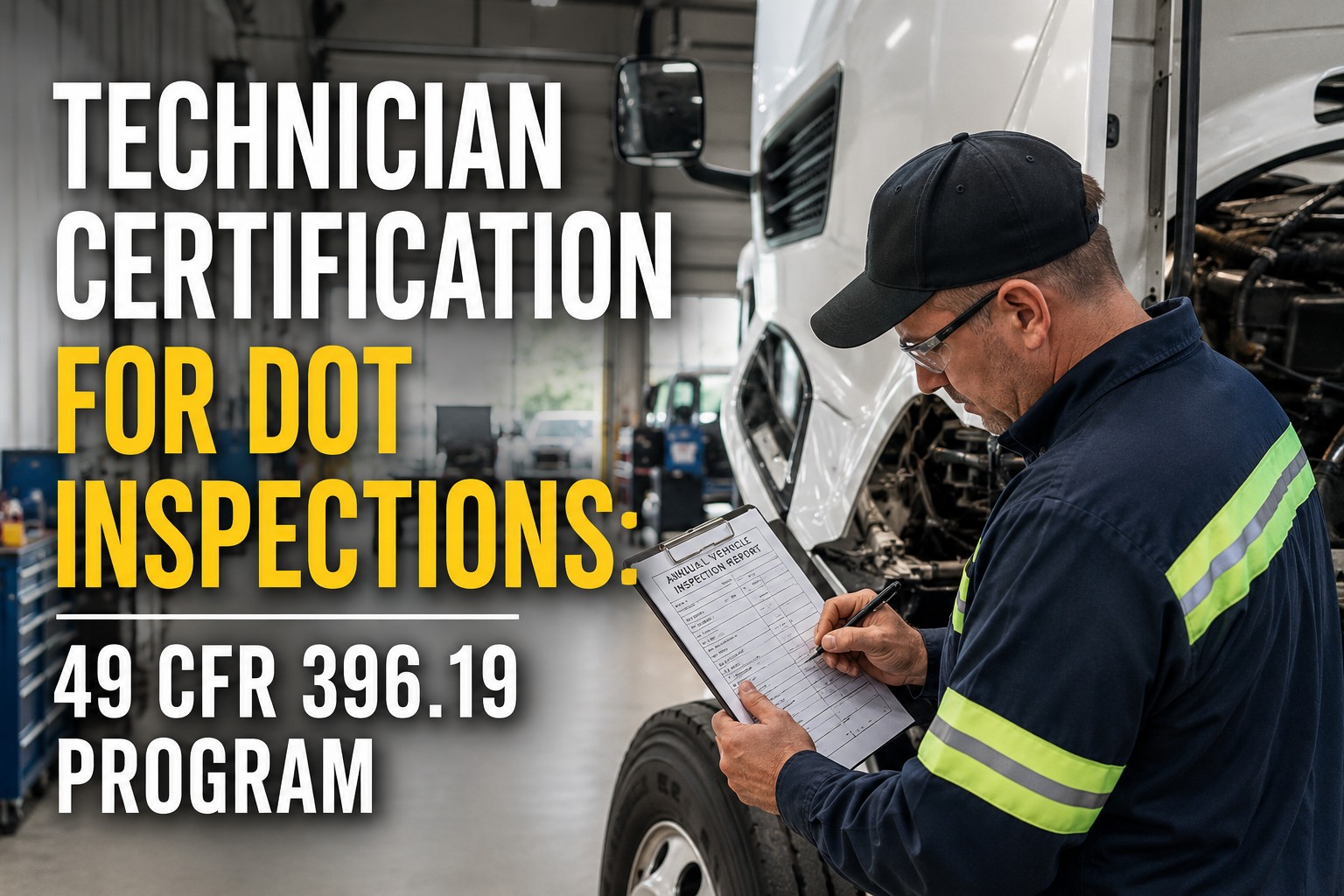
Technician Certification for DOT Inspections: A 49 CFR 396.19 Program Guide
A plain-language walkthrough of the technician training and experience requirements under FMCSA 396.19 — plus a suggested internal certification program that keeps inspector evidence files audit-ready, retention-compliant, and instantly retrievable.
What 49 CFR 396.19 Actually Requires
The regulation is short but layered. It applies to any technician — in-house, third-party garage, or leasing partner — performing the annual inspection required under 396.17. Every person signing an annual inspection report must satisfy all three criteria below, and the carrier is responsible for holding the evidence.
Understand the inspection criteria in Part 393 and Appendix A, and be able to identify defective components against those criteria.
Be knowledgeable of and have mastered the methods, procedures, tools, and equipment used when performing an inspection.
Qualify by either completing a Federal/State-sponsored training program with certificate, or by holding a combination of training and experience totaling at least one year.
The Two Paths to Qualifying Under 396.19(a)(3)
This is where most confusion lives. A technician doesn't need both a certificate and a year of experience — either path stands alone. The right choice depends on the technician's background and how quickly you need them cleared to sign inspections.
The faster route for new hires or techs without a long service record.
- Successful completion of a Federal- or State-sponsored inspection training program
- Or a certificate from a State or Canadian Province qualifying the individual for CMV safety inspections
- Certificate itself is the evidence — no accumulated experience required
- ATA-approved self-certified programs may also qualify under FMCSA exemption
The common path for experienced shop technicians already on your bench.
- Combined training and experience totaling at least one year
- Employment as a mechanic or supervisor with CMV inspection duties
- Participation in a manufacturer or apprenticeship program
- Experience as a State, Provincial, or Federal CMV inspector
Why Documentation Fails Audits More Often Than Skill Does
FMCSA auditors don't watch the technician inspect a truck. They read the evidence file. The technician can be genuinely excellent — decades of experience, deep tool mastery — and the finding lands anyway if the paper trail can't stand up on its own. These are the five failure modes we see most.
A training completion certificate with no date, or a date in a form that can't be verified, undermines the entire timeline.
Path B relies on documented experience. Verbal "he's been doing this for years" does not satisfy the recordkeeping requirement.
Files are purged when a tech leaves — but 396.19(b) requires retention for one year after separation. Auditors ask.
Sending vehicles to an outside garage doesn't remove the carrier's duty — you still need evidence for the tech who signed.
Some certificates carry expiration dates. Without renewal alerts, a lapsed cert invalidates every inspection signed after it.
Every Inspector Evidence File, One Click Away
Truck Inspection & Maintenance stores every technician's certificates, training records, experience log, and inspection history in a single profile that links directly to every annual inspection they sign — so when an auditor asks for the evidence behind a specific report, you produce it in seconds, not days.
A Suggested Internal Certification Program
The regulation sets the floor. A good internal program raises it — giving your shop a repeatable process that qualifies techs faster, holds evidence in a durable format, and passes audits without last-minute scrambling. Here's a five-stage program most fleets can stand up in a quarter. Start free and map these stages directly into technician profiles from day one.
On hire or program launch, document each tech's existing training and experience. Identify which of them qualify today under Path A, Path B, or neither — and set a target date for each.
Deliver formal instruction on Part 393, Appendix A, and inspection methods. Use in-house sessions, third-party courses, or a hybrid — but capture completion for every module.
New techs shadow qualified inspectors for a defined number of inspections before signing solo. Log every supervised inspection with the qualified tech's countersignature.
A designated supervisor certifies in writing that the tech meets all three 396.19(a) requirements, with dates and supporting evidence attached. This becomes the anchor of the evidence file.
Annual review of each active inspector's file. Refresh training as regulations change, track any expiring certificates, and confirm the file is retrieval-ready if an auditor calls tomorrow.
How Truck Inspection & Maintenance Runs the Program for You
The regulation is a paperwork problem as much as a training problem — and paperwork problems are what maintenance software should solve. Here's exactly how our platform maps to each part of 396.19 and the internal program above.
Attach training certificates, module completions, and quiz results to each tech's profile. Every Part 393 refresher is timestamped and versioned.
Supervised-inspection logs, tool proficiency check-offs, and countersignatures live in the same profile — no separate binder to lose.
Every annual inspection a tech signs auto-logs to their experience record, building a durable, dated history no manual spreadsheet can match.
Departed-technician files auto-archive with the required tenure-plus-one-year retention. Nothing gets purged early, nothing gets lost.
Certificates with expiration dates trigger renewal alerts to the tech and their supervisor before they lapse — no invalid inspections.
When DOT asks who signed inspection #12,847, one click surfaces the tech's full evidence file — certificates, experience log, training history.
Frequently Asked Questions
Yes. If the person who signed a 396.17 annual inspection doesn't meet 396.19 qualifications — or if the carrier can't produce evidence they did — FMCSA can treat the inspection as invalid. That can pull the vehicle out of service and cascade into other findings for every day the truck operated on that inspection. Prevention is entirely a documentation discipline. Start free and never lose an evidence file again.
Yes, with one exception. Under 396.19(b), the carrier must retain qualification evidence for the specific technician who signed the inspection — even when that technician works for an outside garage or leasing company. The only carve-out is for inspections performed as part of a State periodic inspection program, where the state's oversight substitutes for the carrier's file. Ask third-party providers for a copy of every signing technician's qualification evidence and keep it in your own records.
The regulation is broad: employment as a mechanic or supervisor with CMV inspection duties, participation in a manufacturer- or union-sponsored apprenticeship program, or experience as a State, Provincial, or Federal CMV inspector all count. The key is that the training or experience must be documented, add up to at least one year in combination, and specifically relate to commercial motor vehicle inspection — not general auto repair.
One full year after the technician stops performing annual inspections for your fleet. That means if an inspector signed inspections through November 2026 and then left, you must retain their qualification file through November 2027 at minimum. Many carriers retain longer as best practice — and with digital storage, the marginal cost of longer retention is effectively zero. Ask about our default extended retention policy.
Yes. 49 CFR 396.25 sets a parallel — and equally documented — qualification standard specifically for individuals who inspect, repair, or maintain brake systems on CMVs. The structure mirrors 396.19: knowledge, method mastery, and training or experience totaling at least one year. Many technicians hold both qualifications, but each requires its own evidence in the file. Our platform tracks both under a single tech profile.
Turn 396.19 Compliance Into a One-Click Answer
Truck Inspection & Maintenance is the fleet maintenance management software built around the reality that inspections, technicians, and evidence files all belong in one system. Every certificate, every experience log, every annual inspection signature — linked together and instantly retrievable — so your next DOT audit is a search, not a scramble.