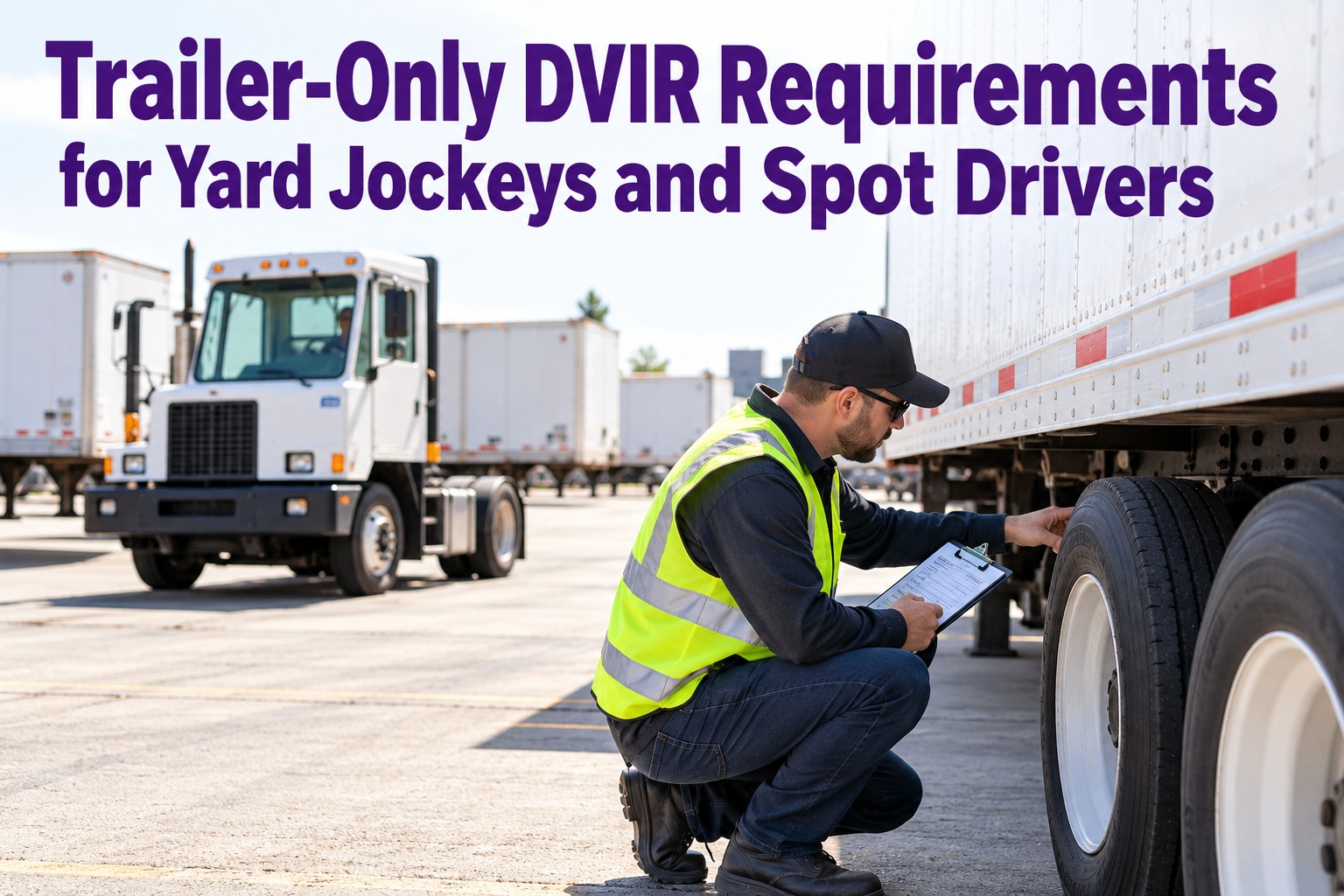
Yard moves are where DVIR compliance quietly goes dark. A jockey shuttles forty trailers a shift, spots them at the dock, leaves them in the lot — no over-the-road run, no obvious "trip," and somewhere in that churn the paper stops. But the trailer a spot driver pulled still has brakes, lights, and a coupling that either worked or didn't, and the regulation doesn't stop caring just because the move was short. A trailer left with an uncaught defect carries it straight into the next carrier's hands. This guide covers what a trailer-only DVIR has to show, who signs it, and why the yard is exactly where auditors look. Start free and put a trailer-only DVIR on every yard move.
The Yard Is Your DVIR Blind Spot. Close It.
Spot pulls and yard shuttles generate real DVIR obligations — but they're the moves most likely to skip the report, and a trailer left with an uncaught defect becomes the next carrier's problem and your audit finding. Truck Inspection & Maintenance Management Software gives yard jockeys and spot drivers a fast trailer-only inspection on their phone, routes any defect to a graded work order, and keeps the full sign-off chain and defect history attached to the trailer — not lost in the churn.
Why the Yard Gets Skipped
The DVIR habit was built around the over-the-road trip: pre-trip, drive, post-trip, file. Yard work doesn't fit that shape. A jockey isn't taking a "trip" in the usual sense — they're making dozens of short moves, and the mental trigger for "do a DVIR now" never fires. So the inspection that would catch a dragging brake or a dead marker light simply doesn't happen, and the trailer moves anyway. The gap isn't that anyone decided to skip it; it's that the yard never looked like the situation the rule was written for.
What a Trailer-Only DVIR Must Cover
When a driver operates a trailer, the inspection report covers the trailer's own safety components — the parts that affect safe operation or could cause a breakdown. You're not inspecting a tractor; you're inspecting the box and its running gear. These are the component areas a trailer-only DVIR addresses under 49 CFR 396.11.
On the Yard vs. On the Road
The common question is whether a move that never touches a public road needs a DVIR at all. The honest answer is that it's a grey area that turns on whether the operation counts as a commercial move in commerce — and the moment a trailer crosses or runs on a public road, the obligation is clear. Rather than litigate each move, the practical standard most fleets adopt is simple: if the trailer is going to be pulled and could end up on the road, inspect it. The risk of guessing wrong is a defect leaving the property undocumented.
A move that never leaves the yard sits in a grey zone — the DVIR obligation depends on the specifics of the operation. But a defect found here is still a defect, and documenting it costs nothing.
Once the trailer runs on a public road, it's clearly a commercial motor vehicle operation and the full 49 CFR 396.11 DVIR obligation applies. No ambiguity.
This is general information, not legal advice — confirm your specific obligations with your compliance team or counsel. The safe operating standard is to inspect any trailer that will be pulled, so a defect never leaves the property uncaught.
The Sign-Off Chain Still Applies
A trailer-only DVIR isn't a lighter document — it carries the same certification chain as any DVIR. Three sign-offs, in order, and the record kept. In the yard, with trailers changing hands constantly, this chain is what keeps a defect from vanishing between the person who found it and the person who pulls it next.
The yard jockey or spot driver records the trailer condition and notes any defect found, specifically — not "trailer bad."
Any defect affecting safe operation is repaired and certified — or certified as not needing repair — before the trailer moves on.
Whoever pulls the trailer next reviews and acknowledges the prior certification before operating it.
Defect reports and their repair certification are retained for 3 months. In the yard, the weak link is step 3 — the next driver who never saw what the last one found.
Keep the Defect With the Trailer, Not the Driver
In a yard, trailers outnumber drivers and change hands all day — so a defect has to live with the trailer, not in one driver's memory. Truck Inspection & Maintenance Management Software attaches every DVIR and defect to the trailer as its own asset: a jockey runs a fast trailer-only check on their phone, any defect opens a graded work order, and the next driver to hook that trailer sees its open history before pulling. Leave it in the lot and the record stays with it — so nothing rolls out of the yard carrying an uncaught, undocumented defect.
Drop-and-Hook: The Vanishing Defect
The yard's hardest compliance problem is the parked, unhooked trailer. It sits in the lot or at a customer with no tractor and no driver watching it, then gets hooked by someone who never saw its last inspection. That's the blind spot in which a defect logged on Monday is unknown to the driver who pulls it Thursday — unless the record travels with the unit.
What Auditors Look For
When a compliance review reaches your yard operation, the questions are specific. Auditors aren't impressed by volume of paper — they want the records organized by trailer, retrievable, and showing attention to the categories that actually put trailers out of service.
| What they check | What they expect to see |
|---|---|
| Defect DVIRs retained | 3 months of reports plus matching repair certification |
| Searchable by trailer | Records retrievable per trailer, driver, date, or defect type |
| The sign-off chain | Driver, mechanic, and next-driver acknowledgment all present |
| High-OOS categories | Attention to brakes, tires/wheels, and lights — the top trailer OOS defects |
| Yard moves covered | Evidence the yard isn't a documentation gap |
Frequently Asked Questions
Do yard jockeys and spot drivers really need to do DVIRs?
What does a trailer-only DVIR need to cover?
Who signs a trailer DVIR in a yard operation?
What happens to a defect when a trailer is parked and unhooked?
How long do we keep trailer DVIR records?
Make the Yard as Documented as the Road
Truck Inspection & Maintenance Management Software gives yard jockeys and spot drivers a fast trailer-only DVIR on their phone, routes every defect to a graded work order, and keeps the inspection, the sign-off chain, and the defect history attached to the trailer as its own asset. Drop it, hook it, hand it to another carrier — the record travels with the unit, the next driver sees it before pulling, and the three-month retention builds itself. That's how fleets turn the yard from a compliance blind spot into audit-ready evidence, one trailer at a time.