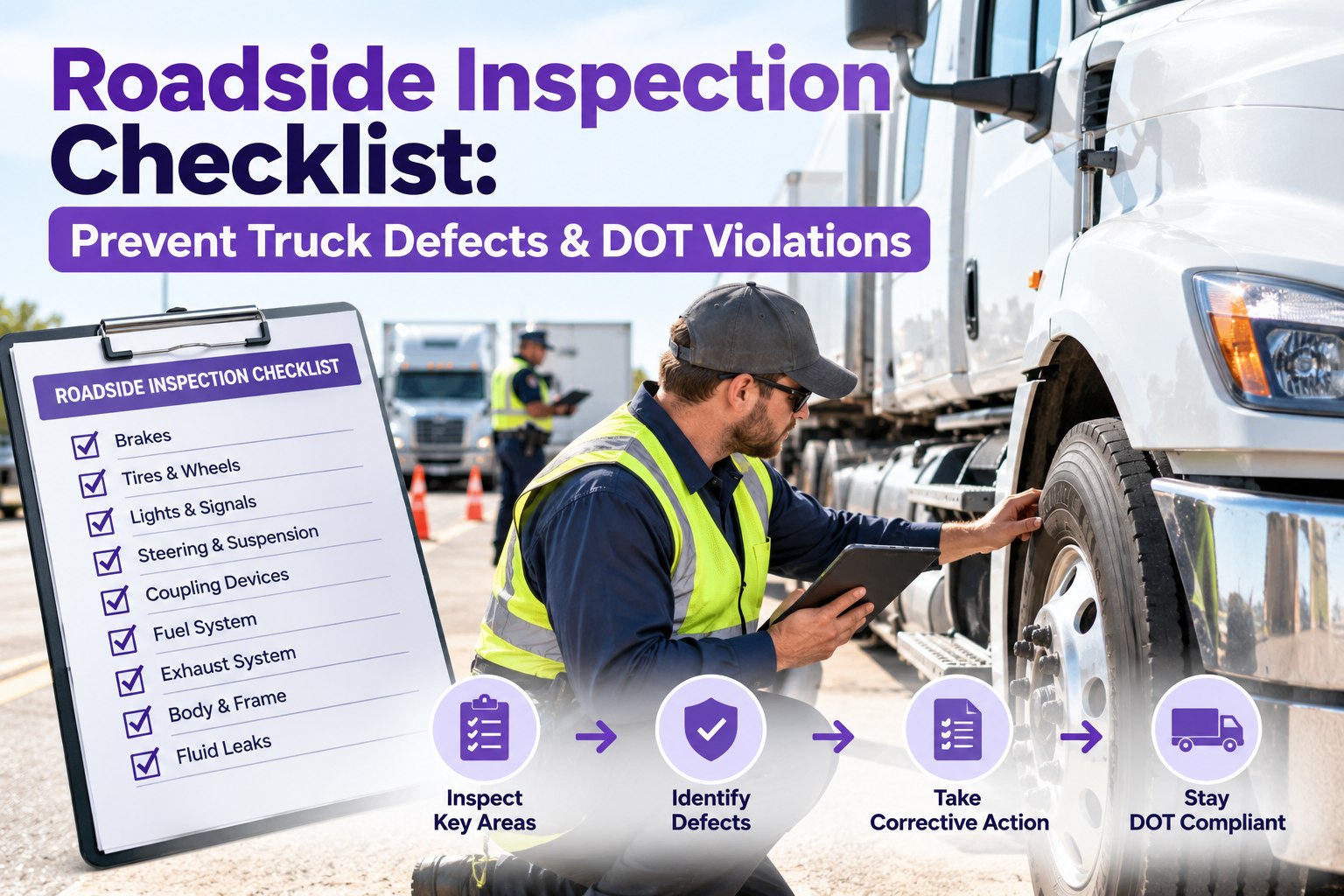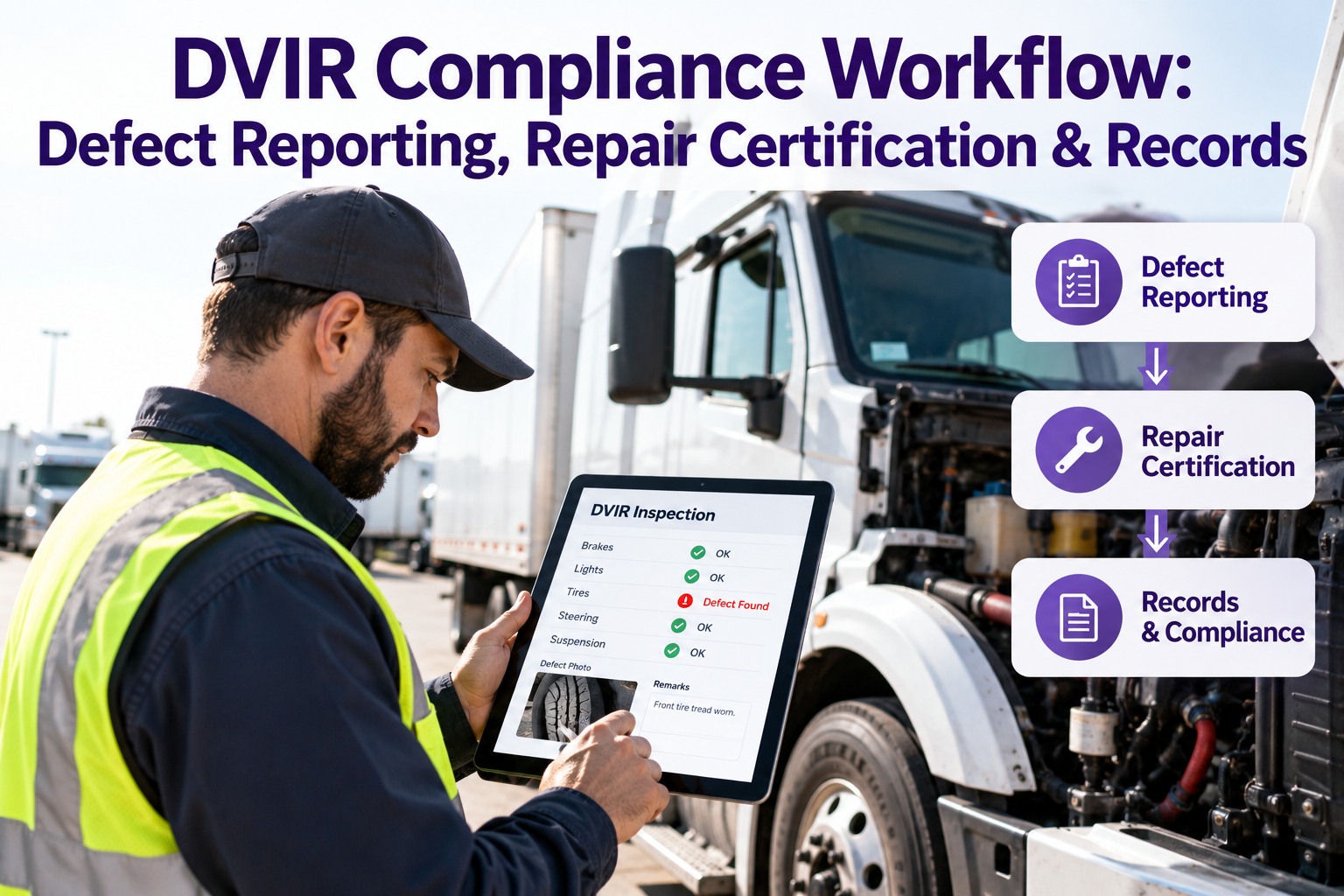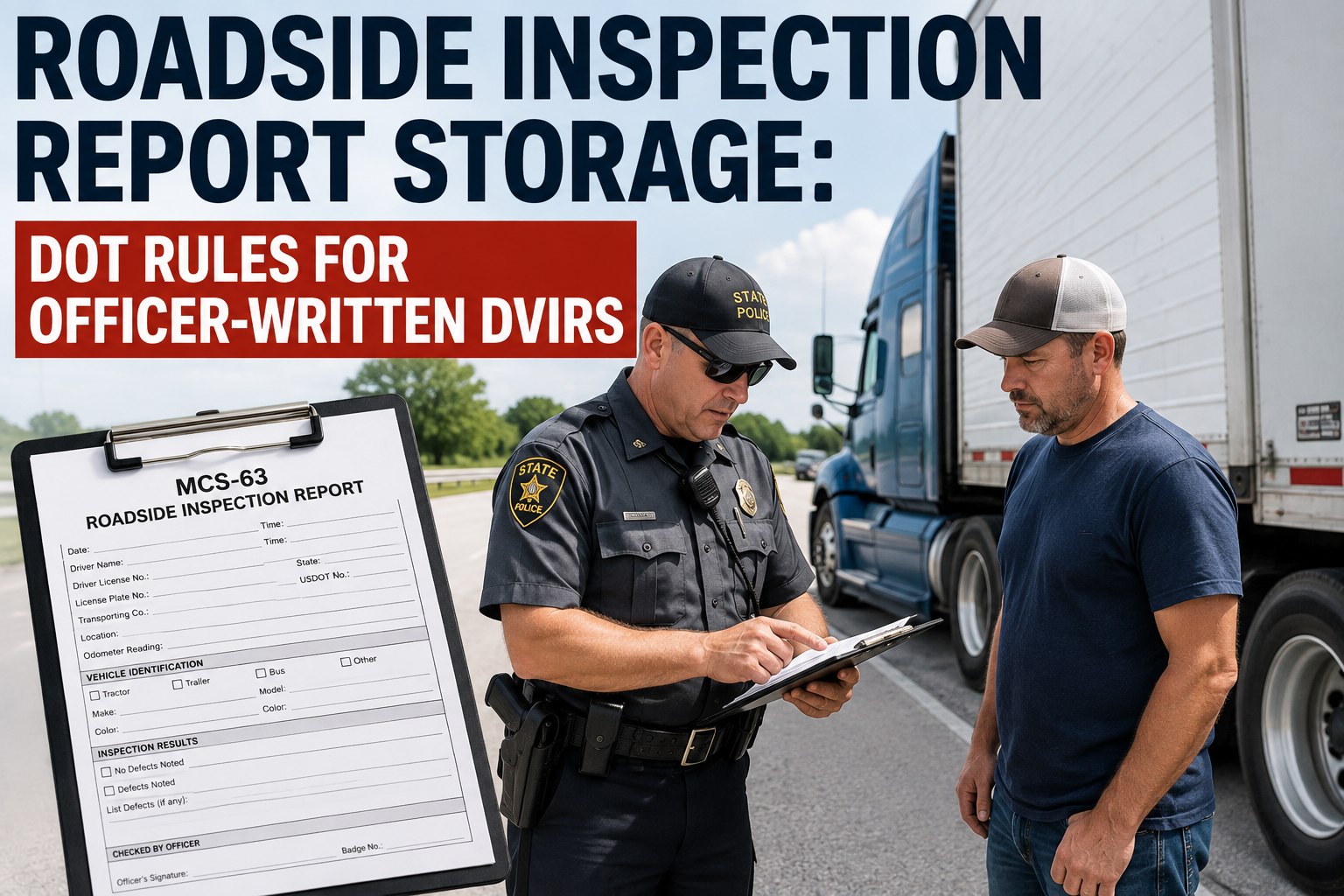
When a DOT officer or CVSA-certified inspector writes a roadside inspection report, that document instantly becomes a federal recordkeeping obligation with a 15-day compliance window and a 12-month retention requirement. Miss the certification deadline, misplace the paper copy, or fail to correct a noted violation and you're facing civil penalties that can exceed $15,000 per violation — plus a percentile hit in the 2026 CSA methodology. This article breaks down 49 CFR § 396.9, the recent 2026 disposition rule change, and the exact process for logging and storing roadside reports, plus how Truck Inspection & Maintenance keeps every officer-written report inside a defensible audit chain. Start a free trial to build the recordkeeping workflow today.
Roadside Inspection Report Storage: DOT Rules for Officer-Written DVIRs
Officer-written roadside inspection reports carry a 15-day certification window and a 12-month retention obligation. The 2026 disposition rule change, the storage rules, and the exact workflow that keeps every report audit-ready from the moment it hits the cab.
What a Roadside Inspection Report Actually Is
A roadside inspection report — officially the Driver/Vehicle Examination Report, or DVER, and often called the MCS-63 in older references — is generated whenever a special agent of FMCSA or a CVSA-certified state officer inspects a commercial vehicle. It's a federal document from the moment it's written, and it triggers recordkeeping obligations that are separate from and stricter than a driver's own DVIR.
FMCSA special agents and state law enforcement officers certified under CVSA — not shop mechanics, not drivers. The distinguishing mark: it comes from an inspection performed by a government inspector.
During any of six levels of roadside inspection — Level 1 (full North American Standard), Level 2 (walk-around), Level 3 (driver-only), Level 4 (special study), Level 5 (vehicle-only), Level 6 (radioactive).
Officer identity and agency, inspection level and date, unit info, driver info, all violations found (with citation to specific CFR sections), OOS orders if any, and a certification block for the carrier to sign.
Every violation on the report feeds directly into the carrier's CSA Safety Measurement System scores under the 2026 methodology. The document is also the primary evidence in any DataQs challenge.
The Three-Stage Compliance Timeline Under § 396.9
49 CFR § 396.9 lays out an unambiguous three-stage timeline from the moment an officer hands the report to the driver. Miss any stage and you're outside compliance — even if the underlying violations were fixed.
The driver who receives the report must transmit a copy to the motor carrier upon arriving at the next terminal or facility. If the driver won't reach a terminal within 24 hours, the report must be immediately mailed, faxed, or electronically transmitted.
An official of the motor carrier must examine the report, ensure all noted violations are corrected, sign the certification block ("Signature of Carrier Official, Title, and Date Signed"), and return the completed form to the issuing State agency if that agency requests it.
The signed report must be retained at the motor carrier's principal place of business, at the intermodal equipment provider's principal place of business, or where the vehicle is housed — for 12 months from the date of the inspection. Available on demand for FMCSA compliance review.
The 2026 Rule Change: What's Different Now
FMCSA finalized a significant change to § 396.9(d)(3)(ii) in June 2026 that removed some — but not all — of the paperwork burden on carriers. Understanding what changed and what didn't is essential to avoiding a compliance gap based on outdated procedures.
Carriers had to certify and return the completed roadside inspection form to the issuing State agency in all cases — even to States that no longer requested return of the form. Created significant paperwork burden with no compliance benefit for many agencies.
Carriers now return the completed form to the issuing State agency only if that agency requests it. Retention obligation is unchanged — carriers still keep a signed copy for 12 months in all cases, and violations must still be corrected within 15 days.
The Recordkeeping Requirements You Cannot Miss
Beyond the 15-day certification, the storage requirements themselves have specific technical elements a carrier must satisfy. Getting any of these wrong turns a compliant report into an audit finding.
Reports must be stored at the motor carrier's principal place of business, the intermodal equipment provider's principal place of business, OR where the vehicle is housed. Not the driver's cab, not the shop foreman's desk, not a manager's home.
Retention clock starts on the date the officer wrote the report, not the date the carrier received or certified it. A 14-month-old report that was signed 3 months ago is still eligible for disposal.
The signature of a carrier official, that official's title, and the date signed. Missing any of the three = incomplete certification = compliance failure regardless of whether violations were corrected.
Records must be produced during an FMCSA compliance review or intervention. "Available" means accessible within reasonable time — not "somewhere in a warehouse full of boxes."
The full report — every page, every violation, officer identity, certification block. Faded thermal paper or partial scans are the same as no record for compliance purposes.
FMCSA allows electronic recordkeeping as long as records are reproducible on demand in a legible form. This is the practical path for most modern fleets — properly implemented, it's more defensible than paper.
The Penalty Framework for Missed Compliance
Failure to certify, return, or retain roadside inspection reports triggers civil penalties that scale with severity and pattern. The bar is not "did you eventually get it done" — it's whether the record is complete and produced on request during audit.
Recordkeeping violations under 49 CFR Part 396 can exceed $15,000 per violation — and each missing or improperly maintained report can be counted as a separate violation.
A missed roadside report certification in a compliance review can escalate an audit's severity rating — turning what might have been a satisfactory rating into conditional or unsatisfactory.
Under the 2026 CSA methodology, uncorrected violations continue to weigh against the Vehicle Maintenance BASIC percentiles — including the new Driver Observed category.
Deliberately falsifying certification (claiming a violation was corrected when it wasn't) crosses from civil penalties into potential criminal prosecution under federal law.
Every Officer Report, Logged and Traceable
Truck Inspection & Maintenance builds the full chain-of-custody for every roadside report — from driver upload the day of the inspection, through defect routing to shop, to certification signature, to 12-month archival with searchable retrieval. One platform, one audit chain, one system that produces the right document within seconds of an FMCSA request.
The Workflow That Passes an Audit Every Time
Compliance is what your workflow produces on the worst day, not the best day. A workflow that requires a driver to hand-carry a paper form back to the terminal, then a dispatch clerk to file it in a physical binder, then a mechanic to remember to sign a certification, will fail — eventually and predictably. Here's the workflow that doesn't. Start free and configure this workflow inside a single platform.
Report is captured to the platform the moment it's issued — GPS-tagged, timestamped, tied to the unit. The 24-hour delivery clock is satisfied immediately, not the day the truck rolls back to the yard.
Each violation on the report becomes a defect record and a work order line. Shop foreman sees what needs correction before the truck even returns.
Mechanic certifies each corrective action with timestamp and photo evidence. Chain-of-custody documented per violation — the exact evidence chain FMCSA looks for.
Official reviews the corrected violations and applies the certification signature within the platform. Signature includes name, title, and date automatically — no missing blocks.
Report, certification, and correction evidence all archived together — searchable by unit, driver, date, or violation. Ready for retrieval on any FMCSA request.
The Compliance Mistakes That Show Up Every Audit
Every failed compliance review on § 396.9 makes the same handful of mistakes. Watch for these — they're the ones auditors know exactly how to find.
Frequently Asked Questions
No — the requirement now depends on whether the issuing State agency requests return of the form. Some States still require it, some don't. The safe default is to return every report unless you have specific written confirmation from that State agency that they've waived the requirement. Maintain a state-by-state disposition tracker: which States you're currently returning to, which you're not, and when each policy was last confirmed. Assume you must return until proven otherwise. Start free and track disposition state-by-state in one place.
Yes. FMCSA permits electronic storage of records required under Part 396 as long as they can be reproduced on demand in a legible form. In practice this means the storage system must be capable of producing a full, legible reproduction of the original report within reasonable time when FMCSA requests it. Well-implemented electronic storage is more defensible than paper — no fading, no lost binders, searchable by any field, retention automatically calculated from the correct date. It also lets you satisfy the 24-hour transmission requirement from the roadside itself.
Different documents, different regulations. A DVIR (Driver Vehicle Inspection Report) is what a driver files at end-of-shift under § 396.11 — a self-inspection of the vehicle. A roadside inspection report is what a DOT officer or CVSA-certified inspector writes under § 396.9 after inspecting your truck at the roadside. DVIRs are retained for 3 months (post-trip inspections only, and only if defects were noted). Roadside inspection reports are retained for 12 months, all cases, and require the 15-day certification workflow. Both exist. Both matter. Don't conflate them in your recordkeeping system.
The regulation is written as an absolute — "within 15 days" — with no explicit grace period. In practice, an FMCSA investigator finding a report certified past 15 days may treat it as a recordkeeping violation subject to civil penalty. More significantly, if the underlying violations weren't actually corrected within the window, the compliance failure compounds: uncorrected violation plus late certification plus potential falsification concern if the certification date was backdated. The correct move on a late-discovered report is to certify immediately with the actual signature date, document what happened, and treat it as a process failure to address system-wide. Ask about certification deadline tracking.
Yes. Every level of roadside inspection — from Level 1 full North American Standard down to Level 3 (driver only) — generates a Driver/Vehicle Examination Report subject to the same § 396.9 requirements. A Level 3 might result in fewer or no vehicle violations, but the report itself still requires the same delivery, certification, and 12-month retention workflow. Any recorded violations must be corrected within 15 days regardless of inspection level.
Turn Every Roadside Report Into an Audit-Ready Record
Truck Inspection & Maintenance automates the full § 396.9 workflow — driver upload from roadside, auto-routed defect work orders, digital certification signatures, and 12-month archival with searchable retrieval. Mobile-first for drivers, work-order-driven for the shop, audit-ready for management. Compliance without the paperwork.