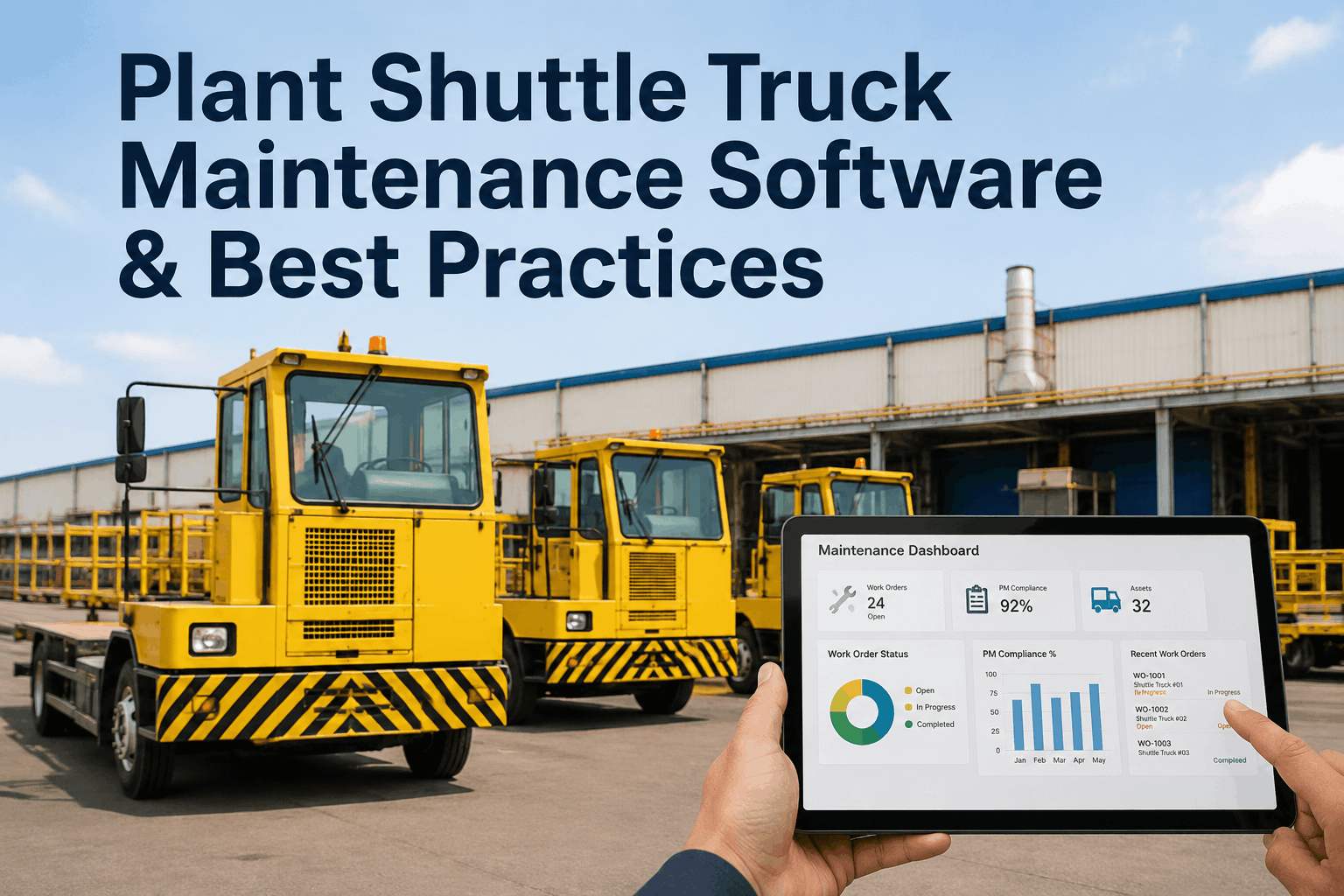
Plant shuttle trucks — yard tractors, spotters, plant haulers, and between-building delivery vehicles — operate under a different maintenance profile than any other commercial truck category. The combination of continuous 8-24 hour daily operation, high-cycle trailer hookup activity (50-200+ daily moves typical), low-speed urban facility driving, multi-shift operator rotation, and mixed regulatory status (some operate on plant property only, others cross public roads) produces wear patterns and management challenges that generic fleet software addresses poorly. Major equipment manufacturers include Capacity (TJ7000, TJ6000), Kalmar Ottawa (T2 series), Autocar (Class 8 yard tractor), and increasingly electric yard tractors entering the market. The software needs reflect this operational reality: engine-hour-primary scheduling rather than mileage-based, KPI tracking optimized for cycle counts and uptime metrics, multi-shift operator coordination, and tight integration with manufacturing operations rather than highway compliance focus. Start your free trial of our truck inspection and maintenance software to deploy plant shuttle-specific workflow — live in 10 minutes, free for up to 3 trucks.
Plant Shuttle Truck Maintenance Software & Best Practices
Why Plant Shuttle Truck Maintenance Is Different
Plant shuttle trucks face operational conditions that produce wear patterns and management challenges no generic fleet software addresses well. Six factors make shuttle truck maintenance operationally distinct.
Continuous High-Hour Operation
High-Cycle Trailer Moves
Low-Speed Urban Operation
Multi-Shift Operator Rotation
Mixed Regulatory Status
Production Integration Critical
The 8 Must-Have Features for Plant Shuttle Software
These 8 features distinguish plant shuttle-focused software from generic fleet platforms. Contact our sales team to evaluate platform fit against your shuttle operation requirements.
01 Engine-Hour-Primary PM Scheduling
02 Pre-Shift Inspection Workflow
03 Work Order Management
04 Parts Inventory Tracking
05 Multi-Shift Operator Coordination
06 KPI Dashboards
07 Cost Tracking & Analysis
08 Manufacturing System Integration
The 6 Key KPIs for Plant Shuttle Operations
Six KPIs drive plant shuttle truck operational excellence. Track them monthly with trending analysis; act on degradation before production impact develops.
| KPI | What It Measures | Target / Benchmark |
|---|---|---|
| Hours Operated | Engine hours per shift / per day / per month | Utilization data baseline |
| Cycles per Shift | Trailer moves per operating hour | 15-25 cycles/hour typical for yard tractors |
| MTBF | Mean Time Between Failures (operational hours) | 400-800 hours for well-maintained shuttle |
| MTTR | Mean Time To Repair (defect to back in service) | Under 4 hours for in-house repairs typical |
| Cost per Operating Hour | Total maintenance cost ÷ operating hours | $3-8 per hour typical for well-maintained units |
| Uptime % | (Available hours ÷ Scheduled hours) × 100 | 92-97% for well-managed shuttle operations |
These benchmarks vary by equipment type, age, and operating conditions. New yard tractors should achieve 95%+ uptime; aging units approaching replacement may drop to 85-90%. The trending matters more than absolute values — a unit dropping from 95% to 88% over 6 months signals developing problems that should trigger investigation. Cost per operating hour trending similarly reveals approaching replacement economics: a unit running $3/hour at 3,000 hours rising to $8/hour at 12,000 hours indicates the maintenance cost curve approaching capital replacement cost. KPI dashboards should display 12-month trending lines, not just current values, to reveal these patterns. Without trending analysis, fleets discover declining performance only when production impact occurs.
Plant Shuttle Maintenance Best Practices
Five best practices distinguish high-performing plant shuttle operations from average. Each addresses a specific operational challenge unique to shuttle truck maintenance.
Engine-Hour-Primary PM Scheduling
Multi-Operator Pre-Shift Inspection
Defect-to-Repair Time Tracking
Parts Staging for Consumables
Production Schedule Integration
Common Plant Shuttle Truck Failures
Six failure categories produce most plant shuttle truck unscheduled downtime. Structured PM addressing these patterns prevents the majority of expensive failures.
Cooling System Failures
DPF Regeneration Problems
Transmission Wear
5th Wheel Mechanism Wear
Brake System Wear
Electrical & Cab Door Wear
Frequently Asked Questions
What's the difference between yard tractor and regular truck maintenance?
The differences are substantial despite similar appearance. Yard tractors (Capacity TJ7000, Kalmar Ottawa T2, Autocar yard tractor) are purpose-built for continuous low-speed high-cycle operation rather than highway driving. Key maintenance differences: engine-hour-primary scheduling (yard tractors accumulate massive hours at low mileage — annual hours typically 3,000-7,500+); 5th wheel mechanism maintenance critical (50-200+ daily hookup cycles vs occasional cycling on highway trucks); cooling system stress from continuous low-speed operation prevents adequate airflow; DPF regeneration problems from low-speed operation that prevents passive regen; transmission wear from continuous forward/reverse shifting; brake wear 2-3× highway baseline from constant stops; cab door wear from operator cycling (100+ times per shift). Service intervals: yard tractor oil change typically every 250 engine hours (every 2-3 weeks at high utilization vs every few months for highway trucks); brake service every 1,000-2,000 hours (vs mileage-based for highway); 5th wheel maintenance monthly (vs annual on highway trucks). Software platforms supporting yard tractors must use engine-hour-primary scheduling with cycle counting alongside calendar triggers. Generic fleet software calibrated for highway operation consistently under-services yard tractors and produces the gradual decline that ends in catastrophic failure. Start your free trial for yard tractor-specific workflow.
What KPIs should I track for plant shuttle trucks?
Six KPIs provide essential visibility into plant shuttle operations. (1) Hours Operated — engine hours per shift, per day, per month. Tracks actual utilization vs scheduled hours. Benchmark depends on operation. (2) Cycles per Shift — trailer moves per operating hour. Typical yard tractor: 15-25 cycles/hour during productive operation. Trending reveals operator efficiency differences and equipment performance issues. (3) MTBF (Mean Time Between Failures) — average operating hours between failures requiring repair. Target: 400-800 hours for well-maintained shuttle. Falling MTBF signals approaching replacement economics or PM gaps. (4) MTTR (Mean Time To Repair) — average time from defect identification to back-in-service. Target: under 4 hours for in-house repairs. High MTTR indicates process problems in defect routing, parts availability, or technician capacity. (5) Cost per Operating Hour — total maintenance cost divided by operating hours. Target: $3-8 per hour for well-maintained units. Trending reveals approaching replacement: units rising from $3/hour at 3,000 hours to $8/hour at 12,000 hours signal capital decision point. (6) Uptime Percentage — (available hours ÷ scheduled hours) × 100. Target: 92-97% for well-managed operations. New equipment should achieve 95%+; aging units may drop to 85-90% before replacement. Display all 6 KPIs with 12-month trending lines, not just current values. Trending reveals patterns that absolute values miss. Contact our sales team for KPI dashboard setup.
Do plant shuttle trucks need DOT compliance?
It depends on where they operate. Shuttle trucks operating exclusively on plant property (not crossing public roads): typically not subject to FMCSA regulations under 49 CFR Parts 380-399. OSHA jurisdiction applies — §1910.178 for powered industrial trucks (where applicable based on equipment classification), §1910.176 for materials handling, internal facility safety requirements. Shuttle trucks crossing public roads (between buildings on opposite sides of public road, to off-site staging areas, etc.): subject to FMCSA regulations including §396.11 DVIR requirements, §396.17 annual periodic inspection, §396.3 systematic maintenance, Part 391 driver qualification requirements where CDL required. CDL requirements: depends on vehicle GVWR and operation. Yard tractors typically 26,000-33,000+ lbs GVWR require CDL Class A or B; non-CDL operation possible for smaller plant shuttles. Common compliance gaps: assuming "yard only" operation when occasional public road crossings occur; not maintaining records that would satisfy DOT compliance for occasional public road operations; using non-CDL operators for occasional public road operations requiring CDL. Best practice: maintain DOT-compliant records and DOT-compliant operators for any equipment that ever crosses public roads, even occasionally. The 2026 environment: eDVIR Final Rule (March 23, 2026) authorizes electronic DVIRs for non-exempt operations. Software platforms should support both OSHA-only operations and OSHA + DOT mixed operations with integrated workflow.
How often should plant shuttle trucks have PM service?
Plant shuttle truck PM cadence runs on engine-hour-primary scheduling combined with calendar and cycle triggers. Daily pre-trip inspection: each operator, sub-5-minute workflow, before placing equipment in service. Weekly: detailed walk-around, fluid level checks, 5th wheel inspection (yard tractors), brake performance verification. Monthly: PM A service typically at 250 hours — oil and filter change, lubrication, comprehensive inspection. At high utilization this falls every 2-3 weeks. Quarterly: hydraulic fluid analysis, transmission fluid analysis, brake adjustment, comprehensive inspection. Semi-annual: major fluid changes, belt/hose inspection, cooling system service. Annual: major service including coolant change, transmission service, comprehensive structural inspection. Annual DOT (where applicable): §396.17 periodic inspection for vehicles crossing public roads. Yard tractor-specific intervals based on hours: 250-hour oil service, 1,000-hour minor service, 5,000-hour major service. Critical principle: engine hours drive most wear on plant shuttle trucks, not mileage. A yard tractor running 4,000 miles annually but accumulating 5,000 engine hours needs service calibrated to hours not miles. Mileage-based scheduling produces 50-70% under-service for continuously operating equipment. Software platforms supporting plant shuttle operations should make engine-hour-primary scheduling the default with cycle counting and calendar as secondary triggers. Sign up free for engine-hour scheduling workflow.
What software do manufacturing plant shuttle fleets use?
Manufacturing plant shuttle fleets typically use one of four software approaches. (1) Integrated fleet management platforms designed for industrial operations — handle compliance + maintenance + KPI tracking + work order management on one workflow. Best for fleets of 5-50 shuttle trucks. Pricing: $25-65 per vehicle per month typically. Recommended approach for most manufacturing operations. (2) Dedicated CMMS (Computerized Maintenance Management System) with vehicle modules — better fit when shuttle fleet is part of broader manufacturing asset management. Higher complexity, longer implementation, more comprehensive but heavier solution. (3) Standalone apps with separate systems — separate DVIR app, maintenance system, KPI tracking, parts inventory. Common in operations growing into compliance but produces data fragmentation and manual reconciliation. (4) ERP modules — SAP, Oracle, IBM Maximo with fleet modules. Appropriate only for largest manufacturing operations with broader ERP commitments. 6-18 month implementation typical. Selection considerations: validate engine-hour-primary scheduling, multi-shift operator coordination, KPI dashboard capabilities, integration with manufacturing systems (ERP, telematics, production scheduling), and procurement compatibility (state contracts, cooperative purchasing where applicable for government operations). Most platforms offer free tiers for 1-3 vehicles allowing validation before fleet rollout. Manufacturing-specific features that matter: OSHA + DOT integration, work order routing aligned with maintenance team structure, KPI dashboards displaying the 6 essential metrics, parts inventory management for common shuttle consumables.
How can I reduce plant shuttle truck operating costs?
Five approaches deliver substantial cost reduction in plant shuttle operations. (1) Engine-hour-primary PM scheduling — eliminates the gradual under-service problem from mileage-based scheduling. Catastrophic failures driven by skipped PM commonly cost 5-15× preventive service. Single avoided catastrophic engine or transmission failure pays for years of disciplined PM service. (2) Defect-to-repair time reduction (MTTR) — every hour of avoided downtime is operational hour delivered. Structured workflow reducing MTTR from 12 hours to 4 hours adds 8 productive hours per defect across the fleet. (3) Parts staging for common consumables — eliminate the 24-72 hour parts wait that produces avoidable downtime. Staged inventory carrying cost typically pays back through single avoided long parts wait. (4) Multi-shift operator coordination — operators have visibility into equipment defects identified by previous shifts; new defects get routed promptly; PM compliance verified across all shifts. Reduces the "fell through the cracks" problem that produces compound failures. (5) Production schedule integration — PM scheduled during planned production downtime where possible. Emergency repairs prioritized based on production impact. Communication with production planning prevents the "we needed that truck" emergencies. Combined impact: 20-30% reduction in maintenance cost, 5-10% improvement in uptime, substantial reduction in production disruption. Platform cost trivial compared to operational savings. Talk to our sales team for cost reduction analysis.