Engine oil is the single most consequential consumable in any commercial diesel fleet. Get the change interval and procedure right and a well-maintained Class 8 truck routinely reaches 500,000+ miles before major engine work; get it wrong and you're looking at accelerated bearing wear, sludge accumulation, and premature engine failures that cost $15,000-$40,000 per replacement. The commercial vehicle industry loses an estimated $12 billion annually to deferred and improperly executed oil change programs — costs that compound because oil degradation is invisible until the engine is already damaged. The fleets that protect their engine investment treat the oil change as a structured, multi-phase procedure with measurable acceptance criteria, not a "drain and fill" task to delegate without oversight.
Diesel oil specifications matter more in 2026 than ever. The API CK-4 standard (introduced 2016 to replace CJ-4) is backward-compatible and remains the dominant choice across most fleets — typically in 15W-40 grade, though many fleets are migrating to 10W-30 CK-4 for better cold-temperature performance and improved fuel economy. The newer API FA-4 standard offers an even lower viscosity for fuel efficiency but is not backward-compatible, so it requires explicit OEM approval per engine. Both CK-4 and FA-4 are formulated as "Low Ash" (max 1.0% sulfated ash) — critical because ash from oil additives doesn't burn off during DPF regeneration, it accumulates and clogs the filter. The right oil grade is whichever your engine manufacturer specifies; substitutions risk warranty voids and premature wear.
This guide is the complete diesel truck oil change checklist for 2026: the 4-phase structured procedure (pre-service, drain and fill, post-service, interval tracking), oil grade selection logic, filter and fluid coordination, and the documentation that turns every oil change into a predictive maintenance dataset. Start your free trial of our truck inspection and maintenance software to log oil changes and track interval compliance across your fleet — live in 10 minutes, free for up to 3 trucks.
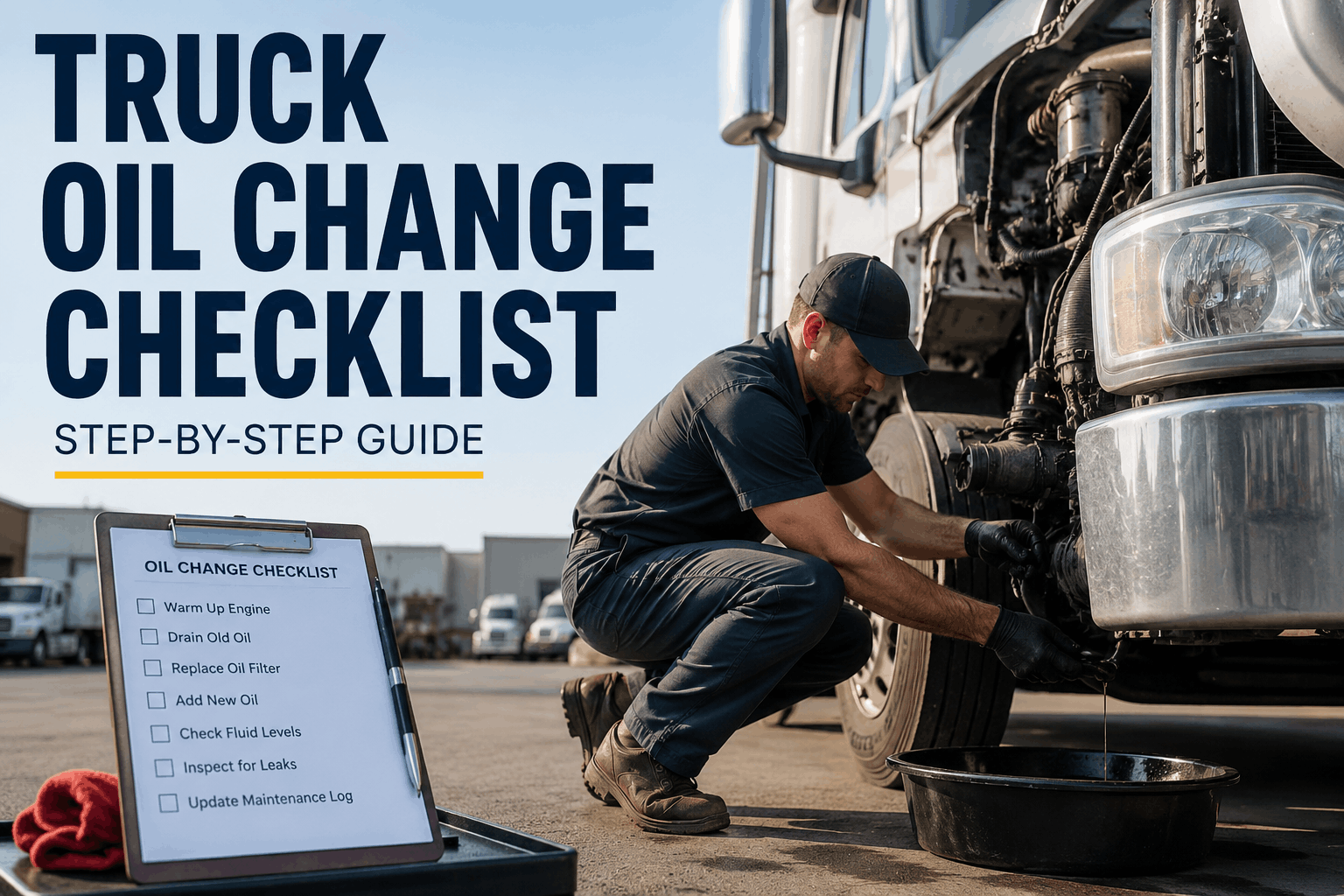
Truck Oil Change Checklist: Step-by-Step Guide
The complete 2026 diesel truck oil change framework — 4-phase procedure, API CK-4 vs FA-4 selection, oil and filter coordination, post-service verification, and the interval tracking that keeps engines running to 500,000+ miles.
The 4-Phase Oil Change Procedure
Every commercial oil change follows the same 4-phase structure with gate criteria between phases — a problem at any gate stops the procedure until resolved. Skipping a phase or accepting a non-conformance creates the failures that produce $15,000-$40,000 engine bills. Contact our sales team for help configuring oil-change workflows across your fleet.
Oil Grade Selection — CK-4 vs FA-4
Picking the wrong oil grade can void engine warranties and accelerate wear. The decision is straightforward when you follow the OEM spec — but understanding the differences helps when migrating fleets to newer grades for fuel economy gains.
Always use the exact oil specification recommended by the engine manufacturer. Using incorrect oil can void warranty and cause premature wear. Engine manuals list approved API standards and viscosity grades — that's the authoritative source. When in doubt, default to CK-4 in the manufacturer's recommended viscosity.
Oil Change Intervals — How to Pick the Right One
Interval selection is not one-size-fits-all. Operating conditions matter as much as mileage, and the wrong interval costs either money (too frequent) or engines (too extended).
| Service Profile | Interval | Conditions |
|---|---|---|
| Light-duty diesel pickup | 7,500-10,000 mi | Standard mineral oil, mixed operation |
| Class 8 highway, mineral CK-4 | 15,000-25,000 mi | Mostly highway, low idle, OEM filter |
| Class 8 highway, full synthetic | 25,000-50,000 mi | Extended-drain program + oil analysis |
| Severe service (construction, refuse) | 5,000-10,000 mi | Heavy load, dust, frequent stops |
| High-idle operation (30%+ idle) | Per hours, not miles | 250-400 engine hours typical |
| Cold-weather northern operation | Shortened 20-30% | Fuel dilution from short trips |
High idle time is severe duty for engine oil. Idling engines run cooler, preventing oil from reaching temperatures high enough to evaporate water and unburned fuel — leading to fuel dilution and acid formation. If trucks idle more than 30-40% of the time, track engine hours rather than miles for interval scheduling. Modern fleet maintenance software can auto-convert idle hours into "equivalent miles" for unified scheduling.
Coordinated PM — What to Do During Oil Change
The truck is already on the rack with the engine warm. Bundle other quick PM items into the same service appointment to maximize labor efficiency and minimize total downtime.
Frequently Asked Questions
Diesel oil change intervals run 7,500-15,000 miles for typical operation, with extended-drain synthetic programs reaching 25,000-50,000 miles when validated by oil sample analysis. The exact interval depends on operating conditions: light-duty diesel pickup 7,500-10,000 mi; Class 8 highway operation with mineral CK-4 oil 15,000-25,000 mi; severe service (construction, refuse, heavy loads) 5,000-10,000 mi; high-idle operations measured in engine hours (typically 250-400 hours) rather than miles. Always follow OEM-recommended intervals from the engine manual as the starting point, then adjust based on actual operating conditions and oil-sample trend data. Start your free trial to track intervals by operating profile across your fleet.
Both are current API diesel oil categories introduced in 2016. CK-4 replaced CJ-4 as the backward-compatible standard — meaning it works in virtually all diesel engines, both new and older. FA-4 is a lower-viscosity formulation designed to help engine makers meet fuel efficiency standards, but it's not backward-compatible — only specific engines designed for FA-4 may use it, and only with explicit OEM approval. Both are "Low Ash" formulations (maximum 1.0% sulfated ash) to minimize buildup in Diesel Particulate Filters, since ash from oil additives doesn't burn off during DPF regeneration. For most fleets, CK-4 remains the default choice. Check your engine manual for the authoritative spec — using incorrect oil can void warranty.
Significantly. High idle time is severe duty for engine oil — idling engines run cooler, preventing oil from reaching temperatures high enough to evaporate water and unburned fuel. This causes fuel dilution (thinning the oil) and acid formation (corrosion). If trucks idle more than 30-40% of operating time, switch to engine-hour-based interval tracking instead of mileage-based — typically 250-400 hours between changes. Modern fleet maintenance software can convert idle hours into "equivalent miles" so all your tracking stays unified. Idle-heavy operations include yard tractors, refrigerated trailers with reefer units, construction equipment, refuse trucks, and any vehicle running PTO-driven equipment. Contact our sales team for help setting up multi-trigger oil-change intervals.
Yes — oil sample analysis is one of the highest-value predictive maintenance tools in fleet operations. A lab analysis at $20-$40 per sample reveals wear-metal content (iron, copper, aluminum, chromium) that indicates which internal components are wearing, coolant or fuel contamination, soot loading, and oil degradation. Trending values across multiple samples per engine predicts bearing failures, liner wear, and contamination problems 6-10 weeks before they cause breakdowns. The cost is modest against the $15,000-$40,000 cost of engine failure. Best practice: pull a sample at every oil change, log results against the vehicle, and track trends. A single sample is a snapshot; the trend across samples predicts failures. Sign up free to log and trend oil sample results per engine.
Only with structured analysis — not by guesswork. Extended-drain programs are real and valid (full-synthetic CK-4 oils can run 25,000-50,000 miles with proper validation) but they require oil sample analysis at each change to confirm the oil is still protecting the engine. The data-driven approach: start at OEM-recommended interval, pull samples for 3-4 cycles, review wear-metal and contamination trends, then extend interval only when analysis confirms protection margin remains. Extending intervals without analysis is gambling with the $15,000-$40,000 engine. The commercial vehicle industry loses an estimated $12 billion annually to deferred and improperly executed oil change programs — most of that comes from fleets stretching intervals based on cost optimization rather than data. The math doesn't work in your favor when one engine fails. Talk to our sales team for help structuring an analysis-driven program.
Three tied for first. (1) Incomplete drain — draining cold oil that leaves significant old oil in the system, contaminating new oil immediately. Bring oil to operating temperature before draining. (2) Wrong oil grade — using CJ-4 or non-CK-4 oil in newer engines, or substituting different viscosity than OEM specifies, voiding warranties and accelerating wear. Always verify spec from engine manual, not memory. (3) Over-torqued drain plug or oil filter — stripped threads on the drain plug create leaks that aren't caught until significant oil loss; over-torqued filters distort gaskets and leak. Use torque wrench, follow OEM specs. Honorable mention: skipping the post-service leak check — leaks discovered after the truck leaves are catastrophic versus the 30 seconds it takes to verify before release. Sign up free to deploy structured oil-change workflows that prevent these mistakes.
Run Engines to 500,000+ Miles With Structured Oil Programs
500+ fleets deploy structured oil-change workflows on our truck inspection and maintenance software: 4-phase service templates, multi-trigger interval scheduling (mileage + hours + calendar), oil-sample integration, photo evidence, technician sign-off, and complete PM history. The 2026 standard for protecting your most expensive fleet asset.