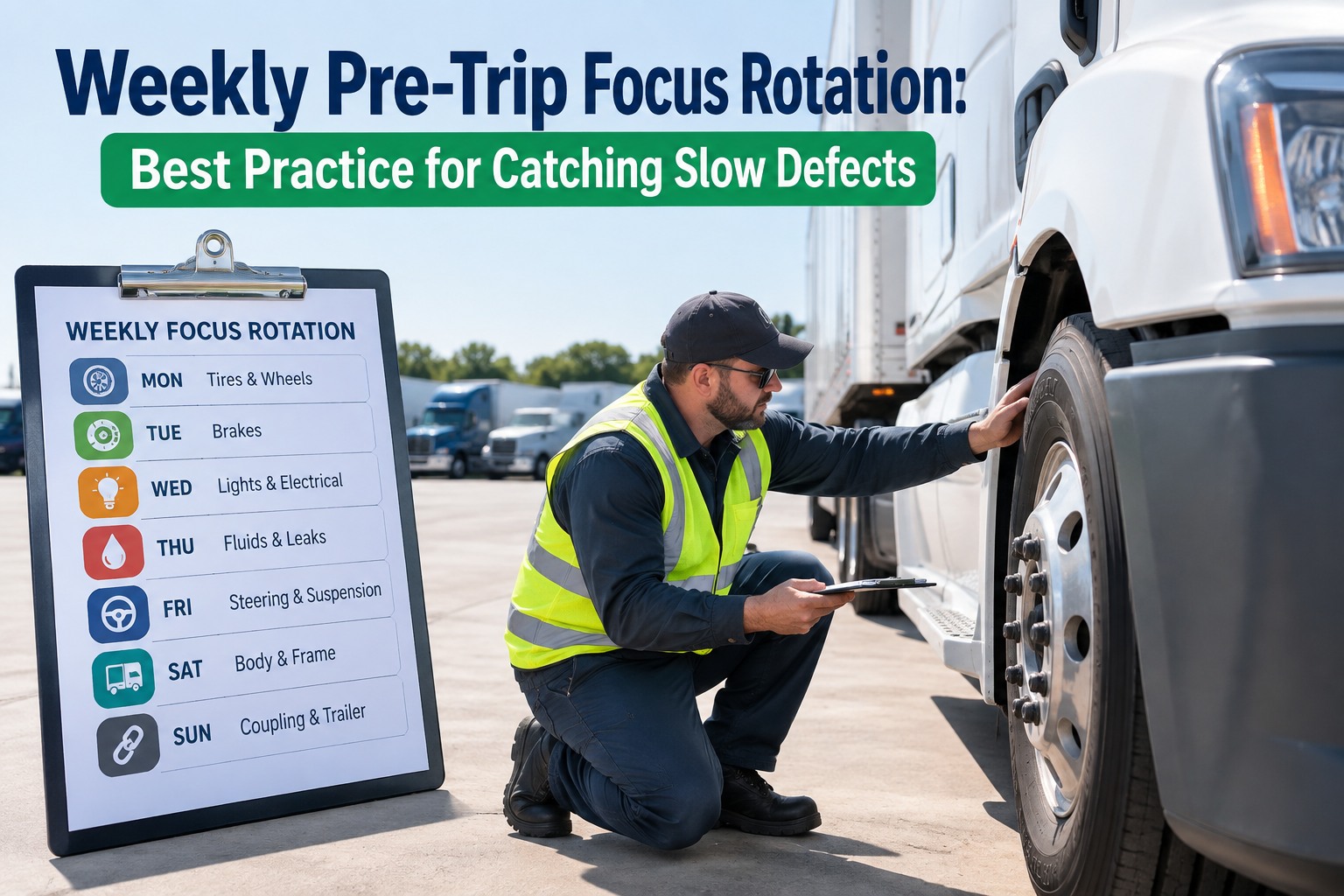
Here's the uncomfortable truth about the daily walk-around: a driver who inspects the same 45 checkpoints every single morning stops seeing any of them by week two. The eye glides over the brake chamber, the tire sidewall, the marker light — a familiar shape, "looks fine," move on. That's exactly how a slow-developing defect survives thirty consecutive inspections and then shows up as a roadside out-of-service order. The fix isn't a longer inspection. It's a rotating weekly focus — brakes on Monday, tires on Tuesday, lights on Wednesday — layered on top of the normal daily check. This guide breaks down why rotation catches what repetition misses, the exact schedule top fleets run, and how Truck Inspection & Maintenance turns it into a system drivers actually follow. Sign up free and set your rotation schedule this week.
Weekly Pre-Trip Focus Rotation: Catching the Defects a Daily Walk-Around Misses
Daily inspections catch what broke overnight. They miss what's been slowly failing for six weeks. A rotating weekly focus — one system in the spotlight each day — is how disciplined fleets catch brake fade, tread loss, and creeping air leaks before enforcement does.
Why the Daily Walk-Around Goes Blind
The daily pre-trip is not the problem — skipping it is a §392.7 violation and running the 7-minute "lot lizard" version is where most citations begin. The problem is a specific blind spot the daily check has by design: it's built to catch sudden failures, and most fleet-killing defects aren't sudden at all.
- A blown marker light that worked yesterday
- A flat or visibly low tire
- A fresh air leak you can hear hissing
- A fluid puddle under the truck this morning
These changed since the last inspection — so they stand out against yesterday's memory. The daily check is excellent here.
- Brake linings wearing 1/32" a week toward the limit
- Tread depth dropping from legal toward OOS over a month
- A slack adjuster creeping past adjustment stroke
- Feathering that signals alignment drift, not a bad tire
These look identical to yesterday because they only changed a hair. Thirty "looks fine" inspections in a row — and it fails at the roadside.
The Rotation Method: One System in the Spotlight Each Day
The mechanic is simple. The driver still runs the full daily walk-around — nothing is removed. But each day, one system gets the deep, measured, deliberate version of the check while everything else gets the standard pass. Over a five-day week, every major system gets one day of real scrutiny — and every system gets measured roughly four times a month instead of glanced at twenty times.
Measure pushrod stroke against chamber type. Inspect linings for the ¼" minimum, drums and rotors for cracks, air hoses for chafing. Run a full air-loss test: 3 psi/min single, 4 psi/min combination. Brakes are ~41% of all roadside OOS violations — they earn the first day of the week.
Gauge tread at three points across every tire — never eyeball it. Steer 4/32", drive/trailer 2/32" DOT minimum. Log the numbers so you see the wear rate. Read wear patterns: feathering means alignment, center wear means over-inflation, shoulder wear means under-inflation.
Every marker, clearance, brake, turn, and reflector — front to back, both sides, trailer included. Check for dim bulbs, cracked lenses, corroded connectors, and the specific units that "burn out frequently" on each unit. Lighting is a top-cited defect precisely because it's the easiest to wave past.
Look for looseness in steering linkage, cracked springs, broken shackles, missing U-bolts. Sight down the trailer side for lean. A truck that pulls or feels loose almost always traces to one of these — and it wears tires unevenly weeks before you'd blame the tire.
Fifth-wheel jaw lock around the kingpin, safety latch, glad-hand seals, air-line chafing, landing gear. The defects drivers "frequently overlook" cluster here — incomplete lock, worn glad hands, a slow leak that only shows up under load. End the week where the roadside inspector loves to look.
What Rotation Actually Buys You
This isn't a compliance ritual — it changes the economics of maintenance. Catching a defect in the "slowly developing" window instead of the "roadside OOS" window is the difference between a scheduled shop visit and a stranded truck plus a CSA hit.
Measuring one system weekly builds a wear curve. A lining dropping toward ¼" tells you when to schedule the reline — days in advance, on your terms, not the inspector's.
Catch a defect early and it's a plug, an adjustment, a bulb. Catch it at the roadside and it's a tow, a violation, lost dispatch, and a percentile hit. Reactive repairs run 3–5× the planned cost.
A driver checking tires "for real" on Tuesday is engaged, not autopiloting. Rotation fights the exact complacency — "I'd notice if something were wrong" — that lets gradual deterioration slide.
Under the 2026 CSA methodology, Vehicle Maintenance splits into two categories including a Driver-Observed track. Defects caught in the yard never become the roadside violations that move your percentile.
Turn the Rotation Into a System, Not a Sticky Note
A rotation written on a whiteboard lasts until the first busy Monday. Truck Inspection & Maintenance builds the weekly focus into the mobile inspection itself — the app surfaces today's deep-check system, captures the measured values, trends them per truck over time, and auto-routes anything out of spec straight to a work order. The rotation runs whether or not anyone remembers it's Tuesday.
How the Numbers Play Out Over a Month
Consider a single brake lining wearing steadily toward the ¼" out-of-service limit. Here's the difference between a flat daily glance and a Monday deep-check that logs the measurement — the flat check sees "fine, fine, fine, FAIL," while the rotation watches the line drop and schedules the fix before it crosses.
Setting Up Your Rotation in Four Steps
You can start this week. The goal isn't a perfect schedule — it's making sure every major system gets one deliberate, measured look before another week passes. Sign up free and schedule the five-day rotation inside one platform.
Put your highest-risk system on the day drivers are freshest. Brakes lead the week for most fleets because they're the top OOS category. Match the other four days to your unit mix — reefers might swap in a refrigeration-unit day.
The deep check must produce a number or a logged observation, not a checkmark. Tuesday isn't "tires OK" — it's "steer 6/32, drive 5/32, feathering on left drive." Measured values are what turn inspections into trend data.
Paper checklists let drivers fill in from memory — the exact behavior that hides slow defects. A guided mobile inspection forces the value in, timestamps it, and photo-verifies. Digital pre-trips also run 40–67% faster with better defect detection.
A logged defect that never becomes a repair is just a line on a form. The value of the whole method is the auto-generated work order the moment a measured value crosses a threshold — reline scheduled, part ordered, truck kept out of the OOS window.
Frequently Asked Questions
No — you still check brakes (and everything else) every single day as part of the normal walk-around required under §392.7. The rotation adds a deeper, measured check of one system each day on top of that. So brakes still get looked at daily, and once a week they get the full pushrod-stroke, lining, drum, and air-loss treatment with the numbers logged. You're inspecting more, not less — just smarter about where the deep attention goes.
In theory they could — a full, measured inspection of all systems takes 15–30 minutes. In practice, under dispatch pressure, that's exactly what erodes into the 5–7 minute glance that produces most roadside citations. Rotation is realistic: it concentrates the deep, time-consuming work into one system per day so it actually gets done, instead of asking for a 30-minute inspection every morning that quietly shrinks over time. It's a discipline that survives contact with a busy schedule.
Lead with your highest-risk system on the freshest day — for most fleets that's brakes on Monday, since brakes drive roughly 41% of roadside out-of-service violations. A common five-day cycle is brakes, tires, lights, steering & suspension, then coupling & air. But match it to your equipment: a reefer fleet might dedicate a day to the refrigeration unit, a flatbed operation to deck and securement. The principle is fixed — every major system gets one deliberate, measured look per week — while the specific assignment flexes to your duty cycle.
They work together but operate on different clocks. A PM service is a periodic shop event — every 15–25K miles or so — where the truck is on a lift and technicians do intrusive work. The weekly rotation is a driver-level habit that happens in the yard, catching wear between PM services. A truck can pass its PM in January and still develop a brake defect in March that a driver catches on a Monday deep-check. The rotation feeds the PM program too: the trend data you log tells you whether to tighten intervals before the next service is even due.
The idea is free — you can run it on paper. But paper is where it fails, because paper lets drivers fill in values from memory and gives you no way to see a wear trend across weeks. Software makes the rotation stick: it surfaces the right deep-check system each day, forces the measured value in at the point of inspection, trends it per truck so a slow decline becomes visible, and auto-generates a work order the instant a reading crosses a threshold. That last step — turning a logged defect into a scheduled repair — is what separates a method that reduces breakdowns from one that just documents them. Sign up free and schedule your first rotation week to see it run.
Catch the Slow Defects Before the Roadside Does
Truck Inspection & Maintenance replaces paper DVIRs and PM spreadsheets with guided mobile inspections, a built-in weekly focus rotation, per-truck wear trends, and automatic work orders the moment a value goes out of spec. Fleets use it to lift PM compliance above 95%, cut breakdowns, and stay DOT-ready year-round — with a maintenance system drivers will actually use.