Year after year, brakes top the roadside out-of-service list — roughly 41% of vehicle OOS violations trace to the brake system. The reason is simple: air brakes fail in numbers, not looks. A chamber leaking 4 psi a minute, a pushrod half an inch past spec, a low-air warning that triggers too late — none of it shows in a glance, all of it grounds a truck. Inspecting them well is two jobs: the driver's in-cab test sequence and the tech's hands-on component check. This guide covers both, with the exact psi and stroke numbers each one turns on. Start free and put the air brake test on every driver's phone.
Driver Test · Tech Inspection · Shared Thresholds
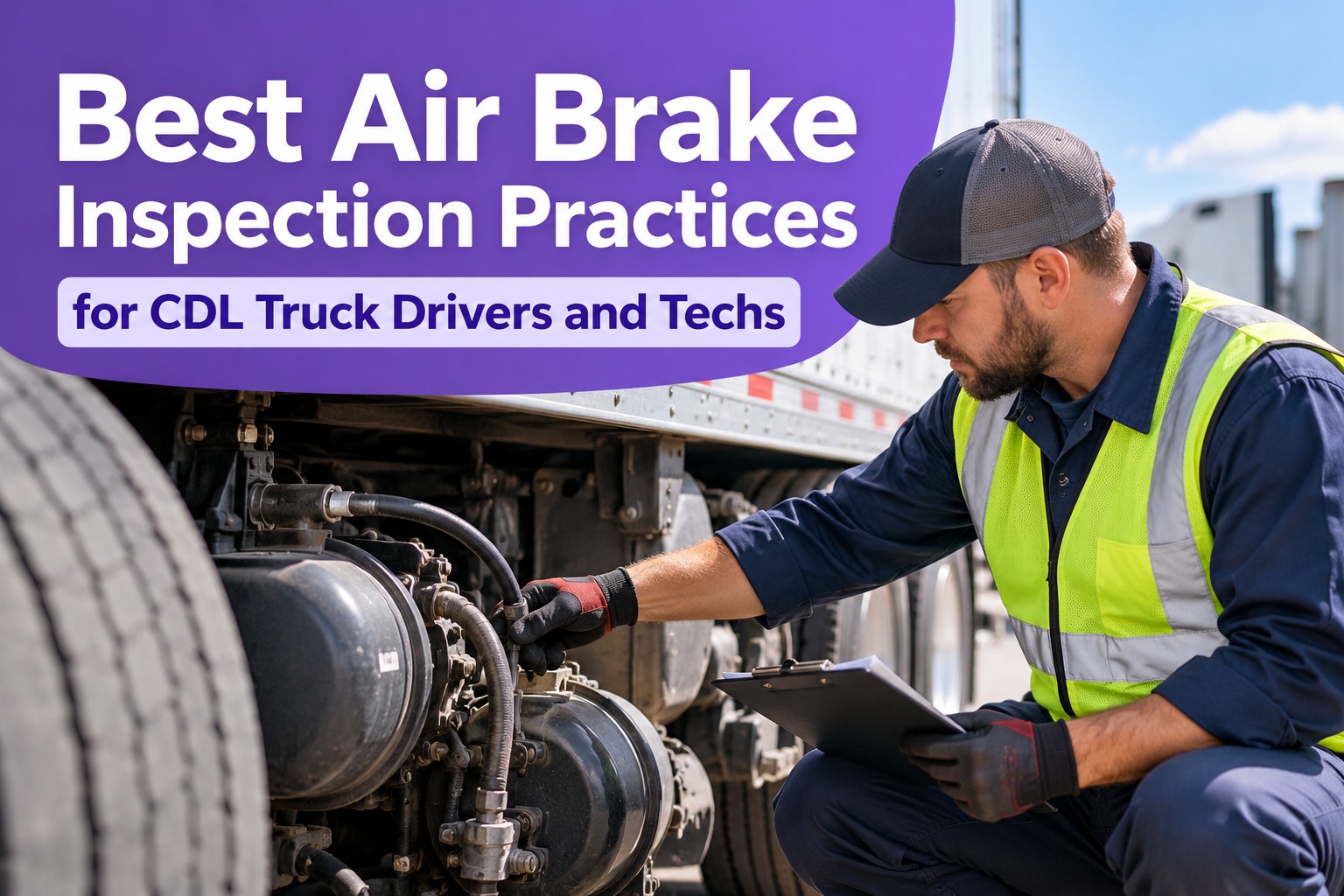
Best Air Brake Inspection Practices for CDL Truck Drivers and Techs
A leak rate over limit, a slack adjuster past an inch, a warning that fires at 50 instead of 60 — air brake defects put more trucks out of service than anything else, and every one is a number, not a look. Truck Inspection & Maintenance Management Software gives drivers a guided air brake test with the psi thresholds built in and techs a per-wheel component check — and routes any failed value straight to a graded work order before the truck rolls.
~41%of vehicle OOS violations are brakes
≤60 psilow-air warning must activate by
20%defective brakes = out of service
Two Inspections, One System
Air brakes get checked twice, by two people, for two reasons. The driver runs the in-cab test before every trip to confirm the system holds air and the warnings work — a functional check anyone can do from the seat. The tech inspects the hardware on a schedule: chambers, pushrods, slack adjusters, linings, lines. One proves the system behaves; the other proves the parts are within spec. A fleet that does only the first misses wear; one that does only the second misses the leak that showed up this morning.
DriverThe in-cab test sequence
A functional check from the seat, before every trip: build-up, governor, leak-down, low-air warning, spring-brake pop-out. Catches leaks and warning failures that appeared since the last shift.
TechnicianThe component inspection
A hands-on check on a PM schedule: pushrod stroke, slack adjusters, chambers, linings, drums, air lines. Catches wear and adjustment drift before it crosses an out-of-service line.
The Driver's Air Brake Test, Step by Step
The in-cab test is a fixed sequence with a numeric pass criterion at each step — examiners score it as a script, and so should your drivers. Done in order, it confirms the system builds pressure, holds it, warns on loss, and sets the spring brakes before pressure gets dangerous. Each number below is the pass line.
1
Build-up timeWith the system drained, air should build from about 85 to 100 psi within 45 seconds in a dual system. Slow build points to a weak compressor or a leak.
2
Governor cut-out & cut-inCompressor cuts out around 120–125 psi, then cuts back in around 95–100 psi as you fan pressure down. Confirms the governor regulates correctly.
3
Leak-down, releasedEngine off, brakes released: loss stays at or under 2 psi/min for a straight truck, 3 psi/min for a combination.
4
Leak-down, appliedFull brake application held: loss stays at or under 3 psi/min straight, 4 psi/min combination. Higher means a leak under load.
5
Low-air warningFan pressure down — the light and buzzer must activate at or before 60 psi, per 49 CFR 393.52. A warning that fires late is itself a defect.
6
Spring-brake pop-outKeep fanning — the parking and trailer supply valves must pop out between 20 and 45 psi, applying the spring brakes automatically.
Call every number out loud On the CDL skills test, a silent check earns no credit — the driver states each reading as they take it: "building to 100 in under 45 seconds… warning at 58… spring brakes popped at 30." The same habit on a daily pre-trip turns a vague "brakes are fine" into specific values a manager and an auditor can both trust — and it's exactly what a guided digital test captures as numeric entries.
The Technician's Component Inspection
The driver's test says the system holds air today; the tech's inspection says the hardware will hold up for the next interval. This is where out-of-adjustment and worn components get caught before they fail a roadside check — and it's measured, not eyeballed. Pushrod stroke and slack-adjuster play are the two readings CVSA officers reach for first.
Pushrod strokeMeasure travel on a full apply against the limit for the chamber size. Over-stroke means the brake isn't applying fully — the most common adjustment defect.
Slack adjustersAligned, and no more than about 1 inch of free play by hand. Automatic slack adjusters that need manual adjustment are themselves a warning sign.
Brake chambersMounted secure, no cracks, no missing bolts, correct size matched side to side. A cracked chamber is an out-of-service item.
Linings & drumsLinings above minimum thickness and not contaminated; drums and rotors free of cracks through the friction surface.
Air lines & fittingsSecure, no chafing against frame or moving parts, no audible or soapy-water leaks at fittings and glad hands.
Per-wheel recordLog stroke and play at each wheel position, so a wearing pattern shows two inspections early instead of at the scale house.
The 20% rule On a five-axle tractor-trailer with ten brakes, the vehicle goes out of service when 20% or more of the brakes are defective — that's just two. One over-stroke pushrod plus one cracked chamber is an OOS order. That's why per-wheel measurement matters: a single dashboard that shows which trucks are one wheel away from the line lets the shop catch them before a roadside inspector does.
The Numbers Both Inspections Share
Driver and tech work from the same spec sheet — the pass/fail values that decide whether the system is safe. Keep them in one place so nobody is guessing at a threshold on the shop floor or in the cab.
| Check | Pass criterion | Who |
| Air build-up |
~85–100 psi within 45 sec (dual system) |
Driver |
| Governor cut-out |
~120–125 psi |
Driver |
| Governor cut-in |
~95–100 psi |
Driver |
| Leak, released (straight / combo) |
≤2 / ≤3 psi per min |
Driver |
| Leak, applied (straight / combo) |
≤3 / ≤4 psi per min |
Driver |
| Low-air warning |
Activates at or before 60 psi |
Driver |
| Spring-brake pop-out |
Between 20 and 45 psi |
Driver |
| Slack adjuster free play |
No more than ~1 inch by hand |
Tech |
| Pushrod stroke |
Within limit for chamber size |
Tech |
| OOS threshold |
20% of brakes defective grounds the vehicle |
Both |
Put the Pass Line Inside the Inspection
A threshold a driver has to remember is a threshold that gets missed. Truck Inspection & Maintenance Management Software builds the numbers into the check itself: the driver keys in the actual build-up time, leak rate, warning psi, and pop-out, and anything outside the pass window flags the truck automatically. Techs record pushrod stroke and slack play per wheel, so a trend shows before it's a violation — and any out-of-limit value opens a graded work order that keeps the truck flagged until a mechanic signs it off.
Where Air Brake Inspections Go Wrong
Most failed brake checks aren't from not knowing the system — they're from habits that skip the parts that don't announce themselves. These are the shortcuts that put trucks on the OOS list.
✕
Eyeballing instead of measuring"Looks adjusted" isn't a pushrod stroke reading. Over-stroke is invisible until it's measured on a full apply.
✕
Skipping the leak-down timingA slow leak passes a glance and fails a scale. The psi-per-minute test is the only way to catch it.
✕
Assuming the warning worksA low-air warning that fires at 50 instead of 60 is a defect hiding behind a working-looking light. Fan it down and watch the number.
✕
Not logging per wheelA fleet-level "brakes OK" hides the one wheel drifting toward OOS. Per-position readings are what reveal the pattern.
Frequently Asked Questions
What psi should the low-air warning come on at?
The low-air warning light and buzzer must activate at or before 60 psi, per 49 CFR 393.52. During the in-cab test, the driver turns the engine off and fans the brakes to drop pressure, watching for the warning to trigger — if it comes on below 60, say at 50, that's a defect even though the light technically works, because it's warning too late to be useful. A warning that never activates at all, or only well below 60, should ground the truck until it's repaired. It's one of the quietest failures on the whole system, which is why the test fans pressure down deliberately instead of assuming it's fine.
Start free and capture the warning psi as a recorded value.
What are the air-loss leak rate limits?
With the engine off and the system charged, the allowable leak-down rate depends on the vehicle and whether the brakes are applied. Brakes released: no more than 2 psi per minute for a straight truck, 3 psi per minute for a combination. Brakes applied and held: no more than 3 psi per minute straight, 4 psi per minute combination. Anything faster points to a leak somewhere in the system — a fitting, a chamber, a line — and the applied test often reveals leaks that the released test doesn't, because pressure is being pushed through the service circuit. Timing it with a watch is the only reliable way to judge it; a hiss you can hear is already well past the limit.
What makes air brakes an out-of-service violation?
The headline rule is the 20% threshold: on a vehicle with a given number of brakes, if 20% or more are defective, the vehicle is placed out of service. On a five-axle tractor-trailer with ten brakes, that's just two — so one over-stroke pushrod and one cracked chamber is enough. Individual conditions also ground a truck on their own, such as a cracked brake chamber, a brake out of adjustment beyond the limit for its chamber size, or a non-functioning low-air warning. Because the threshold is so low, a fleet that tracks pushrod stroke and slack play per wheel can see which trucks are one defect away and fix them on schedule instead of at the roadside.
How is the driver test different from the tech inspection?
The driver's in-cab test is a functional check done before every trip — build-up time, governor cut-in and cut-out, leak-down, low-air warning, and spring-brake pop-out — all performed from the seat to confirm the system holds air and the safety devices work today. The technician's inspection is a hands-on, scheduled check of the hardware: pushrod stroke measured on a full apply, slack-adjuster free play, chamber condition, lining thickness, drums, and air lines. The driver catches what changed since the last shift; the tech catches wear and adjustment drift before it crosses a line. You need both — the system can pass the driver's test in the morning and still have a pushrod quietly past spec.
How does the software help with air brake inspections?
It builds the pass thresholds into the check so nobody works from memory. Drivers enter the actual build-up time, leak rate, warning psi, and pop-out pressure, and any value outside the pass window flags the truck automatically. Technicians log pushrod stroke and slack play at each wheel position, so the readings build a per-unit history that reveals a wearing pattern two inspections before it becomes a violation. Any out-of-limit value opens a graded work order that keeps the truck flagged until a mechanic certifies the repair — and because every reading is captured with a timestamp, the brake records that back up a roadside dispute or an audit are already filed, not reconstructed.
Measured · Logged · Flagged
Inspect Air Brakes by the Numbers, Not the Look
Truck Inspection & Maintenance Management Software gives drivers a guided air brake test with every psi threshold built in, and techs a per-wheel component check for pushrod stroke and slack play. Out-of-spec values flag the truck and open a graded work order automatically, PM triggers keep brake service on schedule, and timestamped records stand up to a roadside dispute or a DOT audit. That's how fleets stop losing trucks to the most-cited defect on the road — by catching the leak, the over-stroke, and the late warning before an inspector does.
No credit card required. Free for up to 3 trucks. Built for FMCSA-compliant fleets.