The wrong engine oil costs a fleet more than the right oil ever could. Switch from factory-fill 10W-30 back to 15W-40 "out of habit" and you lose 1–2% fuel economy — roughly $400–$800 per truck per year. Run conventional in an engine designed for synthetic and you compress your drain interval from 50,000 miles back down to 15,000. Use the wrong API service category and you can poison the catalyst, plug the DPF, and trigger $5,000+ in aftertreatment damage. Engine oil is the single most consequential maintenance decision a fleet manager makes — and most fleets are still making it based on what their last shop recommended in 2018.
The 2026 reality has moved on. Roughly 30% of large North American fleets have switched to synthetic blends. 10W-30 is now the factory fill for most new heavy-duty diesels. API CK-4 has fully replaced CJ-4 as the mainstream service category, with FA-4 specifically formulated for newer 2017+ fuel-economy-tuned engines. The next-generation API PC-12 standard arrives in 2027 with even lower viscosity grades (0W-20, 5W-20) targeting EPA's 75% NOx reduction mandate. Fleets that haven't reviewed their oil specification in 18 months are running yesterday's program — and paying for it twice.
This guide is the decision tool you actually need: a step-by-step selection flow, a 15W-40 vs 10W-30 head-to-head, the API service category decoder, synthetic vs conventional ROI math, and OEM-by-OEM recommendations. Start your free trial to track oil specifications and drain intervals across every truck in your fleet.
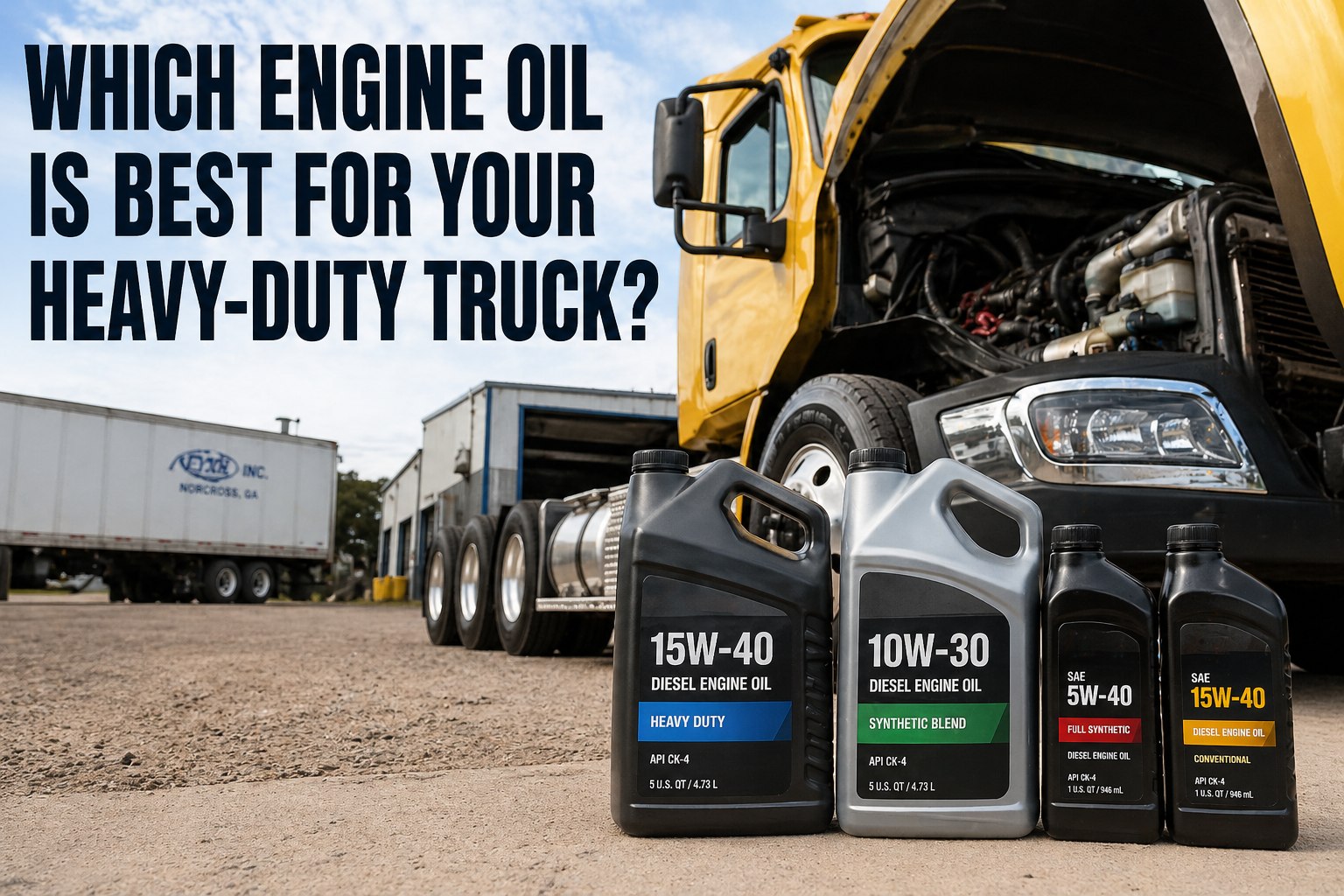
Which Engine Oil Is Best for Your Heavy-Duty Truck?
15W-40 or 10W-30? CK-4 or FA-4? Synthetic, blend, or conventional? The 2026 decision tool that picks the right oil for your specific engine, climate, and operation — without the guesswork.
Quick Answer: How to Choose Heavy-Duty Engine Oil
The right heavy-duty truck engine oil is determined by three independent decisions: viscosity grade (most modern Class 8 engines factory-filled with 10W-30; older or high-mileage engines may benefit from 15W-40), API service category (CK-4 for nearly all current diesel engines; FA-4 only for specifically-approved 2017+ fuel-economy engines), and base oil type (synthetic for extended drain intervals up to 50,000 miles; synthetic blend for balanced cost-performance; conventional only for budget-constrained legacy operations). The single most important rule: follow the OEM specification stamped on your engine — never guess. Wrong viscosity voids warranties, wrong API category damages aftertreatment systems, and wrong base oil shortens drain intervals and accelerates wear.
The 4-Question Decision Flow
Run any truck through these four questions in order and the answer drops out. Skip any question and you're guessing. Contact our support team to apply this decision flow across every engine in your fleet.
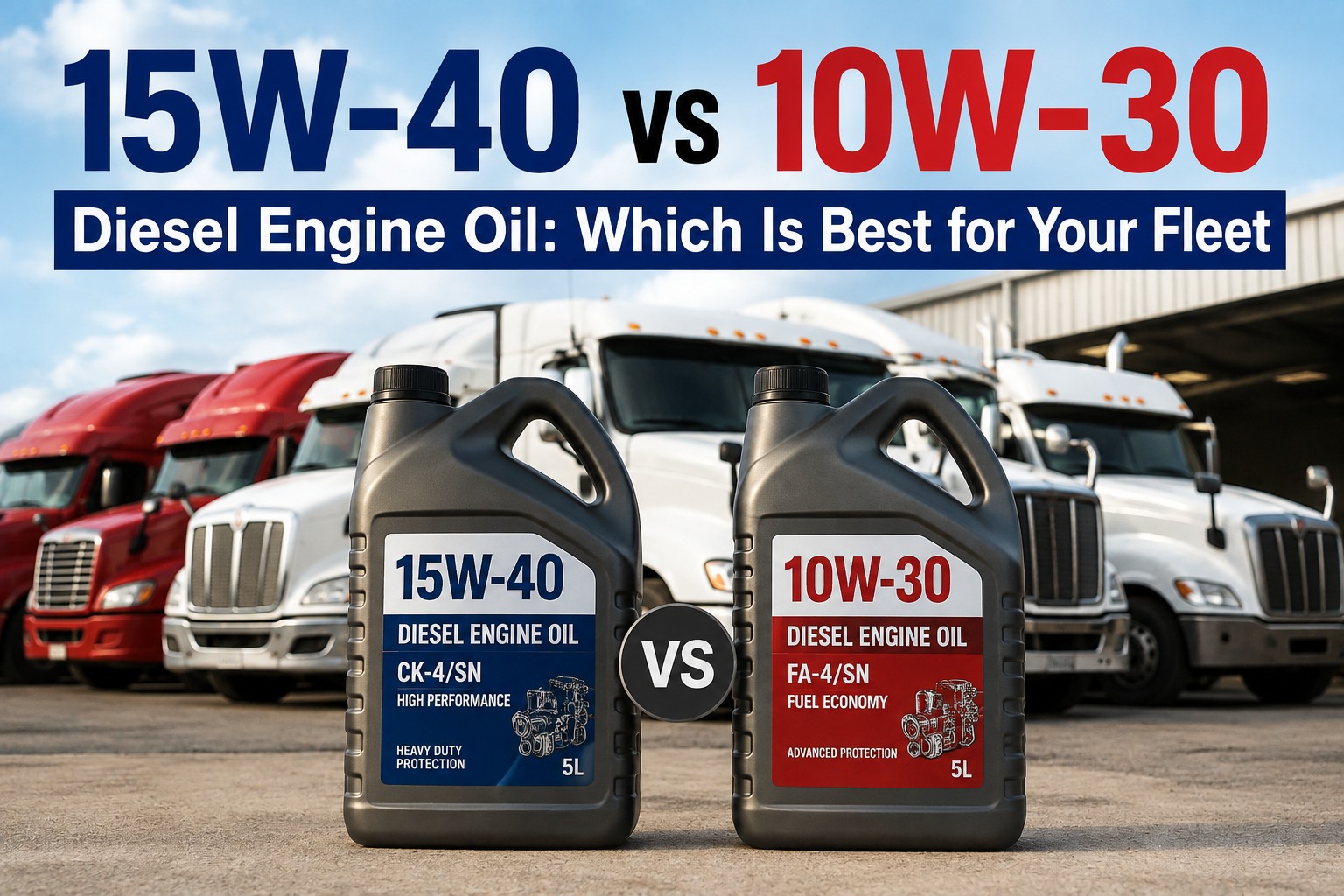
15W-40 vs 10W-30: The Head-to-Head
The single most-asked oil question for heavy-duty trucks. Both grades are now available in CK-4, both protect well, but they optimize for different priorities. Here's the side-by-side that ends the debate.
API CK-4 vs FA-4: The Service Category Decoder
The API service category is as important as the viscosity grade — and getting it wrong damages your aftertreatment system. CK-4 is the safe default for nearly every diesel engine. FA-4 is a fuel-economy specialty oil with strict approval requirements.
Synthetic vs Synthetic Blend vs Conventional: The Math
The base oil type drives drain interval, cost per service, and total cost of ownership. Don't compare oil prices — compare cost per mile across the full drain cycle. Sign up free for 3 trucks to track oil cost per mile across your fleet, or talk to our support team for help modeling synthetic ROI on your specific routes.
OEM Recommendations Quick-Reference
Always verify against the latest OEM bulletin for your specific engine model and year, but here's the standard 2026 recommendation by major heavy-duty diesel platform.
| Engine Family | Standard Recommendation | Approved API | Approved Viscosity |
|---|---|---|---|
| Cummins X15 / ISX | 10W-30 CK-4 or 15W-40 CK-4 | CK-4 (CES 20086) | 10W-30, 15W-40 |
| Detroit DD13 / DD15 / DD16 | 10W-30 (factory fill) | CK-4 / FA-4 (DFS 93K222) | 10W-30, 5W-30, 15W-40 |
| Volvo / Mack MP / D-series | 10W-30 (factory fill) | CK-4 (VDS-4.5) | 10W-30, 15W-40 |
| PACCAR MX-11 / MX-13 | 10W-30 CK-4 | CK-4 | 10W-30, 15W-40, 5W-30 |
| International A26 | 10W-30 (factory fill) | CK-4 | 10W-30, 15W-40 |
| Older Cummins ISB / ISC (pre-2017) | 15W-40 CJ-4 or CK-4 | CJ-4 / CK-4 | 15W-40 preferred |
The 5 Most Common Oil Mistakes
Even fleets running structured PM programs leak ROI through these recurring oil decisions. Each one is fixable in your next service cycle.
Frequently Asked Questions
Most 2010+ diesel engines can run 10W-30 CK-4 safely — check your owner's manual or OEM bulletin to confirm. Engines with 150,000+ miles may benefit from staying with 15W-40 because the larger internal clearances from natural wear pair better with thicker oil. The exception: never substitute FA-4 (lighter formulation) in an engine not specifically approved, regardless of mileage. Sign up free to track OEM-specific oil approvals across your fleet.
OEM-approved extended intervals typically range 60,000–75,000 miles for modern highway applications running synthetic with proper filtration. Some programs extend to 100,000+ miles when oil analysis validates condition every 30K–50K miles. Severe-duty applications (construction, oilfield, heavy idle) cannot extend regardless of oil quality — duty cycle limits supersede oil capability. The rule: extend only when oil analysis confirms the additive package is still active.
Yes. Using non-approved oil viscosity or API category can void engine warranty if damage occurs. Every major OEM specifies the approved oils in the engine documentation, and warranty claims are routinely denied when oil analysis or service records show non-approved oils were used. Best practice: keep documentation of every oil purchase and change, including invoices showing API category and viscosity grade. Contact our support team for help building oil-tracking into your maintenance records.
FA-4 has had slow uptake despite being introduced in 2016 — most fleets stayed on CK-4. The next major shift is API PC-12, scheduled for 2027, which introduces 0W-20 and 5W-20 grades for heavy-duty applications to support EPA's 75% NOx reduction and 50% PM reduction mandates. Modern engines are increasingly tighter and more capable of running lower-viscosity oils — the long-term trend is unmistakably toward thinner oils for fuel economy.
For most heavy-duty fleets running 80,000+ miles per year per truck: yes. The math: full synthetic costs 30–50% more upfront but supports 2–3× longer drain intervals. Cost per mile typically drops 25–30%. Add the labor savings from fewer service events, less downtime, and improved fuel economy from lower-friction formulations, and synthetic delivers lower TCO across the typical fleet life cycle. Light-mileage operations may not see the same return. Start your free trial to model synthetic ROI for your specific fleet.
For trucks running standard intervals: oil analysis once or twice a year per truck is sufficient. For fleets running extended drain intervals (35K+ miles): oil analysis at every change validates the interval is safe. Sample at mid-interval and again before draining to establish baselines and catch problems early. Watch viscosity (is it holding?), TBN (additive depletion), fuel dilution, and wear metals. Costs $25–$40 per sample but routinely catches issues months before failure.
Track Oil Specifications Across Your Entire Fleet
OEM-specific oil approvals, drain-interval auto-alerts, oil cost-per-mile tracking, and warranty-grade documentation — all in one platform. See how 500+ fleets eliminate "wrong oil" mistakes and capture full fuel-economy ROI.