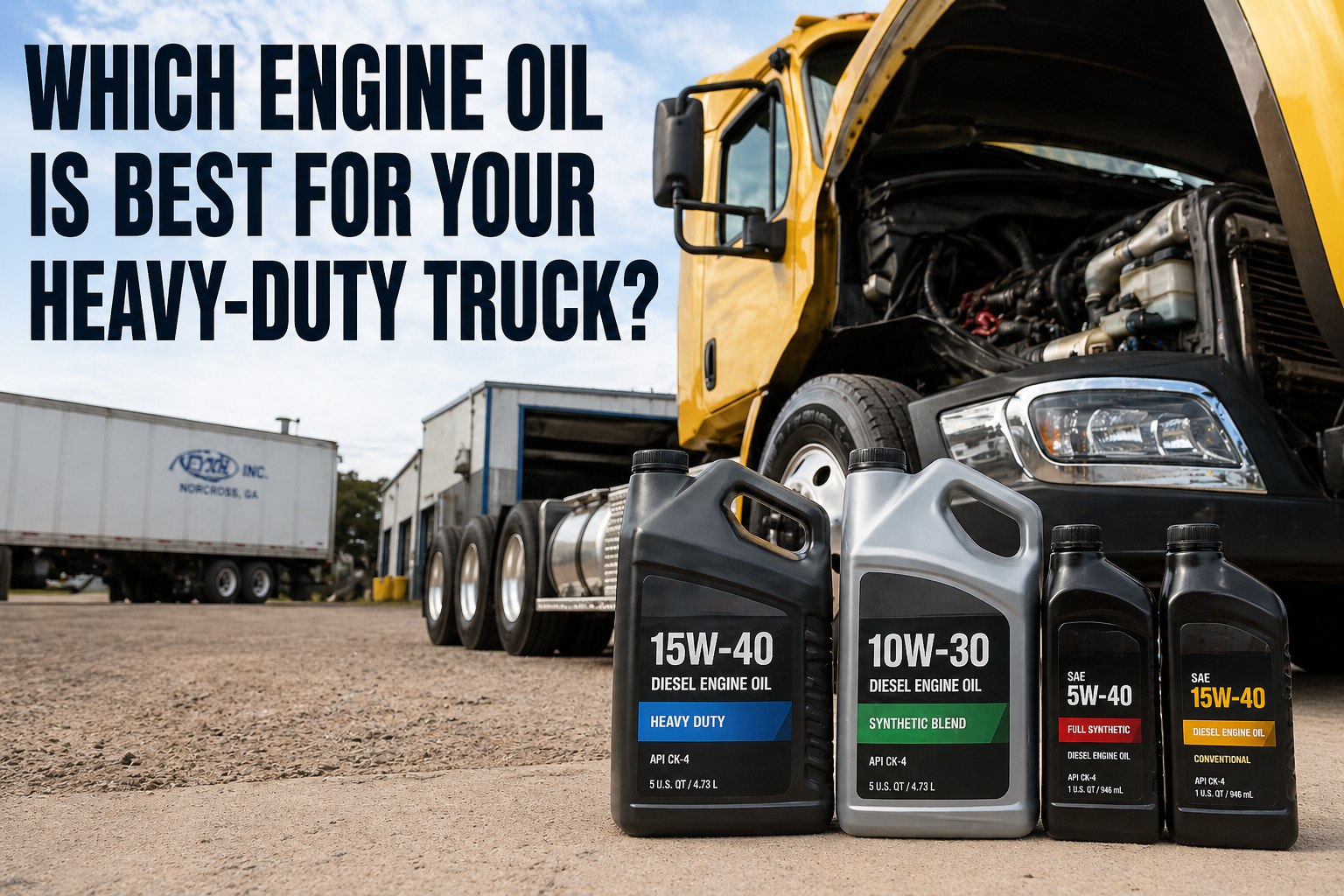
For 20 years, 15W-40 was the answer. It was the oil that came out of the barrel at every truck stop, the grade every mechanic recommended, the viscosity that filled 75% of every heavy-duty engine in America — and for good reason. It works. But the modern diesel engine changed underneath the oil while nobody was looking. Post-2017 engines are built with tighter tolerances, common-rail injection, cooled EGR, and DPF-friendly emissions systems that are specifically engineered around lower-viscosity oil. Every major OEM — Detroit Diesel, Cummins, Volvo, Mack, PACCAR, International — now specifies or approves API CK-4 10W-30 as factory-fill on their newest engines, and several have moved to FA-4 5W-30 for maximum fuel economy. The numbers are hard to ignore: a fleet running Class 8 trucks that switches from 15W-40 to CK-4 10W-30 typically sees a 1–2% fuel economy improvement, which pencils out to $400–$800 per truck per year at current diesel prices. On a 100-truck fleet, that is $40,000–$80,000 flowing directly to the bottom line — not counting reduced cold-start wear, faster oil pump priming, or extended drain intervals. Yet 15W-40 is not dead. In high-load, hot-climate, high-idle, and older-engine applications, the thicker film strength of 15W-40 still protects better and cheaper than any lighter alternative. The right answer is not universal — it is a decision that depends on your engine year, duty cycle, ambient temperature range, and OEM specification. This guide walks through the viscosity science in plain English, compares 15W-40 and 10W-30 head-to-head on the metrics that actually matter to fleet P&L, decodes the CK-4 vs FA-4 API categories, gives you a decision matrix for your specific fleet mix, and shows how the free Truck Inspection & Maintenance app tracks oil grade, drain intervals, and per-truck engine health so you never lose track of which unit runs which spec. Sign up free for up to 3 vehicles or contact our team for larger fleet rollouts.
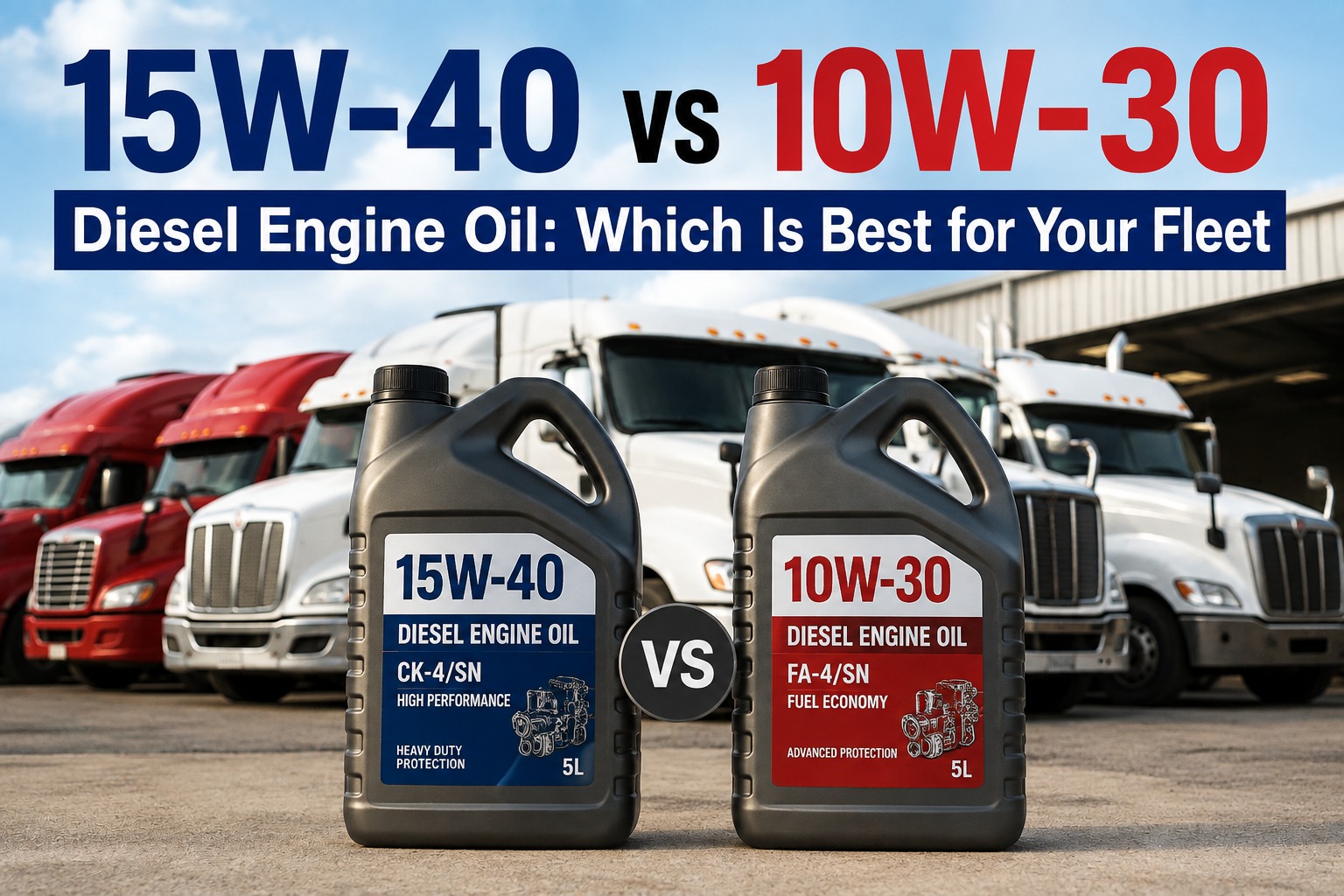
15W-40 vs 10W-30 Diesel Engine Oil — Which Is Best for Your Fleet?
The head-to-head that matters: viscosity science, fuel economy math, API categories, and the decision matrix for your specific engine mix.
What the Numbers on the Jug Actually Mean
Before comparing grades, decode the label. Every oil jug tells the same story in the same order — winter viscosity, "W" for winter, hot viscosity — and understanding it is the difference between a right pick and an engine claim:
First Number — Cold-Start Viscosity
Measured at 40°C. Lower = flows faster in cold weather. A 10W oil reaches valvetrain components roughly 25% faster than a 15W at 0°F — critical because up to 75% of engine wear happens at startup.
"W" Stands for Winter
Not "weight." It certifies the oil meets ASTM cold-flow standards. The lower the W number, the colder the temperature at which the oil still pumps without starving the engine.
Second Number — Hot Operating Viscosity
Measured at 100°C. Higher = thicker film at operating temperature. A 40-weight maintains a heavier protective barrier under peak turbo load than a 30-weight, which matters most under continuous heavy-haul stress.
Head-to-Head Comparison
The full breakdown on the seven metrics that actually decide the pick for a working fleet:
The Fuel Economy Math That Matters
Every fleet operator wants a real ROI number, not a marketing percentage. Here is the actual dollar impact per truck at typical Class 8 operating parameters:
API CK-4 vs FA-4 — The Category That Decides Warranty
Viscosity is only half the answer. The API service category — CK-4 or FA-4 — determines which engines the oil is actually approved for. Get this wrong and warranty claims get denied:
The Backward-Compatible Universal
CK-4 is the current top-tier heavy-duty diesel category. Fully backward-compatible with every earlier API service class (CJ-4, CI-4, CH-4). Available in 5W-30, 10W-30, 15W-40, and 20W-50. Minimum HTHS viscosity of 3.5 mPa·s ensures film strength under load.
The Fuel-Economy Specialist
FA-4 is engineered for maximum fuel economy in new-generation engines only. Lower HTHS viscosity (max 3.5 mPa·s) reduces internal drag. NOT backward-compatible with older engines — using it in a pre-2017 engine causes low oil pressure, bearing wear, and denied warranty claims. Available in 5W-30 and 10W-30 only.
The FA-4 Warranty Trap
Pouring FA-4 10W-30 into a 2014 Cummins ISX because "10W-30 is 10W-30" is one of the most expensive mistakes in fleet maintenance. The lower HTHS viscosity is below what older engine bearings need to maintain hydrodynamic film — the result is accelerated bearing wear, low oil pressure alarms, and a denied warranty claim when the engine fails. Always verify OEM approval before switching categories. Our app tags every truck with its approved oil spec so the wrong grade never gets loaded — try it free.
The Decision Matrix — Which Grade for Your Fleet?
Match your operating profile to the recommended grade. When your fleet spans multiple profiles, split your inventory or default to the safer choice for the majority:
Engine Model Year
Ambient Climate
Duty Cycle
Fleet Priority
Never load the wrong oil grade in the wrong engine again.
Truck Inspection & Maintenance tracks per-truck OEM oil spec, drain intervals, oil analysis results, and PM schedules automatically. Every unit tagged with its approved grade (CK-4 vs FA-4, 15W-40 vs 10W-30) so drivers and shop techs never guess. Alerts fire before drain intervals lapse — no more overperformed changes wasting money or missed changes causing warranty claims. Create your free account in 10 minutes or talk to our fleet team for a live walkthrough.
OEM Recommendations at a Glance
Every major heavy-duty engine OEM has a published position on 15W-40 vs 10W-30. When in doubt, the engine manual wins — but here is the current landscape:
When 15W-40 Is Still the Right Answer
The industry is drifting toward lighter oils, but a large portion of the working fleet is genuinely better off staying on 15W-40. Six scenarios where the heavier grade wins:
Pre-2010 Engines
Older bearing tolerances and lower-precision oil pumps depend on thicker film strength. Switching a 2005 C15 or ISX to 10W-30 often produces noise, oil consumption, and lower hot idle pressure.
Heavy-Haul & Logging
Constant heavy load generates extreme HTHS conditions. 15W-40 maintains thicker film under peak torque, protecting bearings and rings that lighter oils cannot match at full-load hot idle.
Hot-Climate Operations
Sustained 90°F+ ambient with sun-baked pavement pushes oil sump temps past 250°F. 15W-40 holds viscosity spec longer under prolonged heat than lighter oils that thin out more aggressively.
High-Idle Duty Cycles
Concrete pumpers, refuse trucks, and service vehicles with idle time above 40% deal with fuel dilution and cool-running acidic sludge. Thicker CK-4 15W-40 tolerates dilution better than lighter grades.
High-Wear Engines
Engines with 800,000+ miles on the original bore develop bearing clearance beyond spec. Thicker oil compensates for wear, maintaining oil pressure at hot idle where lighter oils would starve.
Simple Inventory Preference
Single-grade inventory across a mixed fleet reduces mis-fill risk and simplifies purchasing. If fuel savings math doesn't clearly beat the operational cost of dual inventory, staying with 15W-40 is defensible.
Frequently Asked Questions
Can I put 10W-30 in an engine that has always used 15W-40?
Only if the engine OEM has approved that grade in its service manual and the oil carries an API service category the engine requires (typically CK-4 for backward compatibility). For most post-2007 engines with common-rail fuel injection, CK-4 10W-30 is safe and delivers a 1–2% fuel economy gain. For pre-2010 engines with older bearing tolerances, staying with CK-4 15W-40 is usually the better choice — the fuel savings do not offset the wear risk on worn or high-mileage engines. Never switch to FA-4 without explicit OEM approval; FA-4 is not backward-compatible.
What is the difference between CK-4 and FA-4?
Both were introduced by the American Petroleum Institute in 2016. CK-4 is the backward-compatible universal category — safe for every engine that previously required CJ-4, CI-4, or older diesel oil. CK-4 has a minimum HTHS viscosity of 3.5 mPa·s and is available in 5W-30, 10W-30, 15W-40, and 20W-50. FA-4 is a lower-HTHS fuel-economy category designed for post-2017 engines only, with maximum HTHS of 3.5 mPa·s. FA-4 is NOT backward-compatible and can cause bearing damage in older engines. Always match the API category to the engine OEM's requirement.
How much fuel economy will I actually gain switching from 15W-40 to 10W-30?
Independent fleet studies and OEM lab testing consistently show a 1–2% fuel economy improvement when switching from CK-4 15W-40 to CK-4 10W-30 in Class 8 line-haul applications. Moving further to FA-4 10W-30 adds another 0.5% (total 1.5–2%), and FA-4 5W-30 can reach 2–3% in Classes 3-6. At current diesel prices of $3.85/gallon and typical Class 8 operation of 110,000 miles/year at 6.5 MPG, that translates to $400–$800 in fuel savings per truck per year. Larger fleets see the effect multiply — a 100-truck line-haul fleet can save $40,000–$80,000 annually.
Does 10W-30 protect my engine as well as 15W-40 under heavy load?
For engines OEM-approved for 10W-30 in your specific duty cycle: yes. Modern CK-4 10W-30 additive packages deliver protection comparable to 15W-40 at operating temperature. However, for continuous heavy-haul, logging, refuse, or extreme-heat applications, 15W-40 maintains a thicker hydrodynamic film that gives more protection margin under peak stress. When the choice is between a small fuel gain and maximum engine protection under severe duty, most fleet engineers still recommend 15W-40 for the most stressed units in the fleet.
Should I run different oils in different trucks in my fleet?
Many well-run fleets do. Split inventory strategies typically pair CK-4 10W-30 for post-2017 line-haul units where fuel economy matters most, with CK-4 15W-40 held for older engines, heavy-haul units, or severe-duty vehicles. The tradeoff is inventory complexity and mis-fill risk. Fleets running a maintenance management system that tags each unit with its approved oil spec avoid the mis-fill problem entirely — start free to try per-truck oil tracking.
How does Truck Inspection & Maintenance help me manage oil grades and drain intervals?
Truck Inspection & Maintenance tags every truck with its OEM-approved oil spec so the wrong grade never gets loaded. PM scheduling tracks each unit's drain interval — whether that's 25,000, 40,000, or 60,000 miles under extended-drain programs — and fires alerts before intervals lapse. Oil analysis results log against each unit for trend tracking. Fleet dashboards show which trucks are due for service, which are overdue, and which have open defects. Free forever for up to 3 vehicles with no hardware. Contact our expert team for larger fleet rollouts.
The right oil in the right engine — automated, tracked, and never wrong.
Choosing between 15W-40 and 10W-30 is only half the battle. The other half is making sure the right grade reaches the right engine on the right interval, every single time. Truck Inspection & Maintenance turns per-truck oil spec, drain intervals, and PM schedules into a live dashboard that runs on every driver and tech's phone. Free forever for up to 3 vehicles. No hardware, no contract, no credit card to start.