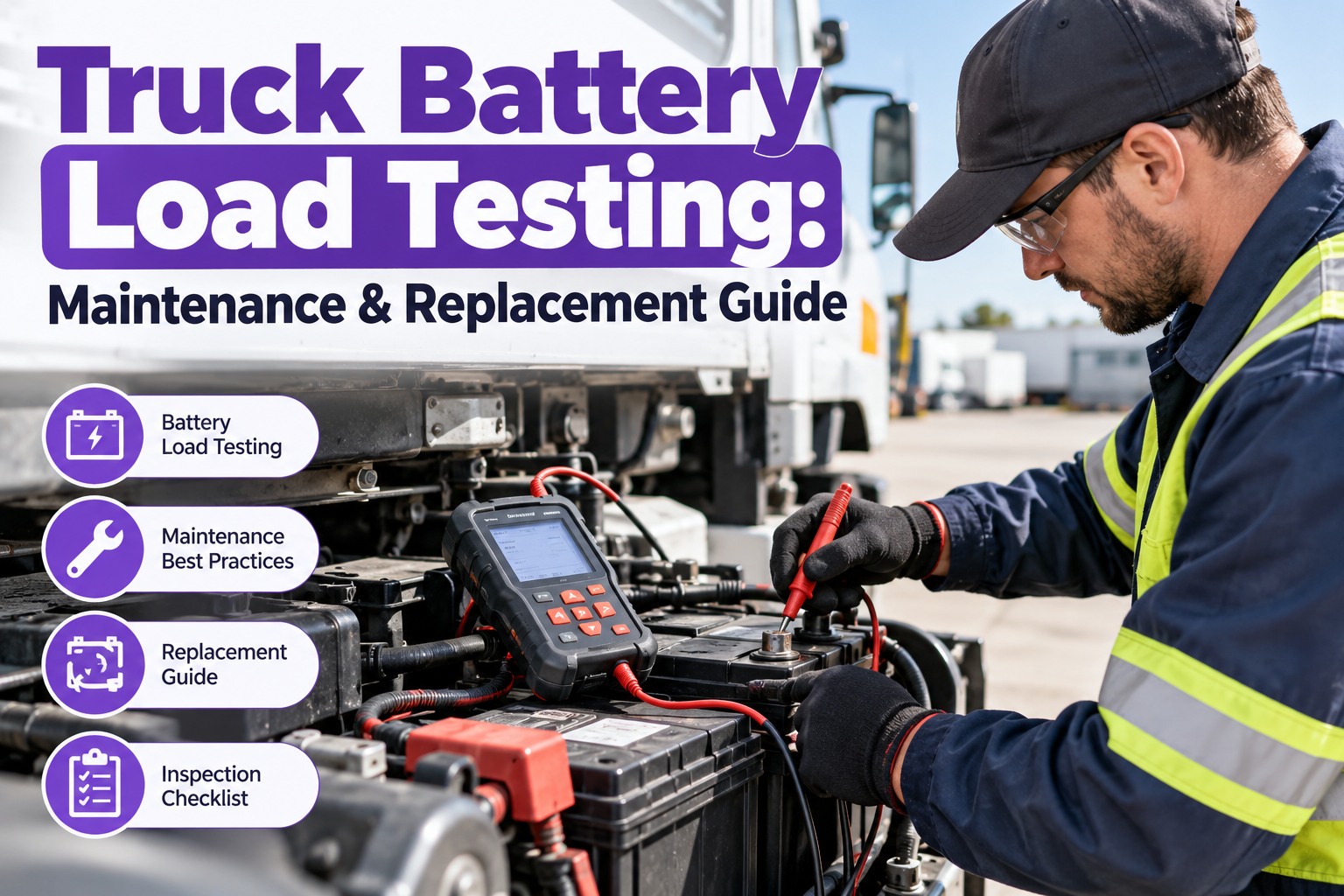
A no-start is the most avoidable breakdown in trucking, and it almost always has a warning. The truck cranks a little slower in the morning, the voltage dips on a cold start, one battery in the bank is weaker than the others. A battery that looks fine and shows 12.6 volts can still fail the moment you ask it for real current. That's why a load test, not a voltage glance, is the check that tells you whether a battery can do its job. This guide covers what a proper load test involves, how to read results, how to check the charging system behind the battery, and when to replace batteries before they strand a truck. It also shows how Truck Inspection & Maintenance Management Software keeps battery test results and replacement dates per truck so weak batteries get flagged early. Start free and log battery tests per truck.
Truck Battery Load Testing: Maintenance & Replacement Guide
Batteries fail quietly, then all at once. Truck Inspection & Maintenance Management Software lets technicians record voltage and load-test results on a PM checklist, keeps each truck's battery history and install dates, and turns a weak result into a work order before the truck is stranded.
Voltage Tells You Charge. Load Tests Tell You Health.
Resting voltage shows how charged a battery is. It doesn't prove the battery can deliver cranking current. A worn battery can sit at a healthy voltage and still collapse under load.
State of Charge by Resting Voltage
For a typical 12V flooded lead-acid battery, rested and disconnected from loads, these approximate readings show charge level. AGM batteries read slightly higher, so check your battery maker's chart.
How a Load Test Works, Step by Step
One Battery Record Per Truck
Log voltage, load-test result, battery position, brand and install date for every battery on the truck. The software keeps the history, shows which batteries are getting old or weak, and creates a work order when a result fails your threshold. Free for up to 3 trucks.
The Symptom → The Likely Cause
A dead battery isn't always a bad battery. Before replacing, check what's behind it:
Don't Skip the Charging System
A new battery on a bad alternator will fail too. Check these during the same visit:
| Check | What good looks like | If it's off |
|---|---|---|
| Voltage with engine running | Typically in the range of about 13.8–14.8V; follow OEM spec | Test alternator and regulator |
| Cable and ground connections | Clean, tight, low voltage drop | Clean, tighten or replace the cable |
| Belt and pulley | Correct tension, no slip or glazing | Replace or adjust |
| Parasitic draw with key off | Small, within the OEM's allowance | Trace and fix the circuit drawing power |
When to Replace: Proactive Triggers
When replacing, match type and age across the bank where the OEM calls for it, since one weak battery in a parallel set can drag down the others. Many fleets also test all batteries before cold weather and replace borderline units on schedule.
Frequently Asked Questions
Stop Letting Weak Batteries Surprise You
Battery tests on your PM checklist, results and install dates stored per truck, and weak batteries flagged into work orders. Start free to try it on your own trucks, or contact us and we'll help set it up.