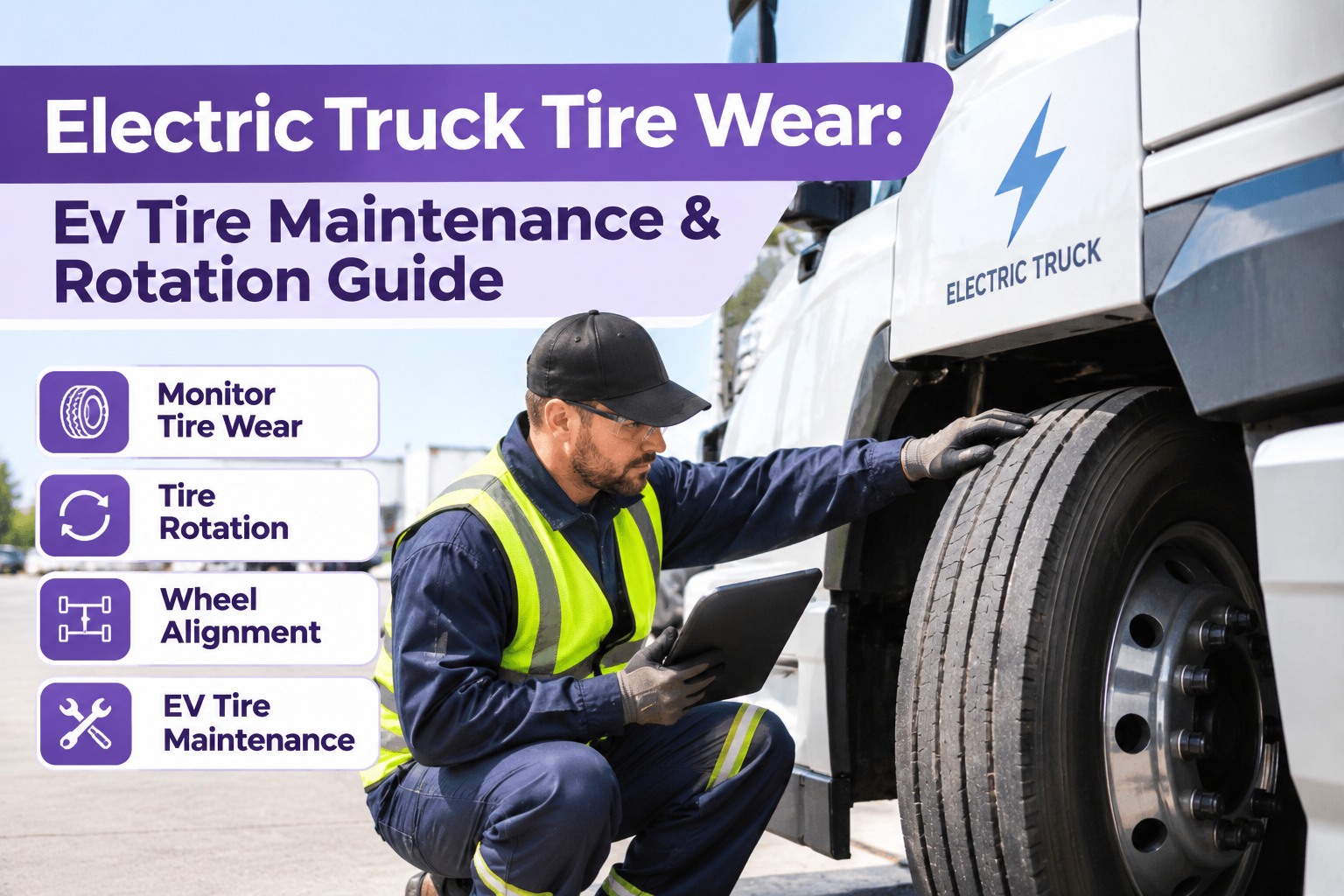
Electric Truck Tire Wear: EV Tire Maintenance & Rotation Guide
By William Jerry on November 16, 2026
An electric Class 8 can out-torque a diesel from a dead stop and carries a battery pack that adds thousands of pounds — and the drive tires pay for both. Electric truck tire management isn't diesel tire management with a new badge: the wear is faster, and the patterns are different. This guide covers why EV tires wear the way they do and how to manage it, and shows how Truck Inspection & Maintenance Management Software tracks tread by wheel position to catch the drive-axle acceleration early. Start free and track tire wear on every EV in the fleet.
Electric Truck · EV Tire Wear
Electric Truck Tire Wear: EV Tire Maintenance & Rotation Guide
Instant torque scrubs the drive tires on every launch, the battery adds thousands of pounds of load, and regenerative braking piles deceleration onto the same drive axle — so EV tires wear faster and less evenly. Our software runs the tire check as readings per wheel position, trends the wear rate by axle, and raises a work order for rotation or replacement before the wear turns irregular. You manage the faster wear by the numbers, per truck.
Peak torque at a standstill goes straight to the drive tires — the first force of three.
Three Forces That Wear EV Tires Faster
Fleets electrifying heavy-duty routes report the same thing: more torque, more weight, more wear. Three forces drive it, and each lands somewhere different.
↯Instant torqueElectric motors deliver peak torque from zero. That surge can scrub and slightly slip the drive tires on launch — the biggest single cause of faster rubber loss.
⬇Battery weightA pack can add thousands of pounds of tare, raising the load on every contact patch and the heat in the tread. The tire doesn't know the weight is batteries or cargo — it just carries it.
⟲Regenerative brakingAn EV decelerates mostly through its drive tires, far more than a diesel leans on a retarder. That adds braking torque in the opposite direction — bi-directional stress that shows up as irregular wear.
Where the Wear Lands
The forces don't hit every tire equally. The drive axle and the steer axle each feel a different one.
Drive tires
Higher wear rate from launch torque
Regen adds reverse braking torque
Irregular heel-and-toe wear appears
The axle to watch first on an EV
Steer tires
Higher vertical loads from the weight
Less inflation headroom than drive tires
Wear tracks alignment closely
Where weight, not torque, is felt
That split is why a single fleet-wide tire number hides the problem — the drive axle on an EV is on a different wear clock than the steer. Book a demo to trend wear by axle position.
Measure the Fast Axle Before It Goes Irregular
Tread logged per wheel position, with the drive axle trended on its own — so a scrubbing drive tire shows on a line, not as a heel-and-toe pattern you find at replacement.
You can't change the torque or the weight, but four habits keep the faster wear from becoming a shorter tire life.
1Rotate more oftenMove the fast-wearing drive tires on a shorter cadence than a comparable diesel, before irregular wear sets — confirm the interval against the truck maker's guidance.
2Hold alignment tightTorque and weight punish an off toe or camber faster than on a diesel. Recheck alignment after potholes and curb strikes, not just on a calendar.
3Spec EV-ready tiresLook for a higher load rating, a casing reinforced for bi-directional torque, and low rolling resistance for range — accepting that some EV compounds trade a little tread life for it.
4Guard inflationHeavier loads make under-inflation costlier in heat and wear. Hold pressure to spec and watch it with TPMS, since the drive tires run hot.
Rolling Resistance Does Double Duty
On a diesel, low rolling resistance saves fuel. On an EV it saves range — so the same tire feature matters more, and it has to be balanced against wear resistance.
DieselLow rolling resistance = fuel economy, a cost lever.
→
ElectricLow rolling resistance = miles of range, a route-planning factor.
Some tire makers now offer EV-specific or EV-ready truck tires built for that balance; a conventional tire of the right size, load rating and construction can still suit an EV. Match the tire to the duty, not the badge. Book a demo to track tire spec per vehicle.
From Tread Reading to Rotation Work Order
EV tire wear is predictable once it's measured. A reading logged by position turns the faster wear into a schedule instead of a surprise.
1MeasureTread depth at each wheel position.
2Trend by axleDrive-axle wear rate plotted on its own.
3Rotation work orderRaised before irregular wear sets in.
4Forecast replacementThe mile a tire reaches its pull point.
Three forces: instant torque that scrubs the drive tires on launch, battery weight that raises the load on every tire, and regenerative braking that adds reverse torque through the drive axle. Together they wear tires faster than a diesel. Book a demo to track the wear.
2How often should I rotate EV truck tires?
On a shorter cadence than a comparable diesel, because the drive tires wear faster and can go irregular. There's no single universal number — confirm the interval against the truck maker's guidance and trend the readings. Book a demo to set the rotation cadence.
3Do electric trucks need special tires?
Not strictly — a conventional tire of the right size, load rating and construction can work. But EV-specific and EV-ready tires are built for the higher torque, weight and the low rolling resistance range needs, and often pay off. Book a demo to log tire spec per truck.
4Does regenerative braking affect tire wear?
Yes. An EV brakes mostly through its drive tires, far more than a diesel uses a retarder, which adds sustained braking torque in the opposite direction — raising the risk of irregular heel-and-toe wear on the drive axle. Book a demo to flag irregular wear.
Torque · Weight · Regen · Rotation
Manage the Faster Wear by the Numbers
Truck Inspection & Maintenance Management Software logs tread per wheel position, trends the drive axle on its own, and books the rotation before the wear turns irregular — so an EV's fast-wearing tires come off on your schedule, not the roadside's.