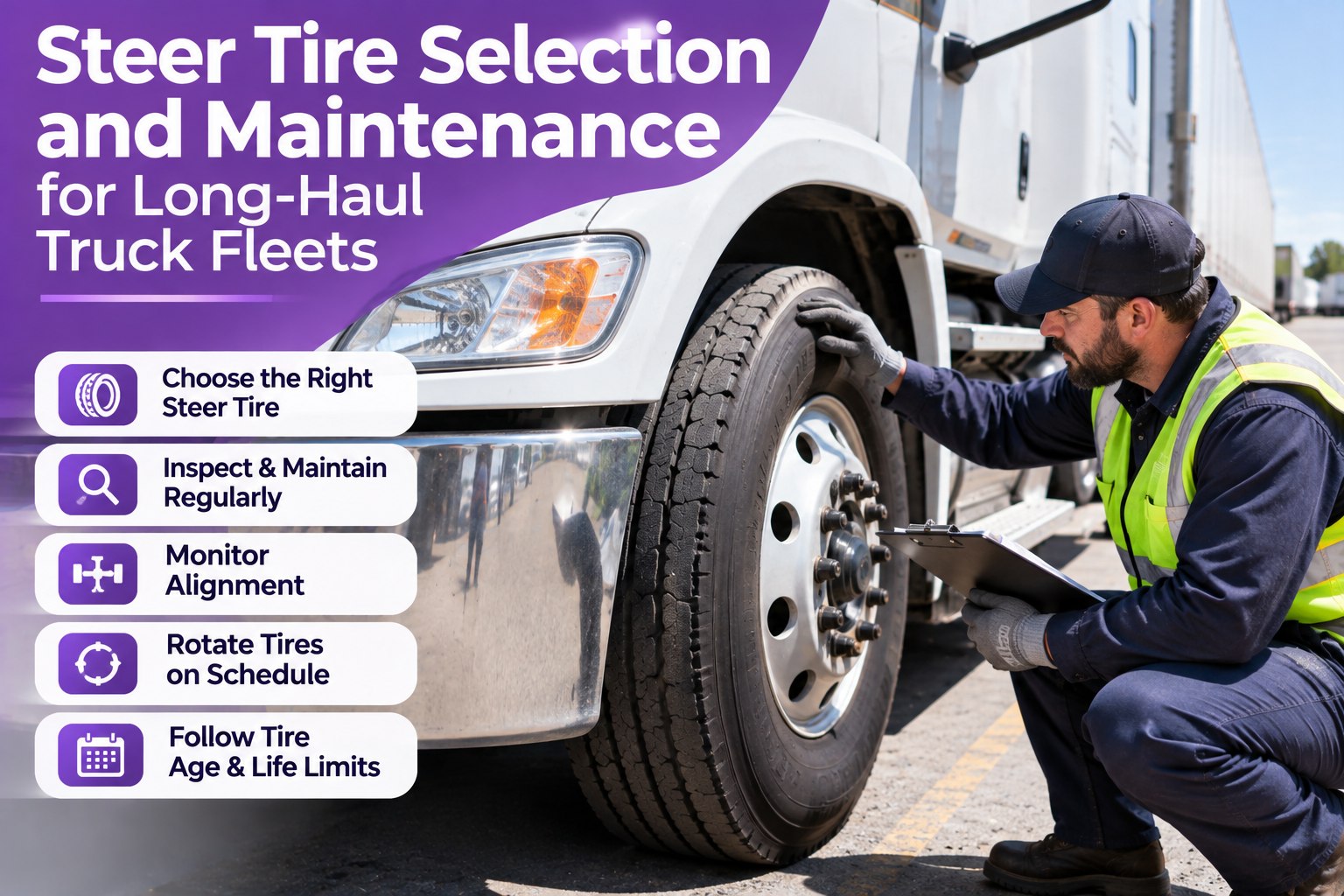
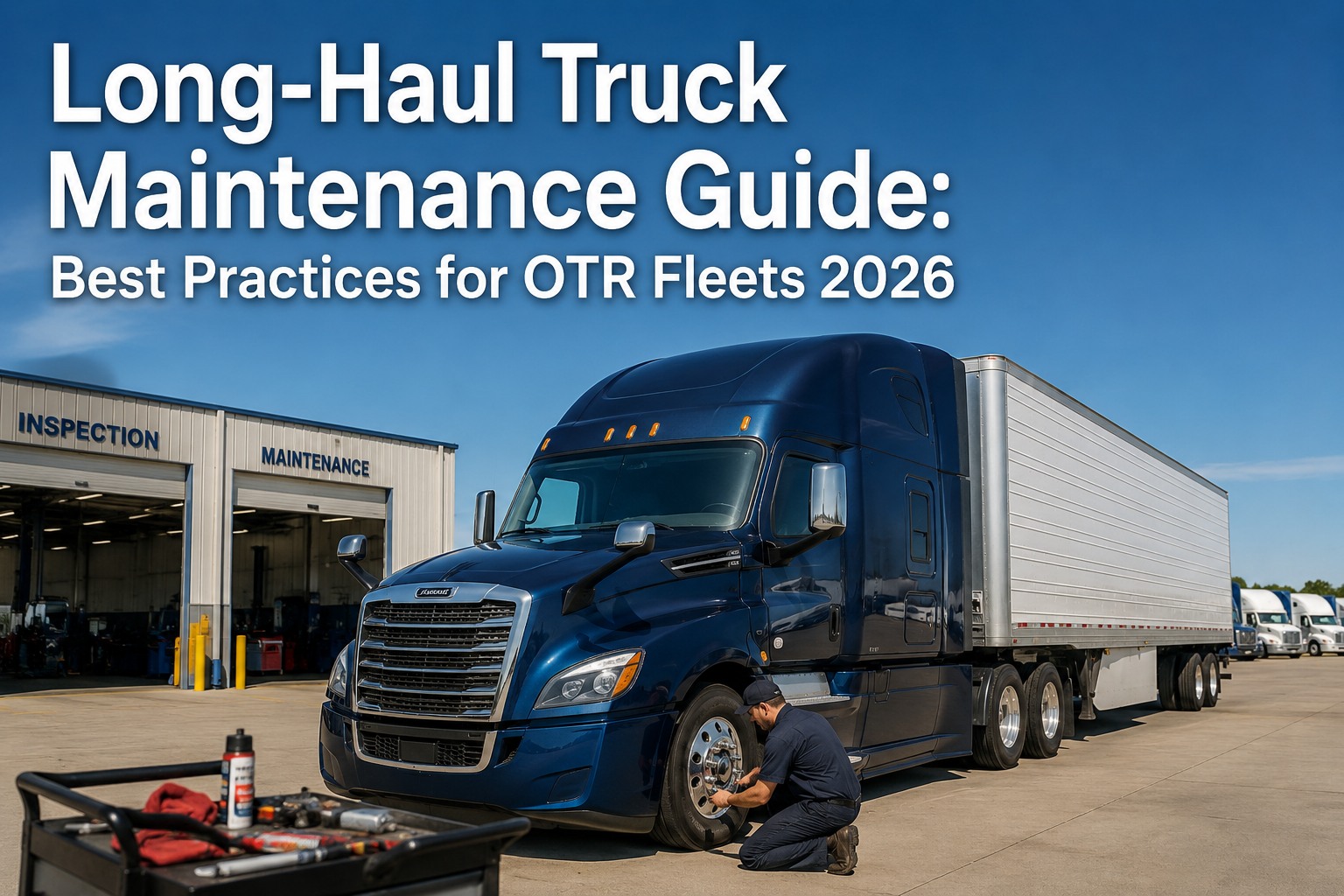
Two tires carry the entire front of a loaded Class 8 tractor, steer it, and give the driver zero redundancy if one lets go at highway speed. That is why the steer position gets its own federal tread minimum — double every other tire on the truck — and why a steer tire that's feathering or cupping is telling you something is wrong up front long before it goes bald. Steer tires are the one position where the cheap choice is the expensive one. This guide covers how to choose them, how to read their wear, and when to pull them. Start free and put steer tire checks on every inspection.
Long-Haul Fleet · Steer Tire Management
Steer Tire Selection and Maintenance for Long-Haul Truck Fleets
A steer tire wearing on one shoulder is an alignment bill you haven't paid yet — ignore it and you feed a new $500 tire to the same broken front end. Truck Inspection & Maintenance Management Software runs the loop that catches it: tread depth and wear pattern logged on every digital inspection, an irregular pattern routed to an alignment work order, and the steer tire's history kept per position — so you fix the cause up front instead of replacing the symptom twice.
Steer tread life — the zones that matter
8/32"+New / good
6/32"Smart pull point
4/32"Legal floor (OOS below)
4/32"FMCSA steer minimum — double the 2/32" for other positions
No retreadsretreads on a power-unit steer axle are out of service
~40%longer wet stopping at 4/32" vs 8/32" tread
40–60k mitypical steer alignment interval, or after any hard impact
Choosing the Right Steer Tire
Steer tires are built differently from drive tires for a reason — their job is stable, even, long-mileage wear, not traction.
TreadRib patternContinuous circumferential ribs for stability, even wear, and fuel economy — not the deep open lugs of a drive tire.
ShoulderDecoupling rib for long-haulA sacrificial shoulder rib keeps the footprint flat and lets the shoulders wear evenly on slow-wearing highway miles.
SpecHighest quality you can affordBest casing, low rolling resistance, SmartWay-verified where fuel matters. Two tires, no redundancy — this is where to spend.
For rough regional routes, a solid-shoulder steer with stronger irregular-wear resistance beats a pure highway rib. Book a demo to track steer tire spec by route type.
A Steer Tire's Wear Is a Diagnosis
Irregular wear is a symptom, not the disease. Each pattern points at a specific front-end cause — read it right and a tire check becomes a diagnostic.
Feathering
→Sharp one edge, smooth the other — a toe misalignment
Cupping / scalloping
→Wavy dips — worn shocks, suspension, bearings, or imbalance
Inside edge worn
→Negative camber — ball joints, sagging spring, or kingpin play
Outside shoulder worn
→Positive camber or hard cornering
Center worn
→Over-inflation
Both shoulders worn
→Under-inflation or overload
Diagnose in order: confirm inflation first, then matching and rotation, then alignment — shoulder and center wear are inflation until proven otherwise. Start free and log each wear pattern with its likely cause.
Route the Pattern, Not Just the Tire
Replacing a feathered steer tire without touching the toe just buys you the same wear on a new tire. Truck Inspection & Maintenance Management Software logs the wear pattern on inspection, opens an alignment or suspension work order for the cause, and keeps the steer position's history — so a recurring problem on one truck shows up as a pattern, not a repeat purchase.
Alignment, Rotation & the 4/32 Rule
Three habits keep steer tires reaching their mileage instead of dying young.
01Align on a scheduleRealign the steer axle every 40,000–60,000 miles, and immediately after any hard curb or pothole strike — an alignment is a fraction of the tire wear it prevents.
02Rotate to reclaim lifeMove worn-but-sound steer tires to a drive position to use the remaining tread — but fix the root cause first, or the new steer tire wears the same way.
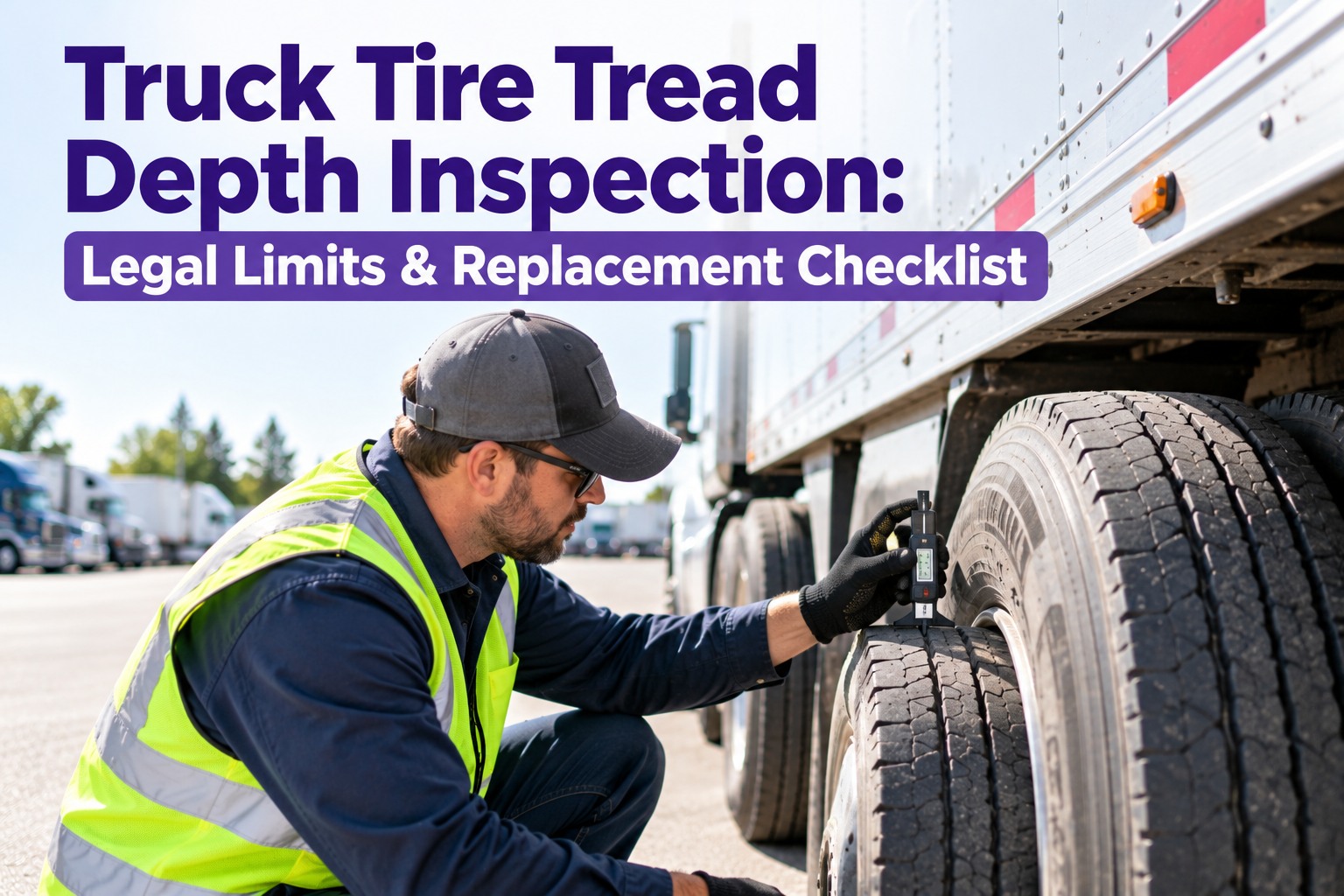
03Measure to the right numberGauge every major groove; the shallowest reading governs. Pull at 6/32" for a buffer — 4/32" is the legal floor, and below it the truck is out of service.
Measure with a tread gauge, not a coin or your eye — the difference between a legal steer tire and an out-of-service one is one 32nd. Book a demo to track tread depth per position.
When to Pull a Steer Tire — Beyond Tread Depth
Tread at 4/32"
→Legal floor reached in any major groove — replace (most fleets at 6/32")
Irregular wear not fixed
→A pattern that keeps returning means the front-end cause is still live
Cuts, bulges, sidewall damage
→Structural damage warrants replacement regardless of remaining tread
Exposed cord or belt
→An immediate out-of-service condition — do not run it
Replace steer tires in matched pairs where applicable, and keep the shock-replacement history — cupping traces straight back to it. Start free and flag pull-point tires automatically.
Tread life, alignment intervals and wear rates vary by load, route, road surface and driver behavior — the figures here are typical for long-haul operations. Confirm compliance against 49 CFR 393.75 and replacement criteria against your tire maker's guidance.
Frequently Asked Questions
1What tread depth means a steer tire must be replaced?
The FMCSA legal minimum is 4/32 of an inch in every major groove — double the 2/32" allowed at other tire positions, because the steer axle has only two tires and no redundancy. Below that, the truck is out of service. Most well-run fleets pull steer tires at 6/32" to keep a legal tire from ever becoming a borderline one between services. Always measure with a gauge, not a coin.
Book a demo to track steer tread depth.
2What does irregular steer tire wear tell me?
It points at a specific front-end fault. Feathering means a toe problem; cupping means worn shocks or suspension; one-sided inside or outside wear means camber; center wear is over-inflation and both-shoulder wear is under-inflation or overload. Check inflation first, then matching and rotation, then alignment — and fix the cause, because replacing the tire alone just wears the new one the same way.
Book a demo to route wear patterns to the cause.
3Can I put retreads on the steer axle?
No. The FMCSA prohibits retreaded tires on the steer axle of a power unit, and a retread up front is an out-of-service violation. Retreads are fine and common on drive and trailer positions, but the steer position takes new tires only — which is also why it's the place to fit the best-quality tire you can, since it controls steering and has no second tire to back it up.
Book a demo to track tire type by position.
4How often should steer alignment be checked?
Plan a steer-axle alignment every 40,000 to 60,000 miles, and do one immediately after any hard front-end impact like a deep pothole or a curb strike. Toe and camber drift slowly from normal component wear and suddenly from impacts, and an alignment costs a small fraction of the tire wear it prevents. Pair it with inspecting the steer tires at every PM and logging any irregular pattern.
Book a demo to schedule alignment checks.
Right tire · Read the wear · Aligned · On record
Make Your Steer Tires Last the Miles They Should
Truck Inspection & Maintenance Management Software logs steer tread and wear patterns on every inspection, routes an irregular pattern to the alignment or suspension cause, and keeps each position's history — so steer tires reach their mileage and the front-end fault gets fixed once, not paid for twice.
No credit card required. Free for up to 3 trucks. Built for long-haul and mixed-duty fleets.