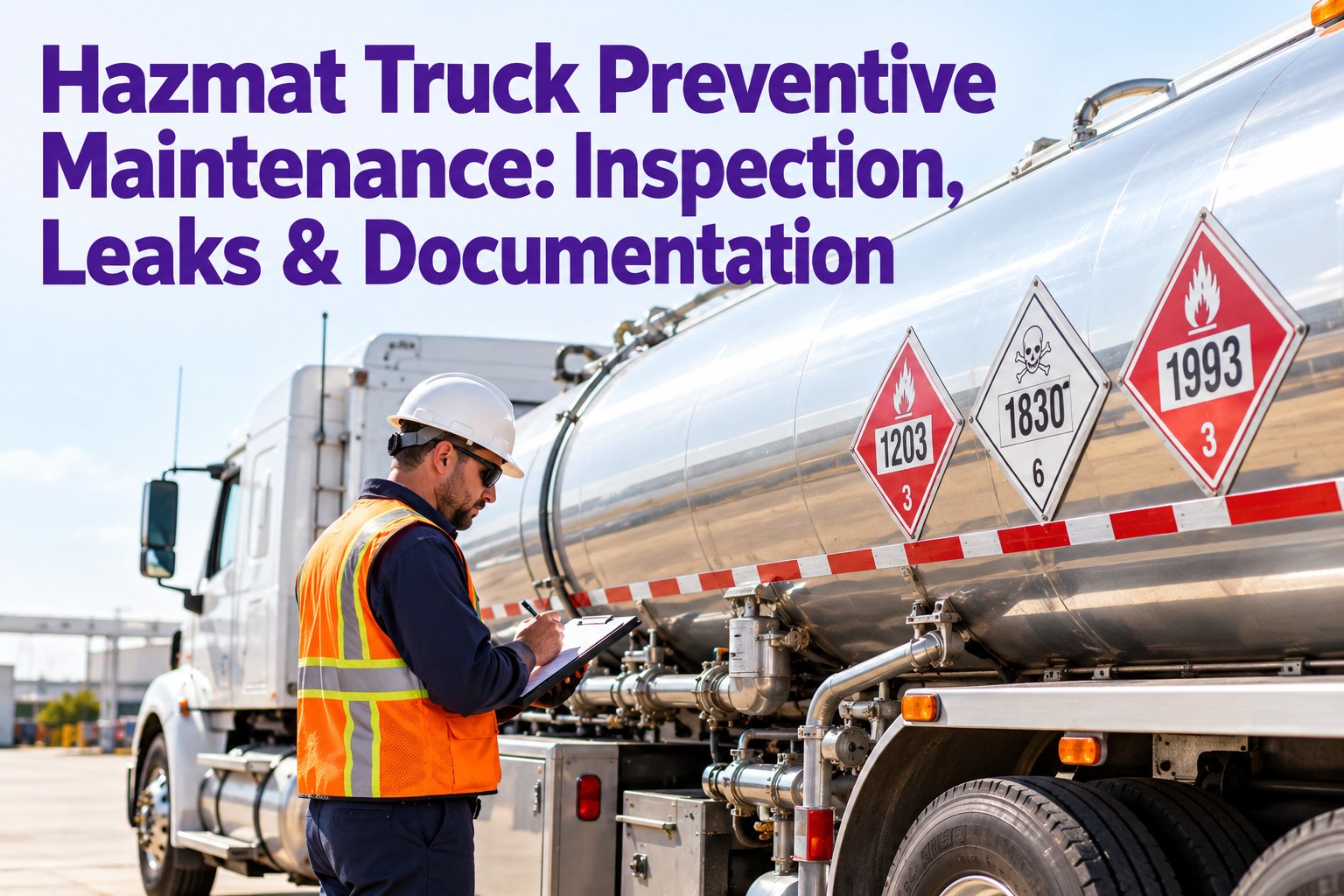
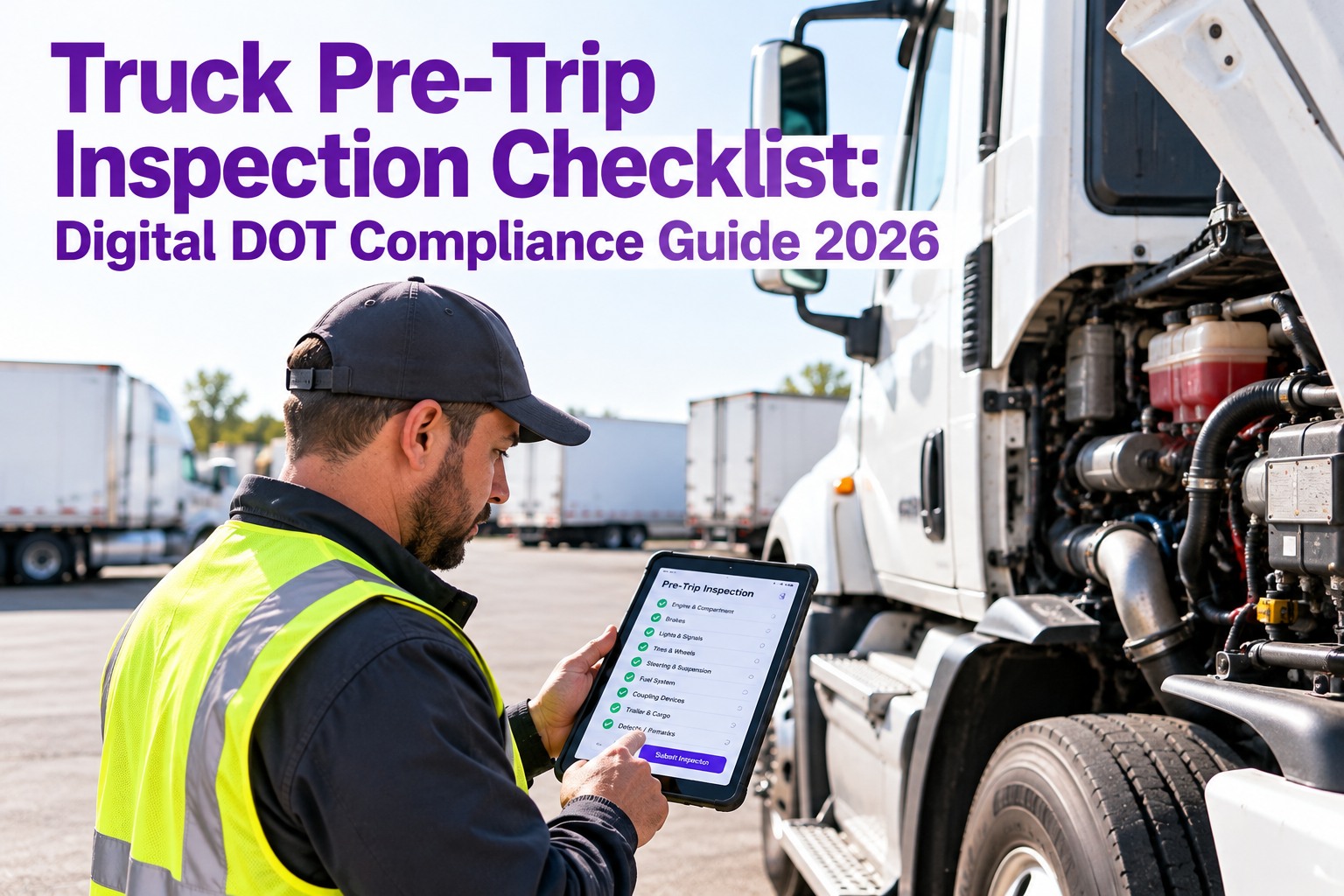
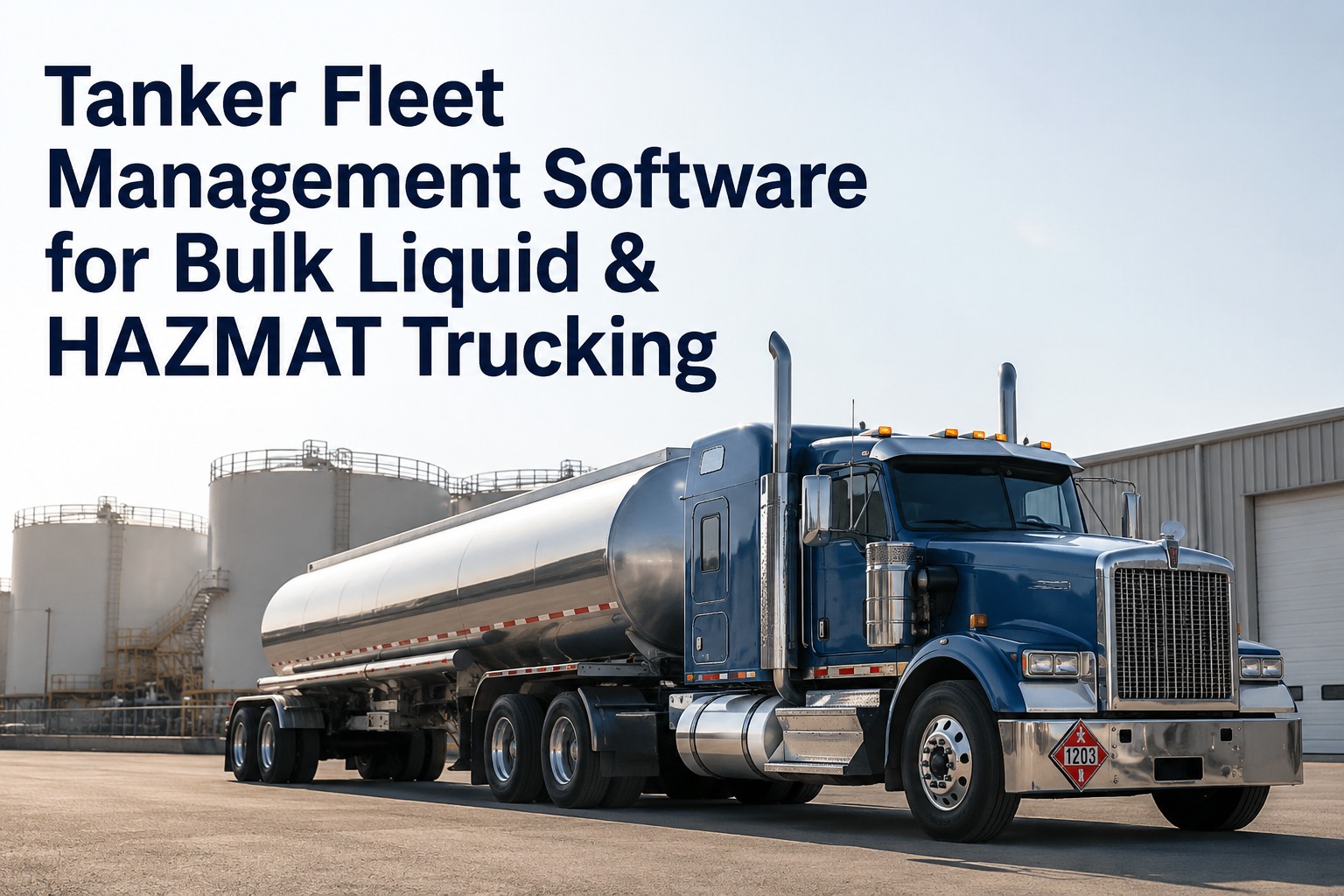
On a hazmat truck, a missed defect isn't a breakdown — it's a release. A weeping valve or a worn gasket becomes a spill, a shutdown, and a reportable incident, and the paperwork behind it is federally mandated down to the test stamp. Preventive maintenance here is inspection, leak control, and documentation working as one system. This guide covers all three, and shows how Truck Inspection & Maintenance Management Software (TIM) schedules the work and keeps the records. Start free and run hazmat PM on one record with TIM.
TIM · Hazmat PM · Inspection · Leaks · Records
Hazmat Truck Preventive Maintenance: Inspection, Leaks & Documentation.
The stakes change everything. A seep that would be a shrug on a dry van is a release on a cargo tank — with cleanup, downtime, and a federal paper trail attached. Hazmat PM means catching leaks before they escalate, running the DOT-mandated test schedule on time, and keeping every record audit-ready. TIM schedules the work and holds the documentation so none of it slips.
Our promise: every flagged leak or defect gets a 4-hour first response — acknowledged, graded, and assigned.
3
fronts: inspect · leaks · records
180.407
the test schedule you run to
1
record, inspection to repair
Why Hazmat PM Is a Different Job
A hazmat truck carries the same brakes and tires as any rig — plus a regulated pressure vessel and a cargo that punishes every oversight. Three things set its maintenance apart.
⚠
A defect becomes a releaseA leak isn't downtime — it's a spill, an exposure risk, a cleanup, and a reportable event, so defects can't be allowed to ride.▤
The records are mandatedCargo tank tests, inspections, and repairs carry federal documentation and retention requirements — the proof is part of the job.⟳
The tank has its own scheduleBeyond the annual DOT inspection, the cargo tank runs a separate cycle of tests on fixed intervals set by 49 CFR 180.407.
Miss any of the three and the consequences are bigger than a sidelined truck. Contact our team to build a hazmat-specific program.
How a Leak Escalates — and Why Early Wins
Leaks almost never start big. They start as a seep that a sharp pre-trip catches, and they end as an incident only if nobody did. The whole case for leak-focused PM is in this progression.
1
SeepA faint weep or stain at a gasket or fitting — caught here, it's a cheap part.→
2
DripProduct collecting and dripping — still a scheduled fix, not an emergency.→
3
Active leakA steady loss of product — the truck is now a hazard and off the road.→
4
ReleaseProduct escaping to the ground or air — a spill response begins.→
5
Reportable incidentCleanup, exposure risk, and the federal report — the costliest end of the line.
Every stage to the right costs more than catching it one stage to the left. Start free and catch leaks at the seep stage with TIM.
Where Leaks Hide — The Leak-Point Inspection
A leak check on a cargo tank isn't a glance underneath. These are the six points where product gets out, and each one belongs on every pre-trip.
◉
ValvesInternal, external, and emergency shutoff — seats, stems, and actuators that weep when worn.◉
Gaskets & sealsDomelid, flange, and fitting gaskets that harden, flatten, and let product past.◉
Domelid & manholeThe lid assembly and its seal — a classic leak path if it doesn't seat tight.◉
Pressure-relief ventsRelief valves and vents that should seal fully and open only at set pressure.◉
Fittings & pipingThreaded joints, elbows, and outlet piping — vibration loosens them over time.◉
Hoses & pump sealsLoading hoses, couplers, and pump packing that wear and seep at the connection.
Six points, checked every trip, is what keeps a seep from ever becoming a release. Contact our team to put leak points on every inspection.
The Cargo Tank Test Schedule
Beyond the walk-around, the cargo tank itself runs a cycle of DOT-required tests on fixed intervals — performed by a registered inspector and marked on the tank. The typical intervals are below; the exact ones vary by tank specification, so always confirm against 49 CFR 180.407.
1 YEARExternal visual (V)Tank, piping, and hardware inspected externally — the most frequent check (6 months for some specs).
1 YEARLeakage test (K)The tank is tested for leaks at its rated condition — annually for the listed specs.
2 YEARSThickness test (T)Wall thickness measured to confirm it's above the minimum — by condition on some specs.
5 YEARSInternal visual (I)Interior inspected for corrosion and damage — annually on lined tanks, longer on others.
5 YEARSPressure test (P)Hydrostatic or pneumatic test of the tank's integrity — the longest interval for most specs.
Each test has a hard due date, and a lapsed one takes the tank out of service. Start free and track every test interval with TIM.
DOCUMENTATION
Hazmat maintenance lives or dies on records. Each cargo tank test is marked on the tank by letter — V external, I internal, P pressure, L lining, T thickness, K leakage — and the written test and inspection reports must be retained for the period the regulations require and kept available for inspection. Repairs, the inspector's registration, and the inspection history all form the proof an auditor or officer expects to see. The practical rule: the test isn't finished until the record is filed. Confirm current federal and state requirements — this is general guidance, not legal advice.
What a Missed Leak or Record Costs
On a hazmat truck, the failures are the expensive kind — and every one is preventable with inspection and tracking.
✕
A release and cleanupA leak that ran becomes a spill response, environmental cleanup, and a reportable incident.✕
Out of serviceAn overdue cargo tank test or an active leak sidelines the truck until it's corrected and re-tested.✕
Failed auditIf the test reports and repair records can't be produced, the paperwork gap is its own violation.✕
Compliance exposureHazmat violations carry weight that an ordinary maintenance miss never does.
Every one traces back to a leak unchecked or a date untracked. Start free and close both gaps with TIM.
How TIM Helps
Inspections Scheduled, Leaks Routed, Records Retained
TIM doesn't perform the cargo tank tests — a registered inspector does — but it runs the program around them: scheduling every test and PM by its interval, turning a leak-point finding into a graded work order, and keeping the inspection and test records on the unit so the proof is always at hand. One record carries the truck from pre-trip to filed report.
1Leak point inspected
→
2Finding graded
→
3Work order routed
→
4Record retained
Test intervals trackedEvery cargo tank test due date held and counted down so none lapses.
Leak-point checklistValves, gaskets, domelid, vents, fittings, and hoses on every guided pre-trip.
Finding becomes a work orderA seep flagged on inspection routes to the shop the moment it's filed — no re-keying.
Severity-based routingAn active leak goes now; a minor wear item joins the planned queue.
Records on the unitTest reports and repairs kept on the truck's record and produced on demand.
Per-unit historyEvery test, leak, and repair logged against that tank for its service life.
Frequently Asked Questions
How often does a cargo tank need to be tested?
It depends on the test and the tank specification, but the common pattern under 49 CFR 180.407 is an external visual and a leakage test every year, a thickness test every two years, and an internal visual and pressure test around every five years — with lined tanks inspected internally more often and some specs on shorter cycles. Because each test has its own interval and each tank spec varies, confirm the exact schedule against the regulation and track every due date per unit.
Start free and track every cargo tank test with TIM.
Where do cargo tank leaks most often start?
At the connections and seals, not the tank shell. The common leak points are valves, gaskets and seals, the domelid and manhole assembly, pressure-relief vents, fittings and outlet piping, and loading hoses and pump seals. These wear, loosen with vibration, and harden with age, which is why a leak-point check at each of them belongs on every pre-trip — a seep caught at a gasket is a cheap fix, while the same leak ignored becomes a release.
Who is allowed to perform cargo tank tests?
A registered inspector who meets the federal requirements performs the periodic cargo tank tests and inspections, and the tank is marked with the test type and date once complete. Drivers and technicians still handle the daily pre-trip leak and defect checks, but the formal 180.407 tests — pressure, thickness, leakage, and the rest — are the registered inspector's responsibility. The carrier is responsible for keeping proof of both the tests and the inspector's qualification.
What records does hazmat maintenance require?
The written cargo tank test and inspection reports, the repair records, and proof of the inspector's registration, all retained for the period the regulations require and kept available for inspection. The tank itself carries the test markings — V, I, P, L, T, K — showing what was done and when. The core principle is that the documentation is part of the maintenance, not an afterthought: a test that was performed but can't be shown on paper is treated as a gap.
How does software help with hazmat preventive maintenance?
By handling the scheduling and the records that hazmat lives on. Software like TIM tracks each cargo tank test interval so none lapses, puts the leak-point checks on every guided pre-trip, turns a flagged leak into a routed work order, and keeps the test and repair records on the truck's own record for audits. It doesn't replace the registered inspector or the physical tests — it makes sure they happen on time and that the proof is always retrievable.
Inspect · Catch Leaks · Test on Time · Document
On a Hazmat Truck, the Small Stuff Is the Serious Stuff
A seep at a gasket, a cargo tank test a week overdue, a test report that can't be found — on an ordinary truck these are nuisances; on a hazmat load they're the start of an incident or a violation. Preventive maintenance here is inspection, leak control, and documentation run as one disciplined system. TIM schedules the tests, routes the leaks, and keeps the records, so the truck that rolls is safe, compliant, and provably both.
No credit card required · Free for up to 3 trucks · Test-interval tracking, leak-point checks, and record retention built in