Hauling hazmat means every load comes with a paper trail — and inspectors check it. In 2025, roadside inspectors logged 35,700 hazmat violations, and about a quarter ended with the truck out of service. This guide maps every record DOT expects from a hazmat carrier, how long each one must be kept, and where it has to be — and shows how Truck Inspection & Maintenance Management Software keeps the truck side of that trail complete without extra paperwork. Start free and keep every truck record audit-ready.
Papers · Training · Plans · Permits · Truck Records
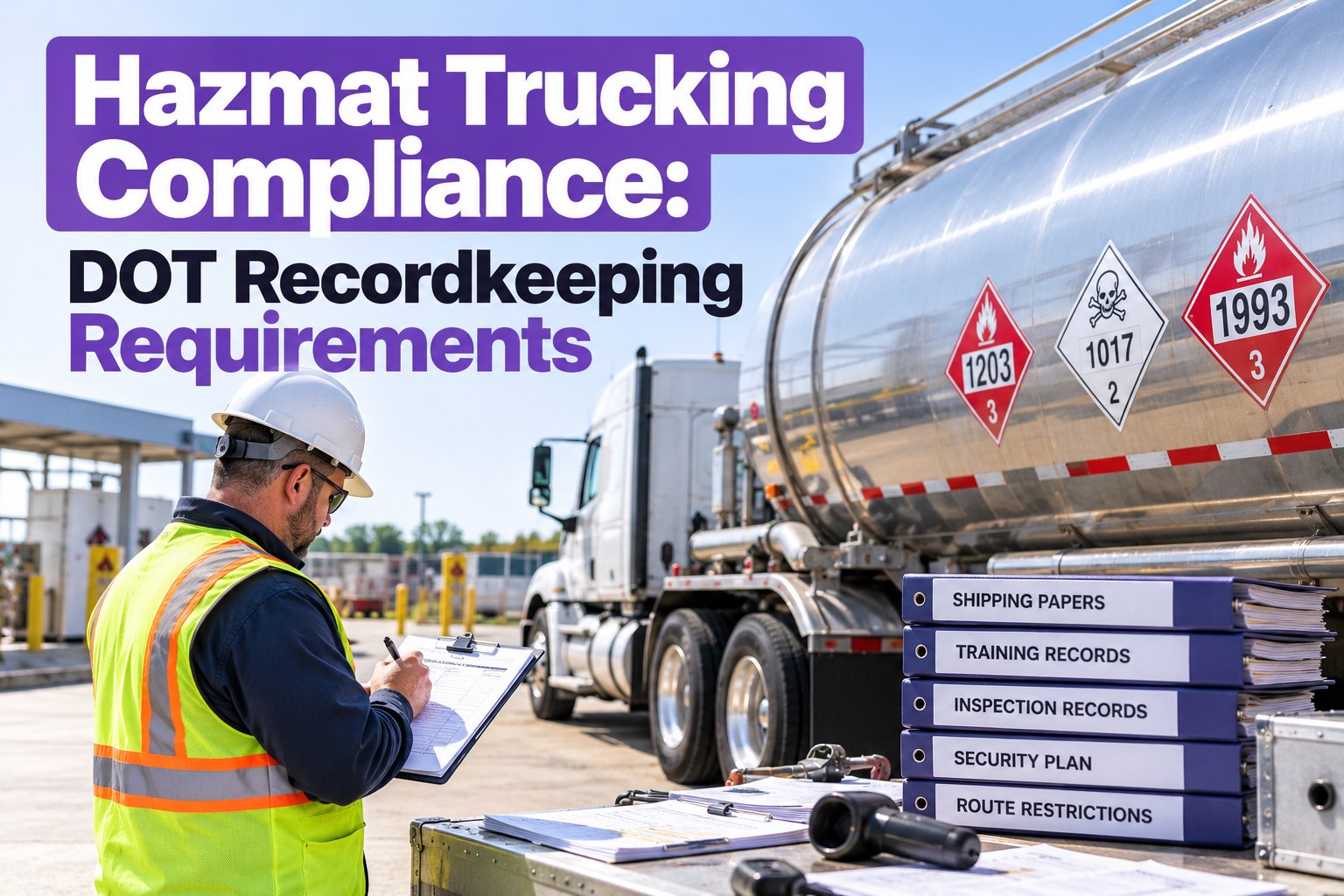
Hazmat Trucking Compliance: DOT Recordkeeping Requirements
Hazmat compliance runs on six record trails, and the one that fails most quietly is the truck's own inspection and repair history. Truck Inspection & Maintenance Management Software ties every inspection, DVIR, and repair to its truck, runs the retention clock for you, and keeps the file reachable from any yard — so one audit request never turns into a scramble.
35,700hazmat roadside violations in 2025
26%of those ended in an out-of-service order
$102,348maximum civil penalty per violation, per day (2025)
In the Cab vs. In the Office — Where Each Record Must Be
Some papers ride with the driver; others are produced from your home terminal on request. Sort your records this way and missing ones show up fast. Contact our team to map your own records against this split.
A
In the CabTravels with the driver, every trip
Shipping paperTabbed or on top of the pile, in a door holder or on the seat when the driver steps out§177.817
Emergency response informationRides with the shipping paper so responders get it fast§172.602
PHMSA registration proofA copy of the certificate, or a document showing the U.S. DOT Hazmat Reg. No.§107.620
Safety permit numberOnly if your loads require an FMCSA hazmat safety permit§385.415
Route planOnly for load types that require a written plan§397.67 · .101
B
In the OfficeProduced from the home terminal on request
Shipping paper copiesKept at or reachable through your principal place of business§172.201 · §177.817
Hazmat training recordsOne current record per hazmat employee, with prior history§172.704(d)
Written security planOnly if you move loads that trigger the rule§172.800
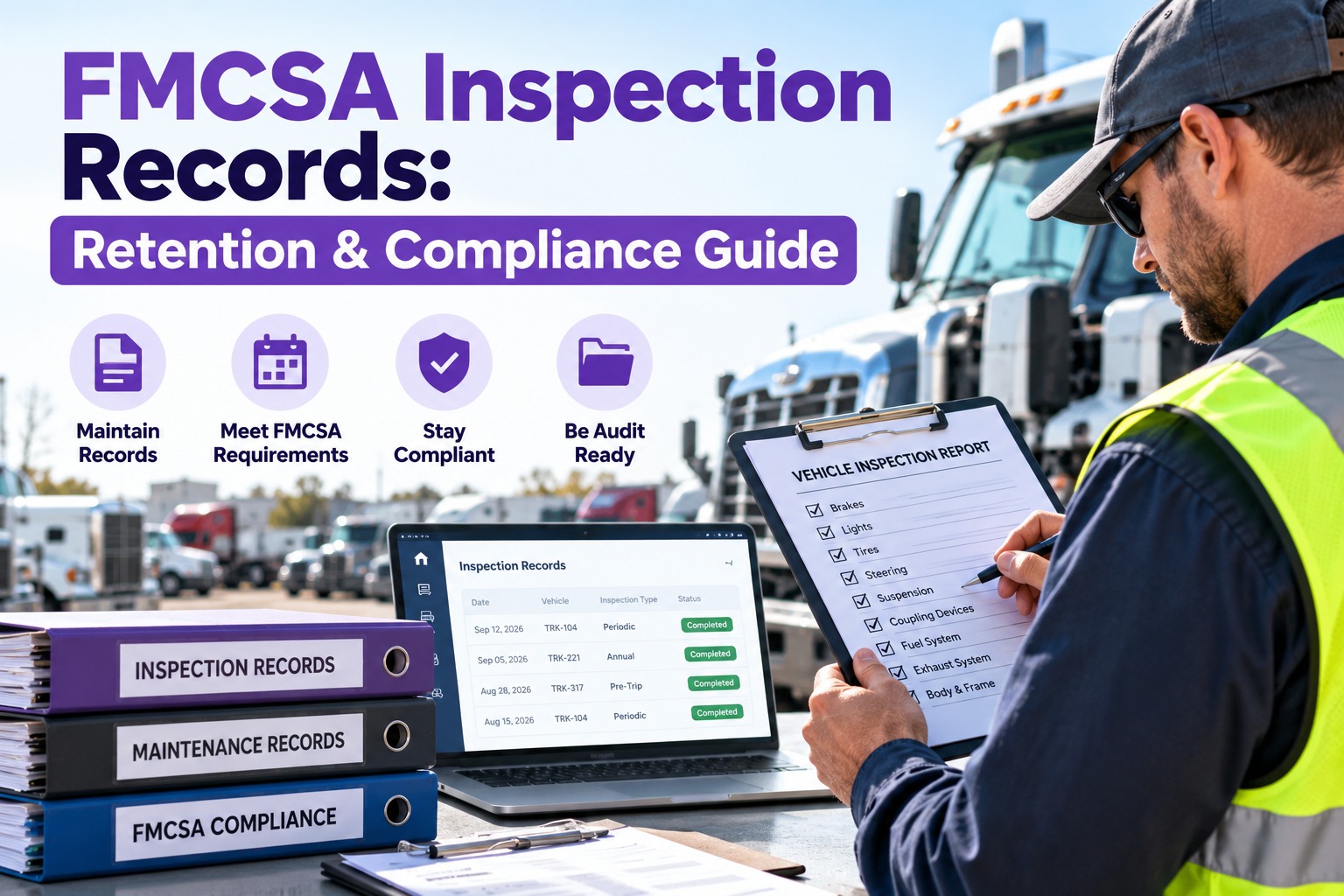
Truck inspection & maintenance fileDefect DVIRs, annual inspection reports, repair history — the one file Truck Inspection & Maintenance Software builds and keeps for youPart 396
Registration recordsFurnished in paper or electronic form when asked§107.620
The Retention Ladder — How Long Each Record Survives
Every record has its own clock. Three of them — defect DVIR, annual report, and maintenance records — belong to the truck, and Truck Inspection & Maintenance Management Software tracks them for you. Start free and let the retention clock track itself.
DVIR noting a defect §396.113 months
Shipping paper — carrier copy §177.817(f)1 year
Annual inspection report §396.2114 months
Maintenance & repair records §396.31 year + 6 months after the truck leaves
Shipping paper — shipper copy §172.201(e)2 years
Hazardous waste shipping papers §172.201 · §177.8173 years
Hazmat training record §172.704(d)3 years of history + 90 days after employment ends
Full bar = 36 months on file
Carrier or shipper? Keep the longer one The carrier rule is one year, and the shipper rule is two. If your company also prepares or offers shipments, the papers you provide fall under the two-year rule — so when roles blur, keep the longer clock. A carrier that reuses one shipping paper for repeat loads may keep a single copy, but only alongside a record of each shipment: shipping name, ID number, quantity, and date.
Training, Security Plan, Route Plan — The Three Files Auditors Ask For Next
After the cab paperwork, reviewers move to the programs behind the load — each with its own trigger and record. Contact our team to see how fleets keep these files organized.
01Training Record§172.704
1
New hireUp to 90 days to finish training, under supervision until then
2
Every 3 yearsRecurrent training and testing for each hazmat employee
3
Record on fileName, completion date, materials used, trainer name and address, certification
02Security Plan§172.800 · .802
Required only when you move loads that meet one of 16 triggers — certain explosives, poison-by-inhalation materials, and large bulk quantities (over 3,000 kg or 3,000 L in one package) of listed classes. A written plan covers:
Risk assessmentPersonnel securityUnauthorized accessEn route securityNamed responsibilitiesIn-depth staff training
03Route PlanPart 397
Written planClass 1 explosives (1.1, 1.2, 1.3) and highway route controlled radioactive loads
State rulesOther placarded loads must follow state and tribal routing designations
Permit holdersCarriers with an FMCSA hazmat safety permit maintain, follow, and carry a route plan
Two Credentials Fleets Mix Up
They sound alike but are different: one covers a wide group of hazmat carriers, the other only those hauling the most dangerous loads.
PHMSA Registration
The wider net
Applies to persons who offer or transport placarded quantities of hazmat and other listed materials. Each motor carrier carries a copy of its certificate, or another document showing the current registration number. Electronic copies are accepted.
§107.601 · §107.620
FMCSA Safety Permit
The narrower net
Covers carriers moving the most hazardous loads, such as explosives, certain radioactive materials, poison-by-inhalation materials, and large natural gas shipments. Valid for 2 years, it sits on top of PHMSA registration — never in place of it.
49 CFR Part 385, Subpart E
How Truck Inspection & Maintenance Software Keeps the Truck File Audit-Ready
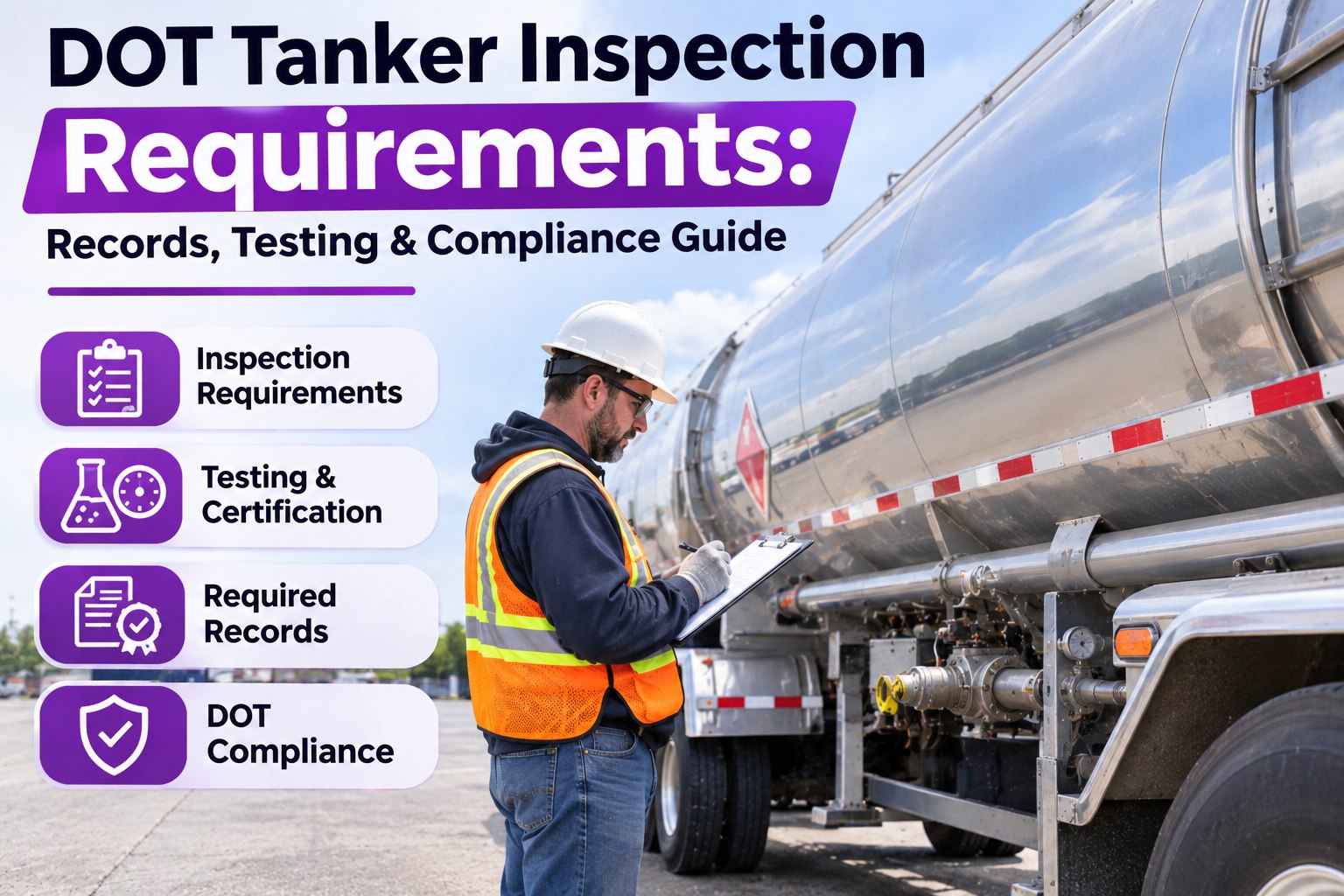
Part 396 still applies to hazmat trucks, and cargo tanks add Part 180 test records. Truck Inspection & Maintenance Management Software logs every inspection, defect, and repair on the right truck as it happens — so the file is built as you work, not rebuilt before an audit. Start free and build the truck file as you work.
1InspectThe driver's inspection is recorded against the specific truck
2Flag the defectA noted defect stays tied to its DVIR until it is resolved
3Repair and sign offThe repair is logged on the same truck, closing the loop
4Clock startsThe right retention window attaches to each record
5Pull on demandAny truck's history is a date filter, from any yard
Where audits find gapsWith the software
A DVIR notes a defect, the repair happens, but nothing proves itThe repair and sign-off sit on the same truck record as the defect
The annual report is filed at the wrong yardOne file per truck, reachable from any yard
Months with no entry for a truck that ran every dayInspections and repairs are logged as they happen, so gaps show up early
A clock is missed and the file is purged too soonEach record carries its own retention clock, and the next annual is flagged before the old report ages out
Let the Software Carry the Truck Side of Your Hazmat Audit
Shipping papers, training, and security plans stay with your hazmat team. The truck's inspection and repair trail is the part software can run for you — stored per truck, clocked automatically, and ready as a date filter instead of a binder hunt.
What a Missing Record Actually Costs
Of 590 missing-shipping-paper violations in the first half of 2025, 570 ended in out-of-service orders. Federal penalties can reach six figures per violation, per day — and a growing hazmat market ($69.22 billion in the U.S. in 2025) means more scrutiny. Contact our team before an auditor does the review for you.
Missing shipping paper violations that ended out of service570 of 590
$102,348maximum per violation, per day
$238,809maximum if a violation causes death, serious injury, or major property damage
$617minimum penalty for a training violation
Penalty figures are adjusted every year The amounts above reflect the 2025 inflation adjustment, and DOT revises them annually. Treat them as a floor for planning, and check the current figures with PHMSA or FMCSA before quoting them internally. The records you can control most easily are the truck's — which is why they are worth putting on software first.
Frequently Asked Questions
How long do I have to keep hazmat shipping papers?
Carriers keep their copy for one year after the material is accepted. Shippers keep theirs for two years, and hazardous waste shipping papers are held for three years. Each copy must show the date of acceptance and be reachable through your principal place of business. Many carriers simply keep two years across the board to avoid sorting out which role applied.
How often is hazmat training required, and what must the record show?
Each hazmat employee must be retrained at least once every three years. The employer keeps a record of current training that includes the preceding three years: the employee's name, the latest completion date, a summary or copy of the training materials, the trainer's name and address, and certification that the employee was trained and tested. Keep it for as long as the person works as a hazmat employee, plus 90 days.
Does every hazmat carrier need a written security plan?
No. A security plan is required only when you transport or offer materials that meet one of the 16 triggers in §172.800(b). A fleet hauling small amounts of lower-risk materials may not need one, while a tank fleet moving large bulk quantities of listed classes does. Even if no plan is required, security awareness training still applies to every hazmat employee.
Can I keep hazmat records electronically instead of on paper?
Largely yes. The shipping paper rules allow a copy or an electronic image, and PHMSA registration records may be furnished in paper or electronic form. FMCSA has also said an electronic copy of the hazmat safety permit satisfies the carry requirement. The condition is the same everywhere: the record must be complete and producible on demand. For the truck's inspection, DVIR, and repair history, Truck Inspection & Maintenance Management Software does exactly that: one per-truck file, reachable from any yard, with the retention clock attached.
Start free and see how the truck side works.
Filed · On the Clock · Retrievable
Walk Into Any Hazmat Audit With the Truck File Ready
Truck Inspection & Maintenance Management Software ties each inspection, DVIR, and repair to its truck, attaches the retention clock, and keeps the whole file reachable from any yard. Fleets use it so the vehicle side of every hazmat review is complete, dated, and a few clicks away.
No credit card required. Free for up to 3 trucks. Built for FMCSA-compliant fleets.