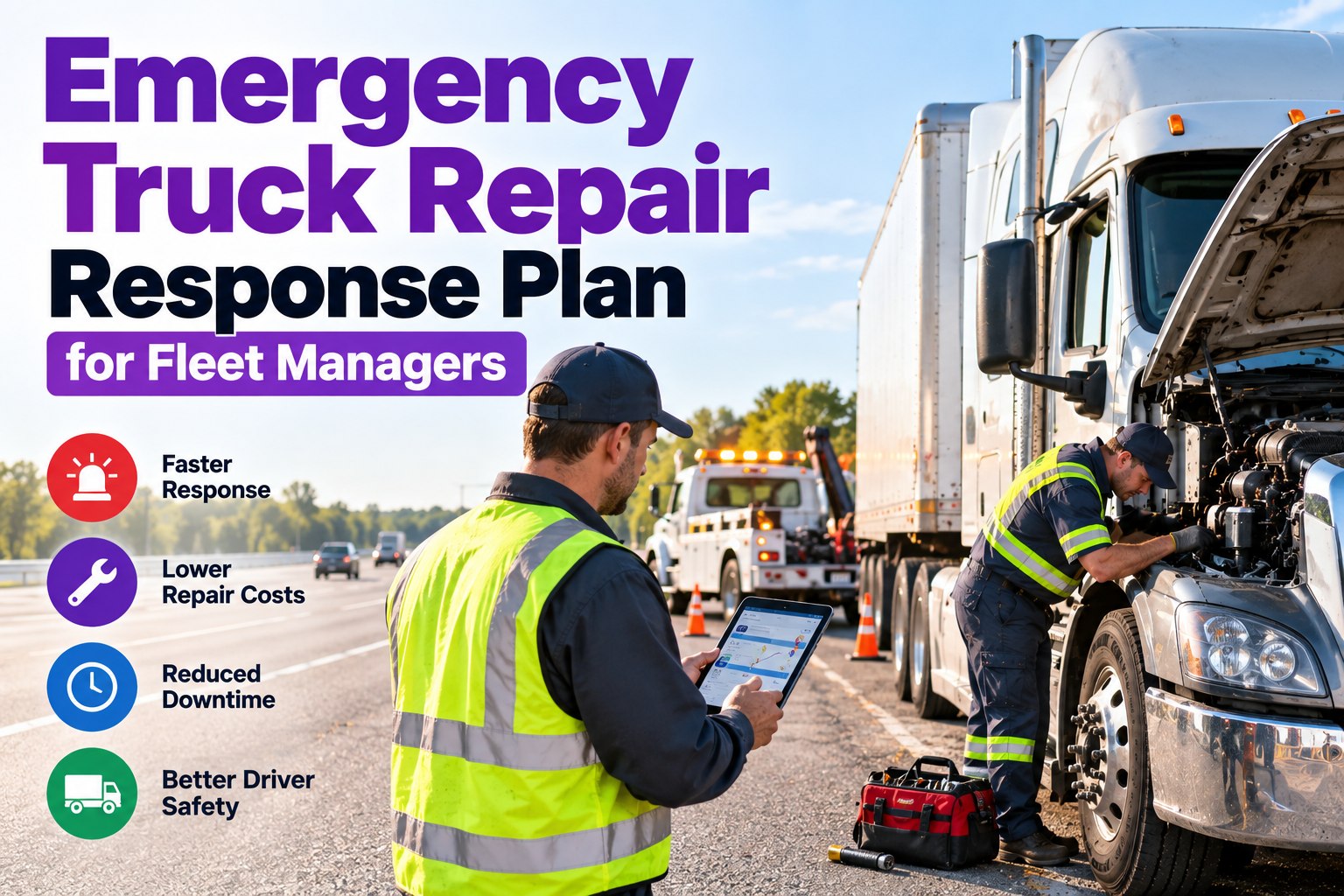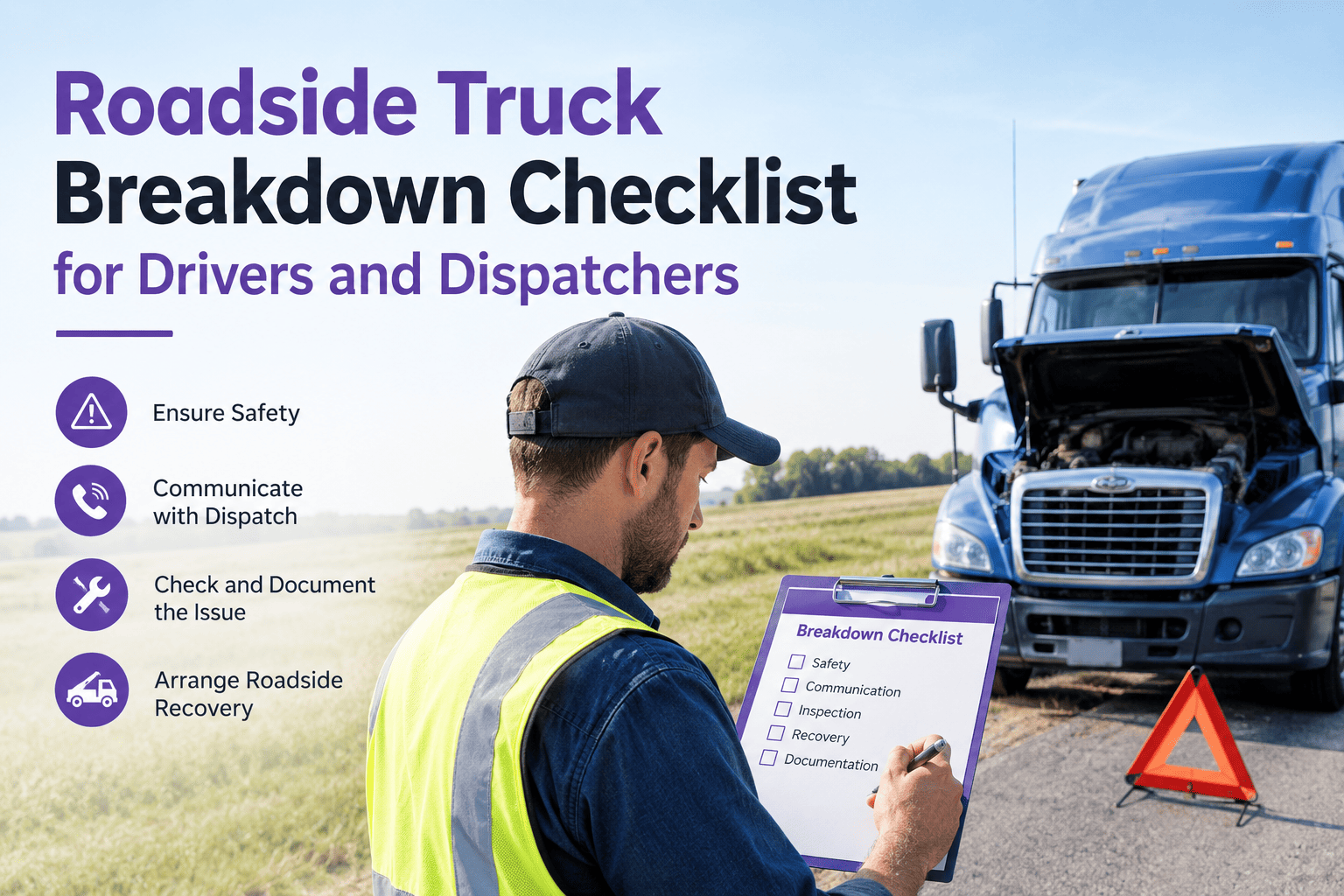
A breakdown with no plan is a liability event in motion — a stranded driver, a blocked lane, no towing contact to hand. The fleets that recover in an hour instead of a day run a written response plan the driver and dispatcher both know by heart. This guide lays it out: the driver's first ten minutes, how dispatch triages and launches help, how you manage towing vendors and a load transfer, and how to track what every breakdown costs. Build it on your own fleet with a free Truck Inspection & Maintenance account.
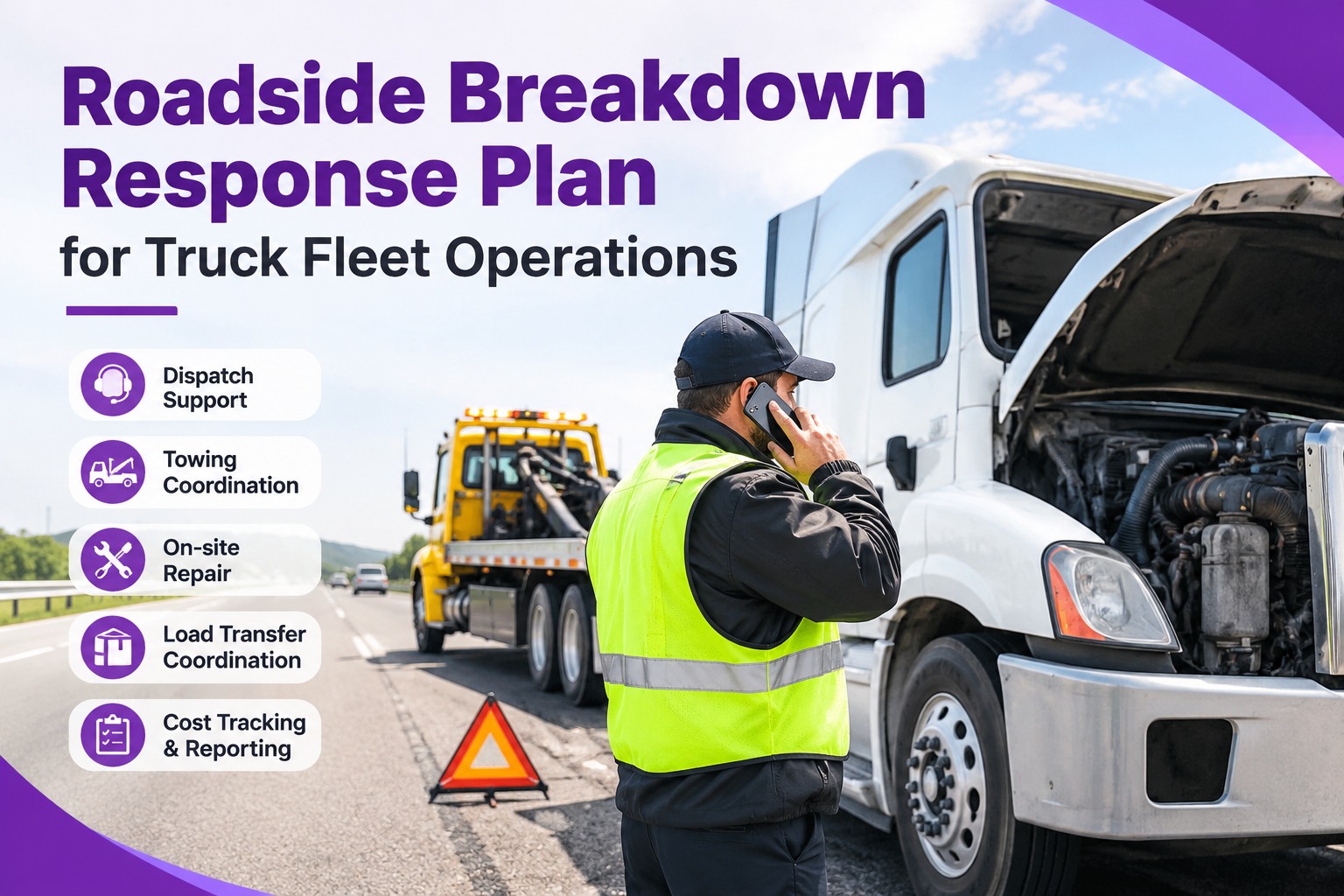
Roadside Breakdown Response Plan for Truck Fleet Operations
When a truck stops on the shoulder the meter is already running — and the driver's fourteen-hour HOS clock does not pause for a breakdown. Truck Inspection & Maintenance turns the chaos into one loop: the driver logs the breakdown from a phone with GPS and photos, the event opens as a graded defect and work order, dispatch sees it live and launches the right vendor, and the full cost closes back against the vehicle. On any safety defect you get a guaranteed four-hour first response — acknowledged, graded, and assigned within four hours — so no truck sits waiting for someone to notice.
Why minutes cost so much
The towing invoice is the smallest number in the story. A loaded truck on the shoulder keeps burning the fully-loaded cost of operation — the American Transportation Research Institute put that near ninety-one dollars an hour in 2024 — while the HOS clock ticks, the load slips toward a missed appointment, and a heavy-duty recovery alone can run twenty-five hundred to five thousand dollars or more. The plan exists to shrink the one variable you control: the time between the truck stopping and help arriving.
Fully-loaded operating cost of a truck, ATRI 2024 — running whether it moves or not.
Heavy-duty towing and recovery for a single loaded-truck event.
Blended out-of-service cost per truck once wages and penalties are added.
The driver's HOS window does not pause during a breakdown — lost hours are gone.
Those are industry benchmarks, not a quote for your fleet — confirm against your own lanes. The point holds either way: speed is the lever. Book a short demo to see how the response loop compresses that timeline.
The five phases of a breakdown response
Every solid plan runs the same sequence, whatever the fleet size. Each phase has one owner and one exit point — the handoffs are where "phone-and-pray" response falls apart, so name them in advance.
Make the scene safe
Truck as far off the roadway as possible, hazards on, warning devices out within ten minutes as FMCSA §392.22 requires. Safety before any phone call.
Report and pinpoint
Log the breakdown in the mobile app — automatic GPS, a symptom note, photos. Dispatch cannot coordinate a tow without a precise location, and a photo often decides repair-in-place versus tow before anyone rolls.
Triage the severity
Grade the event against the vehicle record — driver fix, mobile tech, or tow? The right call needs weight class, trailer config, and cargo type on screen, not a phone-tag guess.
Dispatch the right help
Launch an approved vendor from the corridor network with unit number, VIN, and symptoms attached. A light wrecker to a loaded tri-axle costs hours — the match has to be right the first time.
Recover and close out
Decide the load's fate, capture the vendor invoice and photos, inspect before redeployment, and log the root cause. The event is not closed until the cost is attached.
Wire these five phases into one linked record with a free account.
Triage: not every breakdown is a tow
The fastest recovery never needs a wrecker. A severity matrix keeps dispatch from defaulting to "tow it" when a mobile tech or the driver could clear it faster. Grade on two axes — safety risk and roadside fixability — and let the grade pick the response.
Tires alone account for roughly half of all roadside breakdowns, so a strong mobile-tire relationship pays for itself. When a grade says "do not move," that reaches the driver instantly — book a demo to see the triage grade reach driver and vendor at once.
Managing the towing and mobile-repair network
The time to find a heavy-duty wrecker is not at 2 a.m. on an interstate shoulder. A vendor network built by corridor, not scrambled per event, is what separates a one-hour recovery from a six-hour one.
Two to three pre-approved heavy-duty tow vendors plus a mobile-repair option per region, so there is always a nearby match.
Agree a maximum response time up front and record actual arrival against it, every event, so underperformers surface in the data.
Require an itemized invoice and on-site photos. A tow bill you cannot audit is one you will overpay.
Rate vendors quarterly on response, price, and quality. Drivers and lanes change; the network has to keep pace.
One linked record per breakdown — driver alert, triage grade, vendor, arrival time, invoice, and root cause — so every event feeds the next decision instead of vanishing into a phone log. Plus a four-hour first response on any safety defect.
Book a Demo — Plan Your NetworkThe load transfer: the most expensive decision
When the truck cannot roll, the load becomes the problem. A load transfer — a second truck or a hot-shot to recover the trailer or re-power the load — is one of the costliest, least foreseeable parts of a breakdown. Make the call on facts, weighing three things in order.
Capture the transfer cost against the same event — recovery truck, extra driver hours, any expedited premium — or it scatters across systems and never shows in your true breakdown cost.
Track what breakdowns really cost
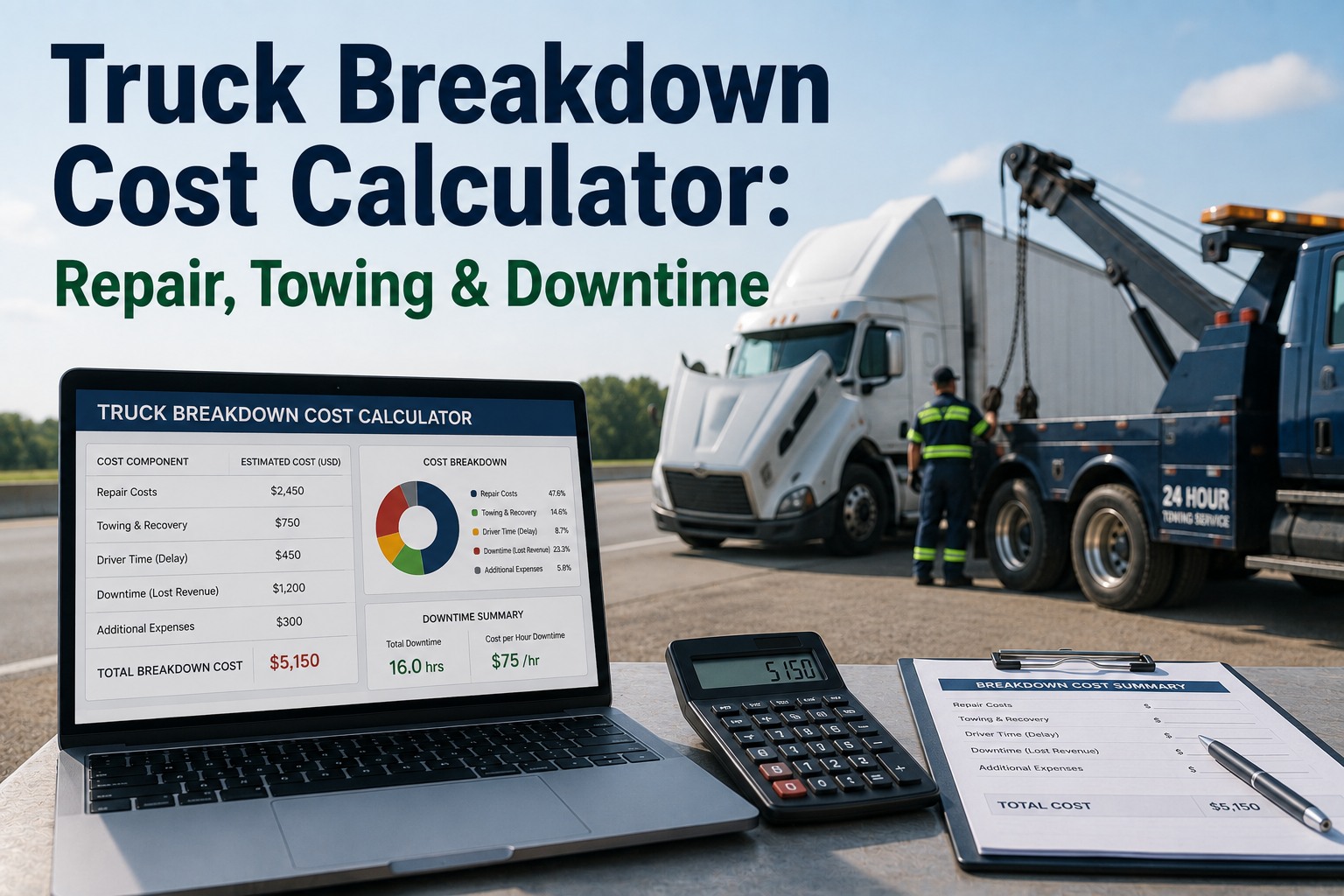
A single breakdown is a story; a fleet needs a measure that moves over time. The one that works is breakdown cost per mile — the total true cost of all breakdowns divided by fleet miles — rolling towing, downtime, load transfer, and penalties into one trend. One outlier truck or lane stops hiding in a total spend number.
Most fleets underestimate the cost because the repair bill is only a fraction of it — driver wages, lost revenue miles, load recovery, and shipper penalties sit in other systems or nowhere at all. Capturing every cost against the event makes the per-mile number honest, and honest numbers justify the preventive work that stops the next breakdown. Spin up a free account to start logging events against each truck.
What the software has to do
GPS, photo, and symptom captured from the phone the moment the driver is safe.
Dispatch sees every active event with location and vehicle details on one screen.
Weight class, trailer config, and cargo type ready, so the right vendor goes the first time.
Pre-approved vendors by corridor with response times tracked against the SLA.
Invoice, transfer, and downtime attached, feeding breakdown cost per mile.
Every event tied to the vehicle so the failure pattern gets caught earlier next time.
Frequently asked questions
Safety first: truck off the roadway if possible, hazards on, warning devices out within ten minutes as FMCSA §392.22 requires — then log the breakdown with location and photos. The phone call comes after the scene is safe. See the driver's mobile steps — book a demo here.
More than the repair bill. A truck out of service runs roughly four hundred fifty to eight hundred dollars a day once wages, lost miles, and penalties are counted, and a heavy-duty tow alone can be twenty-five hundred to five thousand dollars-plus — all while the HOS clock runs. Track it as breakdown cost per mile for the real trend. Map it on your fleet — schedule a demo.
Build it by corridor before you need it — two to three pre-approved heavy-duty tow vendors plus a mobile-repair option per region, each held to a response SLA with arrival times recorded and reviewed quarterly. A per-event scramble turns a one-hour recovery into six. See the vendor network in one place — book a demo.
Decide on three facts: whether a mobile tech can have the truck rolling before the delivery window closes, what the cargo demands (a reefer or hard appointment may justify an immediate transfer), and what recovery option is nearby. A perishable or penalty-bearing load often justifies a transfer once a long repair looks likely. See how the load decision ties to the record — grab a demo slot.
Turn breakdowns into a managed workflow
You cannot stop every breakdown, but you can decide how fast your fleet responds. Truck Inspection & Maintenance runs the full loop — driver one-tap alert, live dispatch feed, pre-built vendor network, load-transfer coordination, cost closed against every event, and a four-hour first response on any safety defect — so a stranded truck becomes a tracked incident, not a lost day.