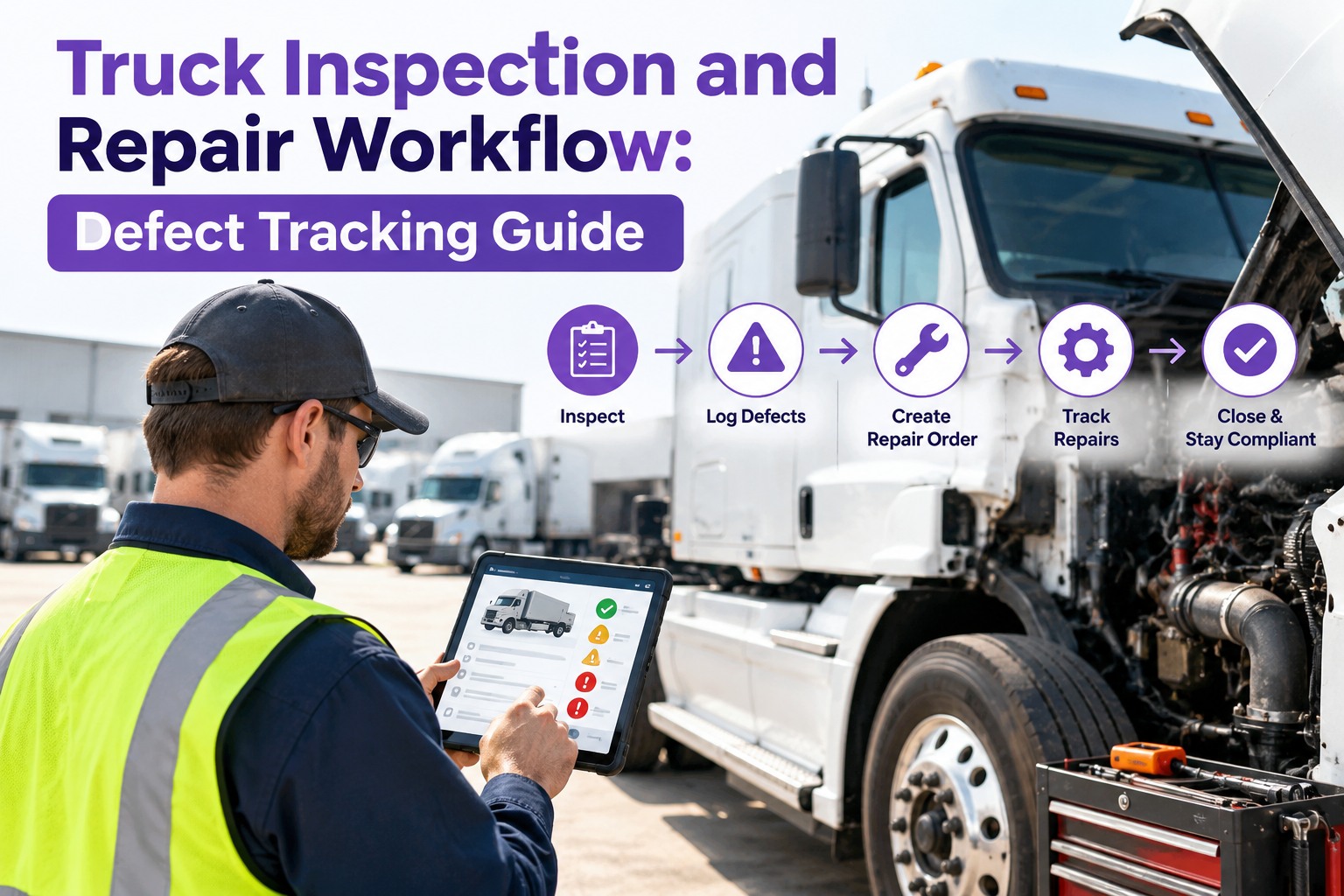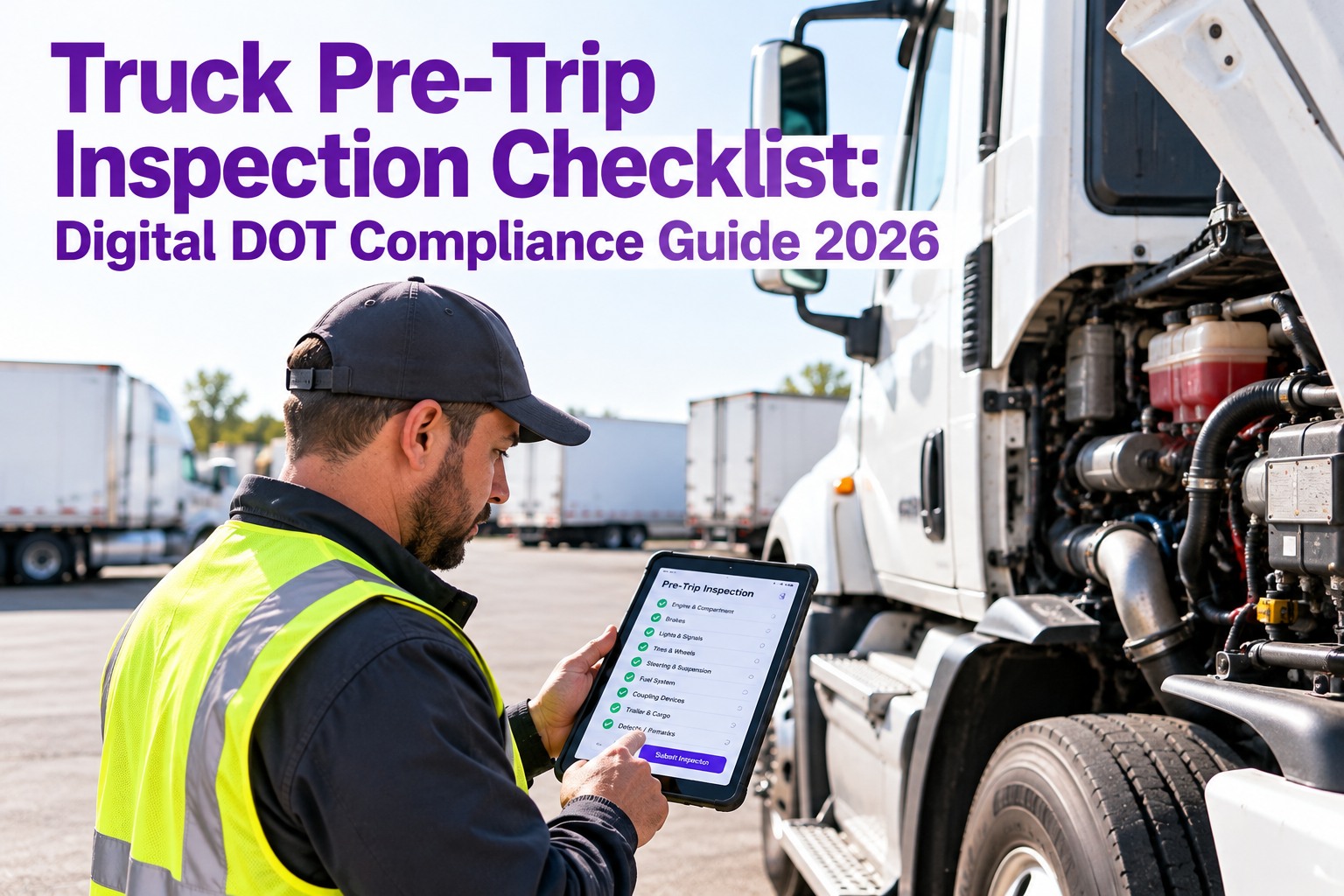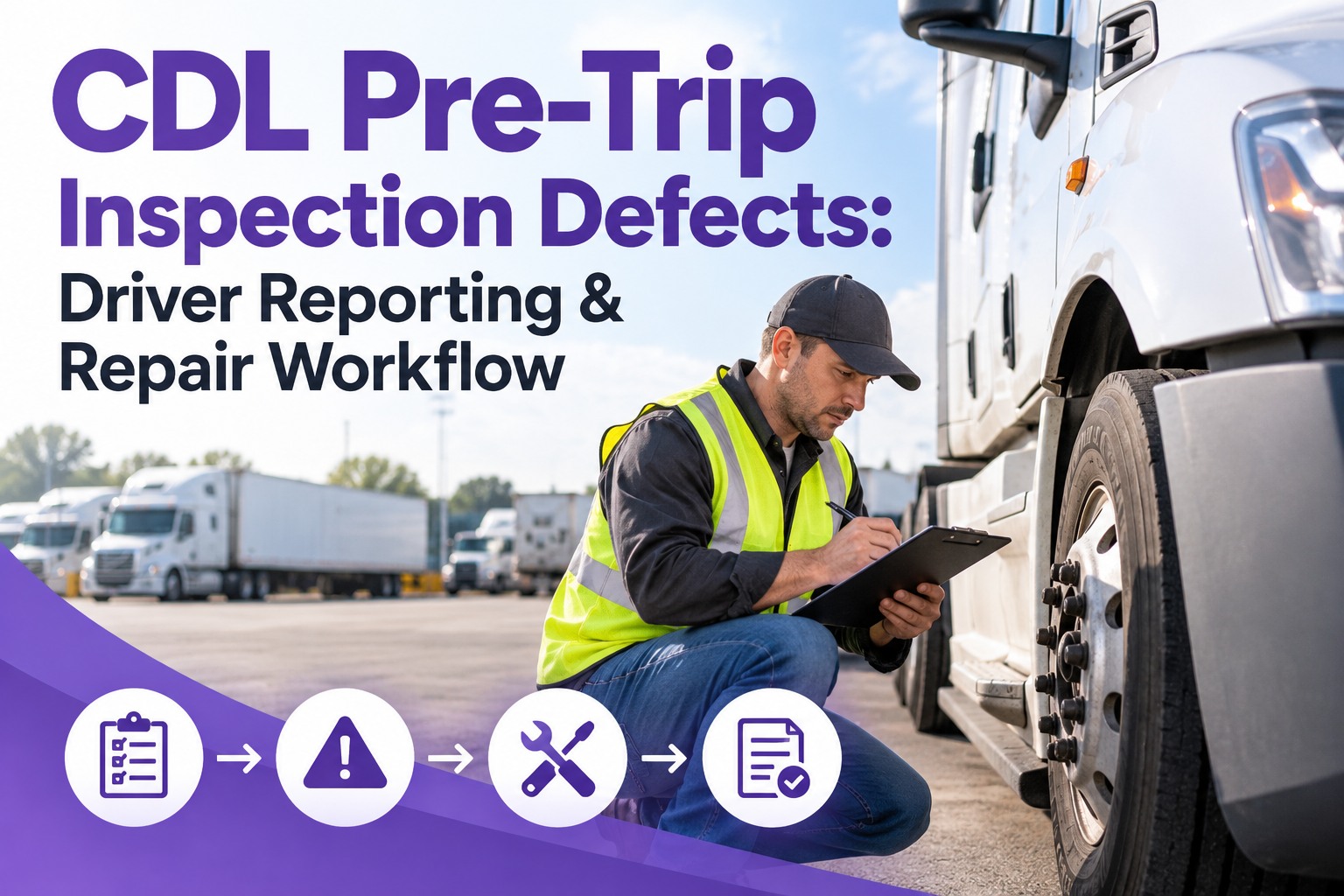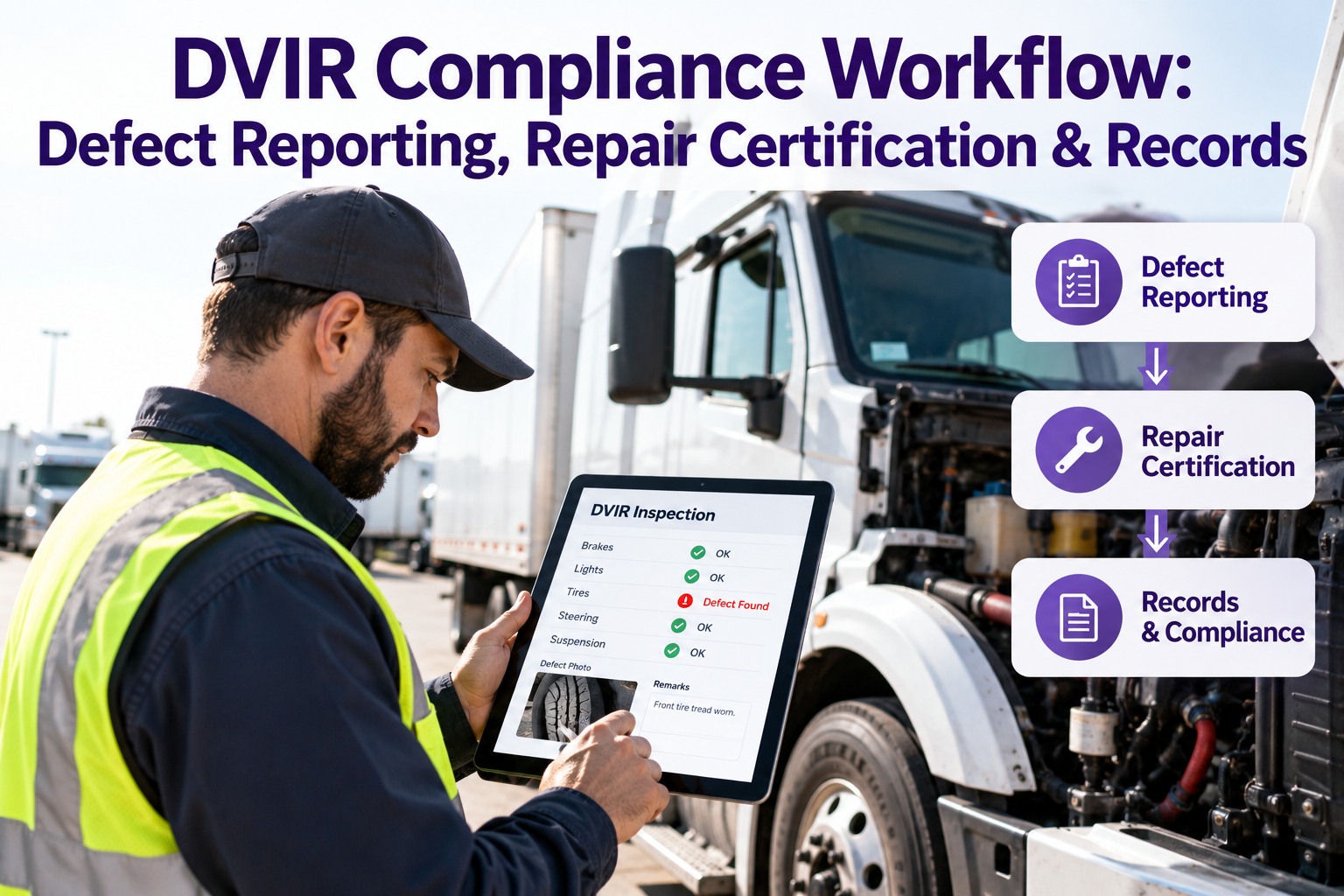
A DVIR isn't one form — it's a chain. A defect gets reported, the repair gets certified, the next driver reviews it, and the whole packet gets kept. Break any link and a clean inspection still becomes a citable violation, because under 49 CFR each missing signature counts on its own. This is the full compliance workflow, stage by stage. Start free and run the whole DVIR loop on one system.
DVIR Compliance Workflow: Defect Reporting, Repair Certification & Records
Most fleets nail the easy part: the driver files the report. Where compliance actually fails is downstream — the repair never gets certified, the next driver signs nothing, or the records aren't kept the full three months. Truck Inspection & Maintenance Management Software runs the entire workflow: a defect becomes a graded work order, the repair is certified and signed, the review is captured, and the complete packet is retained and searchable — so the chain closes every time.
The DVIR Workflow, End to End
The regulation describes a loop, not a document. A defect moves through three stages — reported by the driver, certified by the shop, reviewed by the next driver — and only when all three are recorded and retained is the vehicle compliant to run. Here is the whole chain at a glance.
The driver inspects at the end of the day, lists any defect affecting safety, and signs the report.
Reporting driver signsBefore the truck runs again, the defect is repaired and certified — or certified as not needed for safe operation.
Mechanic / carrier signsThe next driver reviews and signs, and the full packet is kept for three months.
Next driver signsStage 1 — Defect Reporting
Under §396.13, a driver must be satisfied the vehicle is in safe operating condition and review the last report before driving. At the end of the day's work, under §396.11, the driver prepares a written report on each vehicle operated. For property carriers, a report is required when a defect is found — though many fleets file a daily "no-defect" report as policy, because it's the cleanest proof the inspection happened. The report must cover these parts and accessories.
Fleets may add items to the list, but none of these may be dropped. In our software, the driver walks this list on the phone and any failed item becomes a graded work order the moment it's logged, so start free and turn a reported defect into tracked work instantly.
Stage 2 — Repair Certification
This is where paper fleets quietly fall out of compliance. Before a vehicle with a reported safety defect runs again, §396.11(a)(3) requires the carrier to take one of three paths — and the choice has to be documented and signed, not assumed.
A mechanic or authorized person repairs the defect and certifies the repair — who did it, the date, and the defect addressed.
The carrier certifies the repair is not necessary for safe operation, ideally with the basis for that call documented.
If neither certification applies, the vehicle stays parked. A safety defect with no certification is not road-legal.
Stage 3 — Records & Next-Driver Review
The loop closes with a review and a retention duty. Under §396.13(c), the next driver must review the last DVIR and the repair certification and sign before operating the vehicle. Under §396.11(a)(4), the carrier keeps the three documents together — the report, the repair certification, and the driver review — for three months from the date the report was prepared.
The Signature Chain — Where One Gap Becomes a Violation
Three people sign a compliant DVIR, each at a different stage, and each signature answers to a different subsection. An inspector reads the chain end to end — and a missing link anywhere is its own citable violation, even when the truck was actually safe.
Where DVIR Compliance Actually Breaks
The inspection is rarely the problem. Compliance fails in the handoffs — the quiet gaps between report, repair, and record that a paper process can't see. Each of these is a finding a good system closes automatically.
Electronic DVIRs are recognized under §390.32, and FMCSA has added electronic-record language to §396.11 and §396.13. An electronic record has to be readily accessible, printable on request, and kept with its integrity intact for the full retention period — and an electronic signature that meets the §390.32 standard satisfies the signing requirement, so it doesn't have to be handwritten. A digital workflow isn't just faster here; it's the cleanest way to prove every signature and date held.
One System, the Whole Chain Closed
The defect captured on the phone and turned into a graded work order; the repair certified and signed by the technician; the next driver's review captured before the truck moves; and the full three-document packet retained, timestamped, and searchable. That's a DVIR program that passes on the first ask.
How Our Software Runs the DVIR Workflow
Software can't inspect the truck — but it can make sure the chain never breaks after the inspection. Truck Inspection & Maintenance Management Software carries a defect from the report all the way to a retained, signed record, with no step left to memory or a paper slip.
Frequently Asked Questions
What is a DVIR and when is it required?
Who has to sign a DVIR, and what happens if a signature is missing?
What is repair certification under 396.11?
How long do DVIR records have to be kept?
Are electronic DVIRs allowed?
Make the Whole DVIR Chain Close Itself
Capture the defect on the phone, turn it into a graded work order with a 4-hour first response, certify the repair with a signature, record the next-driver review, and retain the full packet past three months — all on one system. Fewer violations, cleaner audits, and a DVIR program that holds up link by link.