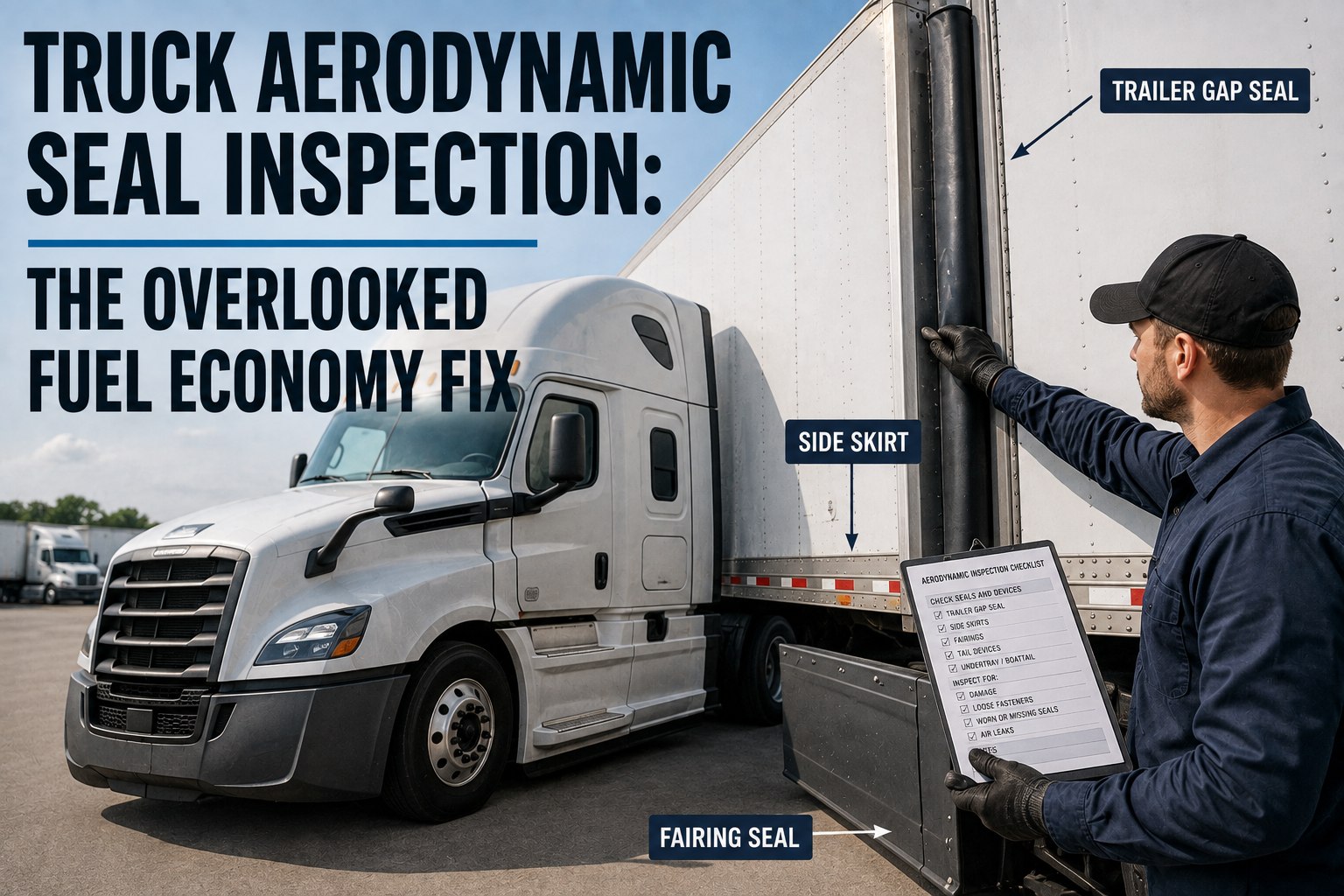
Aerodynamic drag consumes roughly 65% of the energy a tractor uses to pull a trailer at highway speed. Fleets know this — which is why nearly every long-haul truck now runs with side skirts, cab extenders, chassis fairings, and gap-closure devices spec'd from the factory. What most fleets miss is what happens next: these devices get hit. Backing into loading docks tears skirts, curb strikes crack fairings, low bridges buckle roof deflectors, and the mud flap that got ripped off on a rough on-ramp three weeks ago is now costing fuel every single mile. A damaged aero seal doesn't trigger a fault code. It doesn't set off a warning lamp. It just quietly costs a long-haul truck 4–7% MPG until someone actually walks around the vehicle looking for it. And most fleet PM programs — even good ones — don't have a formal aero inspection step. This article gives you the walk-around inspection every long-haul truck needs, the specific damage patterns that kill fuel economy, and how Truck Inspection & Maintenance turns aero condition into a captured DVIR item instead of a $12,000-per-year silent loss per truck. Start a free trial to add aero inspection to your fleet's DVIR checklist this week.
Truck Aerodynamic Seal Inspection: The Overlooked Fuel Economy Fix
Damaged aero seals — tractor-trailer gap, side skirts, mud flaps, cab extenders — cost a long-haul truck 4–7% MPG and never trigger a warning lamp. Get the walk-around inspection guide most fleet PM programs miss, plus the DVIR workflow that catches damage before the fuel bill does.
Why the Aero Problem Hides From Most PM Programs
The reason damaged aero components don't get repaired is not laziness — it's that they slip through every existing detection system a fleet already runs. Understanding the four blind spots is the first step to closing them.
Unlike a fault code or a restriction indicator, aero damage produces no dashboard signal. The truck runs normally — just less efficiently.
Standard pre-trip inspections cover brakes, lights, tires, coupling — not aero condition. Drivers rarely think to look for it.
Most PM sheets skip aero components entirely. Techs focus on engine, driveline, brakes — not fairings and skirts.
A 3% MPG drop attributed to "route mix" or "weather" is actually a torn skirt. Nothing points at the specific cause.
The Aero Anatomy: Every Zone That Matters
A modern long-haul tractor-trailer has six distinct aero zones, each with different components, different damage patterns, and different MPG impact. Walk the truck by zone — front to back, top to bottom — and no critical component gets skipped.
Zone-by-Zone: What to Inspect and What It Costs
Each of the six zones has specific damage patterns, MPG impact ranges (drawn from NACFE, SmartWay, and manufacturer testing), and one common failure that catches most techs off guard. This is the reference to hand every driver and shop foreman.
Look for: Cracked roof fairing, missing bug deflectors, misaligned roof cap. Check that the roof deflector height matches the trailer height — a fairing set for a low trailer costs fuel on a tall one.
Common miss: Bracket mounts loosen over time and let the fairing shift a few inches — invisible from the ground, expensive at speed.
Look for: Cab extenders (side panels behind the cab) — torn, missing, or bent. Any gap-closure device — inflatable, mechanical, or fixed — for damage or failure to deploy.
Common miss: The gap is the single highest-value aero zone on a tractor-trailer. Independent research links narrowing this gap to ~7% drag reduction — one cracked extender kills a big share of the payoff.
Look for: Chassis skirts on the tractor for curb-strike damage, missing mounting hardware, cracked leading edges. Panels should sit close to the ground with no visible gap.
Common miss: Chassis skirts on the passenger side get hit more from curb strikes but rarely get walked — driver-side walk-arounds skip them.
Look for: Torn or delaminated panels, missing sections, brackets pulled from mounts. Skirts should extend from behind the landing gear to the front of the trailer axles at consistent height.
Common miss: Standard side skirts typically save ~766 gallons/year, extended skirts closer to 871 gallons/year — a single torn panel can erase a substantial share of that savings for the rest of the calendar year.
Look for: Wheel covers cracked or missing, mud flaps torn, standard mud flaps still installed where vented aero mud flaps were spec'd. Aero flaps have a slotted pattern that reduces drag.
Common miss: Solid mud flaps installed as roadside replacements — they're cheaper, look identical from a distance, and quietly hurt fuel economy every mile.
Look for: Boat-tail panels stuck folded, damaged hinges, missing panels, self-deploying devices that fail to actuate at highway speed. ATA testing found most rear fairings deliver 5–15% fuel efficiency — a failed one keeps none of it.
Common miss: Manual boat tails that drivers stop deploying because "it's a pain." A device you don't deploy is a device you don't own.
The 5-Minute Walk-Around: What Drivers Should Check
The whole inspection takes five minutes, once a week, and pays back its time cost every mile the truck rolls. Print this as a laminated cab card or add it to the digital DVIR as a weekly checklist item. Sign up free and add the entire walk-around as a required weekly DVIR section.
Roof deflector level and secure. Bug deflector present. No visible cracks in fiberglass or plastic panels.
Cab extender undamaged. Chassis skirts flush and intact. Trailer side skirts continuous, no torn sections. Mud flaps present, aero pattern if spec'd.
Boat tail or rear fairing intact, deployed if manual, hinges free. Rear panels flush with trailer edges.
Repeat all checks passenger side — the side that gets more curb strikes and less driver visual attention.
Any damage: photograph, note zone number, file specific defect entry on the DVIR. Route to shop before next dispatch if MPG impact is above 2%.
Turn the Walk-Around Into a Digital Habit
Truck Inspection & Maintenance adds aero inspection as a native DVIR section — drivers walk the six zones, capture photos of any damage, and route defects instantly to work orders. PM reminders schedule the deep aero inspection quarterly. The cost of a torn skirt stops accumulating the day the DVIR entry lands.
The Repair-vs-Replace Decision
Not every damaged aero component needs a full replacement. Field repairs are often perfectly effective if done correctly. The rule of thumb: repair what preserves airflow function; replace what compromises structural integrity or contamination-blocking capability.
- Small tears on side skirts (under ~6 inches)
- Loose mounting hardware (re-torque and monitor)
- Minor cracks in chassis fairings with no missing material
- Boat-tail hinge stiffness — lubricate and cycle
- Cab extender alignment adjustments
- Missing panels or sections
- Structural cracks spanning mounting points
- Delamination across large areas of skirt or fairing
- Non-aero mud flaps installed where aero were spec'd
- Any component compromised enough to affect airflow shape
The Quarterly Deep Aero PM
The weekly walk-around catches obvious damage. A quarterly formal PM catches the slow-developing issues — loose brackets, gradual delamination, fastener corrosion, drift in factory-set alignments — that never present dramatically enough to trigger a driver report.
Every bracket, every fastener. Vibration loosens hardware over quarters, not weeks. Re-torque prevents component loss before it happens.
Roof deflector height matched to trailer height. Cab extenders parallel to trailer sides. Chassis skirts at OEM ground clearance spec.
Deploy every self-deploying gap closer, boat tail, and active aero panel. Confirm smooth actuation, no binding, no failure to retract.
Confirm aero-vented flaps are still installed where originally spec'd. Roadside solid-flap replacements silently reverse the fuel savings.
Measuring the Payoff
An aero PM program justifies itself in measurable MPG within one quarter. These are the four metrics to track — and to publish to the shop and drivers, because visible wins compound behavior.
The headline number. Aero-focused fleets typically move this 2–4% within one quarter of formal walk-around adoption.
Number of aero defects flagged per unit per month. Rising early (finding more) then declining (fewer to find) is the healthy pattern.
How fast an aero DVIR entry becomes a closed work order. The window in which the truck keeps burning fuel while damaged.
The end-state metric. High-performing fleets hit 80%+ within two quarters. Below 50% signals the walk-around isn't happening.
Frequently Asked Questions
Consistently, and by wide margins. NACFE research shows trailer side skirts alone can save 1–5% fuel — around 766 gallons per truck per year for standard skirts, closer to 871 gallons for extended versions. At typical 2026 diesel prices, that pays for the skirt within its first year. What kills the ROI isn't the initial spec — it's letting damaged devices remain damaged. A torn skirt costs more per month in lost fuel than a repair invoice. Start free and track aero repair spend against MPG movement.
Primarily, yes. Aero drag is a function of speed squared, which means the fuel penalty from damaged aero components grows sharply above 55 mph. Regional and local trucks running mostly at 40 mph or below see much smaller impact — 1% or less. For long-haul OTR fleets running highway miles every day, aero inspection is a first-order fuel program. For P&D and vocational fleets, it's a marginal add-on at best. Spend PM time where it moves the meter.
At highway speed, aerodynamic drag consumes roughly 65% of the total energy a tractor uses to pull a trailer. It's the single largest energy sink on a moving truck — bigger than rolling resistance, bigger than driveline losses. That's why device manufacturers can quote 5–15% fuel efficiency gains from rear fairings alone. The corollary is that damaged aero components punish you more than damage to almost any other non-mechanical part of the truck.
Yes — that's exactly what mobile DVIR software is for. Add a weekly aero section with six checkboxes (one per zone) and a photo prompt for any defect. The additional friction is under a minute for a driver already doing a walk-around. Truck Inspection & Maintenance supports custom DVIR sections and photo capture as standard features, so the whole thing lives inside the tool drivers are already using. See how the custom DVIR section works.
These need their own inspection cadence — the actuation mechanism is a moving part that can fail silently. A self-deploying gap closer that stopped deploying at highway speed still looks fine at the yard, but is delivering zero of its intended fuel benefit on the road. Quarterly actuation tests at speed (with a driver report) catch these; annual sensor calibration keeps them accurate. Add both to your PM schedule — the ROI on active devices depends entirely on them actually activating.
The Cheapest Fuel Program Your Fleet Isn't Running Yet
Truck Inspection & Maintenance is the platform that turns aero condition into a captured DVIR item, a routed work order, and a quarterly PM record — mobile inspection with photo capture, instant defect routing to the shop, PM scheduling that respects your custom cadences, and audit-ready records at every level. Small components managed correctly are how fuel economy compounds.