A commercial diesel that won't crank at 5 AM in a fleet yard is more than an inconvenience — it's a missed dispatch, a broken schedule, and often a $900 tow-plus-repair bill that could have been prevented with 30 seconds of listening. The starter motor is one of the highest-load electrical components on any heavy-duty truck: pushing hundreds of amps at every start, dragging a cold 15-liter diesel from zero to firing speed against 20:1 compression. When it starts to fail, it almost never fails silently — it warns you first with a click, a grind, or a slow labored crank. Learning to read those sounds is the difference between a $250 pre-emptive swap and a $1,100 roadside emergency. This guide breaks down every failure symptom, its root cause, the correct diagnostic path, and how our Truck Inspection & Maintenance software turns cranking-symptom reports into structured work orders before the truck leaves the yard. Not sure where to start? Talk to our support team and we'll walk you through it.
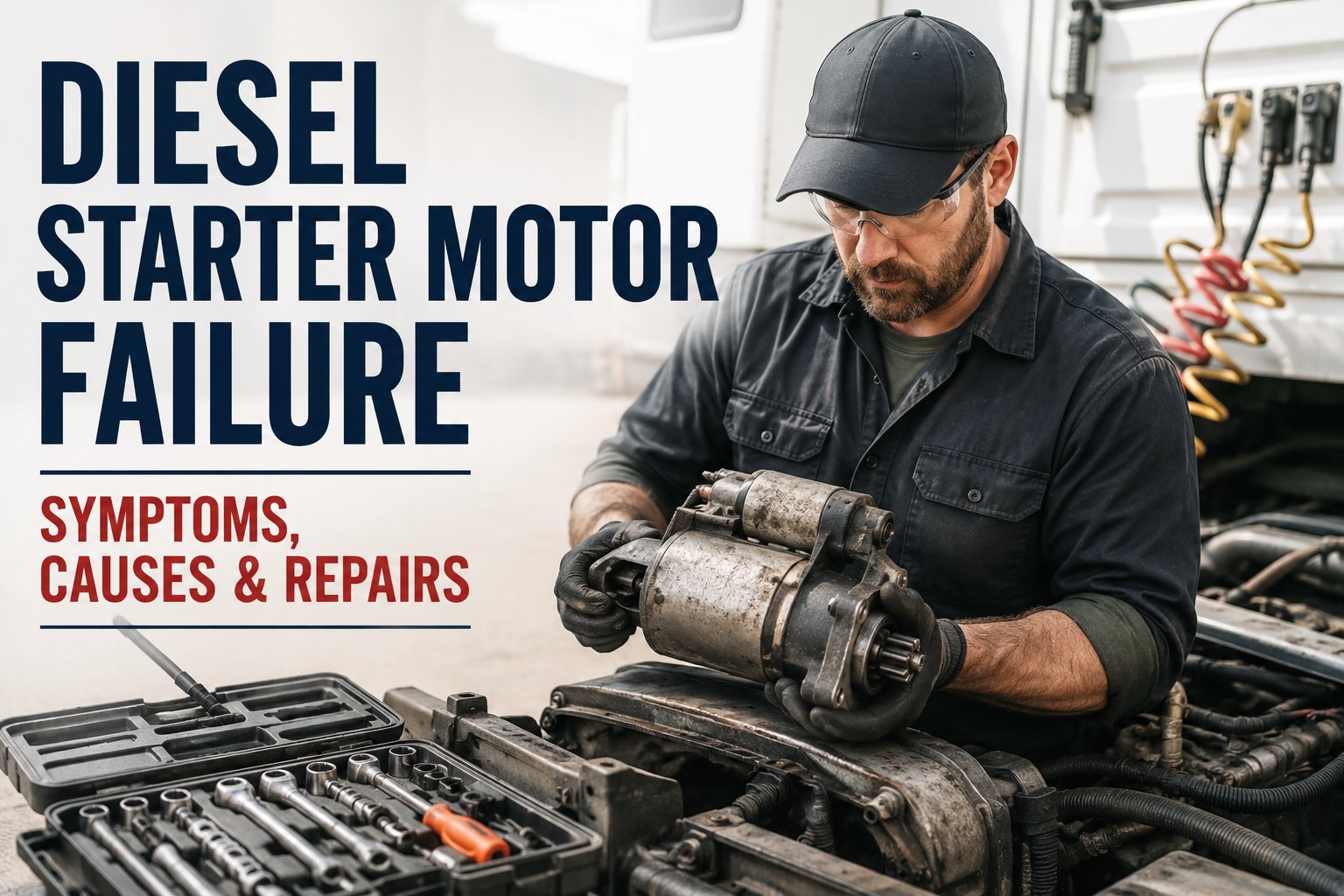
Diesel Starter Motor Failure: Symptoms, Causes & Repair Cost Guide
Every starter failure telegraphs itself before the truck actually strands. Read the sounds correctly and you swap a $250 starter in the shop — miss them and you eat a $1,100 roadside call. Here's exactly what each symptom means and what to do about it.
What a Diesel Starter Actually Does (and Why It Fails)
A diesel starter is a compact but violent piece of engineering. When the driver turns the key, a small signal wire energizes the solenoid — an electromagnetic switch that does two things at once: it slams a heavy copper contact closed, dumping several hundred amps into the starter motor, and it physically pushes the pinion gear forward to mesh with the flywheel ring gear. The motor then spins the flywheel fast enough (roughly 150–200 rpm on a diesel) for compression and injection to fire. All of that happens in about half a second, dozens of times a day, for years. When components inside that assembly wear — brushes, bushings, contacts, pinion teeth — the failures show up as very specific sounds and behaviors that a good technician can diagnose without pulling the starter.
The Symptom-to-Cause Diagnostic Table
This is the diagnostic map every seasoned diesel tech has in their head. Every sound you hear at the key means something specific — and only some of them point to the starter itself.
The 6 Real Causes Behind a Failing Starter
When the starter itself is the problem, one of these six root causes is nearly always behind it. Fixing what killed the starter matters as much as replacing the starter — otherwise the new one dies the same way.
Worn Brushes & Commutator
The single most common wear mechanism. Carbon brushes ride on the commutator millions of revolutions — as they wear thin, contact becomes intermittent, cranking gets slow and inconsistent, and eventually the motor won't turn at all.
Burned Solenoid Contacts
Every start arcs across the solenoid's copper contacts. Over tens of thousands of cycles, those contacts pit and burn — the solenoid still clicks, but current can't flow through to the motor. Classic "single click, no crank" symptom.
Damaged Pinion or Ring Gear
If the pinion sticks in the engaged position or the ring gear develops missing teeth, you get grinding on every start and eventual catastrophic failure. Often caused by ignoring earlier drive-gear symptoms.
Bushing / Bearing Wear
The starter's internal bushings wear out, causing armature drag, side-loading, and overheating. The motor spins hard, draws excess current, and eventually seizes — often preceded by a hot burning smell.
Contaminated Internals
Oil leaks from the rear main seal, coolant, or road water can enter the starter and destroy the windings and brushes. Common on trucks with chronic rear main leaks that go unaddressed.
Heat Soak & Repeated Overcrank
Cranking a stubborn diesel for 30+ seconds at a stretch bakes the starter internally. Manufacturers spec a duty cycle for a reason — ignore it and you shorten the life of a $400 component in one session.
The Correct Diagnostic Sequence
Never condemn a starter without walking this sequence. Each step rules out cheaper failure points before spending on starter parts and labor.
Stop diagnosing starters from memory
Our software gives technicians a structured diagnostic checklist right in the work order — sound reported, tests performed, findings logged. No more wasted starters.
Repair Cost Breakdown: What You'll Actually Pay
Costs vary widely by chassis, access, and part quality. These are the realistic 2026 ranges from independent shops on North American heavy-duty diesels.
What it covers
- Battery terminal cleaning / re-torque
- Ground strap replacement
- Solenoid trigger wire repair
- Relay or fuse replacement
What it covers
- Remanufactured starter ($150–$250)
- Labor 2–3 hrs @ $100–$150/hr
- Battery cable replacement if needed
- Core charge $30–$80 refundable
What it covers
- OEM starter for Cummins/Detroit/MBE ($400+)
- Labor 3–4 hrs on tight chassis
- Battery replacement (dual pack)
- Ring gear inspection / repair
Prevention: How to Make a Starter Last 100,000+ Starts
Starters are the ultimate wear-item — every start pulls a huge current spike through the same brushes and contacts. You can't eliminate wear, but you can slow it dramatically.
Keep batteries at 100% state-of-charge
A weak battery forces the starter to work harder for longer on every crank. The single biggest starter-life factor is battery health — replace at first sign of weakness, not first failure.
Clean and torque battery terminals monthly
Corrosion at battery posts adds electrical resistance — the starter compensates by pulling more current. Clean cables and load-tested connections extend starter life significantly.
Respect the duty cycle
Most HD starters spec a 30-second max crank followed by 2-minute cool-down. Ignoring this on hard-start conditions bakes the starter internally and takes years off its life in minutes.
Fix hard-starts fast
Air in fuel, weak glow plugs, low compression — anything that makes the engine crank longer than 3–5 seconds is quietly killing the starter. Diagnose the underlying cause, not the symptom.
Address oil leaks near the starter
Rear main and bell housing leaks contaminate the starter internally. A $30 seal fix today prevents a $400 starter replacement six months from now.
Log every hard-start event
Our software captures cranking symptom reports directly from drivers on the DVIR — so failure patterns show up on the vehicle record before the starter fails, not after.
How Truck Inspection & Maintenance Software Helps
Starter failures don't happen randomly — they happen with warning signs the driver notices days or weeks in advance. The problem is capturing those signs before they become a breakdown. Our software solves exactly that.
Cranking symptom capture
Drivers report hard-starts, unusual sounds, or slow cranks directly in the daily DVIR — with a dropdown that matches the symptoms in this guide.
Repeat-symptom flagging
When the same starter symptom shows on three consecutive DVIRs for one vehicle, the system flags it as a predictive failure candidate — before the truck strands.
Structured test workflow
Technicians walk the exact 5-step diagnostic sequence in the app — battery, load, voltage drop, signal, starter — with each test result logged and photographed.
Repair vs replace history
Track every starter, battery, cable, and ground replacement per vehicle — see cost-per-start-cycle and identify chronic offender chassis before they eat your budget.
Auto-triggered repair queue
A flagged starter symptom opens a work order automatically — routed to the maintenance queue with the driver's report, symptom code, and diagnostic checklist attached.
Predictive replacement schedule
Starter counters track total start cycles per vehicle. When a chassis approaches its predicted starter life, the system schedules preventive replacement during planned PM — not during dispatch.
Frequently Asked Questions
Realistic 2026 ranges: a remanufactured starter installed at an independent shop runs $300–$500 on most medium/heavy-duty diesels; OEM starters on tight-access chassis (Cummins, Detroit, MBE-series) can push $650–$1,100 including labor. Labor is typically 2–4 hours depending on starter location.
A bad solenoid usually clicks once but doesn't send current through to the motor — the starter itself is fine. A bad starter motor may hum, spin without engaging, grind, or fail to spin even with full current present. On modern trucks the solenoid is integrated into the starter — you replace the whole unit either way.
Yes — and it's the single most common misdiagnosis. Roughly 85% of "bad starter" complaints trace back to weak batteries, corroded cables, or bad ground straps. Always load-test batteries and run voltage-drop tests before replacing a starter.
A well-maintained HD diesel starter typically lasts 80,000 to 100,000 start cycles — roughly 5–8 years of typical fleet duty. Poor battery health, chronic hard-starts, and overcranking can cut that in half.
Jumping helps only if the failure is battery-related. A truly failed starter won't respond to a jump — and continuing to crank against a bad starter risks flywheel ring gear damage, which turns a $400 repair into a $2,000+ repair.
For most fleet applications, remanufactured is the smart choice — 30–40% cheaper than new OEM, with 12–24 month warranties, and functionally equivalent service life. Reserve new OEM for critical high-cycle assets or applications where uptime cost dwarfs the part cost.
Catch starter failures before they strand your trucks
Structured DVIR symptom capture. Trend-based predictive flagging. Guided technician diagnostic workflows. Cost-per-start tracking. Auto-triggered work orders. Everything you need to make starter failures a planned repair, not a roadside emergency.