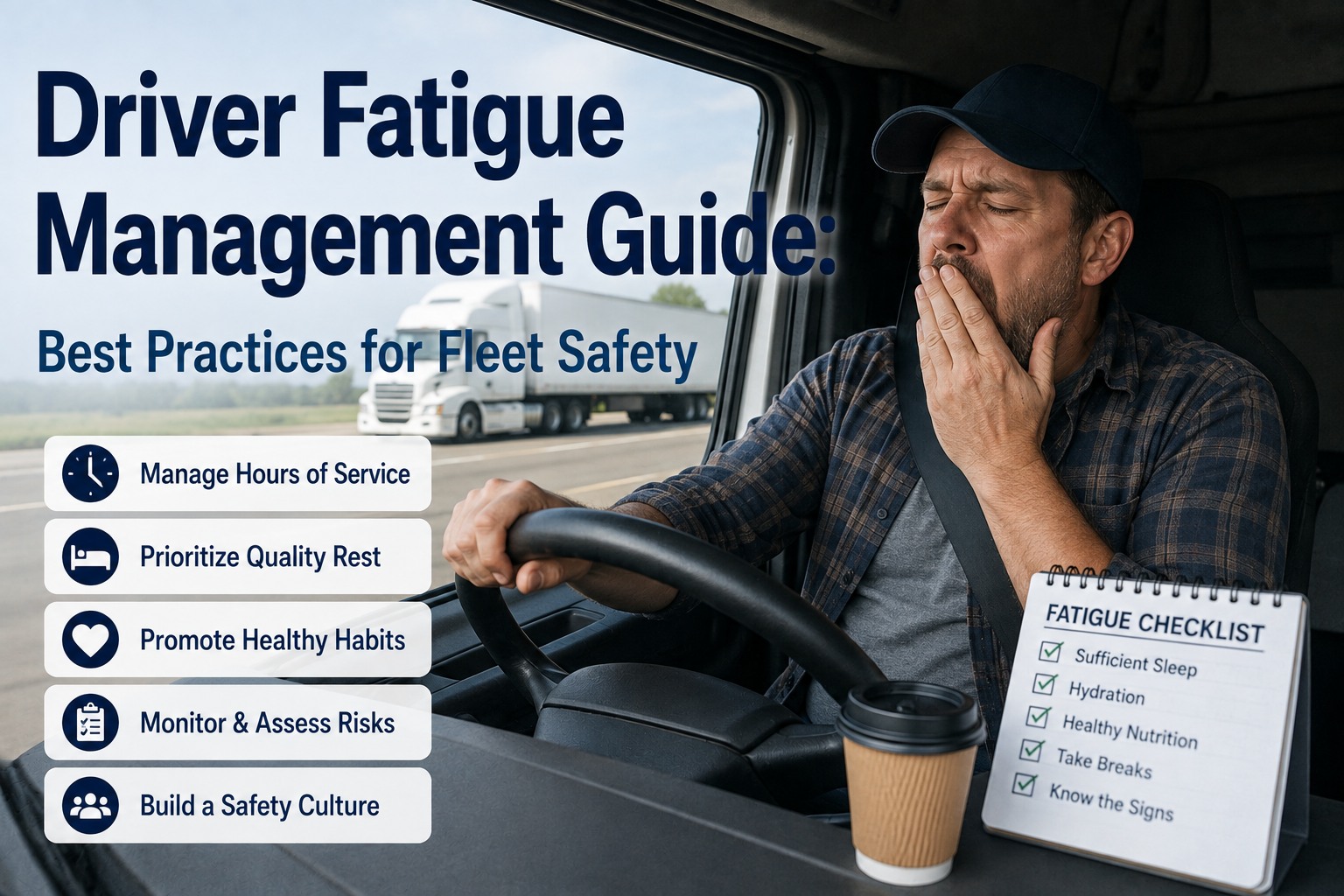
Driver fatigue is one of the deadliest risks in commercial trucking — and one of the most systematically undermanaged. The National Highway Traffic Safety Administration reports drowsy driving contributes to roughly 18% of all fatal commercial vehicle crashes, and NTSB data suggests more than 50% of single-vehicle crashes involving heavy trucks are fatigue-related. FMCSA's own Large Truck Crash Causation Study found 13% of drivers were fatigued at the time of their crash — and researchers agree that number significantly undercounts reality because fatigue leaves no chemical trace. Missing just two hours of sleep per night for five days creates the same cognitive impairment as a 0.08% blood-alcohol level — legally drunk. Yet hours-of-service compliance alone doesn't solve the problem: a driver can be perfectly legal on their ELD and still dangerously impaired behind the wheel. This guide walks through the modern fatigue management program — the science, the warning signs, the five NAFMP pillars, the scheduling rules, and the technology stack — plus how Truck Inspection & Maintenance ties fatigue policy documentation to inspection records so your fleet's safety program is auditable, not just aspirational.
Driver Fatigue Management Guide for Fleets
Because hours-of-service compliance is a floor, not a fatigue program.
The Science of Fatigue in 90 Seconds
Before building a program, understand what you're managing. Fatigue is not laziness or a discipline problem — it's a physiological state driven by three separate systems working simultaneously in every driver's brain. Miss any one and the whole program collapses:
Circadian Rhythm
The 24-hour body clock that dictates when you're wired to sleep and wired to be alert. Two natural low-alertness windows hit every driver — 12 AM to 6 AM and 2 PM to 4 PM — regardless of how much sleep they got. Circadian rhythms cannot be reversed by night-shift experience.
Sleep Debt
The running deficit between the sleep a driver needs (7–9 hours) and what they actually get. Debt accumulates faster than most drivers realize. Two hours short per night for five nights = the cognitive equivalent of legal intoxication — and caffeine doesn't pay it back.
Sleep Inertia
The 15–30 minute grogginess after waking — especially after deep sleep or naps taken at the wrong time. A driver who wakes from a sleeper berth and immediately drives is impaired even if fully "rested." Naps after 3 PM interfere with nighttime sleep and worsen the cycle.
The 24-Hour Alertness Clock
Every driver, every dispatcher, and every safety manager needs to internalize this: alertness is not constant across the day. Crash data consistently shows drowsy-driving incidents cluster in two specific windows aligned with circadian lows. Scheduling work through these windows without countermeasures is the single most predictable way to cause a fatigue crash:
The 5 Pillars of the NAFMP Fatigue Program
FMCSA, Transport Canada, and industry partners collaboratively developed the North American Fatigue Management Program (NAFMP) — the standard framework for building an actual fatigue program instead of relying on HOS alone. The NAFMP identifies five interconnected pillars, and the research is clear: fleets that address only one or two see minimal improvement. Fleets that implement all five see fatigue-related incident drops of 30–50%:
Corporate Culture
Leadership visibly prioritizes rest over on-time delivery when the two conflict. Dispatchers do not pressure fatigued drivers. "Stop driving" is celebrated, not penalized.
Education & Training
Drivers, families, dispatchers, and executives all learn fatigue science. Everyone in the chain of decisions understands how sleep debt, circadian rhythms, and sleep inertia work.
Sleep Disorder Screening
Up to 28% of CMV drivers have some degree of sleep apnea — often undiagnosed. DOT medical exams include OSA screening. Treatment (CPAP) dramatically restores alertness.
Scheduling & Trip Design
Routes and dispatch schedules avoid the 12–6 AM and 2–4 PM circadian lows where possible. Consistent start times protect the driver's internal clock. Split-sleep patterns get audited.
Monitoring Technology
ELDs enforce HOS. AI camera systems detect eye closure, head nods, gaze deviation. Fleets deploying fatigue monitoring report 34% fewer accidents and 19% lower insurance premiums.
The Warning Signs — Red, Yellow, Green
Drivers need a simple mental model to catch fatigue before it catches them. Fleets should train every driver on this three-tier system and empower them to act at the first yellow sign — because by the time symptoms escalate to red, judgment itself is already compromised:
Fatigue policy documentation your DOT auditor will accept
Fatigue programs that live in binders don't survive litigation. Truck Inspection & Maintenance lets you attach your fatigue management policy to every driver qualification file, log training completion with timestamps, and tie stop-driving decisions to inspection records — so when a lawyer asks "prove you managed fatigue," you have digital evidence, not memory. Sign up free for up to 3 vehicles.
Sleep Debt — The Silent Cost Multiplier
Sleep debt is the running deficit between the sleep a driver needs and what they actually get. It compounds — and unlike financial debt, drivers cannot see the balance until performance collapses. Here's the visualization every dispatcher should have on their wall:
Building the Fleet Fatigue Program — 6-Step Rollout
Fatigue programs fail when they're built as documents instead of habits. Here's the sequence proven fleets use to move from policy on paper to daily behavior on the road. Each step depends on the one before it — don't skip forward:
Baseline Assessment
Audit current fatigue-related incidents, near-misses, and HOS violations. Survey drivers anonymously about sleep quality and dispatch pressure. You cannot manage what you haven't measured.
Write the Policy
Clear language: driver's judgment on fatigue is binding, no dispatch retaliation, minimum rest between shifts, sleeper berth quality standards, nap-encouraging break policy.
Train Every Role
Drivers, dispatchers, safety managers, executives. Same training content. Everyone in the decision chain must understand circadian rhythms, sleep debt, and warning signs.
Screen for Sleep Disorders
Partner with DOT medical examiners on OSA screening. Support drivers who need CPAP — treatment restores alertness dramatically and is covered under most fleet health plans.
Redesign Schedules
Audit dispatch patterns against the 24-hour clock. Where possible, keep drivers on consistent start times. Avoid stacking circadian-low windows without countermeasures.
Deploy Monitoring Tech
ELDs are baseline. Add AI camera systems that detect eye closure and head nods. Use data to coach — not punish — and pair with real-time dispatcher alerts.
Fatigue Countermeasures — What Works, What Doesn't
Drivers get bombarded with fatigue "hacks" — most are folk remedies that mask symptoms without addressing sleep debt. Here's the science-backed truth about what actually restores alertness versus what just delays the crash:
Genuine countermeasures
Illusions of alertness
Frequently Asked Questions
Is HOS compliance enough for fatigue management?
No — and this is the single most important thing to understand about fatigue. Hours-of-service rules set legal maximums for driving time, but a driver can be perfectly HOS-compliant and still dangerously impaired. HOS treats time as the variable; fatigue treats sleep quality, sleep debt, circadian timing, and health as the real variables. A proper fatigue management program layers on top of HOS.
What's the North American Fatigue Management Program (NAFMP)?
The NAFMP is a voluntary, evidence-based framework co-developed by FMCSA, Transport Canada, and industry partners. It's free, web-based, and structured around five pillars: corporate culture, education, sleep disorder screening, scheduling, and monitoring technology. It's the closest thing to an industry gold standard for fatigue programs.
How much sleep does a CMV driver actually need?
Adults need 7–9 hours of consolidated sleep per 24-hour period for full cognitive function. Sleeper-berth sleep counts, but often at lower quality due to vibration, noise, temperature, and light. Split-sleep patterns (two shorter periods) can work but require careful timing to align with circadian rhythm — and are more prone to leaving sleep debt behind.
What are the two highest-risk driving windows?
Between midnight and 6 AM and between 2 PM and 4 PM. Both align with natural circadian lows in alertness. Crash data consistently clusters in these windows. Fleet schedules that push drivers through both windows in the same shift — without protective naps — carry substantially higher incident rates. Talk to our team about scheduling audits.
Does fatigue monitoring technology actually work?
Yes — when deployed as part of a full program. April 2026 industry data shows carriers using AI fatigue monitoring report 34% fewer accidents and 19% lower insurance premiums. Modern systems have reached 90% detection accuracy for signs like prolonged eye closure and head nodding. But technology alone doesn't solve fatigue — drivers still need the sleep. Monitoring identifies problems; culture and scheduling solve them.
How does Truck Inspection & Maintenance support fatigue management?
Truck Inspection & Maintenance stores your fatigue management policy, training completion records, and driver-initiated stop-driving events alongside your DVIRs and driver qualification files — with GPS-tagged, timestamped audit trails. When an insurer, regulator, or plaintiff attorney asks for evidence that fatigue was actively managed, you produce records in one click. Sign up free to set it up in 10 minutes.
A fatigue program is only real if the records prove it existed.
Truck Inspection & Maintenance ties your fatigue policy, training logs, medical exam records, and stop-driving events to the same digital driver files that hold your DVIRs — one system, one audit trail, one login. Free for up to 3 vehicles with no hardware and no contracts. Set it up in 10 minutes and start building the safety paper trail that actually protects your fleet.