Fuel is the single largest variable cost in trucking — 30–60% of total operating spend depending on route mix and diesel prices — and it's also the one most fleets reconcile the least carefully. Card swipes, bulk-tank drawdowns, and telematics odometer readings live in three different systems that rarely talk to each other. That gap is where 5–15% of the annual fuel budget quietly leaks: skimmed cards, personal fills, side-pumping into a container, and the honest data errors nobody has time to chase at month-end. This guide is the platform design that closes the loop. Start free and put fuel card, tank, and telematics data on one reconciled view.
Your Biggest Line Item Deserves More Than a Monthly Statement
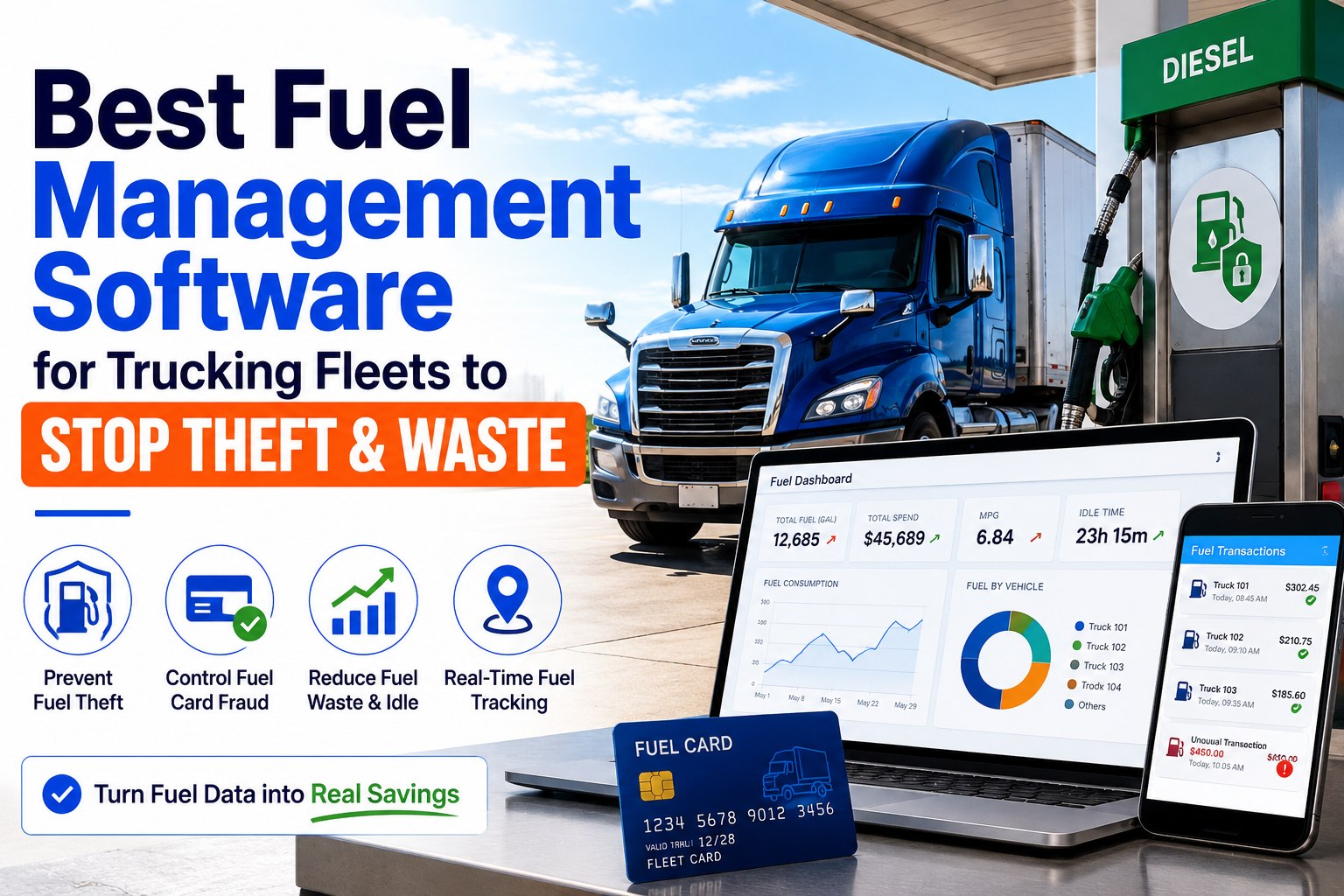
Fuel card data alone shows spend. Telematics alone shows movement. Neither one catches the fraud that lives in the gap between them. Truck Inspection & Maintenance Management Software pulls card transactions, bulk-tank readings, and telematics feeds into a single reconciled view — every gallon paid for is matched to a truck, a driver, a location, and a timestamp, and every mismatch becomes an alert before it clears the next statement.
The Three-Source Reconciliation — Why Two Data Points Aren't Enough
Every real fuel-management program runs on three independent data sources, and the point isn't any single one — it's the cross-check between them. A card charge with no matching GPS position is a fraud signal. A bulk-tank drawdown with no matching card charge is a bulk-tank leak signal. A telematics mileage without a matching card fill is a bulk-tank fill (or an unlogged transfer) signal. Any two of the three will tell you something is off; only three will tell you what.
The Fraud Taxonomy — Which Scheme Needs Which Detection
Not every fuel loss is the same, and not every detection method catches every scheme. The table below maps the seven most common fuel-loss patterns to the detection method that actually catches them — and to the ones that don't. Reading it across is how you decide which control gaps matter most for your fleet.
| Loss pattern | How it works | Caught by GPS match | Caught by tank sensor | Caught by exception report |
|---|---|---|---|---|
| Personal vehicle fill | Company card at pump, fuel goes into a car | Yes | No | Yes |
| Split-transaction (side-pumping) | Card charged for 40 gal, tank rises 32, 8 into a container | No | Yes | Partial |
| Skimmed / cloned card | Stolen card used at a different station than the truck | Yes | No | Yes |
| Off-network unauthorized station | Card used at a non-approved retailer | Partial | No | Yes |
| Card + PIN sharing | Card lent to a friend/spouse for personal fill | Yes | No | Partial |
| After-hours purchase | Card used outside driver's scheduled shift | Partial | No | Yes |
| Bulk-tank unlogged drawdown | Fuel pulled from yard tank without shift record | No | Yes | Partial |
The Card-Program Controls — What You Configure Before Detection Even Fires
Detection is what catches fraud after it happens. Prevention is what stops it at the pump. The controls below don't need expensive hardware — they need policy discipline and card-program configuration, and they cut the fraud rate meaningfully before the anomaly-detection layer ever runs.
Set the max per fill at 5–10 gallons above a full-tank refill for the truck class. A 45-gallon tank should not allow a 90-gallon charge, period.
Cards active during scheduled shift hours only. After-hours attempts auto-decline and fire an alert, not a charge.
Fuel-only on the fuel card. Snacks, cash advances, and non-fuel merchandise disabled at the network level.
Card assigned to the truck, PIN entered by the driver. Two credentials required, both matched against the shift schedule.
Card locked at rest; the driver unlocks it via the app for a single transaction. Skimmed physical card alone is useless.
Card works at the fuel network you've contracted; declines everywhere else. Off-network purchases require a supervisor override.
Prevention Plus Detection — Together, Not Either
Our software integrates with the major fleet fuel card networks and telematics providers to enforce the controls above and layer the detection loop on top: every transaction matched against GPS position and shift schedule, every anomaly graded before it lands on a phone, every flagged card frozen in a click. Fraud stops being a monthly discovery and starts being a real-time notification.
The MPG-Per-Driver Economics — Where Small Numbers Become Big Money
Fuel fraud is the loud problem; MPG variance is the quiet one — and often the bigger one. At $4/gallon diesel and 100,000 miles per truck per year, a 1-MPG difference between drivers is roughly $4,000 per truck per year in fuel-cost variance. Multiply across a 25-truck fleet and the top-vs-bottom quartile spread comfortably covers the salary of the fleet manager watching it. Telematics feeds turn this from an anecdote into a ranked report.
- Idle percentage & APU habits
- Highway speed & RPM discipline
- Progressive shifting vs. floor-it
- Route selection & slow-and-go time
- Tire pressure discipline (1 PSI ≈ 0.4% MPG)
- Per-driver MPG ranking on the same route mix
- Coaching conversations grounded in numbers
- Pay-differential or bonus tied to MPG
- Route-by-route fuel-efficiency comparison
- Vehicle-level trending independent of driver
The IFTA Angle — Reconciliation That Also Files Your Taxes
Interstate carriers file IFTA quarterly on gallons purchased and miles driven per jurisdiction. Manual IFTA is the reason so many fleet managers dread the last week of every quarter — hunting through card statements, matching them to trip logs, allocating gallons across states, and hoping the numbers balance. A properly integrated platform makes this a one-click export because the data is already reconciled: card transactions carry the station location, telematics carries the jurisdiction miles, and the platform does the allocation automatically.
Frequently Asked Questions
Stop Finding Fuel Losses on the Monthly Statement
Card, bulk-tank, and telematics data on one reconciled view. Every gallon matched to a truck, a driver, a location, a timestamp. Fraud caught in real time — not at month-end.