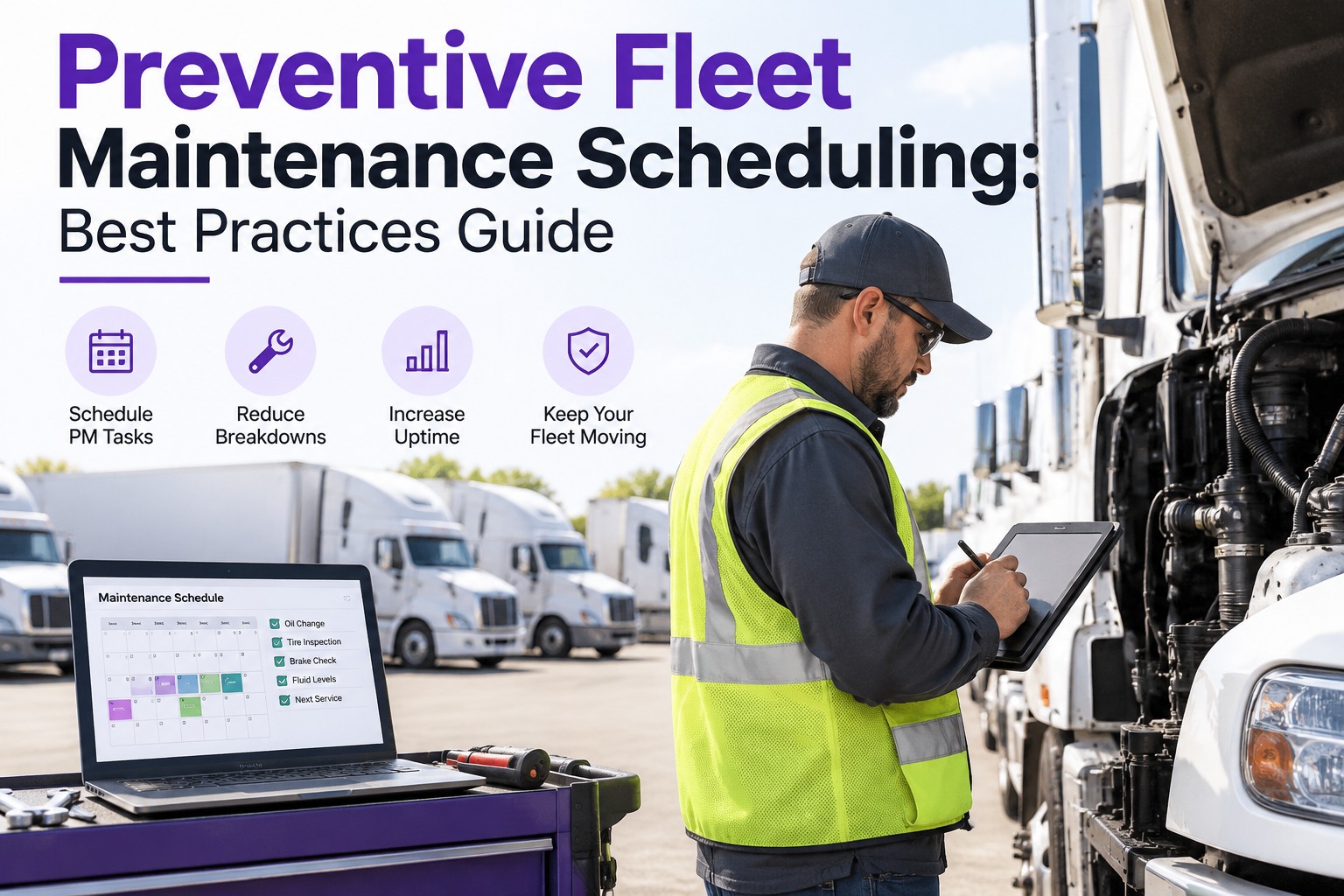
A preventive maintenance schedule looks simple on paper — every truck, every 25,000 miles, oil and filters. What breaks it in practice isn't the interval, it's everything around the interval: the dispatcher who needs the truck at 24,800 miles, the parts that weren't ordered because no one saw the service coming, the shop that had four trucks show up on the same Tuesday. Good scheduling isn't about a stricter calendar — it's about the routing, the resource planning, and the dispatch coordination that let the calendar actually hold. Start free and build a PM schedule that dispatch actually respects.
Preventive Maintenance · Scheduling · Best Practices
A PM Schedule the Shop Can Run and Dispatch Can Live With
Missed PMs almost never come from a missing calendar — they come from a calendar dispatch can't work around. Truck Inspection & Maintenance Management Software builds trigger-based service intervals, forecasts the workload week by week, and coordinates the schedule with dispatch so the truck arrives when the parts, bay, and mechanic are ready — not when the odometer forces a fire drill.
Triggeredmiles, hours, calendar — whichever comes first
Forecastednext 4 weeks of shop load, visible today
Coordinatedschedule handshake with dispatch, not conflict
The Four Pillars of a Working PM Schedule
A schedule holds when four things are in place: the right trigger for each service, the right cadence tiered by depth, the right forecast so the shop isn't blindsided, and the right handshake with dispatch. Miss any one and the schedule drifts within a month.
01
The Right Trigger
Mileage, engine hours, calendar time, or fuel burned — each duty cycle picks a different primary trigger. A city delivery truck at 40% idle can't be scheduled by miles alone.
02
Tiered Cadence
A-service light, B-service deeper, C-service the annual — nested so the C absorbs the A and B tasks and no service duplicates the last one.
03
Rolling Forecast
Which trucks are due in the next four weeks, which bays and parts they'll need, and where the workload spikes are — visible before they arrive.
04
Dispatch Handshake
The truck's service window is negotiated with dispatch a week ahead, not sprung on them at 25,000 miles. Fewer surprises, fewer skipped services.
Pillar 1 — Pick the Right Trigger for the Duty Cycle
The most common PM failure isn't skipping the service — it's scheduling by the wrong trigger. A long-haul over-the-road tractor is a mileage truck. A refuse packer with 800 packing cycles per shift is an engine-hour truck. A yard hostler is a duty-hour truck. Using one trigger for all of them is why some fleets over-service half their trucks and under-service the rest.
🛣️
Miles Primary
Best fit: OTR line-haul, regional dry-van
- 25K / 50K / 100K nested intervals
- Calendar backstop at 12 months for slow-runners
- Idle ratio < 25%
⏱️
Hours Primary
Best fit: Refuse, vocational, high-idle urban
- 250 / 500 / 1,000 engine-hour intervals
- Idle ratio ≥ 40% or PTO-heavy usage
- Mileage backstop for consistency
📅
Calendar Primary
Best fit: Low-mileage assets, spares, seasonal
- Monthly / quarterly / annual cadences
- < 15,000 miles/year expected
- Fluid degradation the real driver
The idle-ratio self-test Multiply engine hours by ~30 — if the result exceeds the truck's actual mileage, you have a high-idle asset that's being under-serviced on a miles-only trigger. A truck reading 1,800 engine hours and 45,000 miles is showing you a ratio of 60,000 "equivalent miles" — 15,000 more than the odometer, and 15,000 miles of wear the mileage schedule never counted.
Pillar 2 — The Tiered A/B/C Cadence
Every well-run fleet uses some version of a tiered PM structure — light services often, deeper services less often, and each deeper service absorbing everything the lighter one did. This is the industry's standard because it works: no duplication, no gaps.
A · Light
15K–25K mi / 250 hr
Every routine service
Engine oil & filters, fuel filter, chassis lube, fluid tops, tire rotation. 1–1.5 hours in the bay. The workhorse service that keeps everything else honest.
B · Deep
45K–75K mi / 500 hr
A-service plus mid-tier
Brake inspection & adjustment, air filter, coolant test, diff & transmission fluid check, front-end alignment check. 3–4 hours. Absorbs the A-service; nothing is repeated.
C · Annual
100K–150K mi / 1,000 hr / 12 mo
A + B plus major systems
Diff/transmission fluid change, coolant flush, injector service, DOT annual inspection §396.17, structural body check. 6–8 hours. The one service that can't slip — it's also your annual DOT.
Pillar 3 — The Four-Week Rolling Forecast
A schedule you can only see one week ahead is a schedule the shop can't plan around. The forecast is what turns PM from a fire drill into a workload — parts ordered ahead, mechanics staffed to the peak day, dispatch given a heads-up on which trucks come off the road when.
4-Week PM Forecast · Dallas South Terminal
Why the peak is where fleets fail Missed PMs cluster on peak weeks — 12 trucks due in one week overwhelms a shop staffed for 8, so the last four slip into the next week, and by week 42 the pattern has cost you a compliance point. A forecast that surfaces the peak three weeks ahead gives you time to smooth it — move two A-services to Week 39, book an extra mechanic for Week 40, negotiate one truck's window with dispatch. The peak stays a peak; it stops being a fire.
Pillar 4 — The Dispatch Handshake
The single biggest cause of missed PM isn't the shop — it's the truck being on a load when the service is due. Fix that not by fighting dispatch, but by talking to them a week ahead about which trucks will need a window and when.
Mon
Forecast published
Shop shares next 4 weeks of due-PM list with dispatch. Every truck with a name, a service tier, and a preferred window.
Tue
Dispatch confirms
Dispatch marks each truck's window against active loads. Conflicts flagged for negotiation before the day arrives.
Wed
Windows locked
Service windows committed on the calendar. Trucks are held or routed around based on the lock, not a last-minute call.
Thu–Fri
Parts & bay staged
Shop orders parts against locked windows. Mechanics staffed to the peak day. Bay time booked to the actual service duration.
The Schedule That Runs Itself
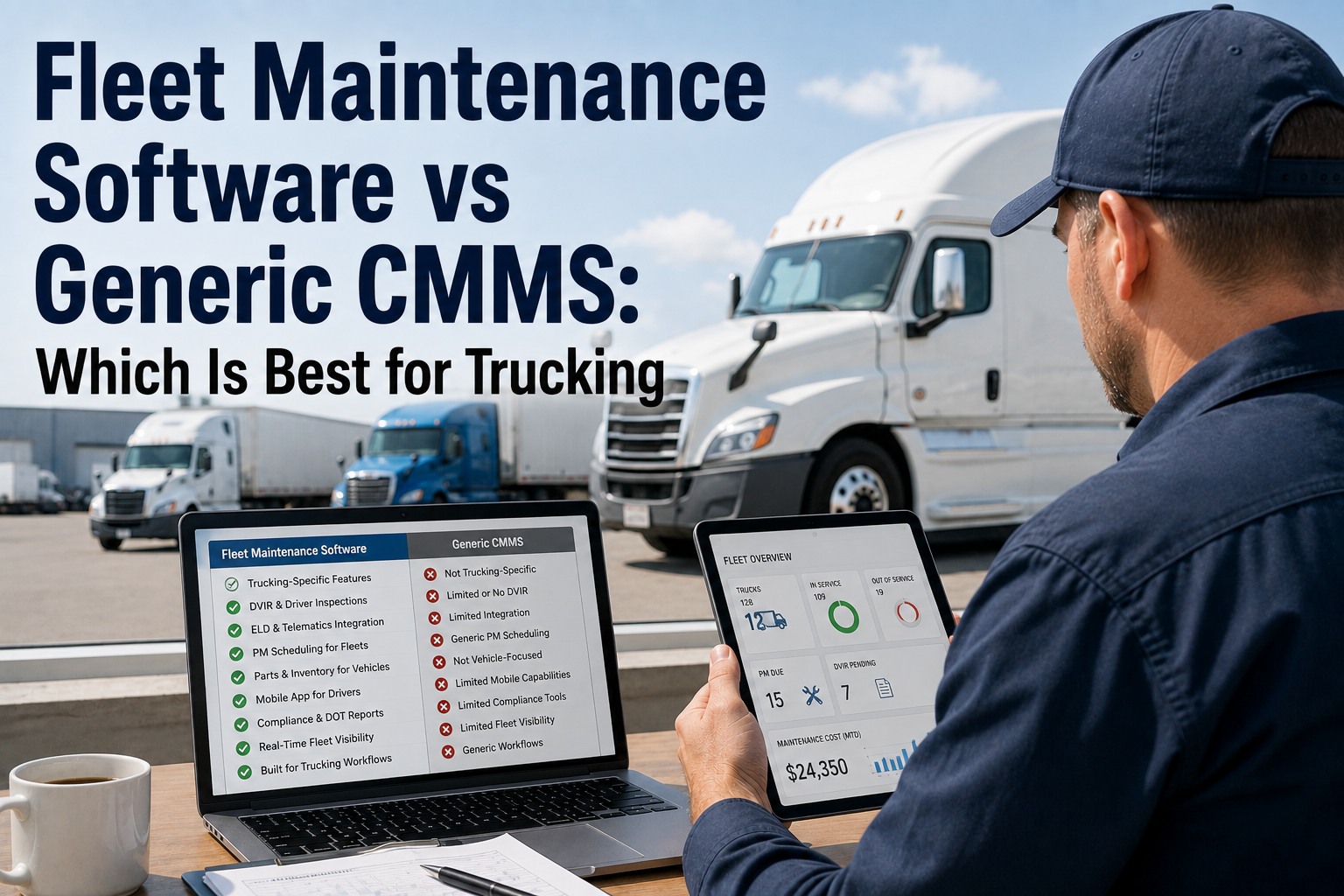
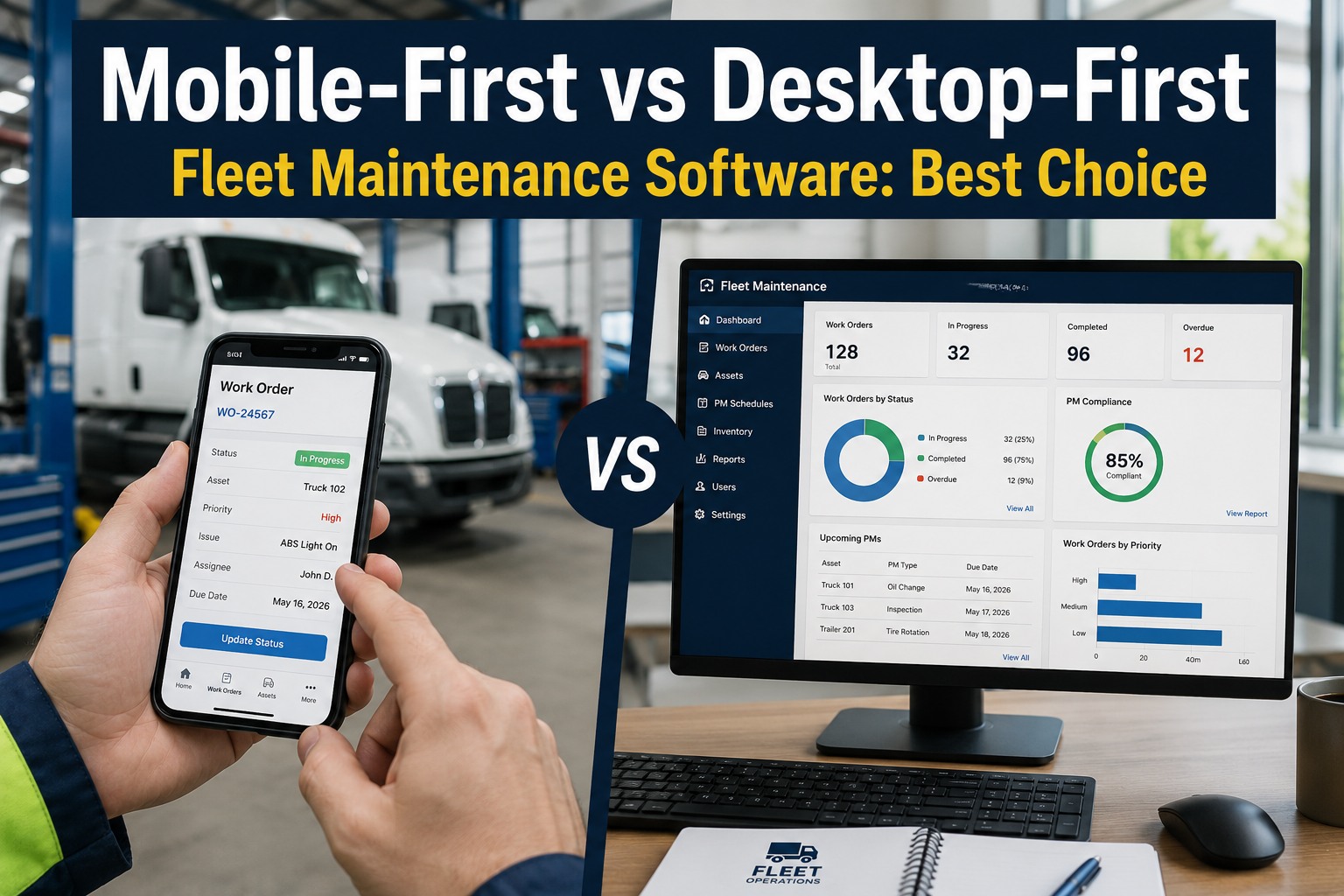
Truck Inspection & Maintenance Management Software sets the right trigger per truck, tiers the A/B/C cadence with automatic task nesting, forecasts the next four weeks of shop load, and publishes the dispatch handshake automatically — so the schedule stops being a spreadsheet the fleet manager rewrites every Monday and becomes a live plan the shop and dispatch actually run against.
The Five Scheduling Mistakes That Break Most PM Programs
Every fleet that misses PM tends to miss it the same five ways. None of them are exotic; all of them are fixable once you can name the pattern.
✕
Single trigger for every asset
Miles-only across a fleet with vocational and OTR trucks under-services the vocational ones every time.
✕
No calendar backstop
A low-mileage spare that ran 8,000 miles all year still needs its annual oil change. Time triggers the service even when miles don't.
✕
Flat cadence with no tier
Doing full A-service tasks every service duplicates work; tiering saves 30–40% of shop hours over a year.
✕
One-week visibility
If the shop only sees this week, parts arrive late, mechanics are overbooked on peaks, and PMs slip into next week.
✕
PM as dispatch's problem
When dispatch finds out about a due service the morning of, they will always choose the load — every time. The handshake fixes it.
Frequently Asked Questions
How do I pick between mileage, hours, and calendar as the primary trigger?
Run the idle-ratio test on a sample of trucks: engine hours × 30 compared to actual mileage. If the ratio product exceeds mileage by more than 25%, the truck is high-idle and should be scheduled on hours; if it's within 10%, mileage is fine; if the truck runs under about 15,000 miles a year regardless, put it on calendar. Most fleets end up with a mix — OTR on miles, vocational and city on hours, spares on calendar. Our software supports all three triggers per truck class and picks whichever fires first.
Start free and mix triggers per truck
What's the difference between A, B, and C services in practice?
An A-service is the routine one — engine oil, filters, lube, fluid tops, tire rotation, roughly 1–1.5 hours in the bay. A B-service does everything A does plus brake inspection, air filter, differential and transmission fluid checks, alignment check — 3–4 hours. A C-service does everything A and B do plus fluid changes, coolant flush, injector service, and the annual DOT §396.17 inspection — 6–8 hours. The critical rule is nesting: the B-service absorbs the A-service, and the C absorbs both. Do it right and no service duplicates the previous one.
Contact us for nested A/B/C templates for your fleet
How far ahead should the forecast look?
Four weeks is the sweet spot. One week is too short to react to a peak; eight weeks is too long — the load book changes too much for the forecast to be actionable. Four weeks lets you see next-week's peak on a Monday, order parts against it Tuesday, and negotiate the tightest dispatch conflicts by Wednesday. Our software rolls the forecast forward every Monday automatically, so the fleet manager and shop foreman are always looking at the same four weeks.
Start free with a 4-week rolling forecast
What happens when dispatch wins the argument and the truck runs past the service date?
If it's within about 500 miles or a few days, no real damage — flag the service as overdue, run it as soon as the truck's back, and note the reason in the asset record so the pattern is visible. Repeated overruns on the same truck usually mean the interval is too tight for that truck's duty cycle, or that dispatch is systematically deprioritizing PM on a specific unit — either way, the data tells you. What you don't want is silent overruns; the software flags every one on the weekly compliance report so nothing slips uncounted.
Contact us to build an overrun-tolerance policy
Trigger · Tier · Forecast · Handshake
Build a PM Schedule Your Shop and Dispatch Both Trust
Truck Inspection & Maintenance Management Software sets the right trigger per truck, tiers the A/B/C cadence automatically, forecasts the next four weeks of shop workload, and publishes the schedule to dispatch a week ahead — so the plan the fleet manager builds on Monday is the plan the shop and dispatch actually run all week. Fleets use it to hold PM compliance above 95%, cut reactive work, and stay ahead of the peak weeks instead of firefighting through them.
No credit card required. Free for up to 3 trucks. Built for FMCSA-compliant fleets.