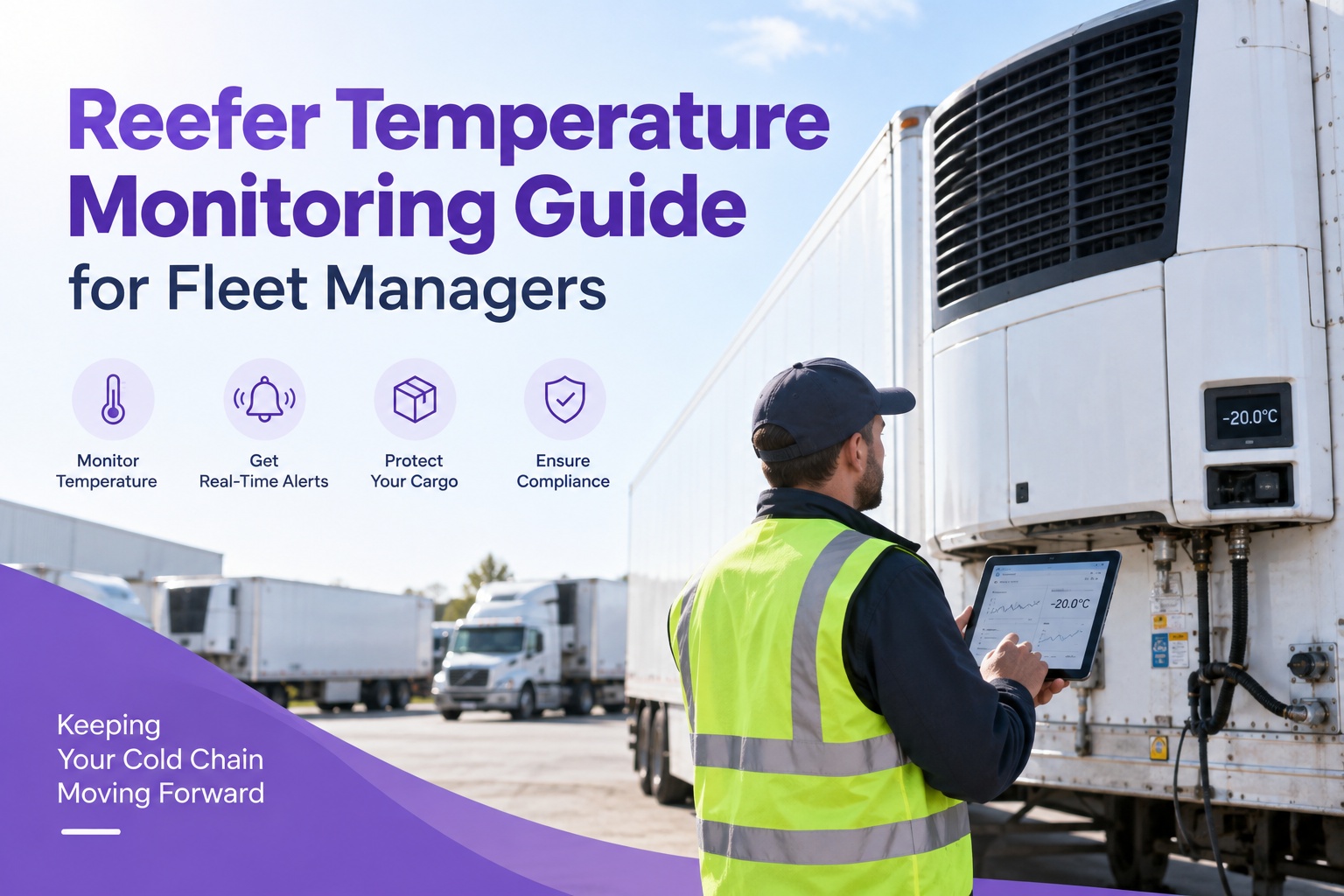
A refrigerated load has one job: stay in its temperature band from pickup to delivery. Cross out of it for too long and the entire shipment is typically considered compromised — regardless of how brief the breach was — and the cost isn't just the spoiled cargo. It's the rejected load, the retailer penalty clause, the insurance claim, and the FSMA compliance exposure that a single gap in a paper log can trigger. Yet many fleets still monitor the old way: a driver glances at the reefer display at pickup and drop-off, with hours of blind spots in between. By the time a problem shows on that display, the cargo is often already lost. Monitor your reefer fleet in real time free. Integrating reefer temperature sensors with Truck Inspection & Maintenance replaces the clipboard with continuous, automated monitoring — live temperature data, instant excursion alerts, audit-ready FSMA logs, and predictive reefer-unit maintenance, all in one platform. This guide breaks down how the integration works, what it monitors, and why the reefer unit needs its own maintenance schedule.
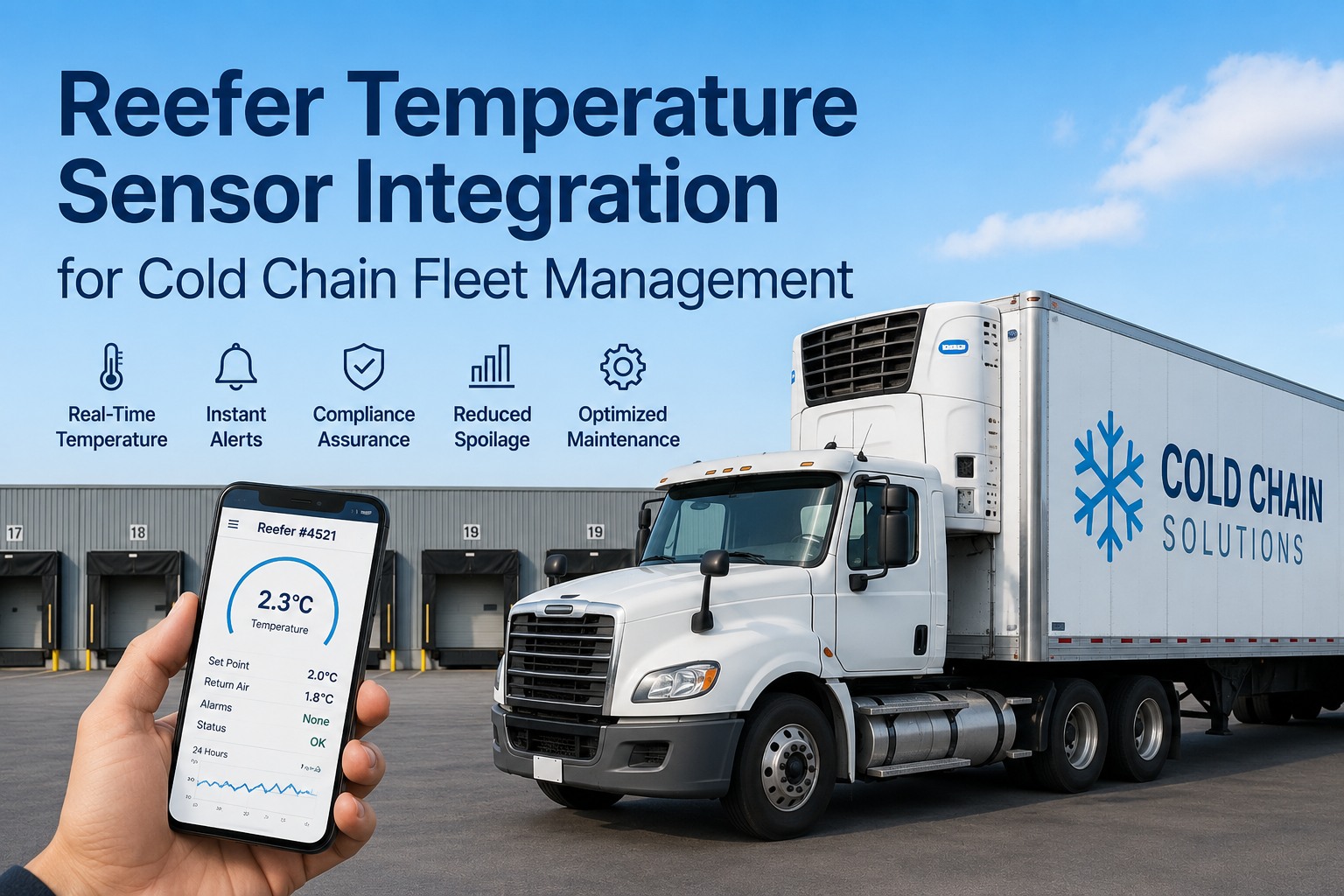
Reefer Temperature Sensor Integration for Cold Chain Fleet Management
Replace clipboard checks with continuous monitoring. Stream reefer temperature, door, and unit-health data into Truck Inspection & Maintenance — with instant excursion alerts, audit-ready FSMA logs, and predictive maintenance that catches a failing unit weeks before the cargo is at risk.
What One Cold Chain Failure Costs
Refrigeration failure is the single biggest threat to cold-chain profitability — and one breakdown rarely costs just one thing. The losses stack, and they stack fast.
How the Monitoring Works
The system replaces manual checks with a continuous data loop. Sensors read conditions inside the trailer, a gateway transmits them to the cloud, and the platform watches every reading against your thresholds — so a problem triggers an alert while there's still time to act.
What It Monitors
A complete reefer setup watches far more than a single box temperature. Each data point protects the cargo — or warns of the unit failure that would threaten it.
Product-level probes track each compartment against its own setpoint — supply air, return air, and cargo zone.
Open/close sensors log every door event, catching the open doors that drive excursions and resolving delivery disputes.
Humidity readings protect produce, pharma, and other loads where moisture matters as much as temperature.
Reefer fault codes and run status from Thermo King and Carrier surface mechanical trouble before it hits the cargo.
Diesel level, battery voltage, and electric-vs-diesel run mode expose wasteful continuous-run and catch fuel loss.
Temperature, door, unit health, and location on each asset's timeline — the complete proof of cold-chain integrity.
Start free →The Reefer Is Its Own Machine
Here's the insight that separates cold-chain-ready platforms from generic fleet software: the reefer unit is a separate mechanical system — its own engine, compressor, and refrigerant circuit — and it wears by engine hours, not tractor miles. A high-cycle frozen route can run the reefer two to three times harder than the tractor pulling it.
Wears by mileage. Its PM schedule is driven by the odometer and the miles it covers on the road.
Wears by run hours. It keeps cooling while the truck is parked, so it needs a service schedule of its own — typically every 1,500 to 3,000 operating hours.
The integration tracks reefer engine hours independently and generates service work orders on the schedule the unit actually needs — so a hard-working reefer isn't quietly running toward failure just because the tractor it's hitched to isn't due yet.
Most Excursions Start as Small Faults
Temperature breaches rarely come out of nowhere. They usually trace back to a minor maintenance issue that was left to compound until cooling capacity dropped below what the route demanded. Catching the early sign is the whole advantage of condition-based monitoring.
Protect the Cargo and the Unit — One Platform
Truck Inspection & Maintenance streams live reefer temperature, door, and unit data alongside the reefer's own maintenance history — so a temperature alarm and the unit's service record sit on the same timeline. Real-time excursion alerts protect the load; independent reefer-hour tracking and predictive alerts protect the unit that keeps it cold.
Built for FSMA Compliance
Under the FSMA Sanitary Transportation Rule and Rule 204, carriers of many foods must document temperature control through pre-cooling, transit, and delivery — and show that corrective action was taken whenever a deviation occurred. Paper logs with gaps don't survive that scrutiny. Continuous automated logging does.
Automated, timestamped logs at regular intervals — the audit-ready trail manual checks can't produce.
Every excursion and the response to it are captured, demonstrating the due diligence FSMA requires.
Records for any asset and date range export on demand, meeting the 24-hour traceability expectation.
Temperature reports share directly with shippers and customers — the documented control contracts now require.
Why Cold-Chain Fleets Integrate
Reefer sensors alone tell you the temperature; connected to maintenance, they protect the cargo, the unit, and the contract at once. Bridging them closes the gap where spoilage and compliance failures live.
Instant excursion alerts give you time to act before a load crosses out of its safe band.
Predictive alerts and reefer-hour PM cut unit failures by up to half — and cargo claims with them.
Continuous FSMA logs mean compliance is a standing state, not a scramble before an inspection.
Shareable temperature proof builds shipper trust and wins the renewals that require documented control.
Frequently Asked Questions
In most cases, no. The integration connects directly with major reefer telematics providers — including Thermo King and Carrier — via API, so existing sensors keep working without a hardware swap. Many Thermo King and Carrier units from recent model years support integration natively, while older units can be retrofitted with a telematics gateway or wireless environmental sensors linked over Bluetooth. Sensor integration runs alongside normal operations, so vehicles keep running their routes while the platform builds a temperature and maintenance history — most fleets connect within days, not weeks. Start a free trial to connect your reefers.
Continuous monitoring systems typically capture readings every one to two minutes — far more frequent than the every-four-hours a manual best practice suggests, and a world away from the pickup-and-drop-off-only checks many fleets still rely on. Multi-point probes placed at cargo level measure the actual product-zone temperature rather than just the reefer unit's output, which is what matters for the cargo. That frequency is what lets the platform catch an excursion within seconds of a reading crossing your threshold, leaving time to protect the load before it's compromised.
Because a reefer is a separate mechanical system with its own engine, compressor, and refrigerant circuit, and it wears based on operating hours rather than the tractor's mileage. It keeps running to hold temperature even when the truck is parked, and a high-cycle frozen route can work the unit two to three times harder than the tractor pulling it. Routine servicing is generally recommended every 1,500 to 3,000 operating hours or about every six months. The integration tracks reefer engine hours independently and generates work orders on the unit's actual schedule — so a hard-working reefer doesn't slip toward failure just because its tractor isn't due yet. See how reefer-hour tracking works.
FSMA's Sanitary Transportation Rule and Rule 204 require carriers of certain foods to document temperature control throughout pre-cooling, transit, and delivery, and to keep written records showing corrective action was taken whenever a deviation occurred. The integration automates all of that: it records temperature continuously with timestamps, captures every excursion and the response to it, and lets you export records for any asset and date range on demand to meet the growing expectation of 24-hour audit retrieval. Continuous automated logs provide the defensible, tamper-resistant trail that manual logs and spreadsheets simply can't, keeping the fleet audit-ready rather than scrambling. Start free and automate FSMA logging.
The economics are compelling because refrigeration failures are both costly and preventable. Around 35 percent of perishable freight claims trace to refrigeration failure, yet most failures show warning signs days or weeks ahead. Predictive monitoring reduces unit breakdowns by up to 50 percent and cuts overall maintenance costs by roughly a third; for a fleet of 10 reefers, that can mean $200,000 or more a year once you factor in avoided spoilage, fewer emergency repairs, lower insurance premiums, and reduced downtime. Most fleets reach full ROI within 60 to 90 days of deployment. And that's before counting the contracts won by being able to prove documented temperature control. Start free and measure your own ROI.
Keep Every Load in Its Band — and Every Reefer Running
Truck Inspection & Maintenance connects your reefer temperature sensors for continuous cold-chain monitoring — live multi-zone readings, instant excursion alerts, audit-ready FSMA logs, and predictive reefer-unit maintenance tracked on the unit's own hours. Protect the cargo, protect the equipment, and prove your temperature control whenever a shipper or regulator asks.