The engine is the single most expensive component on a commercial truck to replace — a diesel engine rebuild runs $25,000-$45,000, and a complete replacement can exceed $50,000 once labor and downtime are factored in. Yet the failures that destroy engines almost never happen without warning. A coolant leak that drops temperature protection, a clogged air filter starving the turbocharger, a degrading serpentine belt, contaminated oil grinding down bearings — every one of these produces detectable early-warning signs days or weeks before catastrophic failure. The fleets that protect their engine investment treat the daily engine inspection as the highest-ROI 5 minutes in their entire maintenance program: a structured visual and functional check that catches the small problems before they cascade into the $50,000 ones.
This isn't a vague "pop the hood and look around" exercise. A proper truck engine inspection follows a systematic 8-system structure — lubrication, cooling, air intake and turbocharger, fuel, belts and hoses, electrical and charging, exhaust and aftertreatment, and mounting and leak detection — with specific checkpoints and acceptance criteria for each. It includes diagnostic reads most drivers never learn: what exhaust smoke color reveals (black means fuel/air imbalance, white means coolant intrusion or injector issues, blue means oil consumption), what battery voltage should read at rest (12.4-12.7V engine off, below 12.2V signals significant discharge), and what changes in starting, idling, or power output indicate about internal engine health. The inspection layers onto your PM program: daily visual checks, weekly fluid deep-dives, monthly belt and hose assessments, and oil sampling at service intervals to track wear trends before they become failures.
This guide is the complete truck engine inspection checklist for 2026: the 8-system inspection structure, the smoke-color and warning-sign diagnostic framework, the inspection interval schedule, and the digital documentation workflow that turns engine inspections into a predictive maintenance dataset. Start your free trial of our truck inspection and maintenance software to deploy structured engine inspections across your fleet — live in 10 minutes, free for up to 3 trucks.
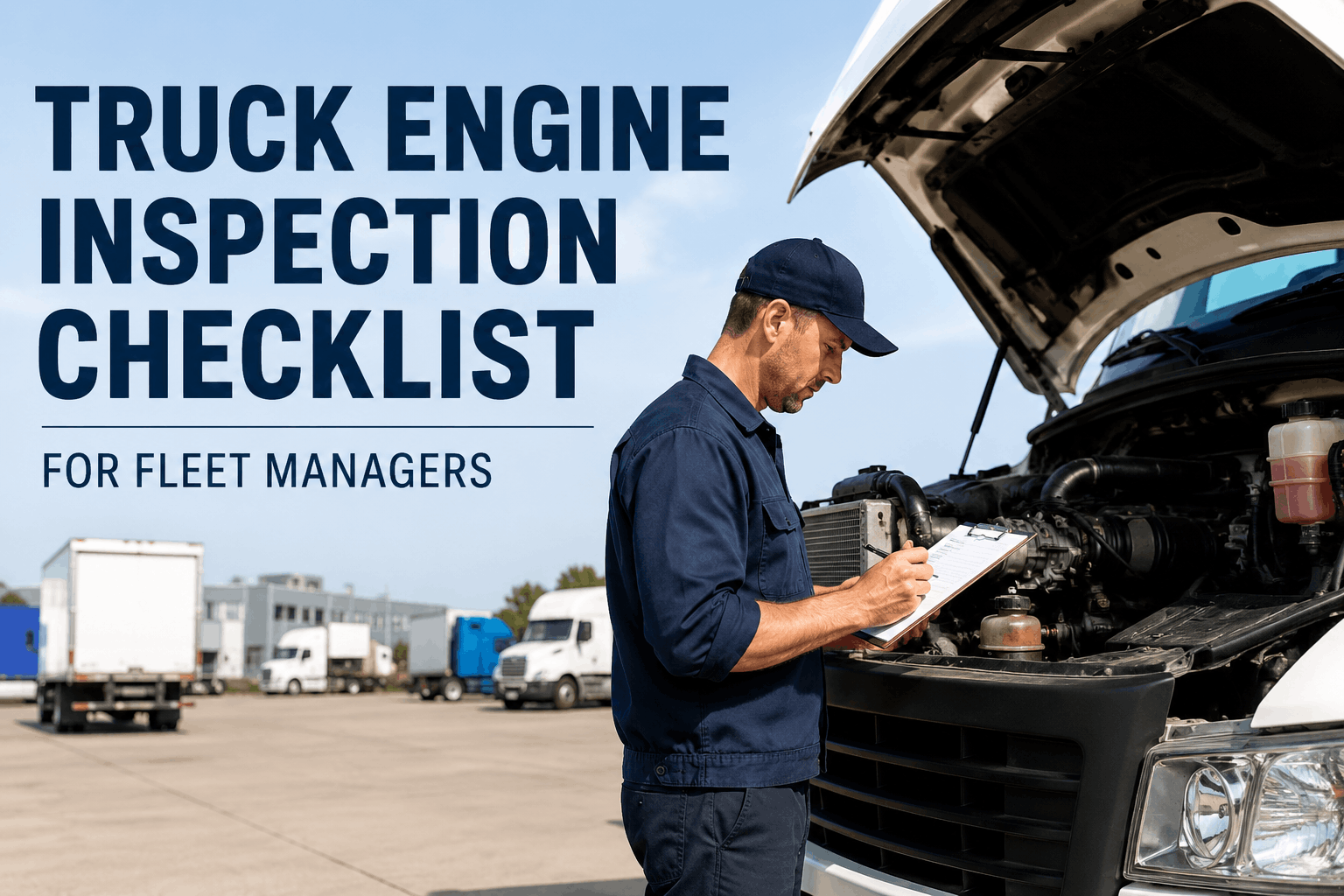
Truck Engine Inspection Checklist for Fleet Managers
The complete 2026 diesel engine inspection framework — 8-system structure, smoke-color and warning-sign diagnostics, fluid and filter intervals, and the digital workflow that catches the small problems before they become $50,000 engine failures.
The 8-System Engine Inspection Structure
Every truck engine inspection follows the same 8-system structure. Each system has specific checkpoints and acceptance criteria — a systematic approach catches problems that a casual "look around" inspection misses entirely. Contact our sales team for help configuring engine inspection templates across your fleet.
Exhaust Smoke Diagnostics — What Color Reveals
Exhaust smoke color is the single most useful engine diagnostic available without tools. A driver trained to read smoke catches engine problems days before fault codes trigger. Here's what each color tells you.
Early Warning Signs — Catch It Before It Cascades
Engine failures rarely happen without warning. These are the early indicators that should trigger immediate inspection rather than a "watch and see" approach — because in diesel engines, small problems cascade into catastrophic ones quickly.
Engine Inspection Interval Schedule
Engine inspection isn't a single event — it's a tiered schedule. Daily checks catch the obvious; deeper assessments at longer intervals catch the gradual degradation that daily visual checks miss.
| Interval | Engine Inspection Tasks | Time |
|---|---|---|
| Daily (pre-trip) | Oil/coolant level, leaks, smells, belt visual, warning lights, smoke color | 5 min |
| Weekly | Deep fluid checks, air/fuel filter visual, battery voltage, hose inspection | 15 min |
| Monthly | Belt tension/wear, coolant flush check, full hose assessment, turbo inspection | 30 min |
| 6 months / 10K mi | Oil + filter change, air filter replace, oil sample analysis, transmission/diff fluid | 2-4 hrs |
| 15K-30K mi | Comprehensive belt/hose/exhaust inspection, fuel system service | 3-5 hrs |
| Annual | Full engine inspection, compression test, injector assessment, aftertreatment service | 4-8 hrs |
Frequently Asked Questions
Engine inspection follows a tiered schedule. Daily (pre-trip): visual check of oil/coolant levels, leaks, smells, belt condition, warning lights, and exhaust smoke color — about 5 minutes. Weekly: deeper fluid checks, air and fuel filter visual inspection, battery voltage test, and hose inspection. Monthly: belt tension and wear assessment, coolant system check, full hose review, and turbocharger inspection. Every 6 months or 10,000 miles: oil and filter change, air filter replacement, oil sample analysis. The tiered approach ensures daily checks catch obvious problems while longer-interval assessments catch the gradual degradation that daily visual inspections miss. Start your free trial to deploy tiered engine inspection schedules.
Exhaust smoke color is a powerful no-tools diagnostic. Black smoke indicates a fuel/air imbalance — too much fuel or too little air, most commonly from a clogged air filter, failing turbocharger, faulty injectors, or EGR problems. White smoke indicates coolant entering the combustion chamber (blown head gasket, cracked head) or unburned fuel from injector/timing issues — if accompanied by dropping coolant levels, it's serious. Blue smoke indicates the engine is burning oil, typically from worn piston rings, valve seals, or turbo seal failure. A driver trained to read smoke color catches developing engine problems days before fault codes trigger — making it one of the most valuable items on any engine inspection checklist. Contact our sales team for help training drivers on engine diagnostics.
With the engine off, a healthy truck battery should read 12.4-12.7 volts. A reading of 12.6-12.7V indicates a fully charged battery; 12.4V indicates roughly 75% charge. Below 12.2V signals the battery is significantly discharged and may not reliably start the truck — especially in cold weather where cranking demand is higher. With the engine running, the charging system should produce roughly 13.8-14.4V at the battery, confirming the alternator is working. Battery voltage is a fast, reliable indicator of both battery health and charging system function — it belongs on every weekly engine inspection. Batteries over 3 years old should be load-tested proactively, since voltage alone doesn't reveal reduced cranking capacity until failure.
Three indicators: (1) blue exhaust smoke, especially under acceleration or after idling; (2) declining oil level between changes without visible external leaks; (3) oil consumption rate that's increasing over time. Common causes are worn piston rings (oil getting past into the combustion chamber), failing valve seals, or a failing turbocharger seal allowing oil into the intake or exhaust. Some oil consumption is normal in high-mileage diesels, but an accelerating rate of consumption needs immediate diagnosis — continuing to operate can foul the DPF, damage the turbocharger, and lead to complete engine failure. Track oil consumption as part of your inspection program: a sudden change in the rate is the warning sign that matters more than any single reading. Sign up free to track oil consumption trends across your fleet.
The oil cooler core at the oil-to-coolant interface. A leaking oil cooler allows coolant into the oil circuit (and oil into the coolant), creating cross-contamination that destroys the engine from the inside while showing few external symptoms until significant damage is done. Signs include milky oil (coolant in oil) or an oil sheen in the coolant recovery tank. Most daily inspections check oil level and coolant level separately but never check for cross-contamination between them. Other commonly overlooked items: the CAC (charge air cooler) piping and clamps where boost leaks reduce power and fuel economy, the intake boot for cracks letting unfiltered air bypass the filter, and engine mounts for cracking. A systematic 8-system inspection catches these; a casual "check the fluids" inspection misses them. Talk to our sales team for comprehensive engine inspection templates.
Yes — oil sample analysis is one of the highest-value predictive maintenance tools available for diesel fleets. A lab analysis of an oil sample reveals wear-metal content (iron, copper, aluminum, chromium) that indicates which internal components are wearing, coolant or fuel contamination, soot loading, and oil degradation. Trending these values over multiple samples lets you predict bearing failures, liner wear, and contamination problems 6-10 weeks before they cause breakdowns. The cost is modest ($20-$40 per sample) against the $25,000-$50,000 cost of engine failure. Best practice: pull a sample at every oil change, log results in your maintenance system, and track trends per engine. A single sample is a snapshot; the trend across samples is what predicts failures. Sign up free to log and trend oil sample results per engine.
Catch the Small Problems Before They Become $50,000 Failures
500+ fleets deploy structured engine inspections on our truck inspection and maintenance software: 8-system mobile templates, smoke and warning-sign diagnostics, oil-sample trend tracking, photo evidence, defect-to-work-order automation, and audit-ready records exported in seconds. The 2026 standard for protecting your most expensive fleet asset.