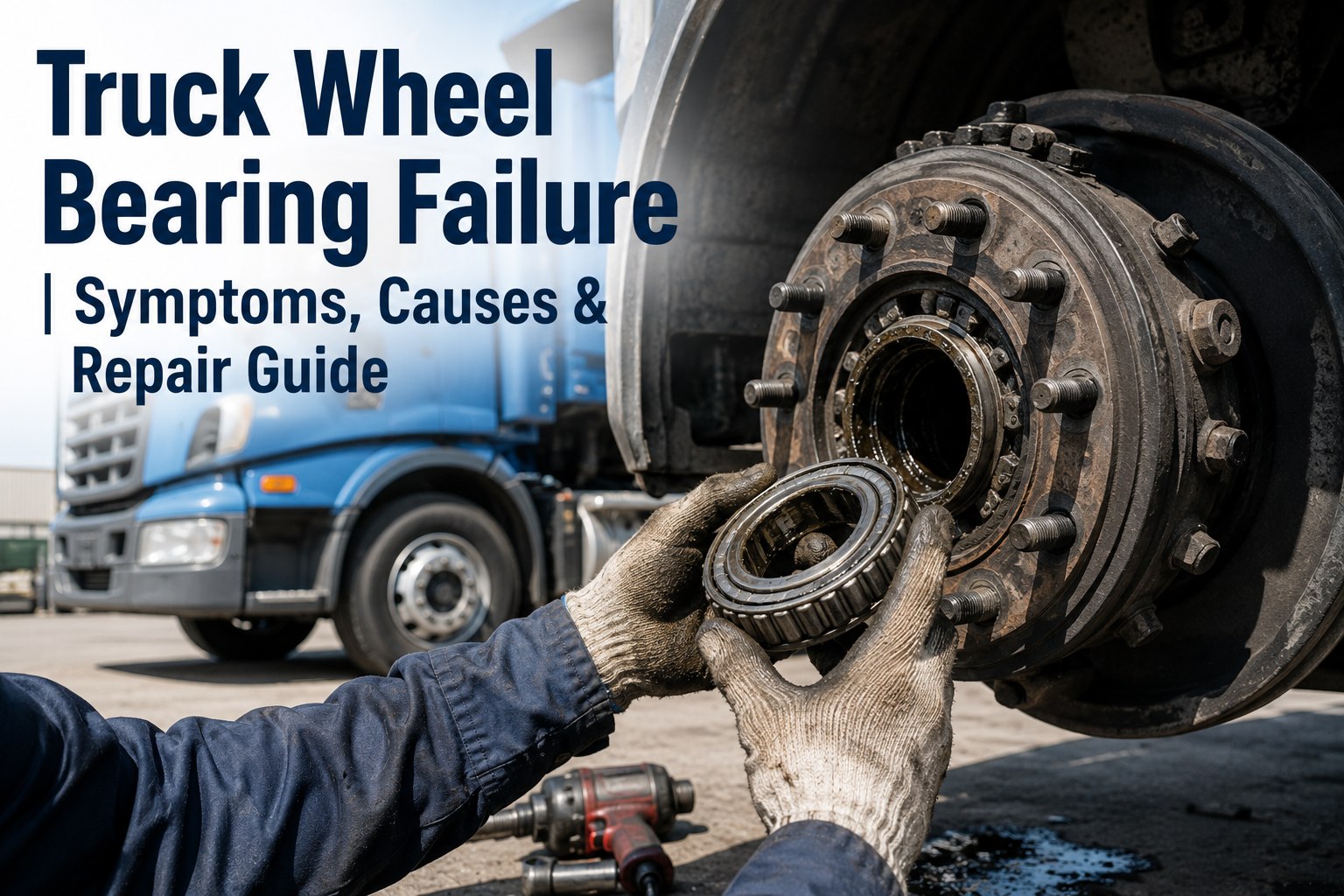
There's a wheel-off incident roughly every eight hours in the United States. That statistic is why wheel bearings occupy a different category from every other component that fails on a truck — when an alternator, starter, injector, or EGR valve dies, the wheels stay attached and you get a tow. When a wheel bearing goes all the way, the wheel can leave the vehicle at highway speed, which is why these failures generate litigation that other breakdowns never do. The redeeming feature is that bearings almost never fail without warning. They announce themselves through a predictable escalation — a faint hum that grows into a growl, then a grind, heat at the hub, play in the wheel, vibration through the steering — and every stage of that progression is a chance to catch it in the shop instead of on the shoulder. Track wheel-end inspections free. This guide covers the failure timeline, how to check for it, what actually causes it, and honest repair costs.
Truck Wheel Bearing Failure: Symptoms, Causes & Repair Guide
Wheel bearings fail on a timeline you can hear. Learn the escalation from faint hum to wheel separation, the three field checks that confirm it, what actually causes premature failure, and when to stop driving entirely.
Why This Failure Is Different
Most component failures strand a truck. This one can separate a wheel from it — and the consequences scale accordingly.
The Failure Timeline
Bearings degrade in stages, and each stage has its own signature. Knowing where a truck sits on this progression tells you whether you're scheduling a repair or parking the vehicle immediately.
A low growl or hum that rises with road speed — often mistaken for coarse pavement or tire noise. The giveaway is that it stays consistent regardless of road surface.
Noise grows and changes when loading the bearing through a turn. The hub begins running measurably hotter than its counterpart on the same axle.
Damaged rolling surfaces scrape instead of roll. Detectable play at the wheel, vibration through the cab or steering, vague steering feel, and seal leakage.
The bearing overheats, seizes, or fractures. A seizure can lock the wheel at speed; a complete failure can separate the wheel from the truck.
Three Checks That Confirm It
You don't need a lift to catch most bearing problems. These three checks take minutes and catch the failure while it's still a scheduled repair.
After a run, use an infrared thermometer on each hub. A properly adjusted bearing runs warm but typically under about 160°F. What matters most is the comparison — a failing bearing runs significantly hotter than the others on the truck. Consistent readings over 200°F signal preload problems or imminent failure.
With the wheel raised, rock the tire at 3 and 9 o'clock for lateral play, then 12 and 6 for vertical. Noticeable lateral movement beyond roughly 0.005 to 0.010 inches on tapered roller bearings indicates wear — and on a loaded commercial truck, any detectable play warrants immediate inspection.
Inspect the hub area for lubricant weeping or leakage, and check hub caps and axle flanges. Seal leakage is a leading cause of wheel-end failure, because losing lubricant and admitting contaminants destroys a bearing quickly once it starts.
What Actually Kills Bearings
Bearings rarely die of old age alone. Most premature failures trace to a handful of specific causes — nearly all of them preventable with proper procedure and inspection.
Excessive endplay or preload causes abnormal heating, fatigue, and fretting. Too tight and the bearing overheats; too loose and you get vibration and instability. TMC RP 618 specifies the verification method and the 0.001–0.005" endplay range.
A failing seal lets lubricant escape and contaminants in — the classic path to a destroyed bearing. Hardened, cut, or distorted seals should be caught at inspection before they leak.
Heat from the brakes reaches the hub, damages the seal, and lubricant leaks onto the shoes — reducing braking, extending stopping distance, generating more heat, and worsening the seal damage further.
Repeatedly exceeding axle and suspension ratings raises radial and axial loads through the bearing's whole service life. Severe-service and construction applications feel this most.
Incorrect grade, low level, or contaminated oil or grease shortens bearing life dramatically. TMC RP 631 covers wheel-end lubrication practice.
Over- or under-torquing the spindle nut preloads the bearing incorrectly from day one, guaranteeing premature failure regardless of part quality.
Once it starts, brake heat and seal damage feed each other — which is why a leaking wheel seal is urgent rather than cosmetic.
Wheel-Offs Trace Back to Inspections Nobody Recorded
Analysis of wheel-off accidents consistently points to the same roots: neglected wheel-hub inspections, improper bearing adjustments, and unnoticed seal or hardware issues. FMCSA requires carriers to systematically inspect, repair, and maintain all parts including wheel-end components — and "systematically" means documented. Truck Inspection & Maintenance schedules wheel-end checks, captures hub temperature and endplay readings against each position, routes seal findings straight into work orders, and keeps the history that proves the inspection happened.
What the Repair Involves
Wheel-end service is precision work, and preload adjustment is the part that determines whether the new bearing lasts its full life or fails early.
What It Costs
The bearing itself is cheap. What makes wheel-end failure expensive is everything it takes with it — and everything that stops while the truck is down.
Varies by whether it's a single bearing, a complete hub assembly, or a cartridge-style unit.
Depends on axle configuration, shop rate, and accessibility. Modern wheel-end systems may require manufacturer-specific procedures.
Cost rises sharply once damage spreads to the hub, spindle, or brakes — which is exactly what happens when a bearing runs to failure.
Towing, emergency roadside labor, missed deliveries, and lost productivity routinely exceed the repair itself.
What does a bad wheel bearing sound like?
It starts as a low growl or hum that rises and falls with vehicle speed — frequently mistaken for coarse pavement or tire noise. The distinguishing clue is that a bearing hum stays consistent regardless of the road surface you're driving on, while genuine road noise changes as the pavement changes. As the bearing degrades, that hum grows into a grinding or rumbling sound that gets louder under acceleration and often changes noticeably when you turn, because cornering shifts load onto the damaged bearing and the worn rolling surfaces begin scraping rather than rolling. By the time a clear grinding noise is present, the internal damage is advanced. Noise alone is enough to justify an inspection — combined with heat at the hub, play in the wheel, or vibration through the cab or steering, it's grounds for taking the truck out of service. Start a free trial to schedule wheel-end checks.
Can I keep driving with a bad wheel bearing?
No — and this is one of the few maintenance questions where the answer isn't nuanced. A failing wheel bearing can progress to complete hub failure and wheel separation at highway speed, and the final stage can arrive suddenly. Before that point, a bad bearing already compromises steering control because the wheel may not track straight, affects braking performance through excessive play or drag, and creates a risk of the wheel seizing at speed. The scale of the risk is why it's treated differently from other component failures: when an alternator or injector fails, the wheels stay attached to the truck. Roughly one wheel-off incident occurs every eight hours in the United States. If you have grinding noise, detectable play, hub heat well above the other wheel ends, or vibration through the steering, the truck should come off the road for inspection rather than finish the run. Ask about out-of-service alerts.
How do I check hub temperature and endplay?
For temperature, use an infrared thermometer on each hub right after a run and compare readings across the truck. A properly adjusted bearing runs warm but typically stays under about 160°F, and the comparison matters more than any single number — a failing bearing runs significantly hotter than its counterparts. Consistent readings above 200°F are a red flag for preload problems or imminent failure. For endplay, raise the wheel and rock the tire at the 3 and 9 o'clock positions to feel lateral play, then check 12 and 6 for vertical movement. On tapered roller bearings, noticeable lateral play beyond roughly 0.005 to 0.010 inches indicates wear, and on a loaded commercial vehicle any detectable play warrants immediate inspection. In the shop, technicians verify endplay properly with a dial indicator against TMC Recommended Practice RP 618, which specifies a typical range of 0.001 to 0.005 inches. Start free and record readings by position.
What causes wheel bearings to fail early?
Improper adjustment leads the list — excessive endplay or preload causes abnormal heating, fatigue, and fretting, with a bearing set too tight overheating and one set too loose producing vibration and instability. Seal problems are the other major cause: a failing seal lets lubricant escape and contaminants enter, and seal leakage is repeatedly cited as a leading contributor to wheel-end failures. Beyond those two, overheated brakes transfer heat into the hub and damage the seal, chronic overloading raises the radial and axial loads the bearing carries throughout its life, incorrect or contaminated lubricant shortens life substantially, and installation errors like over- or under-torquing the spindle nut doom a bearing from day one. Notably, almost every item on that list is a procedure or inspection failure rather than a part-quality problem — which means most premature bearing failures are preventable. Start free and standardize wheel-end PMs.
How much does wheel bearing replacement cost?
The part itself typically runs $80 to $300 depending on whether you're replacing a single bearing, a complete hub assembly, or a cartridge-style unit with integrated components, and labor generally falls between $150 and $400 per wheel based on axle configuration, shop rate, and accessibility. Those are the easy numbers. Costs increase significantly when damage has spread to the hub, spindle, or brake components — which is precisely what happens when a bearing is run to failure instead of caught during the noise stage. Then there are the indirect costs that often exceed the repair: towing, emergency roadside labor, missed deliveries, and lost productivity while the truck sits. It's also worth replacing bearings in pairs on the same axle, since both sides have accumulated identical mileage and loading, and doing the second side during the same teardown is far cheaper than a repeat visit. Catching it early is where the real savings are. Start free and catch failures earlier.
Catch It at the Hum, Not the Highway
Wheel bearings give you a long warning and one catastrophic ending. Truck Inspection & Maintenance puts wheel-end checks on a real schedule, captures hub temperature and endplay readings position by position, routes seal leaks and abnormal readings straight into work orders, and keeps the documented inspection history that FMCSA expects and wheel-off investigations always ask for.