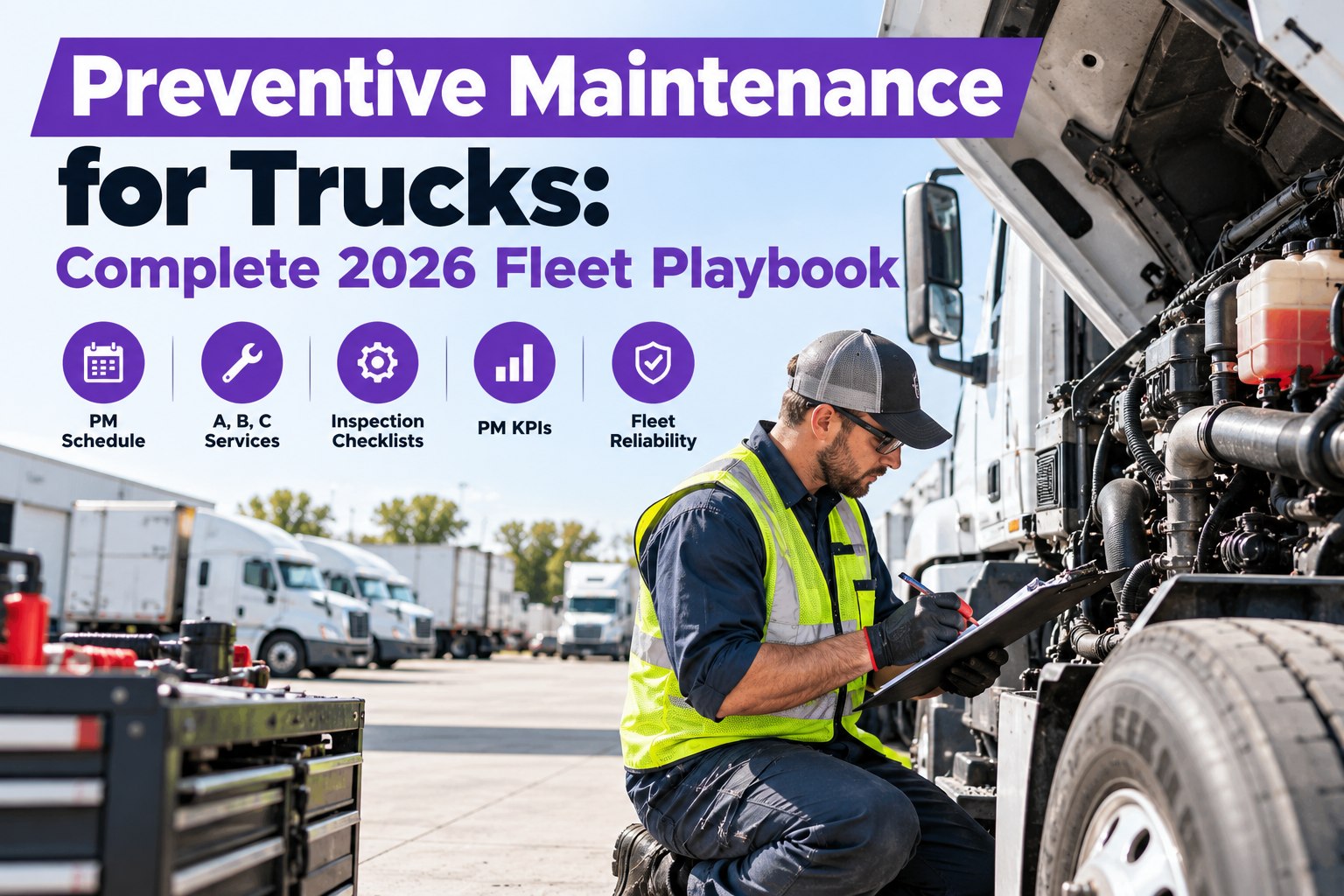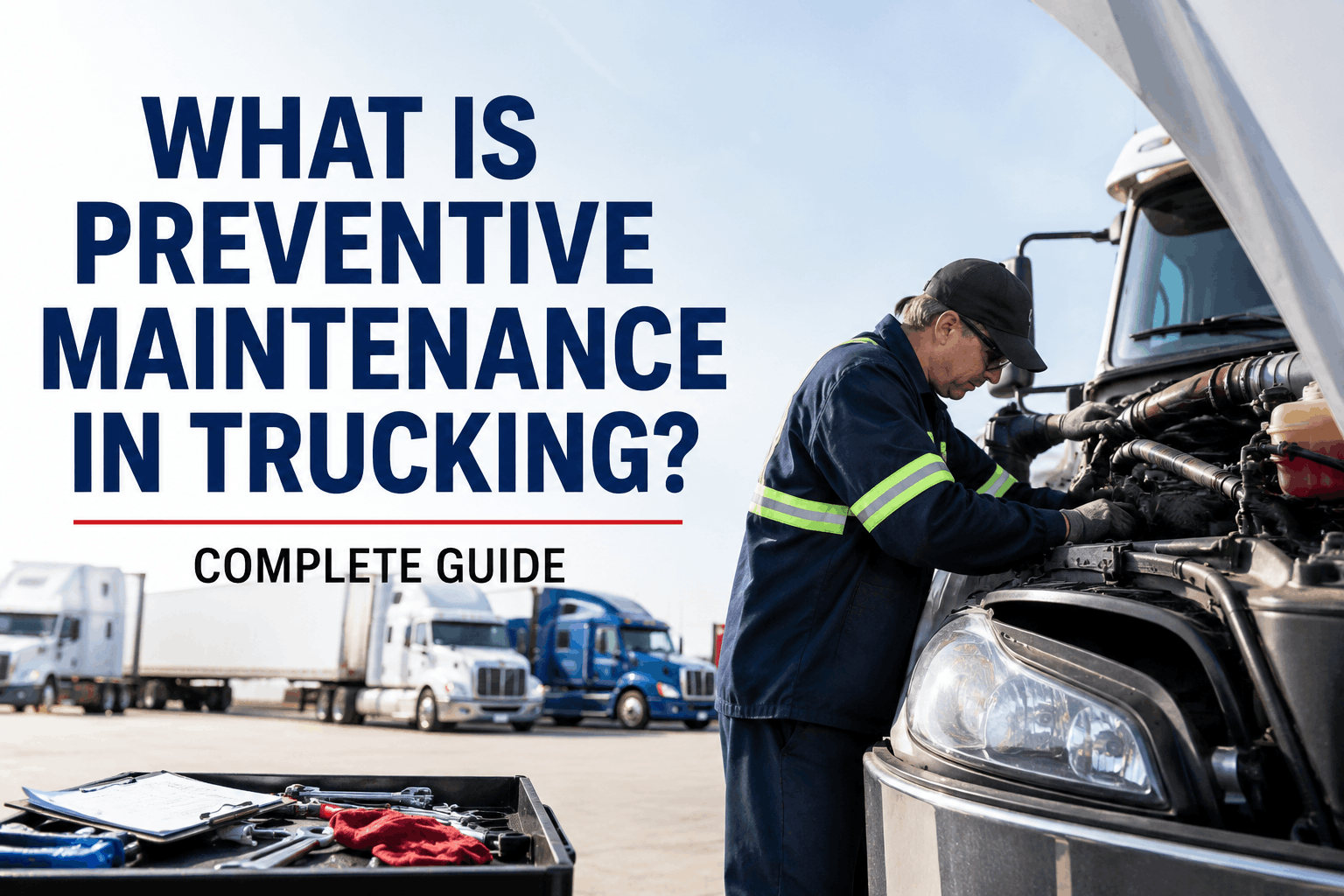
Preventive maintenance in trucking is the structured discipline of servicing commercial vehicles on planned intervals — by mileage, engine hours, or calendar dates — to catch component wear before it causes breakdowns, instead of waiting for failures to force emergency repairs. It's the operational opposite of reactive maintenance, where trucks get fixed only after they break. The financial difference between the two approaches is staggering: industry data consistently shows reactive repairs cost 3 to 9 times more than the equivalent preventive maintenance event, fleets running structured PM programs cut unplanned breakdowns by 25-30%, extend vehicle lifespan by 20-40%, reduce maintenance cost per mile by 22-28%, and achieve 300-500% ROI within the first 12 months. The Maintenance-to-Downtime Ratio explains why: 4 hours of planned PM typically prevents 20 hours of unplanned downtime — a 5× return on every wrench hour invested.
And yet, despite this overwhelming evidence, 70% of fleet managers in 2026 still operate reactively — fixing trucks after they break instead of preventing failures before they happen. That gap represents tens of thousands of dollars per truck per year in avoidable cost, paid out one emergency tow bill, one expedited parts order, one missed delivery at a time. The fleets that have made the switch share one pattern: they use the industry-standard 4-tier PM framework (PM-A through PM-D) with multi-trigger scheduling (mileage, hours, or calendar — whichever comes first), supported by digital tracking that prevents trucks from slipping through the schedule. Whether a fleet runs 5 trucks or 500, the framework scales identically.
This guide breaks down preventive maintenance in trucking for 2026: the foundational definitions, the 4-tier PM service framework (A/B/C/D), the multi-trigger scheduling logic, the cost math that makes PM mandatory, and the implementation roadmap to move from reactive chaos to structured PM control. Start your free trial of our truck inspection and maintenance software to deploy multi-trigger PM schedules across your fleet — live in 10 minutes, free for up to 3 trucks.
What Is Preventive Maintenance in Trucking? Complete Guide
The foundational guide to PM in trucking — definitions, the 4-tier framework (PM-A through PM-D), multi-trigger scheduling, the 3-9× cost-savings math, the 300-500% ROI evidence, and the implementation framework that moves fleets from reactive chaos to structured preventive control.
The 4-Tier PM Service Framework
Commercial fleet PM uses a standardized tiered framework where each level builds on the previous. PM-A catches daily wear; PM-D addresses deep mechanical health. Vehicles cycle through all four levels continuously, creating a complete maintenance safety net at every wear stage. Contact our sales team for help configuring the 4-tier framework on your specific fleet.
The 3 PM Triggers — Why Multi-Trigger Scheduling Wins
PM services don't run on a single timer. The 2026 industry best practice is multi-trigger scheduling — three independent triggers running simultaneously, with the truck serviced whenever ANY of them hits the threshold first. This logic prevents trucks from slipping through any one schedule.
Best practice: schedule PM-A at "10,000 miles OR 250 engine hours OR 90 days — whichever comes first." Modern PM software runs all three triggers automatically per asset, eliminating the manual reconciliation that makes single-trigger systems fail.
PM vs Reactive Maintenance — The Cost Math
Understanding the financial gap between PM and reactive maintenance is the foundation of every fleet's business case for PM investment. Here's the math that drives every other decision. Sign up free to model the PM vs reactive math for your fleet.
The 7 Core Benefits of Preventive Maintenance
Every benefit is independently measurable. Together they form the business case that explains why 30% of fleets have already made the switch and why the remaining 70% are leaving cash on the table.
The 5-Step PM Implementation Roadmap
Going from reactive to structured PM doesn't require a multi-year transformation. Most fleets execute the full rollout in 60-90 days.
Frequently Asked Questions
The 4-tier PM framework represents progressively comprehensive service levels. PM-A (basic safety service, 30-60 min) runs every 10,000-15,000 miles — oil/filter change, fluid checks, tire/lighting/brake inspection. PM-B (intermediate, 2-4 hours) every 25,000-30,000 miles — adds drivetrain fluids, fuel filter, suspension and exhaust inspection. PM-C (comprehensive, 4-8 hours) every 50,000-60,000 miles — includes the full §396.17 annual DOT inspection plus all major fluid changes. PM-D (major service, 8-16 hours) every 100,000 miles or annually — adds injector inspection, EGR cleaning, DPF service, valve adjustments, water pump assessment. Trucks cycle through all four tiers continuously, with each lower tier nested inside higher tiers. Contact our sales team for help configuring all four tiers on your fleet.
The 2026 industry standard runs all three triggers simultaneously: PM-A every 10,000-15,000 miles OR 250 engine hours OR 90 days — whichever arrives first. This multi-trigger logic ensures vehicles in different duty cycles get appropriate service. A highway truck running 100,000+ miles per year hits mileage triggers fastest. A yard tractor accumulating engine hours but few miles hits hour triggers. A low-utilization service truck hits calendar triggers. Single-trigger scheduling (mileage only, for example) misses two-thirds of the wear modes. Modern PM software handles multi-trigger logic automatically — flagging the truck when any one of the three thresholds is reached.
Industry data shows structured PM programs deliver 300-500% ROI in the first 12 months. The math: every $1 spent on preventive maintenance saves $4-$8 in reactive repair costs. For a 50-truck fleet, annual PM program savings typically run $75,000-$150,000 against $9,000-$18,000 in software/scheduling costs. The first prevented Class-8 breakdown ($2,400-$8,000 in direct costs alone) usually pays for the entire program within 45 days. Payback periods run 3-9 months for typical operations and can be as fast as 30 days for high-utilization fleets. Start your free trial to model the ROI on your specific fleet.
Preventive maintenance (PM) services components on scheduled intervals — every 10,000 miles, every 250 hours, every 90 days. The schedule runs regardless of actual component condition. Predictive maintenance uses sensor data, telematics, and AI analysis to detect early signs of component degradation, scheduling service based on actual condition rather than fixed intervals. PM catches wear-pattern failures reliably; predictive catches surprise failures that PM intervals miss. The 2026 best-practice is layered: PM provides the safety net for routine items (fluids, filters, brakes), while predictive targets high-value components (engines, transmissions, after-treatment systems) where condition-based service prevents catastrophic failures.
Start with OEM intervals, then adjust based on duty cycle. OEM intervals assume "normal service" — average mileage, moderate climate, highway operation. Severe service (construction, heavy haul, stop-and-go delivery, extreme climates, dusty environments) typically requires intervals shortened by 25-50%. Light service (long-haul highway only, ideal climate) may extend intervals modestly. The data-driven approach: track failure patterns by component for 90-180 days, then adjust intervals where failures occur consistently before the scheduled service. Modern PM software flags units with recurring defects automatically — making interval adjustments evidence-based rather than guesswork. Talk to our sales team for help calibrating intervals to your operation.
Yes — and this is the single biggest blind spot in most fleet PM programs. Trailers should follow a separate T1/TA schedule typically every 3 months regardless of mileage, because trailers can sit idle in yards for weeks while brakes corrode, lights fail, tires age, and ABS components degrade. A 53-foot trailer hauling 80,000 pounds across hundreds of thousands of miles per year — with its own brakes, suspension, lighting, ABS, electrical, and structural elements — somehow gets relegated to "we'll look at it when something breaks." Roadside trailer brake violations are among the most-cited Out-of-Service issues at CVSA Roadcheck. 2026 best practice: every trailer gets its own VIN-tagged PM schedule, parallel to the tractor. Sign up free to deploy parallel tractor + trailer PM schedules.
From Reactive Chaos to Structured PM Control
500+ fleets deploy the 4-tier PM framework (PM-A through PM-D) with multi-trigger scheduling on our truck inspection and maintenance software: pre-loaded templates, mobile inspections, defect-to-work-order automation, parts inventory management, vendor performance tracking, and FMCSA audit-ready records. The 2026 standard for fleet preventive maintenance — proven to deliver 300-500% ROI in the first year.