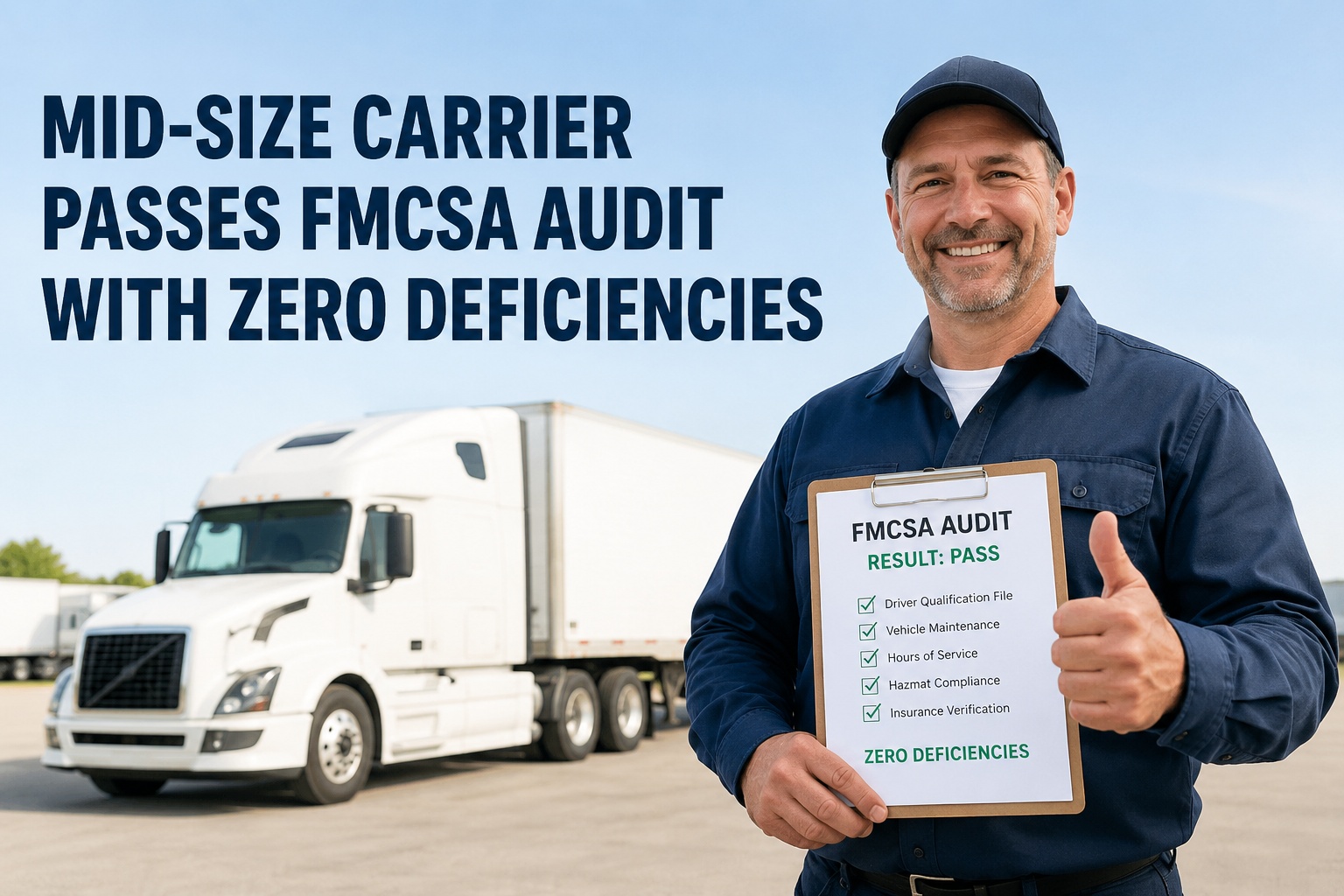
Discover how a 72-truck mid-size carrier passed its FMCSA Comprehensive Compliance Review with zero deficiencies—the outcome only 7% of motor carriers achieve—by replacing a paper-based compliance system with cloud-stored DVIRs, automated driver qualification file management, and a six-factor compliance architecture that mirrored the FMCSA's own audit methodology. According to current industry data, 68% of audit findings are documentation failures rather than operational ones: carriers running compliant operations that simply cannot produce the records to prove it within the 72-hour audit response window. With the 2026 CSA scoring update splitting Vehicle Maintenance into "Driver Observed" and "Inspector Detected" categories, FMCSA shifting toward off-site desktop audits via the NEWS portal, and civil penalties reaching $19,277 per violation, mid-size carriers can no longer pass audits with binders and a prayer. Learn how the Safety Director built a compliance program around the six factors the auditor would actually examine, ran a quarterly internal mock audit cycle, and walked into the Compliance Review with every record indexed, exportable, and ready to deliver inside 60 seconds.
The Documentation-vs-Operations Gap
The single most important insight that drove this fleet's audit win: compliance and documentation are different problems. Most carriers that fail an FMCSA audit weren't running unsafe operations. They were running compliant operations that generated no proof. The audit isn't asking "are you safe?" It's asking "can you show me you're safe?" Contact Support to assess your documentation posture, or Start Free Trial to start building audit-ready records today.
The Carrier at a Glance
The Four FMCSA Audit Types — And Which One Came Knocking
The FMCSA runs four distinct audit types, each triggered by different events and carrying different scopes. Knowing which one you're facing determines exactly which records to prioritize. This fleet's notice was a Comprehensive Compliance Review—the deepest version.
The Six Factors the Auditor Examined
FMCSA compliance reviews are not random fishing expeditions. They follow the same six-factor methodology every time. The Safety Director built the entire compliance architecture around those six factors—each one mapped to a specific cloud record system, retention window, and one-click export.
The Compliance Maturity Score
The Safety Director scored the fleet's compliance posture across the six factors twice—at the start of the year, and just before the audit. The progression from "compliant in practice" to "documented compliance" is the actual case study.
Two factors started at Score 2 (significant audit exposure). By audit day, all six factors hit Score 5 (fully documented, exportable, audit-ready). The Score-5 designation is what produces zero deficiencies.
The Quarterly Mock Audit Cycle
The most effective audit preparation is a self-audit performed 30–60 days before FMCSA notification. The Safety Director ran mock audits every quarter against the same six-factor checklist FMCSA uses—catching gaps internally before they could be found externally.
Could your fleet pass an FMCSA Comprehensive Review tomorrow?
See how cloud-stored records, automated DQF management, and six-factor architecture turn audits into a 60-second export.
The Audit Itself, Hour by Hour
The audit ran from Tuesday morning through Thursday afternoon. Three days. Six factors examined. Zero deficiencies found. Here is exactly what happened.
The Audit Outcome
12-Month Compliance Transformation
| Metric | Before | After | Change |
|---|---|---|---|
| Audit deficiencies (prior year) | 11 findings | 0 | Clean rating |
| DVIR submission rate | ~69% | 100% | +31 pts |
| DQ file completeness | 74% | 100% | +26 pts |
| Audit prep / response time | 3–4 weeks | Under 60 sec | Instant |
| Records lost or illegible | 16% | 0% | Eliminated |
| Late med-cert renewals / yr | 3 | 0 | Eliminated |
| CSA Vehicle Maintenance percentile | 62nd | 21st | 41 pts better |
| Compliance maturity (avg across 6) | 3.0 / 5 | 5.0 / 5 | +67% |
What Made the Zero-Deficiency Result Sustainable
One clean audit is luck. Continuous audit-readiness is architecture. Four design choices kept the compliance posture intact across drivers hired, trucks added, and regulations updated.
Compliance Maturity Scored Quarterly
Every quarter, each of the six factors got a 1-5 maturity score. Anything below 5 had a remediation owner and a 30-day deadline. The score never sat still.
Mock Audits Inside, Not Outside
The Safety Director ran an internal mock audit every quarter against the same six-factor checklist FMCSA uses. Any gap found internally was fixed before it could be found externally.
Records Built for Export, Not Storage
Every record was structured so it could be exported in audit-ready format by date range, factor, or driver. Records that exist but cannot be produced are records that don't exist for audit purposes.
Six-Factor Mapping Was Explicit
Every record in the system was tagged to one of the six FMCSA factors. When an auditor asked for "DQ files," the export was instant, not a search-and-assemble exercise.
I'd seen what an FMCSA review could do to a carrier—eleven deficiencies the prior year, civil penalties, conditional rating risk that scares your insurer and your shippers. The thing I finally understood is that our operations were already mostly compliant. We just couldn't prove it inside seventy-two hours. The cloud platform changed what was provable. The morning the audit notice came in, I pulled the complete six-factor package in under sixty seconds. Three days later we had a clean Satisfactory rating with zero deficiencies. The audit wasn't the project. The project was being audit-ready every single day.
Make Audit Day a Non-Event
FMCSA audits aren't won in the week before they happen. They're won in the months and years of compliance architecture that makes every record exportable, every factor documented, and every gap caught internally before an investigator can find it. Cloud-stored DVIRs, automated DQ files, and six-factor mapping turn the 7% pass rate into your default outcome.
Ready to Build a Zero-Deficiency Compliance Program?
See how cloud-stored DVIRs, automated DQ file management, and six-factor compliance architecture make FMCSA audits a non-event—with measurable readiness gains inside the first 60 days.