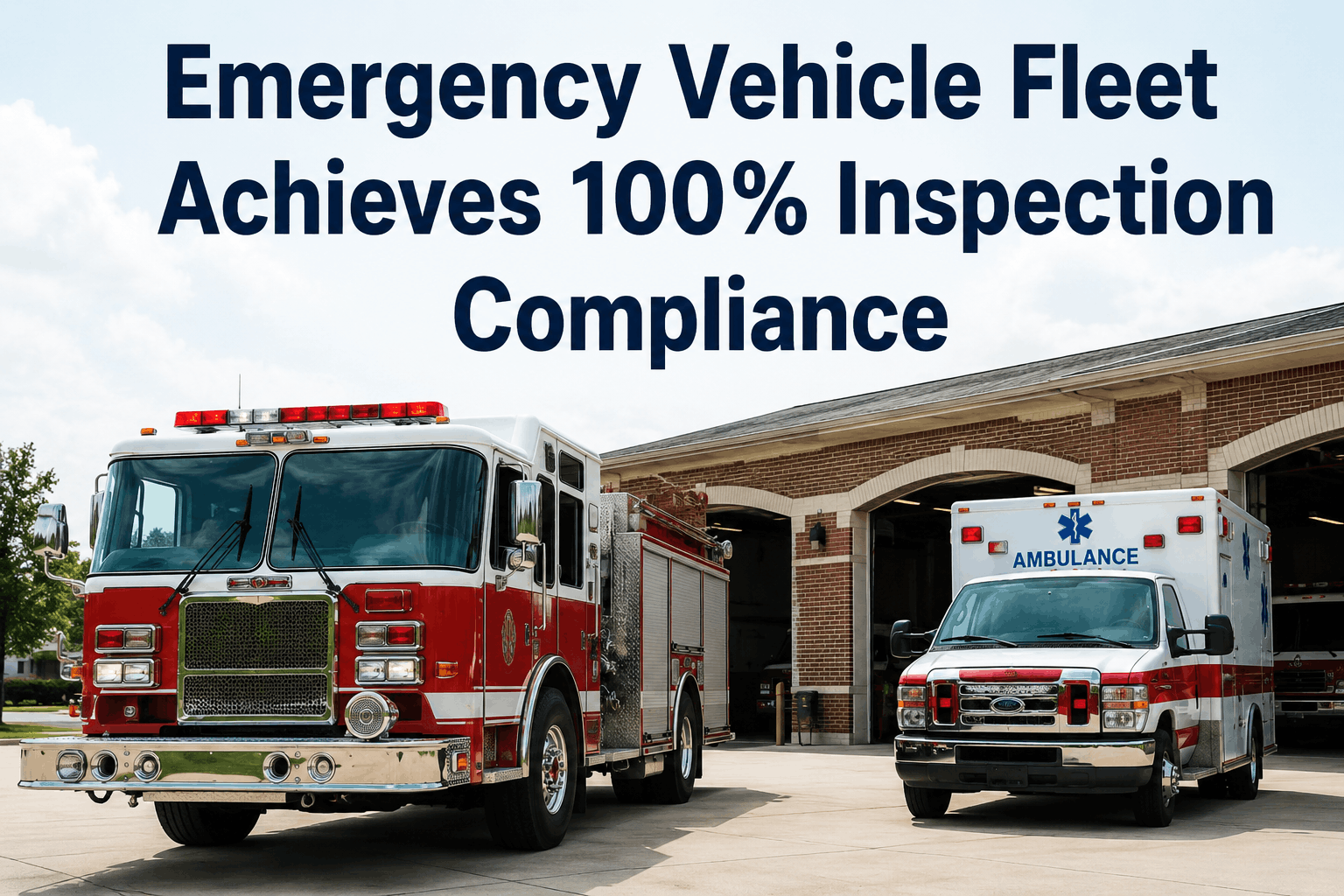
Discover how a county-level emergency services fleet—24 fire apparatus and 18 ambulances responding to over 19,000 incidents annually—reached 100% inspection compliance across NFPA 1911, NFPA 1917, and state EMS standards by replacing carbon-copy logbooks with digital DVIRs and automated maintenance scheduling. This case study follows a mid-sized fire and EMS department where readiness isn't a metric—it's the entire mission. Every missed inspection on a pumper or rig is a potential catastrophic failure on an active call, a community without coverage, and an ISO rating at risk. Yet for years the department relied on a paper system that recorded only the inspections drivers remembered to write down. After 11 months of digital rollout, every required check across daily, weekly, monthly, annual, pump service, aerial load, and hose service intervals was documented, time-stamped, and audit-ready. Learn how moving emergency vehicle inspections off paper protected ISO scores, eliminated audit anxiety, and gave fire chiefs something they'd never truly had before: certainty that every apparatus rolling out the bay door was actually ready.
Why Emergency Fleet Compliance Is Different
Commercial fleets worry about DOT roadside checks. Emergency departments face something heavier: a stack of overlapping standards where a single missed log can ground an apparatus, hurt an ISO rating, or worse—put a crew at risk on the next call. Paper systems can't keep up. Contact Support to map your readiness gaps, or Start Free Trial to start documenting every check today.
Department at a Glance
A county fire and EMS department covering urban, suburban, and rural response zones across nine stations—the kind of operation where one missed log on one tanker can ground that station's primary water supply for an entire shift.
The Starting Compliance Picture
The Compliance Layer Cake
Emergency vehicle compliance isn't a single checklist—it's a stack of overlapping standards, each with its own intervals, its own forms, and its own consequences for missing a record. Paper can document one layer well. It cannot track six layers reliably.
The Shift-Change Readiness Check
The single highest-impact change was tying the digital DVIR to the shift change. When the relieving crew clocked in, an unfinished check on their apparatus blocked it from being marked in-service. Readiness became a structural reality, not a hope.
The Three Calendars That Used to Get Missed
Daily inspections were one problem. The bigger problem was the long-interval tests—annual pump tests, hose tests, aerial load tests—that lived on someone's spreadsheet and crept past due dates while everyone assumed someone else was watching. Automated scheduling closed that gap permanently.
Make every check unmissable
See how digital DVIRs and auto-scheduled NFPA tests turn readiness from a promise into proof.
How "100%" Actually Got Reached
One hundred percent didn't happen because of stricter rules—it happened because the system made missing a check structurally impossible. Five mechanics, working together.
The 11-Month Results
The numbers told a clean story: a department that had been compliant most of the time became a department where compliance was structurally guaranteed. Both the daily checks and the long-interval NFPA tests reached and stayed at 100%.
11-Month Before / After Comparison
| Metric | Before (Paper) | After (Digital) | Change |
|---|---|---|---|
| Daily check documentation rate | 62% | 100% | +38 pts |
| Annual NFPA tests missed or late | 4 per year | 0 | Eliminated |
| Logbooks lost or illegible | 3 / quarter | 0 | Eliminated |
| Defect-to-work-order lag | 2–3 weeks | Same day | Same-day |
| Defects detected per quarter | 17 | 80 | 4.7x |
| ISO audit prep time | 3–4 weeks | Hours | Cut sharply |
| Patient compartment cert tracking | Manual / risky | Automatic | Automated |
For years I told myself we were 'mostly compliant.' I was lying to myself. The paper log told me what crews remembered to write down, not what actually happened. The first month digital, the system caught 30+ defects we'd have rolled past in the old workflow. Eleven months later, every inspection on every apparatus is documented—daily, monthly, annual, ISO-ready. When the ladder load test came up, I didn't have to dig through a binder. I clicked the rig, downloaded the file, and emailed it. That's the difference.
Make Readiness a Certainty
Paper systems document what crews remember. Digital systems document what crews actually do. For emergency fleets—where every apparatus rolling out the bay is someone's emergency response—that difference isn't an efficiency improvement. It's a safety boundary.
Ready to Document Every Check?
See how digital DVIRs, automated NFPA test scheduling, and apparatus-level audit files turn emergency fleet compliance from a paperwork burden into a structural guarantee.