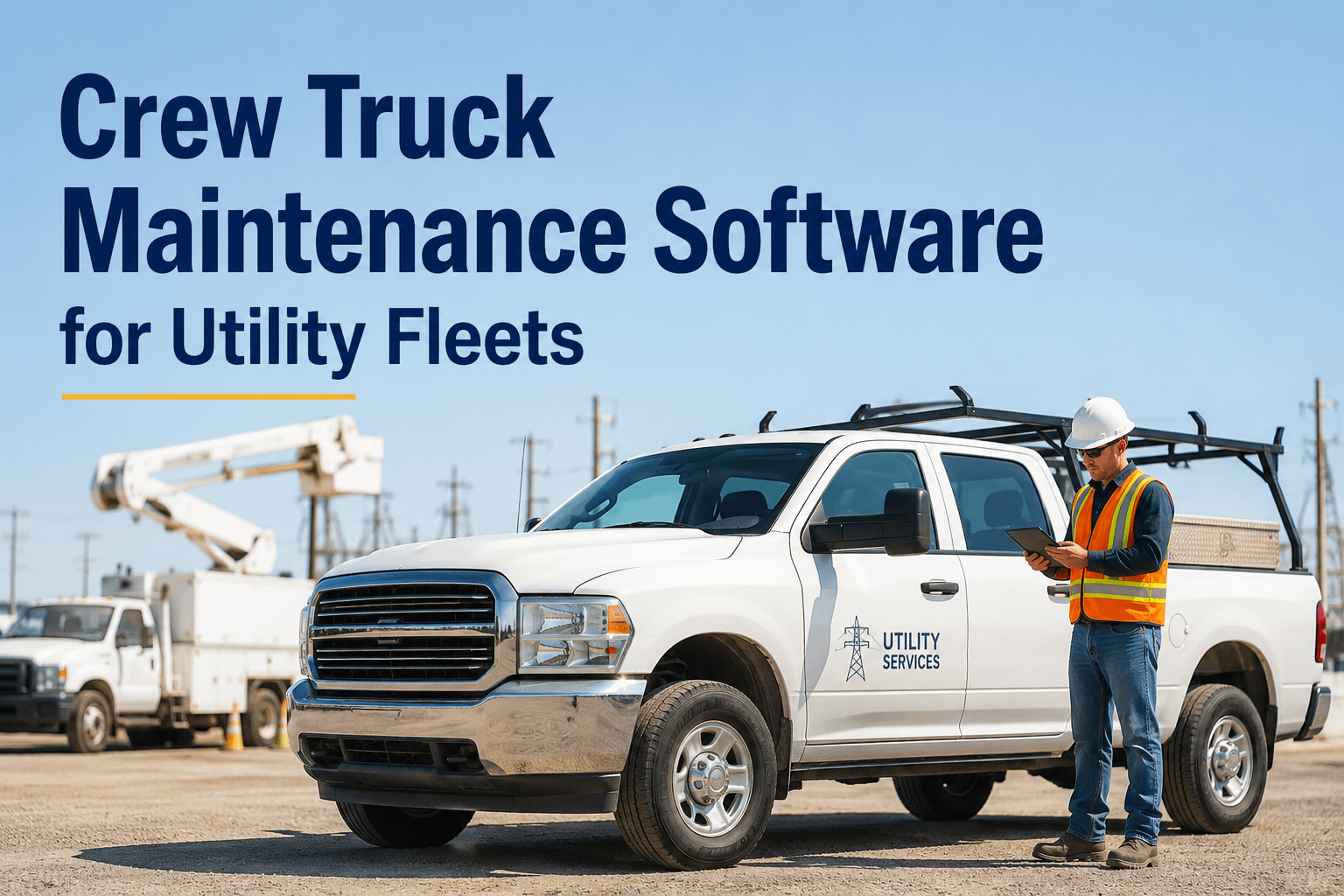
Utility crew trucks are the unsung workhorses of the fleet — the crew-cab pickups and service-body rigs that carry linemen, technicians, tools, and parts to every job site, every day. They're easy to overlook because they're not the dramatic aerial bucket trucks, but they rack up serious mileage, haul heavy tool loads, and idle for hours at the curb running auxiliary equipment. That combination wears them differently than either a highway tractor or a heavy aerial unit, and managing them with a generic fleet tool — or worse, a spreadsheet — leaves money and uptime on the table. The payoff for getting it right is real: properly implemented maintenance software cuts emergency repairs 60–70%, reduces downtime 30–40%, and lifts uptime from an 80–85% baseline to 95–98%. This buyer's guide covers what crew truck software must do, the must-have features, the pricing reality, and how to choose. Truck Inspection & Maintenance is built exactly for this. Talk to our team for a tailored walkthrough.
Crew Truck Maintenance Software for Utility Fleets
High-mileage PM, dual-duty wear, and tool-load tracking — software for the rigs that do the work.
Why Crew Trucks Wear Differently
A crew truck lives a dual life that neither a highway truck nor an aerial bucket truck shares — and that's exactly why it needs its own maintenance approach. It's a high-mileage transport vehicle and a stationary mobile worksite, loaded with tools and often idling to power equipment. That mix accelerates wear in specific, predictable places. Manage those, and you defeat the breakdowns before they strand a crew on a job.
High mileage + idle hours
Crew trucks rack up real miles between sites and then idle for hours powering tools — so both odometer and engine-hour wear matter, unlike a pure aerial unit.
Brakes & tires under load
A fully loaded service body plus tools is heavy. Brakes and tires wear faster than the base truck rating assumes — the top safety items.
Payload & tool load
Overloaded service bodies stress suspension and drivetrain and create safety risk. Tracking what each truck carries protects the chassis and the crew.
The 6 Must-Have Features
Once you're shopping, these six features separate software that actually fits a utility crew fleet from a generic tool wearing a fleet label. Score every option against them. Start a free account to test them on your own crew trucks.
Mileage + hour PM scheduling
Schedule by miles, engine hours, or calendar — crew trucks need all three, since they both drive far and idle long. Mileage-only misses the idle wear.
Mobile DVIR with photos
Crews complete a 5-minute pre-trip from any smartphone — brakes, tires, lights, load — with photo evidence and one-tap defect reporting from the field.
Defect-to-work-order automation
A reported defect auto-routes into a work order with parts and severity attached — so a crew truck moves from "down" to "in the bay" fast.
Parts inventory & auto-reorder
Track fast-wear parts with reorder alerts so a stockout never strands a truck — and crews aren't sitting idle waiting on a part.
Cost-per-truck & history
Full service history per unit and cost-per-vehicle tracking — instant for DOT audits, warranty disputes, and replace-vs-repair decisions.
Mixed-asset support
Manage crew trucks alongside bucket trucks, trailers, and equipment in one system instead of juggling separate tools per asset type.
Built for the rigs that carry your crews
Truck Inspection & Maintenance delivers mileage-and-hour PM, mobile DVIRs, defect-to-work-order routing, parts tracking, and per-truck cost history — for crew trucks, bucket trucks, and everything in between. Set up in days, no hardware, no contracts. Sign up free and run a real pilot on your fleet.
What the Software Returns
The business case for crew truck software is well-documented, and it compounds across a fleet of high-utilization rigs. Here's what properly implemented maintenance software delivers. Reach our team to model the numbers for your operation.
The Pricing Reality
Crew truck software pricing splits by how much beyond core maintenance you need. Knowing the bands keeps you from overbuying a hardware-heavy enterprise suite when a lean per-vehicle platform covers the work. Open a free account to start at the low end with no commitment.
Per-vehicle maintenance & inspection
Mileage/hour PM, mobile DVIRs, defect routing, parts, cost history. Cloud setup in a day, no hardware. The right fit for most utility crew fleets.
Telematics-bundled platforms
Adds GPS, engine diagnostics, and driver behavior on top of maintenance. Requires a device per truck and usually annual contracts — more capability, more cost.
Large multi-asset utility fleets
Custom-quoted suites with advanced analytics and deep system integration. Built for big utilities managing thousands of mixed assets across regions.
Frequently Asked Questions
How is crew truck maintenance different from bucket truck maintenance?
Crew trucks are high-mileage light-duty rigs — crew-cab pickups and service bodies — that both drive far and idle long while powering tools. Bucket trucks are heavier aerial units whose risk lives in the boom, hydraulics, and dielectric insulation. Crew trucks need mileage-and-hour PM with a focus on brakes, tires, and payload; aerial units need annual dielectric and structural inspection. The best software handles both in one place. Start a free account to manage your mixed fleet.
Should crew truck PM run on miles or hours?
Both. Unlike a pure aerial unit (hours) or a highway tractor (miles), a crew truck does meaningful wear on both clocks — it drives real distances between sites and then idles for hours running auxiliary equipment. Software that schedules by miles, engine hours, and calendar captures the full wear picture. Mileage-only scheduling misses the idle-hour damage that quietly degrades these trucks.
What does crew truck software actually save?
A lot. Properly implemented maintenance software reduces emergency repairs by 60–70%, cuts downtime 30–40%, and lifts uptime from an 80–85% baseline to 95–98%. Roughly a third of fleets see positive ROI within six months. For utility crews where a stranded truck means a missed job and idle linemen, preventing even a few breakdowns pays for the platform many times over. Talk to our team about your savings.
Can crews do their own inspections?
Yes — that's the point. Crew members complete a 5-minute mobile DVIR from any smartphone before heading out: brakes, tires, lights, fluids, and load. Photo evidence and one-tap defect reporting mean a problem spotted at the yard reaches the shop instead of getting lost. Mechanics handle repairs. This keeps trucks safe and rolling without adding paperwork to the crew's day. Sign up free to put inspections on every crew's phone.
Do I need telematics hardware to start?
Not for the core maintenance and inspection layer — it runs on existing data and crew smartphones, no hardware required. Telematics devices add GPS tracking, automatic mileage/engine-hour capture, and engine diagnostics, which enhance PM accuracy but aren't required to begin. A sensible path is to start software-only and layer telematics later as ROI justifies. Contact us to plan a phased rollout.
Can one platform handle crew trucks and bucket trucks together?
The best ones do. A utility fleet runs a mix — crew-cab pickups, service-body trucks, aerial bucket trucks, digger derricks, trailers. Managing them in one system with asset-specific PM schedules and checklists beats juggling separate tools, and gives you fleet-wide cost and uptime visibility. Look for mixed-asset support rather than software locked to one vehicle type. Sign up free to manage everything in one place.
Built for crew trucks — and the whole utility fleet.
Truck Inspection & Maintenance brings mileage-and-hour PM, mobile DVIRs, defect-to-work-order routing, parts tracking, and per-truck cost history into one platform for crew trucks, bucket trucks, and every asset between. Free for up to 3 vehicles, no hardware, no contracts.